Tank’s – a screenplay

Image

The following is the opening for my first screenplay. Tank’s  is the story of Tony, an impetuous young fish who gets snatched from his tropical homeland and transported to Tank’s, a pet shop in Rochester, NY. There, he quickly falls for Maya, a royal daughter of the salt water community, and runs afoul of the iron-finned rule of an eel named Kang.

(Image is property of owner and is used here without permission but my sincerest Tank’s.)


FADE IN

EXT. AERIAL VIEW OF A RAINFOREST – AFTERNOON

A canopy of trees extends forever to a distant range of mountains, birds swooping in and out. A break in the forest exposes a broad meandering river that empties into the sea.

One bird descends to skirt along the water. Crocodiles slide from the shore, disrupting the peaceful wading of cranes who take to the air.

A thicket of tree roots plunge into the river, large insects crawling along or flying amongst the gnarled roots. A squirt of water shoots up at a dragonfly, which splashes into the water, to be eaten by a large fish.

EXT. BELOW THE SURFACE – SAME TIME

Schools of fish swim among the roots. Larger fish swim alone, oblivious to the schools that scatter and reform.

A cloud of bleary water blooms across the bottom of the river, causing most of the fish to scatter to the clearer upper layers. A few fish swim between the layers, trailing bleary streams.

The serenity is shattered as four sleek black mollies fly by, weaving chaotically through the weeds. TONY, JUAN, RICKY and CARLOS, hyper adolescents, flip a pebble back and forth, while trying to evade tackle.

TONY

Carlos fades back for a long throw…

Chubby Carlos swerves the wrong way, sliding into the mud and being tackled by the others.

Laughing, they slowly climb out of the tangle. Carlos remains on the bottom, dazed.

TONY (CONT’D)

Hey, look! A flat fish.

Tony pumps his tail to reinflate him. Juan looks to the surface, catching the waning sunlight.

JUAN

It’s late. Gotta go help Mom with the brood.

TONY

A hundred and thirty-nine brothers and sisters and you have to help?

RICKY

Me, too. Summer school.

TONY

C’mon. You’re ruining things for Carlos. He can barely speak.

Tony slaps his fin over Carlos’s mouth.

TONY (CONT’D)

Hush, pal. Save your strength.

Tony slowly backs away. The guys follow.

JUAN

Duty calls, Tony.

TONY

Duties come later. Today is for adventure.

Tony grabs Carlos by the gills.

TONY (CONT’D)

Look at this guy. Ready to grab life by the gills and kiss it on the mouth.

Carlos recoils in disgust.

TONY (CONT’D)

We’re young.

Tony swims into a shadow. The guys stare, mouths agape.

TONY (CONT’D)

We have no fear!

JUAN/RICKY/CARLOS (scattering)

Aaaaaaaaaah!

TONY

Hunh?

Tony looks up and comes face to face with a grinning caiman.

TONY (CONT’D)

Oh.

Tony sticks a fin in the caiman’s nostrils, making it sneeze.

Tony flees, pursued by the caiman. As Tony leads the merry chase, other fish scramble to safety.

The caiman gets close but never quite reaches Tony.

TONY (CONT’D)

C’mon, armor-butt.

Tony suddenly favours his left fin.

TONY (CONT’D)

Cramp! Ow, ow!

The caiman pounces. Tony flits aside and the caiman gets a mouthful of gravel.

TONY (CONT’D)

Psych!

Tony takes off, leaving the caiman to spit out stones.

(To be continued.)

Do it

Image

Do it now!

Don’t think about it.

Go!

Don’t hesitate.

Aaaand now!

You’re stalling.

Now, Now, Now!

Suckage is encouraged.

Make it happen!

Don’t let fear stop you.

You are the [insert action]!

Do or do, there is no failure.

Dooooooo it!

It’s better than sex (unless you’re doing the sex, in which case, it is exactly like sex)

Go-go! Get’m-get’m! Ooh-aah!

Yay you!

(Image is property of owner and is used here without permission because I do’ed it!)

Faith

Image

Faith is believing when common sense tells you not to.

– Fred Gailey (John Payne), Miracle on 34th Street


We all have doubts.

Doubt that we are good enough to accomplish our goals. Doubt that our goals are even realistic or rational.

And sadly, most if not all of us have had or currently have a long line of people who are more than willing to feed those doubts with their own. Often, their superficial motive is to be supportive, to help cushion the blow of failure, to save you from certain doom. But more likely, their motive is to take comfort in the belief that your doubts make it okay for them to have doubts about their own lives.

But, if you’re lucky, you have those special few in your life who have absolutely no doubt in your future success. They’re the ones who listen to your ideas with a smile, an eager nod, and perhaps some sage constructive advice to help make your goals even more realistic.

The latter group are the people you need to heed, for they see the potential of your efforts in the absence of your fears and just as importantly, in the absence of their own.

I am not a religious man—although I have become quite spiritual—so faith has never been top of mind for me until recently. It’s not that I didn’t have faith, in hindsight, but rather that I had a very narrow definition of it. And, like my friends for me, it was easy to have faith in things external. It was faith in myself that I lacked.

More recently, however, I have realized that faith isn’t about rejecting the possibility of failure. Rather it is about accepting the possibility of failure but with the further understanding that failure does not mean your journey has ended.

Failure does not put your destination off limits. It is merely a diversion from your original path to that destination.

I know I am a good writer and story teller, but I also know I have challenges ahead in translating those skills into the money I need to make to continue writing and story telling.

Faith comes in telling myself (and believing) that through hard work on my part (e.g., networking, classes, practice) and unknown forces outside of my control and understanding, those challenges will dissipate at the appropriate time.

Like those well-intentioned naysayers, drawing a line in the sand about giving up (e.g., going back to my former career) only gives voice to my doubts. I will not allow myself to do that anymore.

I have faith that I will endure failure and that I will succeed at whatever it is I am to accomplish, no matter what street I live on.

I wish you that faith as well.


For an interesting piece on questions about talent and faith therein, check out this post from Plotting Bunnies: The ingredients of Writing: Talent…?

(Image is property of owner and is used without permission because I have faith they’ll get my point.)

Off guard

Image

The tiniest of movements,

Almost imperceptible,

At the corner of her mouth

Told me all I needed.

She had heard me.

Her eyes resolute,

Focused keenly

On the wall ahead;

Tremulous in fear lest

She give herself away.

Pulse quickened.

Breathing changed.

Hands once relaxed

Now firmly planted

To still nervous thighs.

And so I repeat,

“I love you”

(Image used without permission mostly just to keep you guessing.)

I can explain

Image

Michael (Jeff Goldblum): Don’t knock rationalization. Where would we be without it? I don’t know anyone who could get through the day without two or three juicy rationalizations. They’re more important than sex.

Sam (Tom Berenger): Ah, come on. Nothing’s more important than sex.

Michael: Oh yeah? Ever gone a week without a rationalization?


Many of us struggle to accept feedback, and in saying that, I put the emphasis on the word “accept”.

It is easy to receive feedback, but to accept feedback takes a certain degree of confidence that most of us struggle to achieve, and the earlier we are in the development of our Art, the worse our ability. It is a cruel irony that this struggle is at its zenith when we most need the feedback.

It seems that the minute someone offers feedback, even if we’ve requested it, our initial response is to explain why the work is the way it is or why the feedback provider is wrong. As Jeff Goldblum’s character in The Big Chill put so eloquently, we rationalize.

Now, before you try to explain why you rationalize or try to convince me that you don’t—you know you were going to—let me tell you that it is a natural response that was bred into us from our earliest days.

As a child, if you came home late or missed an appointment, you were likely met with an angry parent asking where you were. Unfortunately, for the most part, parents don’t actually hear the answer, because with the rarest of exceptions, your answer is unlikely to ameliorate the punishment.

And any attempt on your part to simply accept responsibility with “I am sorry, Mummy. That was disrespectful of me and I shall try to be more thoughtful in the future.” (all 5-year-olds talk like that, right?), was met with continued pressure to explain yourself.

Fast-forward 20, 30, 40, 50 years. A classmate, instructor or colleague has just read your manuscript and has trouble with one or two things. The instinctive reaction—thanks Mom and Dad—is to respond “Uh-huh. Well, you see…”

We immediately want to explain why we made such an astounding choice. We feel we need to prove we’re not stupid or crazy, and in some cases, to prove that our readers are. And this instinct is even worse when we either can’t remember why we made that specific choice—the “I dunno” scenario—or we thought it was a bad choice but felt we had no better ideas—the “I’m a talentless hack” scenario.

If we can just suck all of the oxygen out of the room, the reader will suffocate and no one need know of our disgrace.

STOP! BREATHE! RELAX!

Shut up and listen. Don’t respond other than to indicate that you’re following what the person is telling you.

You’re not being attacked. They don’t hate you. They’re not trying to convince the world that you’re a terrible human being.

Fight the urge to explain yourself and instead think about what you are being told. You may not understand right away, so feel free to ask for clarifications (not offer rebuttals). Take the input away and mull on it.

This is an opportunity to learn something about your work, your abilities and yourself. Take advantage of that.

You likely asked for the feedback, either implicitly or explicitly, and your reader has something to tell you. They may be right. They may be wrong. Annoyingly, it is likely to be somewhere in between. Regardless, they have had a reaction to your work, and you must respect that.

You do not, however, have to act on their feedback. If, after sober reflection, you feel that the feedback is not for your work, then move on, confident that you have heard and considered what they said.

Ahhh.

See? There is still air; you’re not choking. The skies have not darkened. Wagner does not play. You need not walk into the light.

It is tempting rationalize, to try to explain away our feared shortcomings. It has been programmed into us.

Rationalization is a natural reaction, but it isn’t necessary.

(Image used without permission due to alien infestation.)

My Creative Journey – Part Two

Picking up from my first realization that my passion might also be a gift, as explained in Part One.

Image

Over the years, I’ve had opportunities to display my creative demons before an audience. An effective little soap opera episode in Grade 12. Geeky science humour in my own magazine. Heart-wrenching poetry following the end of a close friendship that might have been much more.

I worked my way into the magazine world, writing interesting stories about interesting discoveries and advances, but it wasn’t the same. The words poured forth and the story-telling skills improved, but I was always a chronicler of someone else’s story.

Creativity expressed itself in my approach to the story. In seeing a story that no one else saw. In context that was invisible to everyone else. Creativity manifested itself in identifying authors and writers from all walks of life to fill gaps in the magazines. I may not have been the best project manager, but I was definitely the most creative.

As I matured in my jobs, I extended this creativity to everything I did. Looking for effective solutions to seemingly intractable problems. But it wasn’t enough. That voice within me cried out to be heard. And the more I worked—and overworked—to distract it, the louder it screamed. So loudly, that even my wife could hear it.

While sitting in an Orlando hotel bar one night, she finally challenged me and my workaholic tendencies, demanding that we come up with a hobby for me. When pressed, I admitted that I had always felt like I’d been born 30 years too late. That if I could have any miracle in my life, it would be to work on those old sketch comedy shows from the 1950s as a comedy writer. Sid Ceasar’s Show of Shows came to mind. Imagining myself in the writers’ room with Mel Brooks, Larry Gelbart, Woody Allen and Neil Simon.

Neither of us knew how to make that happen, but my wife challenged me to find something at home that would set me up in that direction. The next week, I signed up for my first improv class at Second City.

Although it still wasn’t where I wanted to be—more performance than writing—the improv classes were amazing; therapeutic on a variety of levels. Eventually, though, I stumbled onto their sketch comedy writing program and that’s when I hit my stride. A wonderful instructor, talented zany fellow students.

The words flowed incredibly quickly. Within weeks, I had dozens of sketches and felt like I was making serious headway in my education of what worked and why. If there was a problem with the class, it was that my production vastly outstripped the need. I tried new things. I broke out of my comfort zone. I pushed my limits. My only goal was funny.

As I honed my sketches, I prepared for the reality of rehearsals with actors, when all of this work would really come true; when my efforts became more than an academic exercise. Rehearsals went well. Out actors seemed genuinely grateful to be performing our work. I saw what worked and what didn’t, even in the work of others.

Interestingly, I wasn’t in control of the process and I was okay with that. There’s something to be said for being so far out of your element that you recognize the limitations of your control. I had complete faith in the director and our actors. I believed they too wanted this to work as badly as I did.

And then the day of the performance arrived. Nervous energy ran through my body and I couldn’t sit still. I could barely communicate. There was no fear. Only anticipation and potential validation. Was I funny?

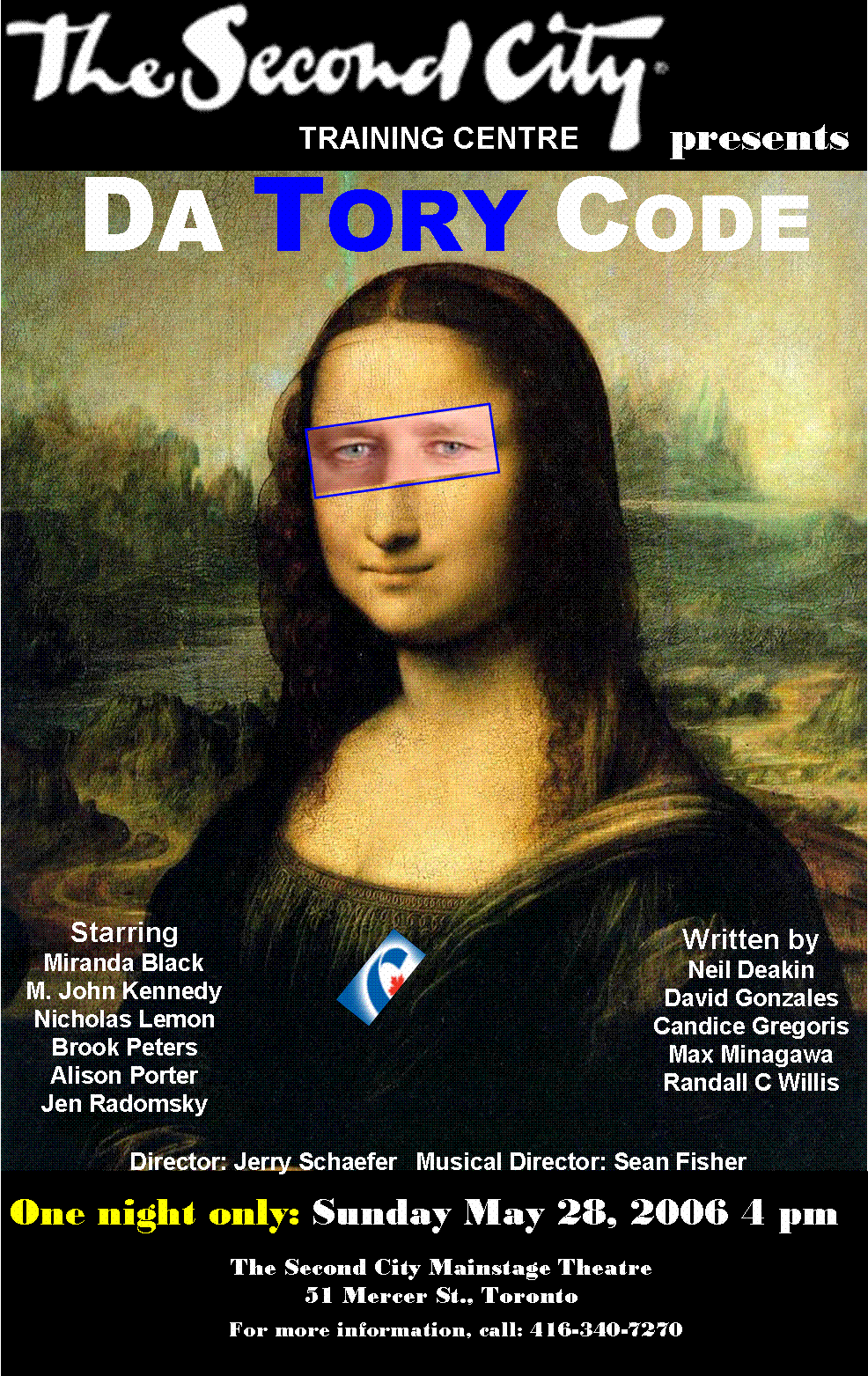
The day we premiered Da Tory Code was easily one of the best days in my life. The audience laughed. Not at everything, which was a valuable lesson, but they laughed at enough to validate my talent.

Image

My Creative Journey – Part One

What follows are a few thoughts on why I write…the moments in my life that led me to embrace my passion. It is an incredibly personal story and I hope it doesn’t make anyone uncomfortable, but rather helps them reflect on why they embrace their own passions.

Image

I need to be creative on my terms.

When I was younger, it was all about acquiring knowledge and being recognized for having acquired that knowledge. In hindsight, I’m not exactly sure what I was planning to do with that knowledge.

In some respects, it was about solving a puzzle, which could range from how does this alarm clock work to how does the universe work. On another level, I think it was about control. Knowing how the universe worked meant knowing that there was a broader sense of organization out there; that the laws of physics and mathematics still held even when my own life seemed in constant flux. The subtle irony of entropy only occurred later.

But it was also about control in the sense that I couldn’t be expected to come up with answers, with solutions, until I had all the information I needed to make that decision. The aggravating reality of that method of control is it only works when you’re the one asking the questions. Nobody else is willing to wait until I have all of the info I need.

At the same time, I needed the safety of analysis and knowledge, I’ve also had a need to be creative. A need that has only recently blossomed as a regular part of my life.

When I was young, I was constantly creating new worlds through my stories. First, as play scenarios and then as the written word. I constantly developed short stories that took me in a million directions. Again, this might have been an attempt at control.

When I wrote, I was the master of my universe. I was the one who decided who lived and who died, who was allied and who was the enemy. I was the protagonist and the antagonist.

It was in 1977, as I started high school, that I first noticed the strength of my writing. That summer, my life changed with the release of Star Wars. So deeply effected was I by the characters and the story, that I immediately went home and started working on the sequel. My version took a very different turn than George Lucas’s—although there were some subplot overlaps—but over the next few weeks, I hand wrote 400 pages of dialogue.

I shared the script with my Grade 9 English teacher, who was impressed with the volume if not the content (my words, not hers). It was in her class that I first realized the power of my words to still and disturb an audience.

On day, Ms. Philp gave us a writing assignment that started with the sentence “I couldn’t believe it when I heard that sound.” It was supposed to be an in-class assignment, but I was onto something and asked if I could take it home to finish it. I guess she sensed something—that this was important to me—and she said yes. While I didn’t finish the story, I did hand her several pages the next day.

After reading the story herself, she decided to read it to the class. Whereas most people had written stories about funny sounds, spooky sounds or weird sounds, I had written about a man who comes upon a murder in an alleyway, first by the sound of bone and sinew breaking, and then by sight. I wrote about the fear and indecision in the witness’s heart as the murderer sees him and he flees for his life.

As Ms. Philp read the story aloud, there was silence in the room—a room of 14 and 15 year olds. No one said a word until she was done reading. It was magical for me.

I wish I could say that there was a rousing round of applause at the end and that this was the day that I decided to become a professional writer. There was no round of applause—although my class seemed to appreciate my story—and Ms. Philp continued to be supportive of my efforts, but there was no effort to foster this creative desire in a young boy struggling to define his world.

The opportunity was there. Everything was laid out for someone to recognize, but nobody tapped into it. Writing continued to be a strange little quirk of my life. I guess it was just easier to find ways to support my interest in science and history by buying me more books, taking me to the Science Centre.

What do you do for a budding writer? Get him a pen and a notebook? Buy him a typewriter?

Eventually, someone did buy me a typewriter—a vehicle to do my homework. But it quickly became the vehicle for my creative outlet, much to my mother’s chagrin. The muse hits me when I have time to be alone with my thoughts. When my day isn’t cluttered with requests for attention and responsibilities. Unfortunately, in my childhood home, those times only tended to occur when my family was asleep.

Routinely, my mother would yell down from her bedroom for me to stop wailing away at the keys. Loudly pounding them into submission. Watching the letter hammers get stuck because the thoughts occurred to me and be translated through my fingertips faster than the typewriter could accommodate. She wanted to be supportive, but not at the cost of a good night’s sleep.

It took no time at all before I had an incredible portfolio of work—half-finished thoughts, short stories—but they languished unread by anyone other than me. I had given voice to the creative urges in my soul but no one heard that voice. It was the proverbial tree in a forest. With no one to even acknowledge the existence of my efforts, did they really exist.

Where was my mentor to guide me through this process? Someone to help me hone my voice. To make my stories better. To help me get my voice heard.

To be continued…

You won’t like this

Many of us spend our lives trying to figure out how to do only the things we like, only the things that feel good, while leaving all of the other stuff behind us. An entire industry—retirement planning—has been built on the belief that if we can put up with the stuff we don’t want to do for a bit, then we can spend the rest of our days comfortably doing only the things we want to do.

Thus, what I’m about to ask you may sound crazy or counter-intuitive.

Have you given any thought to doing something you don’t like?

We read books that match our world view of the way things should be. We see movies and watch television shows that fit comfortable patterns. We hang out with friends and in places that work with our vision for ourselves. But with all due respect to those things and people, these choices limit us.

I’ve read a variety of business books over the years, and I found a number of authors who I think are pretty intelligent, so I read everything they produce. But what dawned on me a couple of years ago was that rather than simply expanding my understanding of how things worked, most of these books really just helped rationalize what I already felt to be true—or at least what I felt ought to be true. (I’m looking at you, Seth Godin.)

I first noticed the inverted reasoning when I read a book entitled Be Unreasonable by Paul Lemberg. His basic thesis was that companies run into trouble because they only do things that would be considered reasonable or expected by their peers and their customers. This behaviour, he holds, severely curtails progress and practically kills innovation.

It is the old “madness is doing the same thing over and over again and expecting a different result” scenario.

His response was to be unreasonable, to do the unexpected, to pretend the box doesn’t even exist. He was quite forthright in his demands on his readers to change their habits, demanding we make specific changes in our behaviours, which I will not go into here.

In principle, I agreed with him, but when it came to actually doing these things, I balked. The things he wanted us to do were completely unreasonable. Ahhh. And there it was. His thesis, slapping me upside the head, or perhaps more accurately, holding the mirror of smug superiority to my face.

Most of what I did was within the normal boundaries of my work or family life. And when I did step outside of those bounds—much to the angst of my bosses or family—my actions were still within the bounds of my personal beliefs, and were thus still limited.

In the years since, I have tried to be more unreasonable as a way of expanding my universe, even if it makes me terribly uncomfortable or those around me nervous. On the macro scale, I quit my job to try to become a working screenwriter…still an effort in progress. At a more micro level, though, I have explored new foods, lifestyles, arts and communities.

Image Dance class, hunh.

I recently watched Anime—Japanese cartoon—for the first time. Don’t see the appeal, but I’m willing to try a few more to see if I can understand the art form better. I listen to a broader selection of music and speak with a broader assortment of people to see what makes them tick and understand how they view the same world in which we both live.

So, I ask you to try doing something unreasonable with your life, however large or small.

If you like rock music, take in a live opera performance.

Gather a few coworkers together and brainstorm the hell out of a work problem…and then present your ideas to someone senior in the management chain.

Rather than go on that golfing weekend, run guns with Somali pirates across the Gulf of Aden (okay, I can’t advocate that one with a clear conscience).

Just because you’re dead certain you don’t like something still doesn’t guarantee you won’t or that you can’t do it. And in doing it—whether you liked it or not—you will have opened up another space in your universe and may find ways to expand your Art.

First d(r)aft

Three days. I have three days to come up with another 10 pages from my latest screenplay for a reading and critique in my screenwriting class. And I have nothing.

Well, that’s not technically true. I have something. I have the architecture of my screenplay written out…I know where I want to go and what steps I need to take, broadly speaking, to get there.

But those are just a series of incomplete sentences that barely fill a page. I need 10 pages of a screenplay. I need narrative (not too much, as is my wont) and dialogue, and yet everything I write right now reads like crap. Absolute, utter drivel.

Welcome to the first draft.

I love to brainstorm and come up with new ideas. Ideas for new screenplays. Ideas for scenes within those screenplays.

Brainstorming is exciting. Everything is possible, so I am at my most creative. Nothing comes off the table, and every idea leads to several others.

I love to plan. I like to arrange those ideas into a semblance of order…it is quite literally the assembly of a puzzle. What if I moved this scene from the first part of Act II to just before the climax? How does that change the story?

But at some point, I have to stop brainstorming and planning. I have to start writing. I have to take those incomplete sentences and turn them into coherent scenes of people interacting with people—directly and indirectly—to accomplish goals and thwart those of others.

And even that description of the process sounds interesting. But then I begin typing and my words take on the feel and smell of two-week old cod.

Image

If the mom character was any stiffer, you could iron shirts on her. Why not just have the son respond “Oh yeah!” and euthanize all of your creative ambitions?

You want the boat captain to do what? Even the most psychotic of fishermen wouldn’t contemplate that idiotic move! What was your research: old Popeye cartoons?

You suck! You suck! You suck!

Okay. Feel better now? Had your little tantrum. Your little pity party. Ready to move forward? Take a deep breath.

This is your first draft, and it’s gonna suck. That’s what first drafts do. But it’s the first draft that sucks, not you.

The idea is still sound. Story improvements you can’t see right now will arise in the workshopping process. The dialogue can be massaged and the narrative edited…in your second draft. You can move some of the scenes around to enhance the conflict…in your third draft.

The only thing about what you are doing today that is anywhere near a final draft is the name of the screenwriting software. [NOTE TO FINAL DRAFT: Give some thought to changing the name of your software. Too much pressure for some of us to handle.]

You’ll be fine. Your story will be fine.

Just start typing…