Cross-border puppetry – Puppet Up!

PUT_wide

As many of you well know, I am interested in puppetry and am currently working as a writer on a sketch comedy television show in development called SomeTV! that involves both human (fleshies) and puppet actors (felties). More on this later.

In the meantime, I am also striving to get an irreverent show called Puppet Up! to come to Canada (more specifically Toronto) and perform. A product of Henson Alternative, these people have taken the inside humour of the Muppet Show and ratcheted it up a thousand-fold.

I’ll let them describe the show:

What happens when Henson puppeteers are unleashed? You get a new breed of intelligent nonsense that is “Puppet Up: Uncensored” – a live, outrageous, comedy, variety show for adults only. Enjoy an unpredictable evening when six talented, hilarious, expert puppeteers will improvise songs and sketches based on your suggestions! With a motley group of characters brought to life by the world renowned puppeteers of The Jim Henson Company, this is not your average night at the improv and it is definitely not for children. But all others are welcome to enjoy the uninhibited anarchy of live puppet performance as never seen before!

PU

Strangely, it seems the show is bashful and so I am asking for everyone’s help to encourage them to come to Toronto with a social media campaign entitled: Bring Puppet Up to Toronto. (How’s that for imaginative!?)

I’ve set up a Facebook page that I ask you to “Like” and “Share” with your friends, colleagues, and that guy you met once who glommed onto your page when you weren’t looking.

As well, please visit the Puppet Up! Facebook page and let them know they should visit Toronto…even if you don’t live here.

And if you follow me on Twitter, please retweet and favourite the relevant posts…most of the other posts are completely irrelevant.

PUT tweet

As Animal is my witness, I will wear them down and they will either have to come to Toronto or file an injunction!

And even if you don’t do any of these things (I feel tears coming on), then at least enjoy these YouTube videos…they are very funny and you should get something for having read this far.

Thanks.

12 Awkward Days of Christmas – Miskreant Puppets

Puppet Up! Hit the Streets of Edinburgh

Neil Patrick Harris and Nathan Filion in Doctor’s Office – Neil’s Puppet Dreams

Where do babies come from – Puppet Up!

A Bug(gy) Life

I run toward bees, not away...and they me, it seems

I run toward bees, not away…and they me, it seems

There is a scene early in the film Ace Ventura: Pet Detective where Ace calls out to all of the animals living in his apartment and they swarm from every crevice to give him the world’s biggest group hug (scene was totally ripped off in Evan Almighty). Well, every once in a while (aka daily), I feel the same way with insects.

Insects—and here I also include arachnids—love me. I don’t know why, they just do.

The best I can figure is that there is something in my personal chemistry—blood, sweat, breath, pheromones—that drives bugs wild.

When I go to the local beach to work—hard life, I know—I cannot sit on a bench for much more than an hour before I become a buffet for biting flies. And when I get home from the local park or ravine, I invariably find a couple small beetle hitchhikers somewhere on my clothing. That I have not yet contracted Lyme disease eludes me, although I am grateful, because that shit’s nasty.

When my grandmother’s seniors’ complex became host to a bed bug invasion, I became the canary in a coal mine. After her place had been sprayed, it was my duty to sit on her couch and see if the fumigation had worked. If there was a bed bug within 1 km of her apartment, it would find me within 10 minutes and leave its mark as a large red welt. I was bed bug fly paper.

As luck would have it, I also seem to attract spiders, which is fine as long as they focus their attentions on the various flies and other critters and not on me. So far, so good.

Perhaps this life-long attention from creepy crawlies has made me immune to the sociological ick-factor and has in fact turned into a fascination with them, as my many photographic blog posts would attest. In short, I like bugs. (I’m not quite ready for a love connection.)

On one of my recent walks through a local ravine, I ran into a young gentleman who also wandered the woods with a camera. As the conversation proceeded, we shared our interests—his was birds. When I told him mine was bugs, he was confused. It made no sense to him that anyone would be interested in insects. He wasn’t questioning my sanity, just my logic.

Other people who wander with me, however, do question my sanity as I approach a flower bed covered in bees rather than run the other way as they do. Or as I walk into a swarm of dragonflies rather than swat them away as a nuisance.

I wish I could explain my interest. As I believe with all other life forms, I believe there is an inherent beauty in the specialization of bugs to their environments—their shapes, decorations, behaviours. It probably doesn’t hurt that they will also stay still when I’m trying to examine them, rather than scatter as most other animals will.

Having recently moved into a basement apartment (as mentioned in the previous post), I will have the opportunity to test the limits of my fascination…and undoubtedly of my camera lenses. Should be fun!

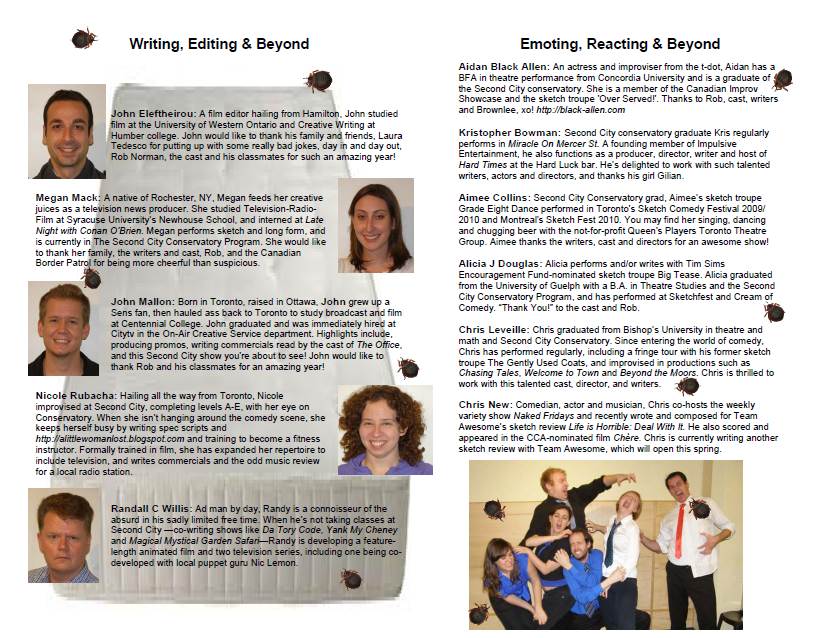
Ironically, I co-wrote a comedy show that became known as Bed Bugs & Beyond

Ironically, I co-wrote a comedy show that became known as Bed Bugs & Beyond

My Creative Journey – Part Two

Picking up from my first realization that my passion might also be a gift, as explained in Part One.

Image

Over the years, I’ve had opportunities to display my creative demons before an audience. An effective little soap opera episode in Grade 12. Geeky science humour in my own magazine. Heart-wrenching poetry following the end of a close friendship that might have been much more.

I worked my way into the magazine world, writing interesting stories about interesting discoveries and advances, but it wasn’t the same. The words poured forth and the story-telling skills improved, but I was always a chronicler of someone else’s story.

Creativity expressed itself in my approach to the story. In seeing a story that no one else saw. In context that was invisible to everyone else. Creativity manifested itself in identifying authors and writers from all walks of life to fill gaps in the magazines. I may not have been the best project manager, but I was definitely the most creative.

As I matured in my jobs, I extended this creativity to everything I did. Looking for effective solutions to seemingly intractable problems. But it wasn’t enough. That voice within me cried out to be heard. And the more I worked—and overworked—to distract it, the louder it screamed. So loudly, that even my wife could hear it.

While sitting in an Orlando hotel bar one night, she finally challenged me and my workaholic tendencies, demanding that we come up with a hobby for me. When pressed, I admitted that I had always felt like I’d been born 30 years too late. That if I could have any miracle in my life, it would be to work on those old sketch comedy shows from the 1950s as a comedy writer. Sid Ceasar’s Show of Shows came to mind. Imagining myself in the writers’ room with Mel Brooks, Larry Gelbart, Woody Allen and Neil Simon.

Neither of us knew how to make that happen, but my wife challenged me to find something at home that would set me up in that direction. The next week, I signed up for my first improv class at Second City.

Although it still wasn’t where I wanted to be—more performance than writing—the improv classes were amazing; therapeutic on a variety of levels. Eventually, though, I stumbled onto their sketch comedy writing program and that’s when I hit my stride. A wonderful instructor, talented zany fellow students.

The words flowed incredibly quickly. Within weeks, I had dozens of sketches and felt like I was making serious headway in my education of what worked and why. If there was a problem with the class, it was that my production vastly outstripped the need. I tried new things. I broke out of my comfort zone. I pushed my limits. My only goal was funny.

As I honed my sketches, I prepared for the reality of rehearsals with actors, when all of this work would really come true; when my efforts became more than an academic exercise. Rehearsals went well. Out actors seemed genuinely grateful to be performing our work. I saw what worked and what didn’t, even in the work of others.

Interestingly, I wasn’t in control of the process and I was okay with that. There’s something to be said for being so far out of your element that you recognize the limitations of your control. I had complete faith in the director and our actors. I believed they too wanted this to work as badly as I did.

And then the day of the performance arrived. Nervous energy ran through my body and I couldn’t sit still. I could barely communicate. There was no fear. Only anticipation and potential validation. Was I funny?

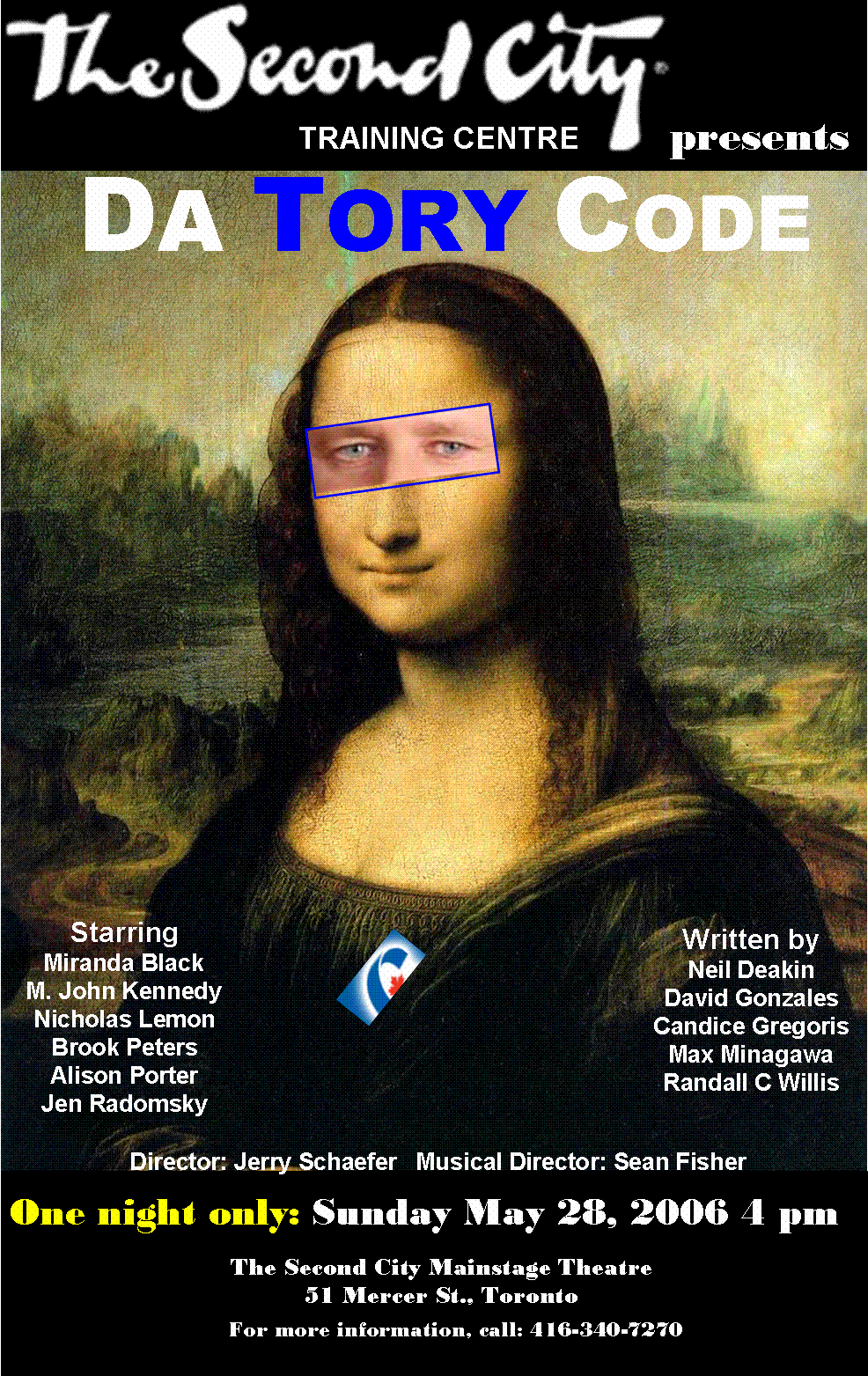
The day we premiered Da Tory Code was easily one of the best days in my life. The audience laughed. Not at everything, which was a valuable lesson, but they laughed at enough to validate my talent.

Image

Dialogue v Narrative

Image

Yesterday, my friend Marsha posted a short piece on her blog—Why the Face (WTF)—where she discussed her challenges in writing narrative/action for a scene and how she found scene writing to be so much easier if she started the dialogue.

“On its own, free of formatting and figuring out what characters are doing physically,” she wrote, “it lets me really get into what these people are actually saying to each other.”

When I read this, I thought, what a fascinating approach as mine is the complete opposite.

When I start a scene, I can go on ad nauseum about the setting and what the characters are doing or how they are behaving, but I find actually expressing the characters in dialogue to be daunting. When I do start writing dialogue, I find that I am writing exactly what my characters are thinking (on-the-nose) or that their emotions and motivations are incredibly superficial.

When I describe a character’s behaviour, however, his or her emotions surface more slowly through unconscious tics. The tensions that I intone in my mind’s eye then inform the word choice when I start to write his or her dialogue. It is as though I have to psych myself into the character’s body before I can express his or her desires and impulses to the fullest.

What makes this ironic is that while discussing this with Leela, another friend, she reminded me of the days when I first started writing sketch comedy, and all I could seem to manage were a series of “talking-head” sketches. At that time, action was unimportant to me as I felt the only way to bring my point across was through words.

On paper, my sketches could be very engaging, whereas on stage, they were significantly less so. Thus, I needed to learn the power of the unspoken word. Apparently, the pendulum has swung full tilt and I am now in the process of finding a happy medium. (No wonder writing is so tiring.)

Ultimately, like a good Oreo cookie, the best screenwriting comes from the combination of solid narrative (icing) and solid dialogue (cookie), so I am glad Marsha has my back and I have hers.

Fitting a pitch

Image

The line has been drawn in the sand. I’ve painted myself into a corner. It’s time to s#!t or get off the pot. [Insert other cliché expression indicating you’re stalling and we all know it.]

It is time for me to start pitching my television show ideas to production companies. No more fine tuning. No more market analysis. Get out there and sell, boy.

I was at an information session over the weekend where a Head of Development for a local production company was talking to new comedy writers (and me) about what producers are looking for in new sitcom pitches, and perhaps just as importantly, what they do not want to see.

Much of what he had to tell me was very familiar, but one factoid took me quite by surprise and shook me off the procrastination horse. Nobody, it seems, wants to see your pilot script (at least not in Canada).

They haven’t got time to wade through it and really just want to know three simple facts:

  • What’s your story idea?
  • How expensive will it be to make?
  • Can we sell it in the U.S. or in Europe?

And all of this, the producer assures us, can be handled in no more than 3 pages and for some, ideally in one.

What’s your story idea? Tell me about the scenario, the characters and what I can expect to see in a typically episode.

How expensive will it be to make? One or a couple of sets works in Canada…multiple location shoots gets expensive.

Can we sell it abroad? Make it Canadian enough to get government tax incentives but not so Canadian that Americans and Europeans won’t want it. Broad and universal is the name of the game.

No pilot script? Too many changes after everyone has had their hands in your concept…although, if you have one, you can use it as a sample of your writing.

Oh.

Hunh.

Well.

Suddenly, I have gone from having one sitcom ready to pitch to producers to three sitcoms, two animated kids programs, one anthology series (think Quantum Leap) and two educational/lifestyle programs. [This is aside from the sketch comedy show on which I am a writer, but is someone else’s puppy to pitch.]

Time to figure out what production companies develop shows similar to mine and arrange some meetings. Time to make this career leap pay some bills.

Wish me luck (and please check in every now and again to keep me honest).

(Photo used without permission from the delightful blog Picnics in the Park.)

Unintended misogyny

According to the Cambridge Dictionaries Onlinemisogyny (n) Feelings of hating women or the belief that men are much better than women.

Image

Let me state for the record that I do not hate women, but over the last decade or so, I have come to realize the insidious ways in which I felt (or made it appear that I felt) men to be superior to women.

As a male writer, I have historically written stories from the male perspective. My protagonists were male. My antagonists were male. My peripheral characters were predominantly male. And when I did include a female character, she tended to be rather two-dimensional (see also my blog post For my friend Emma).

Several years ago, I had the fortunate happenstance to take a sketch comedy writing class at Toronto’s Second City Training Centre under the guidance of actress and writer Aurora Browne, best known locally as one of the actors from the show Comedy Inc. and former mainstage performer at Second City. Perhaps not surprisingly, the class was mostly comprised of men. And to a man, we wrote sketches about guys.

After the first couple of classes, however, when we had each produced a few sketches, Aurora challenged the men in the room to either rewrite one of their existing sketches or write a completely new sketch with a woman (or several) in the lead.

It was at that moment that I realized my unintended misogyny.

Aurora was tired of trying to find material with strong and/or well-defined female characters. She was tired of simply playing the girlfriend, the ex-wife, the nurse, the teacher. Not that there was anything inherently wrong in playing any of these roles, but more that they were almost always written as two-dimensional…if they could even be said to aspire to a second dimension.

This was her opportunity to put her heels into the dirt in moulding the next generation of comedy writers.

From my perspective, the task was amazingly daunting and very surprising, as I found myself breaking down walls and obstructions I never realized I had put in place. I had to think how might a woman character function differently in this scene, without getting cliché, and how would that change the dynamics of the scene. Or even would it?

In the years since, no matter what I write—sketch, screenplay, teleplay, poem—I watch for places where I might fall into gender bias. The minute I decide on my main characters, I ask myself if the protagonist or antagonist could be a woman (sadly, I still typically default to males). If the answer is yes, then I take a second run at my idea to see which way would make for a better story.

As a result, I have both dramatically increased the repertoire of characters I can bring to life and greatly enriched my stories. In fact, the two most recent screenplays I am developing have female protagonists, as do a couple of my television pilot concepts—not out of a sense of political correctness or fairness, but because those choices made the most sense for the story.

So thanks, Aurora, for the creative kick upside the head.

(Illustration used without permission.)

I can do better than that

Almost a year ago, I had the opportunity to substitute teach a class of would-be advertising copywriters at a local community college. I was quite excited because it would give me the chance to talk to people at the beginning of their careers, while they were still fresh with anticipation and ready to take on the world.

Out of the gate, I let them know a little about myself and background, and then went straight for the “So, what made you decide to become a copywriter?”

To a person, the response was largely the same: “Well, I saw so many terrible advertisements and knew I could do better than that.” I am extremely happy to report that this was not all that they had going for them. Each was amazingly talented in his or her own way and it was a great couple of weeks.

But their original motivation hangs in the air, like a persistent echo that refuses to die.

No matter what our art, I would not be surprised to find that out that we have all said at some point in our lives “I can do better than that”. It’s only natural. It is how society has raised us.

I would like us to stop, however, because I fear it is killing our spirit and therefore threatens our art.

First, it’s just negative thinking on a topic for which we do not have a full understanding.

Having worked in advertising for a few years, I have a much better understanding of the great divide between what we came up with creatively and what finally made it to the magazine page or television screen. Trust me, the average ad you watch bears almost no resemblance to the original concept.

And even if my head exploded a little at the thought of the movie Piranha 3DD, I have to give the writers and producers some credit for getting it made and into theatres. They’re well ahead of where I am with my screenplays, which currently sit on my laptop computer and in a few competitions.

But more important than simply being the “why can’t we all just get along” guy, I think we denigrate our own efforts by focusing our attention downward.

Art should inspire and the artist should aspire. We shouldn’t look down and sneer. We should look up in awe at works that truly stir our hearts; that shake us to our artist core and make us strive to be better.

If all we do is attempt to be slightly above the dirt, then we merely set ourselves up to be the target of the next person in line.

If, however, we push ourselves to reach further, attempt more, climb higher, then there is every reason to believe that we will be the one who inspires the next person to stretch beyond our grasp.

I don’t want to write a screenplay that’s slightly better than Walk Like A Man. I want to write one that surpasses The Usual Suspects.

I want to write sketches funnier and more pointed than Sid Caesar and Monty Python.

I want to take the most beautiful photos that tell the most intricate stories, using every other photo as my muse.

By looking up, we become a lightning rod for our art, attracting the energy and inspiration that drives our passion. Looking down, we shut ourselves off from those same spirits, blocking out the positive input that surrounds us.

Simply in aspiring to something greater, we raise our art and therefore ourselves to new levels. And as difficult as each incremental step may be, the rewards are exponentially greater.

When we look up, we are bathed in the light of our truth. Looking down, we see only the threatening abyss of failure.

Aspire or expire, the choice is yours.

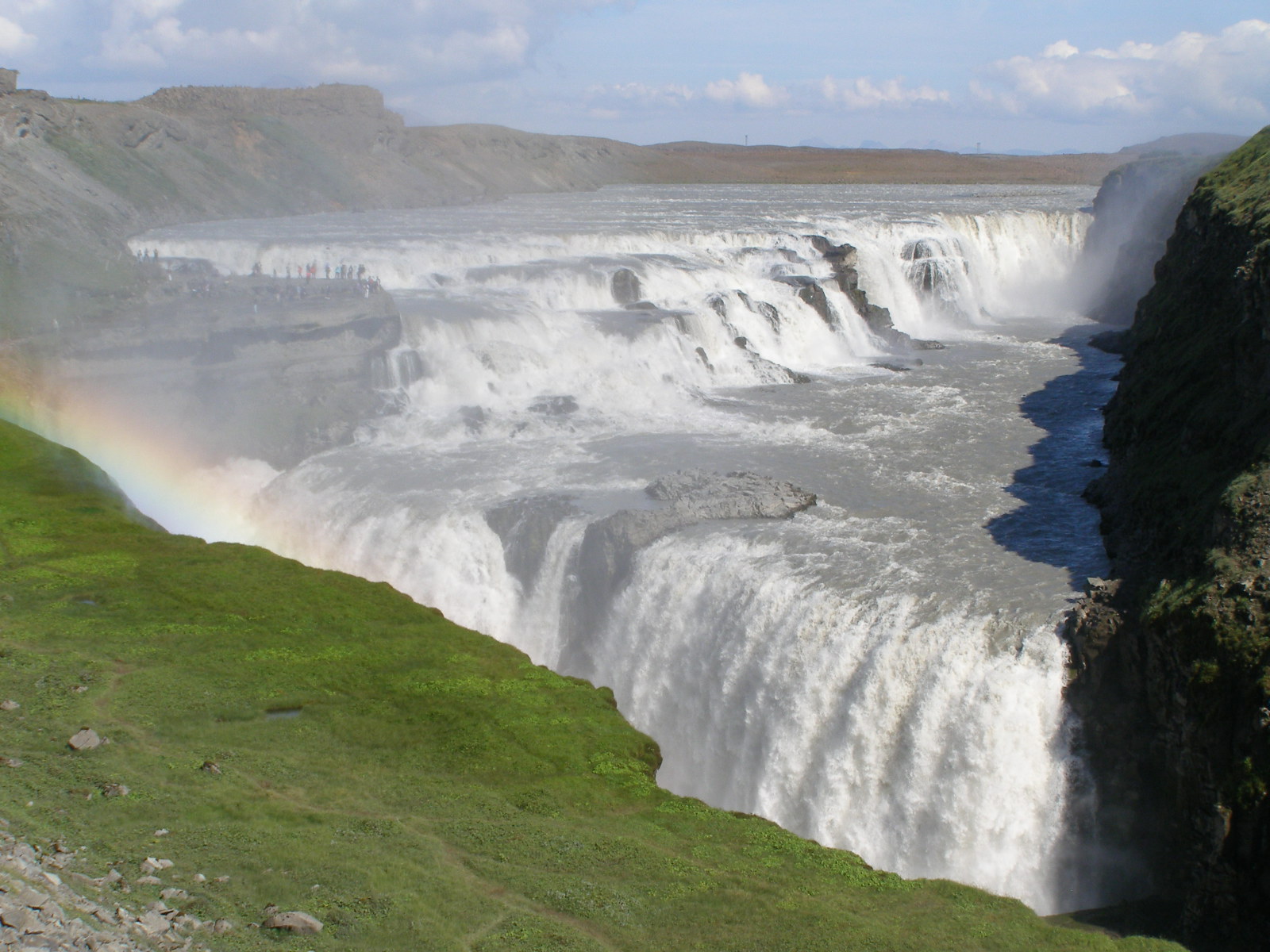
The sheer scale of these falls was only overtaken by the thought that they followed a geologic fault separating Europe from Greenland.

The sheer scale of these falls was only overtaken by the thought that they followed a geologic fault separating Europe from Greenland.

Know when it’s over

Writing a screenplay or novel is a lot like being in a long-term relationship as you largely go through the same steps.

At first, you’re unfailingly passionate about your partner, flush with love for an incredible idea. You dive into her with a zeal you have never felt before and are certain you will never experience again. You embrace every inch of her, her very essence and when finally forced to surface, you just want to show everyone how happy you are.

As time goes on, however, the initial zeal diminishes, if not in scale, at least in monomaniacal focus. You become more comfortable with her. You spend more time contemplating her rather than just diving in. You are caring, loving, nurturing. And even if not everything proceeds as smoothly as it once did, those are just the little maturities that slip into life.

Eventually, you grow into each other. There is love, there is care, but it’s mellower, more set in its ways. She isn’t as all-consuming as she once was, but you’re both okay with that. You might spend time with other couples, sharing common bonds and then making fun of them on your way home. Life is good, it’s right, it’s comfortable.

Now, if you’re fortunate, this goes on for the rest of your time together. You mature with each other. You fulfill her needs until that fateful day when she passes on to the other side. You’re wistful, but satisfied that you had a good life together.

Not every couple is so fortunate, however.

Sometimes little inconsistencies or minor difficulties can inflate in importance. What was once just a tiny tic, becomes this really aggravating feature that just drives you up the wall. Oh, you try to work through it. You try to convince yourself it’s nothing, that you’re just being paranoid, but after a certain point, she just seems to do it all the time and damn it, on purpose.

You soon find yourself coming up with excuses to go out for a little bit to clear your head, but the moment you leave the house, you find your mind wandering off to sexier screenplay ideas. You’re fantasizing and you can’t help it. And damned if, the minute you walk back into the house, there she is, staring right at you like she can read your mind.

“What do you expect?” you scream. “You knew I was an artist when we started.” And she just lay there, letting you stew in your self-incriminating guilt. It’s the silence, the inertness that just gets under your skin.

If you’re lucky enough to calm down, you may decide that you just need a little time apart. Both of you. A little time to remember why you came together in the first place. A month, six months, a year later, maybe those petty little problems won’t be so big. Hell, you might even have found a way around them. But right now, you just need some space.

Time goes by and maybe you do get back together to solve your differences. But maybe you don’t. It’s tough, but you realize it’s over. It’s time to move on.

It’s okay. You’ll live. You can’t beat yourself up over it. You tried and it just didn’t work out.

You may not think it right now, but there’ll be others. You’ll try again and maybe that one will work out differently.

You didn’t fail. You’re not a bad person. It just wasn’t meant to be.

You have to know when it’s over…but nothing says you have to know any sooner than is absolutely necessary.


PS If screenplays and novels are long-term relationships, I guess that makes sketch comedy a quickie in the alley. No wonder they’re so much fun, but rarely fulfilling.

You might be a writer

(Inspired by a post on The Writing Corp blog and of course, Mr. Jeff Foxworthy)

If you’ve ever freaked out because your partner loaned your pen to someone and neglected to get it back…

If you own 17 notebooks and still have a house littered with random pieces of paper containing ideas…

If your friends won’t tell you anything anymore for fear it’ll end up in your next novel, screenplay or comedy sketch…

If you’ve heard voices in your head and your first thought was grab something to write with…

If you go on a tropical vacation and only the back of your neck gets sunburned…

If you’ve developed the skill to write coherent notes to yourself without removing your eyes from the person sitting across from you…

If every jacket you own and every room in your house contains a writing pad of one size or another…

If you instinctively know what inks will smear and which pens write upside down…

If you’ve ever found yourself looking forward to a long bus or train ride…

If reaching a crisis is as satisfying as achieving a climax…

(Personally, I’m still working on the writing while looking someone in the eye, otherwise, I’m good.)

Tach-ing out

I do not take drugs. Well, okay, the odd Extra Strength Tylenol. But hey, all the kids with headaches were doing it.

Anyways, it is my understanding that cocaine brings the sensation of clarity and sends your entire being into a state of overdrive. Your engine doesn’t idle. It runs at full speed and if you’re lucky, you’ll never shift it from neutral to drive or you’ll explode into a wall.

Whether it’s true or not, that’s what I feel like right now, in the creative sense.

Everything about me is running at full speed and then some. Every sense is attuned to the universe and picks up every scintilla of stimulation, translating those sensations into thought and eventually into word.

And while I embrace this period of unbridled energy, particularly after a couple of months of intellectual torpor (or at least that’s what it felt like to me), this constant revving of my creative engines has its problems.

Am I making sense? The words flow out so quickly and the paper cup overflows so easily that I don’t leave myself much time to analyze what I am writing to determine if it isn’t just the word “banana” over and over and over again. (Or the word “over”, for that matter.)

Can I finish anything? Because I find so much joy in the creative process, I worry that I jump from project to project without actually completing anything. Building the seminal moments and scenes for my next screenplay are so much more fun than actually writing 110 pages of dialogue that I am seriously running the risk of waking up two weeks from now surrounded by ideas for 68 movies, but no actual scripts.

How quickly can I become ambidextrous? I have two hands, why can’t I write in two notebooks or on two laptops at the same time? I want to believe that it would cut the noise down by 50%, but something tells me that it would just feed the monster, which would expect 4 times the output. If my toes weren’t the size of rhinoceros heads, perhaps I could up my output even further.

And even if I can finish all of the projects that are exploding out of me, how do I keep them from just hitting the bottleneck of “So, now what?” It took me years, and a very caring friend, to help me deal with the backlog of comedy sketches I wrote during my time at Toronto’s Second City Training Centre and since then.

Must pull my head out of my laptop long enough to transition some of these projects from Word and Final Draft documents into actual films and television shows. (BTW, “pull my head out of my laptop” reads a little weirder than it sounded in my head.)

Oooooh! The ideas are only 30 seconds apart! Must remember my breathing exercises.

Oh god, my creative water broke! Quick, someone get me a notebook, a pen and two Extra Strength Tylenol!