The job you hate is killing your creative spirit

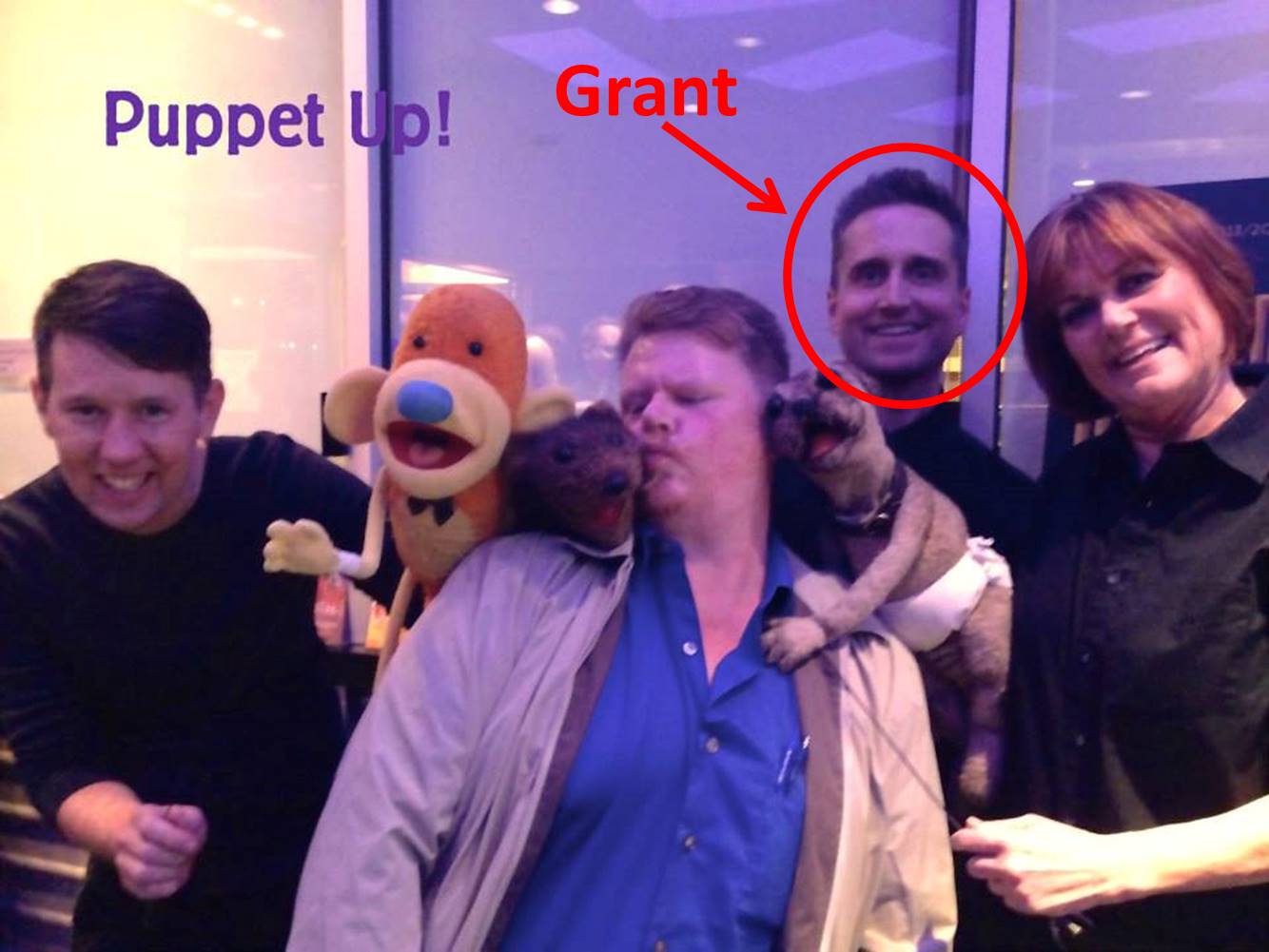
The wonderful Grant and his weasel buddy join me for a post-show photo (also shown Peggy Etra and Brian Clark).

The wonderful Grant and his weasel buddy join me for a post-show photo (also shown Peggy Etra and Brian Clark).

Grant Baciocco is an amazingly talented actor and puppeteer I had the good fortune to meet online and then in person when he came to Toronto with the improv puppetry show PuppetUp! (about which I have raved extensively elsewhere).

Well, aside from his amazing talent, he also has a wonderful creative spirit, both in the sense of what he creates and how he tries to inspire others to be open to their own inner creative spirit. To this latter point, he has a wonderful blog Grantblog: Ruminations & Pomposity that I heartily recommend.

At the beginning of each week, he posts Creative Mondays and today was no exception. Today he talked about “A job you hate”, which I excerpt below:

For years after college, about ten in fact, I worked as a substitute teacher.  It was an okay job, certainly flexible enough and I was making money, but by the end of those ten years I was starting to burn out because it was not the job I wanted to be doing.  I was good at it and several times I was told I should get my teaching credential because I was such a good teacher.  But deep inside of me I could feel a darkness building up because I was doing a job I absolutely hated.

The moment I made the decision to stop subbing and focus on The Radio Adventures of Dr. Floyd, it felt like a weight was instantly lifted from my chest.  I attempted, for the millionth time, to lose weight and it was actually working (lost 80 pounds).  I was just a million times happier than I was when I was subbing.  And guess what?  I became more creative!  This was the creative boom era for Dr. Floyd, because I was doing something I love.

Grant’s is a lesson too many of us learn very late in life (NOTE: I did not say “too late in life”…it is NEVER too late).

In my case, I was fortunate enough to have a series of occupations I loved for a period…scientist, science writer, media relations, advertising copywriter…but with each, I stayed in the occupation long after I had fallen out of love with the choice. I had to be a certain amount of miserable before I was brave enough to jump.

But two years ago, I completely jumped ship to pursue my true love: story telling (screenplays, novel, sketches, short stories). I’m still not making money off any of this, so I live on freelance magazine writing and ad copywriting. But to Tiffany’s point, it is what I do to eat and sleep under a roof.

If you are fortunate to know your passion—it can take time to figure out what it is—then you must make it happen to find happiness (hunh, “happen” and “happiness”…so similar).

And if you haven’t fully defined your passion yet, go with your gut until you do. Explore the universe of opportunities, until you do. You may not end up the financially richest person on the planet, but you’ll definitely be one of the spiritually richest.

If you don’t want to take it from me, then take it from Grant. Find your happiness and pursue it with everything you have. Despite appearances, you really do have nothing to lose and everything to gain.


You can follow Grant on Twitter: @ToasterBoy

Ten books that influenced my life

There is a thing going around Facebook these days—electronic chain mail, really—where friends invite each other to list the 10 books that have stuck with them through life. Thanks (??) to my friend Nancy for inviting me to participate.

shakespeare1

The Complete Works of William Shakespeare

Since my first introduction to the works of the Bard in Grade 9 (Merchant of Venice) through my many pilgrimages to The Stratford Festival in Southern Ontario, I have been entranced. No matter what is going on in my life, I find solace and refuge in the pages of the Master’s folio. Favourite play: Henry V. My lone tattoo: Julius Caesar V.v.73.

His life was gentle, and the elements

So mix’d in him that Nature might stand up

And say to all the world ‘This was a man!’

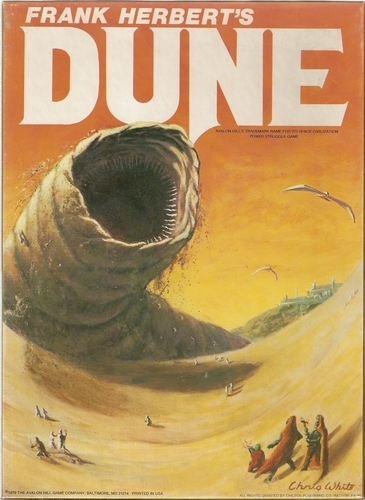
dune_cover

DuneFrank Herbert

For such a short book—and particularly within such a long series—this is a novel I return to on a regular basis. The story is woven so tightly and yet offers mythic proportions. The language is at once simple and profound…and incredibly quotable. Every time I read the story, I find a new interpretation.

I must not fear. Fear is the mind-killer. Fear is the little-death that brings total obliteration. I will face my fear. I will permit it to pass over me and through me. And when it has gone past, I will turn the inner eye to see its path. Where the fear has gone, there will be nothing. Only I will remain.

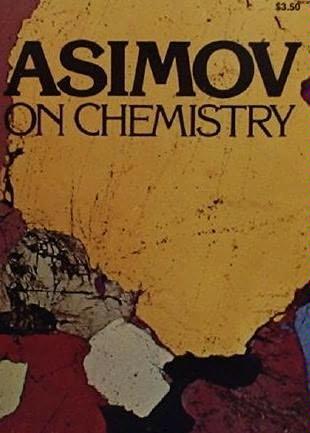
asimov

Asimov on ChemistryIsaac Asimov

To a budding geek, this book and the next on my list were manna from heaven. Although I was a fan of Asimov’s fiction, I found a home in his look at various subjects in science (and eventually theatre and religion). He explained the universe to me in a way that no one else could and gave me the tools to extend that learning to others (whether they wanted to hear it or not).

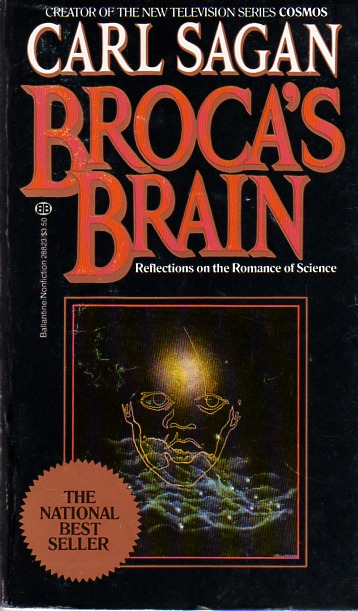
Broca

Broca’s BrainCarl Sagan

While Cosmos was the book (and television series) that everyone else was talking about, this was the book that first grabbed my attention. Like Asimov, Sagan had a way of contextualizing science that few others have mastered, offering not just a series of facts, but the stories of the people behind those facts, including the dearly departed Paul Broca. Asimov and Sagan likely influenced my decision to move into science writing.

Wolf

Never Cry WolfFarley Mowat

If not for my abhorrence of discomfort, I would be living on the Canadian tundra today, studying and communing with the wolves. That’s how powerful this book was to me. Many criticize Mowat for fabricating many elements of his non-fiction and particularly in this story, but I don’t really care because he grabbed a young mind (mine) and transported me into the minds of the wolves he studied for the Canadian government. To see these creatures as more than just vicious wild dogs was life-changing.

purple-cow

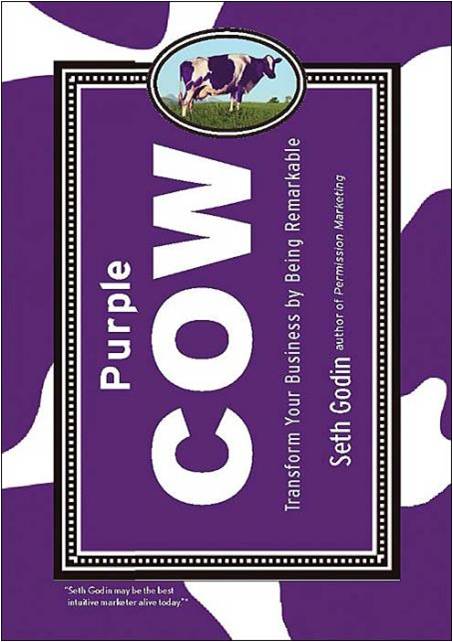
Purple CowSeth Godin

Drive past enough farm fields filled with cows and eventually you cease to see them. Drive past a purple cow, however, and you stop. In short, the premise of a book of blog entries that challenges the reader to skew their view of the world with an eye to drawing the attention of your audience. Less an epiphany than a confirmation of what I already believed, Purple Cow told me there was merit in my mania.

Natural

Popular Natural HistoryRev. J.G. Wood

Published in 1885 (my edition), the content of this book is not only dated (it includes a discussion of the dodo), it is often outright wrong. But it holds a special place in my heart because I received it from my great-grandmother and it initiated my fascination with antiquarian books, something that continues to this day despite my inability to financially support it. These books—particularly the non-fiction—open a portal into another time and another way of thinking, much as the rest of my book collection will in 100 years.

????????????????????????????????????????????????

The Love You MakePeter Brown & Steven Gaines

The murder of John Lennon in 1980 took what was a passing awareness of The Beatles and turned it into an obsession for me. I had heard the music, I had seen the movies, but I was completely unaware of their context. Thus, the biography of the Fab Four, written by insider Peter Brown (…called to say, you can make it okay, you can get married in Gibraltar, near Spain), blew the lid off my ignorance, pouring kerosene on a flame that has not died in the intervening 34 years.

Elements_of_Style_cover

The Elements of Style – Strunk & White

As a writer and editorialist (I will not call myself a journalist…different craft), you might suspect that this book is close to my heart because it helped me become a better writer. And you would be DEAD WRONG. Just the opposite, in fact.

Instead, this book informed me that my new Editor had absolutely no respect for my writing nor that of my writer/editor colleagues. In our first staff meeting, she cheerfully told us she was looking to make some changes in our magazine and then gave us each a gift of this book. In my eyes, it was tantamount to handing Dostoyevsky a first-grade reading primer and suggesting he rewrite Crime & Punishment in the format of Mr. Whiskers (no self-aggrandizing hyperbole intended). I moved on.

Etymology

Chambers Dictionary of Etymology – Robert K Barnhart (Ed.)

As a word-jockey, history-buff and all-around geek, I can never be sure if my wife’s gift of an etymology book was a reward or a well-disguised pun-ishment (the hyphen should give you a clue as to why she would punish me). Regardless, the book has served me well as I endeavour to sculpt language to fit my needs, crossing words at their roots to develop new varietals that colour an otherwise mundane existence.

Besotted Voce – A few (hundred) words on character voice

Voices-graphic-2

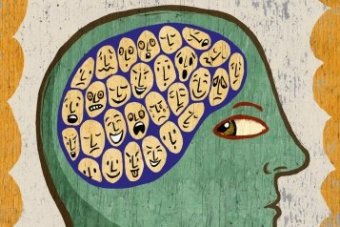
No matter with whom you speak, to an outside observer, the two of you sound different.

I’m not talking about the pitch or timber of your voices—although those likely are different—but rather those other factors that make your speech distinct: cadence, word choice, sentence structure, etc.

For five years, I worked as an editor and writer on a couple magazines in Washington, DC, and over that time, I found that I could tell which of my workmates wrote which articles without looking at their bylines…even without our names, the pieces had our fingerprints all over them.

How Mark Lesney opened an article was very different from the way Nancy McGuire would.

Mike Felton explained his thesis very differently from David Filmore.

And the two Randys were polar opposites in sentence construction: Mr. Frey being pithy, while Mr. Willis would wax poetically at the drop of a proverbial hat.

Some might argue that these differences reflect variations in style, but I believe the situation is less superficial than style. Instead, it reflects who we are as individuals; our personalities, our experiences, our beliefs, and our feelings both emotional and physical. We speak/write as the people we are at that particular moment. I as me and you as you (this sentence screams for a “Goo-goo goo-jube”).

Ideally, this same variety of voice should occur in the fictional characters we create, whether for screenplays, novels, short stories, sketches or whatever.

With all but the shortest lines of dialogue, a reader or listener should be able to tell which lines correspond to the same speaker even in the absence of any overt identifying marks such as the character’s name.

A simple example: Despite achieving the same goal in response to another person, the following lines say them differently:

“You’re nuts.”

“You are insane.”

“You’re one crazy motherfucker.”

“That, sir, is the most ridiculous thing I have ever heard.”

* silent stare *

With these five lines, we see differences in:

  • Relative status (e.g., tone)
  • Degrees of personal control (e.g., length, use of contractions)
  • Emotional state (e.g., length, word choice)
  • Possibly educational or social background (e.g., vocabulary, use of jargon)

It can be a challenge for one mind (the writer’s) to create several distinct voices. It is a form of consciously willed multiple personality disorder. Thus, early drafts of a literary work may sound flat because too many of the characters are speaking with the writer’s voice rather than their own.

In theory, this is an easy thing to fix during revisions. Simply take the sentence and knowing what you do about your character—his or her emotional and psychological state, status, social and educational background, life experiences, physical challenges—make the line more accurately reflect how the character would speak.

One complicating factor is that a seemingly simple change in response by one character may elicit a change in the response of the dialogue partner(s). I am likely to respond very differently if presented with any of the five reactions above. And thus, the writer has triggered a change-reaction that reverberates through the scene.

A second complicating factor is that the change in dialogue may also need to be paralleled with a change in physical action. A high-status character is more apt to be purposeful in her actions and responses, whereas a low-status character may be more physically erratic or perhaps flinching in his response. And again, the change-reaction echoes through the scene.

This may sound daunting. It isn’t…but it is a lot of work.

The trick is becoming comfortable with the many voices you need as a writer. We all start with our own voice, the omnipotent godhead that creates the fictional universe; but the trick comes in developing the skills to inhabit other bodies, other souls as you create other characters and then being able to shift back and forth as required without going insane (well, not fully insane, at any rate).

My best advice to any writer who struggles with this is not to take yet another writing class, but rather to take an improv class or several. Despite the terror that this advice may elicit in some (most?) of you, I can think of no better way of understanding—and more importantly, exercising—the differences between different characters.

You’ll quickly find improv is not about funny; rather it is about truth. And once you’re comfortable with experiencing the truth of a character, the rest of this is much less daunting.


As seems to be a routine now, today’s post was prompted by the amazing words of Marsha Mason and the Why The Face blog she posted earlier today.

PS The magazines from my Washington days were Modern Drug Discovery and Today’s Chemist At Work (because Today’s Chemist in the Boudoir was already taken).

BoJack-sh!t (a review)

bojack-horseman-bar-640

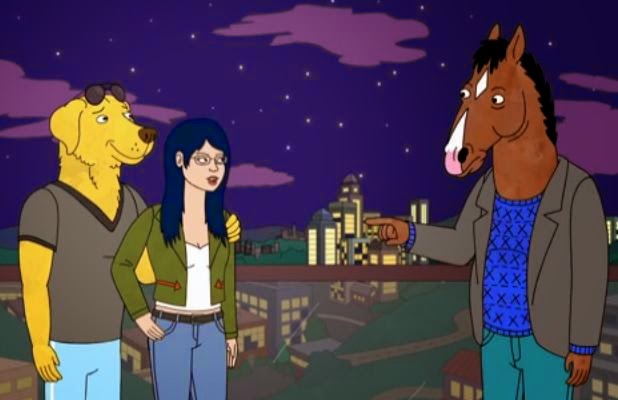
Unless this is a satire about satires, I don’t get the new Netflix Original Series BoJack Horseman.

Ostensibly, the zany life of a washed up sitcom star from the 90s, who also happens to be a horse, who is trying to find meaning in a life of idle emptiness, the show is instead an endless string of really bad puns and lame jokes about anthropomorphic animals and Hollywood, punctuated with long speeches to highlight the irony of a scene or episode.

I am surprised the character giving the speech doesn’t hold up a sign reading “Ironic part” or “Satirical condemnation of status quo” just in case the audience was too stoned to realize that’s what the speech was about.

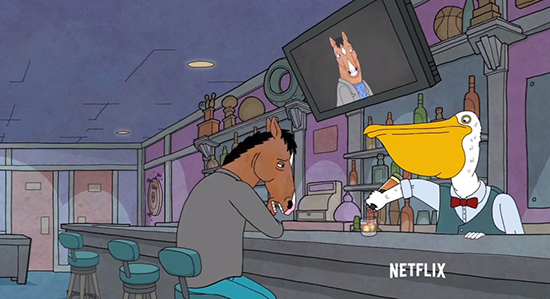
Episode 3 starts with an establishing shot of a bar called The Pelican. We then cut to BoJack sitting at the bar which is being tended by a…wait for it…pelican. Or in Episode 2, BoJack has a run-in with a Navy Seal who is a…here it comes…actual seal. Oh, and at the apex of humour, whenever BoJack’s girlfriend/agent puts him on hold, he listens to music from Cats…oh, did I mention his girlfriend/agent is a cat? Them’s the animal jokes, my friends.

pelican

There are attempts at social commentary, of course. In Episode 3, BoJack’s memoir ghost writer tries to make him feel better about a friend by claiming she was a victim of her circumstances and the pressures of society. But silly BoJack…he misunderstands this to mean that no one is responsible for their actions and that the fault universally lies with society, so he can act like a jerk and it’s not his fault. Silly BoJack.

HORSE

The voice talent is, well, talented. Alison Brie (Madmen, Community), Aaron Paul (Breaking Bad), Amy Sedaris (Strangers with Candy), Paul F. Thompkins (No You Shut Up!) and Will Arnett (everything else)…these people can act.

Show creator Raphael Bob-Waksberg is a mystery to me. An actor and writer, all I can really find out about him is he a member of a sketch comedy group called Olde English.

And the more I read about him, the more I wonder if my original comment wasn’t dead on…this may just be an amazing meta joke perpetrated by a very funny man. Or it’s just not very good.

person_11613

Because I only lose 25 minutes of my life at a go, I will continue to watch to see if it gets better…dear God, let it get better…or let me in on the divine joke of this comedy.

Lessons from bad movies – The Canyons

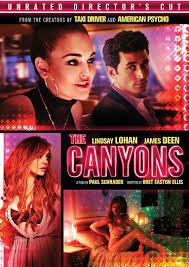
canyons poster

I believe that you can learn something from every experience you have, and because I am trying to learn more about screenwriting and films, this means watching bad movies. Thus, I was intrigued when I saw Netflix was showing a film called The Canyons.

Written by Bret Easton Ellis (American Psycho) and starring Lindsay Lohan and porn-star-going-legit James Deen, The Canyons shows the decay of Hollywood through the eyes of a struggling young actor who is still in love with his former girlfriend who is now the adornment of an unbalanced but oh-so-controlled producer on a trust fund. Paranoid from birth, the producer eventually learns of rekindled flames between the two and slowly his self-control ebbs. To tell you more would be to spoil the (complete lack of) surprise in this film.

Although the story was straightforward and highly predictable, I have to admit to being confused by one very big thing: I don’t know who the protagonist is. Through whose eyes is the audience supposed to see this story?

Lindsay Lohan’s Tara (the girlfriend) shares almost equal screen time with James Deen’s Christian (producer) and Nolan Gerard Funk’s Ryan (actor), and the story’s perspective seems to shift on a whim. If I go purely by a scale of which character left me feeling least icky in their behaviour, I would have to say Ryan was the protagonist. But he feels more like an unwitting pawn in this film.

Interestingly, however, if I was forced onto a limb, I would actually say Christian was the protagonist despite his antagonist schtick. As a character, he is reminiscent of American Psycho’s Patrick Bateman…possibly his baby brother…although there is no comparison between Christian Bale’s performance and James Deen’s.

Speaking of which, the wooden performances of the actors don’t help my quest for a protagonist. (At her best, Lohan’s glamour-gone-gory Tara was reminiscent of Ann-Margret’s characters in Carnal Knowledge and Tommy at their most strung out.) Without distinct emotive clues and any sense of subtext, I really have no clue what any of the characters hopes to accomplish…there simply aren’t any goals, again with the possible exception of Ryan.

Lohan-Margret

To continue piling on, I would be intrigued to find out what kind of movie director Paul Schrader thought he was making.

On the one hand, with rampant over-use of black & white images of derelict movie houses, it seemed Schrader was going for art-house film, using the photographic decay as a metaphor for the social decay of Hollywood (this is the man who wrote Taxi Driver and directed American Gigolo).

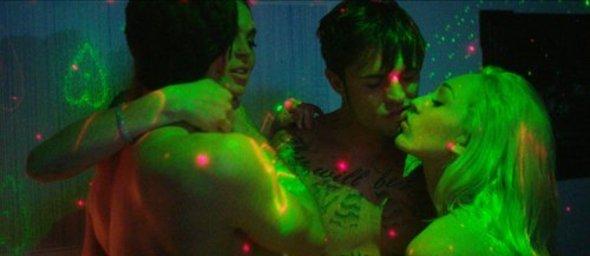
At the same time, his rampant insertion of lengthy scenes of graphic sex gave the film a B-movie, soft-core porn feel. Here, Schrader may have been going for a moral decadence metaphor, but if so, I think he failed terribly. Instead, we were left with a humping morass of buttocks and breasts that a 13-year-old boy couldn’t be bothered to whack off to.

the-canyons-04_article

But the one scene that truly grabbed my attention was a lunch conversation between Tara and Christian’s assistant Gina, played by Amanda Brooks. What caught my attention, however, was not the scintillating or captivating dialogue (there wasn’t any) or the repressed subtextual exchanges (they were incapable) but rather the fact that even the camera was unable to pay attention to the scene.

On either close up, the camera angle perpetually slid to the left or the right, and sometimes back again. Not panned to capture a background element. Slid, as if someone had forgotten to tighten the flange that holds the camera to the tripod. The camera literally nodded off.

So then, if this movie was so bad, how could I learn a lesson?

The lesson of The Canyons is that if you can get an actor of sufficient name recognition who is trying to prove something (e.g., I’m not washed up) interested in your script, you can get anything made.


Postscript:

As I looked up some background facts on this movie, I learned that The Canyons was the first film to be largely funded via crowd-sourcing. Given the performance of subsequent crowd-sourced films like Zach Braff’s Wish I Was Here (poor) and Kristen Bell’s Veronica Mars (modest), I am beginning to wonder if there isn’t some merit in studios having some influence on whether and how a film gets made.

Too many voices (spoil the screenplay)

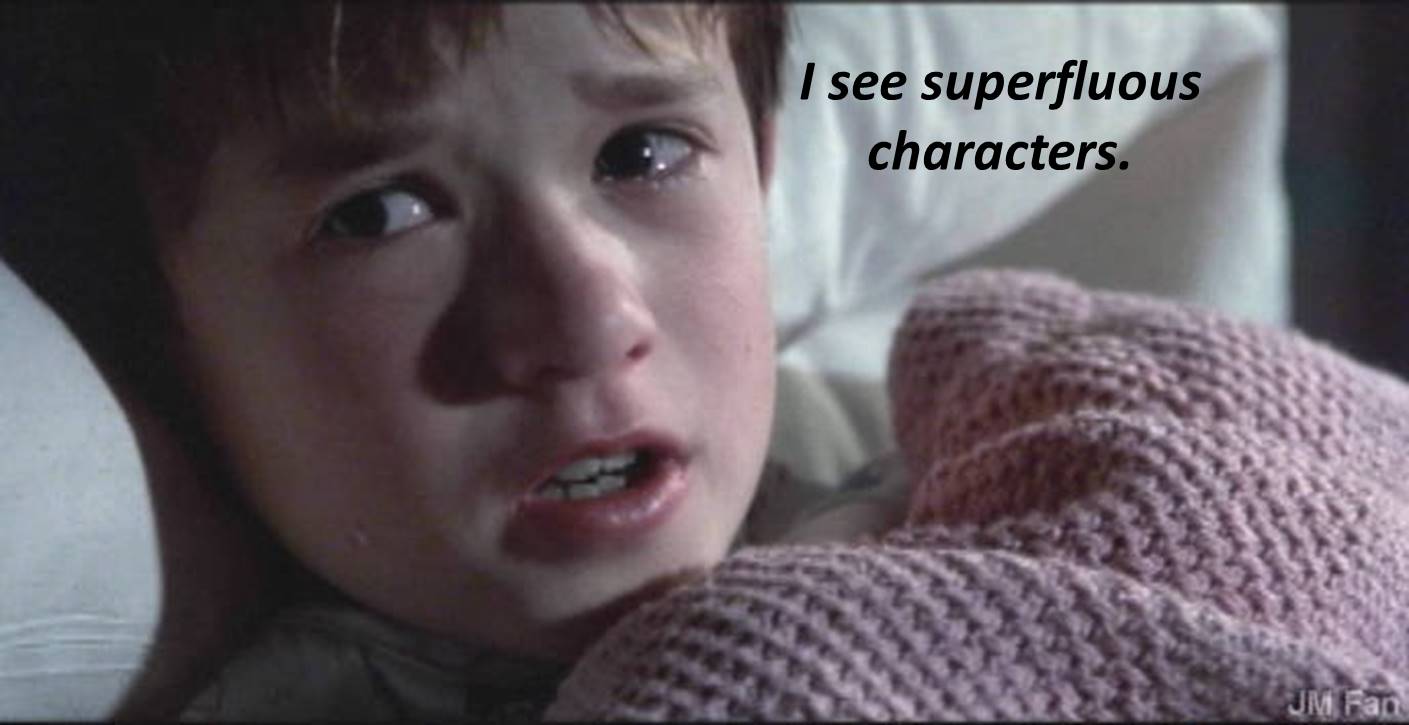
Superfluous

Congratulations! You have just outlined your next screenplay. Or maybe you’ve written “Fade Out”. That’s quite an accomplishment and you should be proud of yourself.

Go ahead. Take a moment to luxuriate. I can wait.

Okay, now I need you to kill one of your characters…or two…or maybe even three.

What? Oh, I know you’re not writing a thriller, but murder will be good for you. And even if you are writing a thriller, you’ll feel better after you pull the plug on certain characters.

Having written a few screenplays and having read 50X more, one common thread I find is that writers (me included) create too many characters, some of which are completely unnecessary.

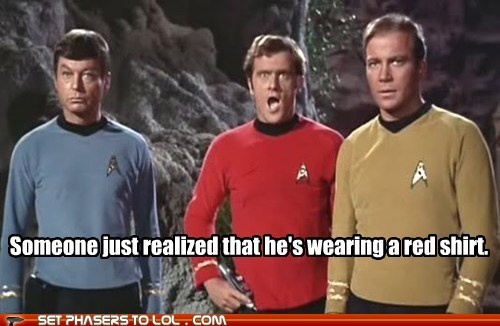
Now, I’m not talking about the red-shirted cannon-fodder that fills the background…the cab driver, the concierge, waiter, ex-boyfriend, whatever. No, I’m talking about those characters just below the protagonist, antagonist, side kick/mentor/love-interest who help move your characters through a plot point (or several) and then disappear completely.

red shirts

Let me give you an example from a murder thriller collecting dust on my hard drive…The Children of San Miani.

In my story, a journalist provides a young detective with just enough information to introduce her to the lead suspect, a victim’s rights advocate with a major reason to want the first murder victim dead.

In reviewing my first draft, I realized that the moment the journalist connected the detective and the advocate, he completely disappeared from the story. He became superfluous to (story) need, so I simply stopped talking about him.

This begged the question: Did I need the journalist character at all?

With very little thought, I quickly realized I could accomplish all of the journalist’s plot points without the journalist, either by ascribing his actions to other main characters or to the story itself. And poof, he was gone.

The result was a story that was that much tighter. A story that was a bit less confusing and yet still maintained the mystery I needed for the thriller.

Look at your story. Focus on those second-tier characters.

Are there some that don’t make it to the end of your story; that simply trigger or drive a scene or two forward?

Can those triggers or drives be handled by another character in your story, maybe a main character? Or perhaps those actions can extend the life of another secondary character who just plops into your story from the ether?

In some cases, the answer may be no; that in the grand scheme of things, this character is vital if temporary.

Fine. Keep the character. You are the best judge of what is needed for your story. But I’ll bet at least one character can go.

1248-left4dead-no-mercy-wallpaper-wallchan-1280x960

Show no mercy. Cut the strings. Release the Kraken. (Oops, sorry. Wrong movie.)

Don’t smother your screenplay. By eliminating the unnecessary, people will better understand and appreciate your story more quickly.

And when you may only get one read (if that), the easier you make it on your audience, the better.

(Images are property of owners and are used here without permission, and may be completely superfluous.)

Stop denying compliments

You’re a really nice person for coming to read my blog, and I really appreciate it.

I just wanted you to know that. You deserve to hear nice things about yourself.

feel good

It’s been a really good week or so for me on the compliment front as two previously unknown people have taken a moment to offer nice comments about my magazine writing.

In reference to a past commentary, Diane wanted me to know:

You’re a superb writer—love the line “One need only look at any war-torn region of the world today to realize that in the middle of a conflict, bullets take precedence over bandages.”

Similarly, Martina offered me her thoughts on a recent interview I conducted:

This was a great interview and a pleasure to listen to it. I don’t hear too many interviews with writers and editors so well prepared.

I tell you this not to say that you should love my work too, but rather to note that it wasn’t that long ago when I would have completely dismissed these lovely comments. Not because I am a dick, but because I am not worthy of such praise.

Throughout my life, I have had a lot of self-worth and self-image problems…still do, to be completely honest. I couldn’t believe that anyone would like me or my work because I and it had no value. Anything nice they had to say was just an effort to…I dunno…I have no idea why they said it.

But it wasn’t true. If it wasn’t a lie, it was a mistake.

As I’ve gotten better with myself over the last several years, I’ve noticed a lot of other people share this problem. They can’t, or perhaps more accurately won’t take a compliment.

dont deny

Please stop! Let people offer you their compliments. And then, say “Thank you.”

Simply say “Thank you” when someone gives you a compliment…no eye roll, no looking away or down, no self-deprecation. Just take it and acknowledge it! It sounds trite, but it isn’t.

A big part of being able to move past self-worth and self-image issues and slowly diminish their impact in my life has been the idea of accepting compliments from other people as more than politeness.

If it works for you as it did for me, at first you just go through the motions…but then slowly, as you take the compliments in and hear them more often–really, really hear them–you begin to think they may be based on something…they may be true. I’m sure they are.

I gave a dear friend of mine similar advice yesterday when she blogged about her vulnerability.

I then proceeded to give her about half-a-dozen compliments in short order to demonstrate my love and appreciation for her, to let her know she was worthy of praise.

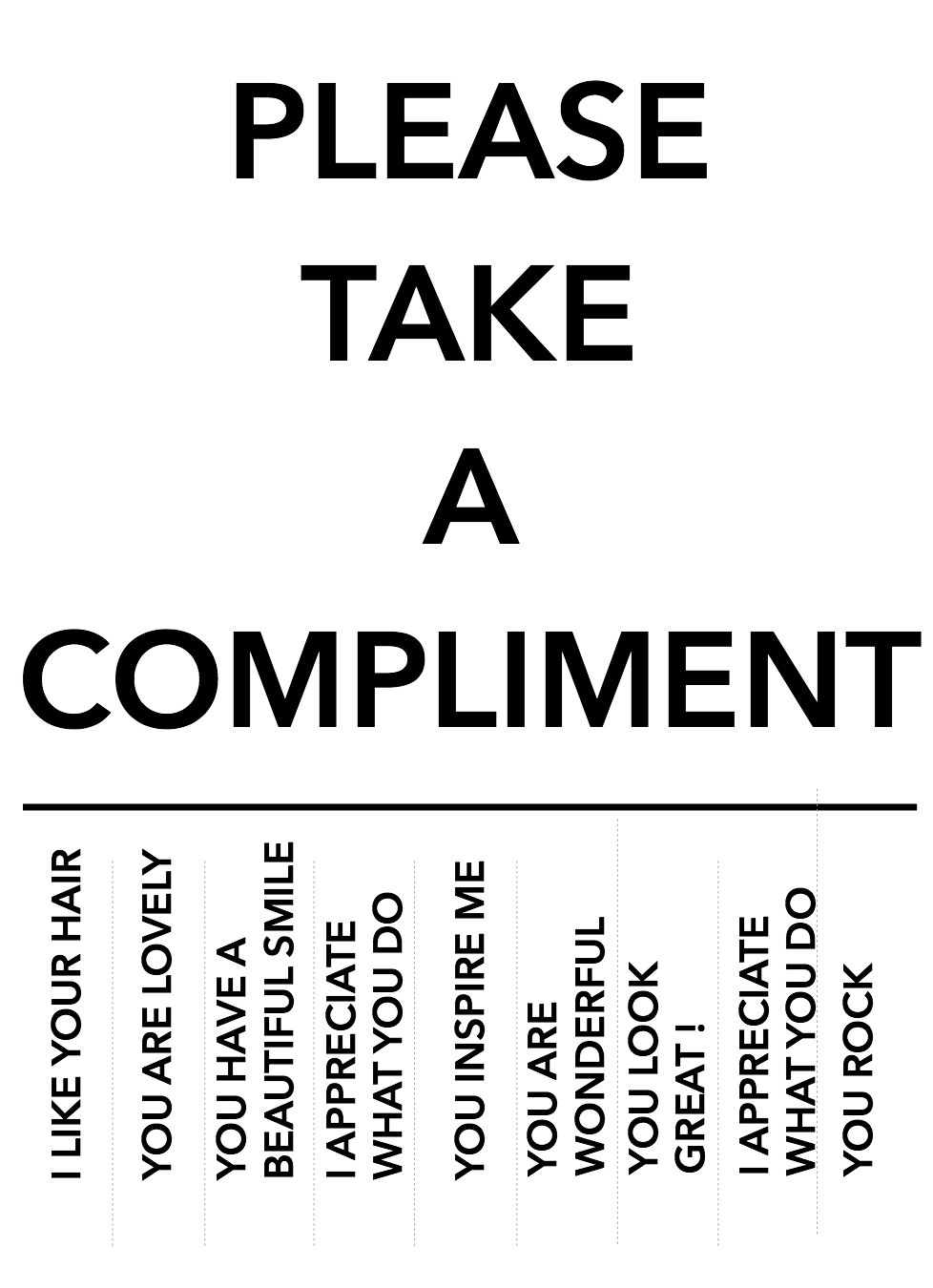
COMPLIMENT1

Without knowing which of you is reading when, it is a little difficult for me to do the same right now, other than to let you know that you too are worthy of praise.

So let people praise you…and then, just say “Thank you”.

thank-you-note

(These beautiful images are the property of their owners and are used here without permission, but deepest appreciation.)