We could be heroes

A new day starts, and you rise from your bed. As you head to the shower, your mind drifts to the challenges your boss is having connecting with her 20-year-old son.

As your boss has focused on her career, both her son and husband have come to feel like second-class citizens, the younger adult acting out by joining a gang.

It’s not your place, but as you’ve known your boss for 15 years, you feel drawn into the family drama and spend your morning devising ways to intervene on her behalf while simultaneously coping with the poison-pill clause in the hostile takeover bid.

Hold it. Wait a second. No, you’re not.

Sure, if your boss is a friend and she’s struggling, you’d likely help. You have your own life, your family and your job, however, to worry about.

You don’t merely exist to serve your boss’s life.

Shrek_Hero-1

(Character likenesses are the property of DreamWorks Animation & are used here for teaching purposes only.)

Consider the movie Shrek, for a moment.

Among the characters, we have Shrek, Fiona, Farquad, Donkey, Dragon and Gingie.

Of those, who was the hero of that movie?

Given the movie’s title, it is pretty likely that the central protagonist of the story is Shrek. And given the way the narrative plays out, based on the scenes we watch, Shrek is indeed the hero of the movie.

But do the other characters see it that way?

Did Donkey wake up one morning with a mission to help an irascible ogre find acceptance not only within a community openly hostile to him, but also within himself through his sacrifice for another?

No, he had his own issues.

Did Fiona allow herself to be locked in a tower, guarded by a knight-immolating dragon, so that Shrek could see her example of isolation as a metaphor for his own, and in rescuing Fiona, he rescued himself?

Not so much. Girlfriend had her own agenda.

So, I ask again: Who was the hero of Shrek?

EVERYONE!

(At least from his or her own perspective.)

Shrek_Hero-2

Everyone saw the same events unfold, but everyone saw them differently.

Shrek followed his life course. Donkey followed his. Fiona hers. Farquad, Gingie, the Three Blind Mice, theirs.

And in seeking to fulfill their own wants and needs, they each experienced their own character arcs. They each suffered their own Hero’s Journey.

As a screenwriter—or more broadly, a storyteller—this understanding is vital to doing proper service to your characters. The secondary and maybe even tertiary characters cannot simply be treated as plot devices, or at least not if you hope to make them seem real.

As you introduce your characters to your story, give thought to what their journeys would look like. Consider what they hope to accomplish by spending time with your main protagonist or the other characters. See their various relationships through their eyes.

And then write them with that in mind.

When they react to a situation or another’s action, they must do so with their own interests at heart, at least as much if not more than their counterpart’s interests.

When one character acts, consider the consequences and stakes for each character, and then watch the dramatic tension rise.

Look for those moments when a character must choose between his or her agenda and the greater good, or those moments where another’s behaviour threatens his or her agenda. There lies conflict.

Hear the words a character speaks and consider if those words mean one thing to the larger story and a different thing to that character’s journey. This is the subtext—conscious or subconscious—that you seek.

You may not—likely won’t—accomplish this level of intricacy on your first draft. First drafts are about getting the central story line onto paper (or whatever medium you prefer).

It gives you several starting points, however, as you enter rewrites and search for ways to tighten and heighten your story.

And at the end of that process, you should be able to write a logline for each of the major characters’ perspectives.

Shrek_Hero-3

Award-winning screenwriter Randall C Willis is Story Analyst & Coach at So, What’s Your Story (Facebook page). He also teaches screenwriting in Toronto at Raindance Canada and George Brown College.

The Commuter shoulda stayed home (a review)

Commuter poster

Liam Neeson is a special actor with a unique set of skills. Unfortunately, few of those skills are on display in The Commuter, his latest outing.

A thriller with few thrills, The Commuter tells us the story of a really unusual day in the life of insurance salesman Michael (Neeson) who meets a mystery woman (Vera Farmiga) during his commute home one evening. She presents him with an opportunity to make $100K if he takes on one little assignment, identifying someone who seems out of place.

Despite being an ex-cop and an intelligent person, Michael takes on the task, which quickly spirals out of control (else we have no movie) and the body count ratchets up. For most of the movie, we then watch an agitated Michael run, walk, crawl, slide and sidle up and down the commuter train, examining and re-examining the same passengers.

To tell you any more would be to present spoilers, but truthfully, this movie really can’t have any because the plot is largely telegraphed.

If you’ve seen Taken, you’ve seen this movie…and Taken was much better.

Forget driving a truck, you could drive a whole network of Amtrak trains through the plot holes in this story, which begins implausibly, becomes ridiculous and then gets downright silly. Had a dragon or demonic nun suddenly appeared, they would not have been out of place in this film.

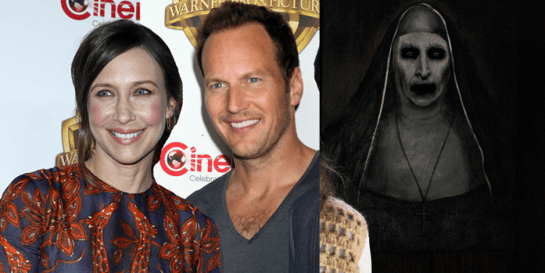
I add demonic nun, by the way, because it seems there is a clause in Vera Farmiga’s contract that stipulates she must only appear in movies with her The Conjuring series co-star Patrick Wilson. I think it has something to do with the two actors having the dynamic range of granite countertops.

Commuter conjuring cast

At several points in the movie, Neeson’s Michael makes reference to his advancing age (he is 60 years old here), and all I kept thinking was “yes, and you should know better”. Despite no outward sign of an exercise regimen—“It’s either walk up and down the aisle or take up yoga.”—this character has the fighting skills of a Navy Seal half his age rather than what might be expected from a decade-long retired NYPD officer.

More broadly, if we ignore the general stupidity of the plot, this movie is a wonderful example of why it is so difficult to effectively tell a self-contained story; a story that takes place within a confined space over a defined period of time. Effectively, after the first few laps through the train, we’ve run out of new things to try.

I’ve tried talking to people. I’ve tried punching people. Now what? More of same, I guess, for the next 45 minutes.

In writing parlance, this is called “running in place” or “repeating beats”; a repetition of actions until complete boredom or a novel insight sets in. Without ham-fistedly introducing “screenwriter ex machina”, what is the poor protagonist to do?

We accept this challenge more easily in a film like Taken if only because the writer gives us new locations and different implementations of kicking ass. We get visual variety even if the actual action is effectively the same.

Confine characters to a single set, however, and that visual variety is eliminated. The plot repetition becomes more glaringly obvious.

There is a reason that most confined space films are shorts. It is truly challenging to reveal anything novel after more than 20 minutes.

If you’re heading out to the movies and this is your best option, stay on the train…and don’t talk to strangers.

Commuter Farmiga-Neeson

Side long

SONY DSC

It’s subtle, almost imperceptible;

The sense you’re being measured.


It’s not malicious; it may not be conscious,

And it’s not the metric of any ruler or scale.

Rather it’s based on history.


Not world history; not even your history,

But a history of pain and joy;

A history of violence and caresses;

A history of anticipation, both eager and dread.


It’s a measurement made during a moment’s pause;

Through a renegade lock of hair;

In a side-long glance rather than challenging stare.


We measure the people we meet,

Seeking solace that this one’s different,

Checking for warning echoes of past sorrows.

Hoping for the best. Wary of the worst.


I am measured. You are measured. And yet,

The result speaks more of the measurer than the measured.

Passing

Droids

When you walked by me tonight,

Did you see the holes in my jeans

Or see the whole of my being?


When you crossed the sidewalk,

Did you see the dirt on my face

Or witness the pain in my eyes?


When you whistled to yourself,

Did you hear the hack of my cough

Or consider the song in my heart?


When you looked away,

Did you see the tracks on my arms

Or the bruises of past abuse?


When you accelerated your step,

Did you smell the stench of urine

Or breathe the scent of possibility?


When you turned your back,

Did you dread unrestrained need

Or wonder at untapped potential?


When you blocked out my cries,

Did you fear the monster before you

Or lose the veil of your delusions?


When you walked by me tonight,

Did you think you could escape?

My truth is your truth.


Walk all you want;

The longer you walk,

The longer I remain.

Stranger

Curtained call

Rides

Tears carve channels

Through caked whiteness,

Intersecting painted smiles,

As limbs that juggled

And balanced on beams

Seem weighted and dead.


The music no longer plays,

Replaced by heavy silence

As tired hands wrestle

Cold cream jars and tissues.

The show has ended.

Only reality remains.


The face in the mirror

Beams gleefully back,

Yet the seated corpse

Sobs uncontrollably;

Everything left behind

On saw dusted floors.


If I give you everything,

Leave nothing for me,

How do I pass the night

Alone with this shell?

What can I be when

The clown is not here?


I frolicked; you smirked.

I stumbled; you laughed.

I collapsed; you roared.

I died; you applauded,

Departing for dull lives

As I melted to decay.


Who am I if not an

Echo of your delight?

As I remove my makeup,

Do I not erase myself?

Who will love the man

Who cries alone?

Hope

Choker

Silence pours forth

Where eloquence fails,

Unable to find words

When thoughts vanish.

Boiling with purpose,

I have no direction;

Faced with the inertia

Of fear and question.


My mind races on,.

Ready to reach out

A touch, a smile,

Connection desired.

You sit so close

That I feel your breath

On my very soul;

Yet mute is my song.


I can still see you,

Feel your musical heart,

Rest in your warmth,

Nestle in your voice.

You, me. One, all.

Easily experienced,

Soundlessly recalled,

Hopefully repeated.

Unknown

Kelp crow

Raven beckons me on a journey.

Its rasping voice pierces my spirit,

Pulling me to a future unknown.


Questions I ask, options propose,

Yet the ebon wraith remains evasive,

Demanding faith when will is weak.


What lies ahead in the darkness,

Where illusions of control are lost

And footing is no longer certain?


Raven ignores my fears, urges me forward.

When I look back for sights remembered,

His tar-pitched plumage absorbs my view.


With vision gone, I now see the unseeable:

The darkness that stills my timid heart

Is the freedom my soul has sought so long.


Where I am, light surrounds me;

Where I’m not, nothing exists.

I am the journey, unceasing while I live.


There is no stasis. There is no rest.

The raven that calls me is me;

And fear dissolves with my next step.

Our songs

SONY DSCWhere are the troubadours?

Who will sing our songs,

Tell our stories, shed our tears?


Our world has so much to say,

Yet our streets and courtyards

Boom with unrelenting silence.

I witness the horrors of another world,

Hear the cheers and jeers of strangers,

But my neighbour weeps in solitude,

Oblivious to the bonds we share,

Unknowing of my face, my voice, my heart.


Where are the troubadours?

Who will hear my story, my song,

Bring it to strangers in a familiar land?


Ghosts pass every day, unseen,

Faces held to the ground they trod,

Eyes focused on illusory distances,

Cacophonous words uncommunicated;

A wall of flesh and bone and cloth,

Devoid of spirit, absent of connection.


Where are the troubadours?

Who will touch our hearts, our souls,

With music, with stories, with love?


A strum of string. A strike of key.

Tremulous glottal vibration.

And an audience thirsting:

To see, to be seen;

To understand, to be understood;

To connect, to love.


Where are the troubadours?

Connection

Chickadee-1

From his water-laden branch,

Hidden among protective leaves,

The chickadee stares down

At the strange cyclops below;

His grasp on the limb

Is tenuous at best,

Close enough for details

Distanced for quick escape.


The one-eyed beast is calm,

Open to new connections,

Seeking only an audience

With his avian companion.

Words are unspoken, unnecessary,

As a bond is formed

In the hush of gentle rain,

Whispers of waving branches

Broken only by buzz-clicks

Of monocular blinks.


For this instant, this

Sodden, frozen moment,

Relationships are formed,

Connections are made,

Eventually to dissolve

Into photographic memory,

But vitally important

Both to he and to me,

Shared in wonder and awe.

Chickadee-2