Life is messy

Reflections on things we cannot control

(Respectively, photos taken in Toronto; Hope, BC; New York City; China Beach, BC; Chilliwack, BC; Volcan Arenal, Costa Rica; and Montezuma, Costa Rica)

Penny Penniston at Toronto Screenwriting Conference 2013

Not Just Talk: How Writers Think About Dialogue

Image

Many people come to screenwriting because they have a good instinct for dialogue, but it is important to look beyond the instinct and understand the theory behind dialogue. If nothing else, this understanding is useful in helping the writer communicate with other artists so that you can articulate why you wrote a specific line a certain way, rather than simply standing there scratching your head saying “I dunno”.

Dialogue vs. conversation: Most people think writing dialogue is easy, Penniston says, because they are under the delusion that dialogue and conversation are the same thing. They are not. In comparing words to the keys of a piano, she loudly showed that conversation is noisy and discordant, while dialogue is musical, it is precise and crafted, it presents voices and themes.

Dialogue gives clear direction to the artist interpreting it, but it also gives the artist a chance to interpret the words in his or her own way, to show off his or her talents.

Like music, you have to develop something of a muscle memory for dialogue through repetition; however, understanding the theory behind dialogue will allow you to step back and analyze your writing with a certain distance.

Using visual cues, Penniston suggested that your story is much like an aerial shot of the Grand Canyon, with long, sweeping turns and deeper and shallower canyons. Dialogue, however, is more like someone kayaking through white water, experiencing the eddies and whorls of the currents and avoiding the rocks where possible.

Forces: Characters, she says, are very lazy. If left to their own devices, they won’t do anything. We need to get them to move and we do that by applying a force on them, which in physics has both a direction and magnitude. You can use physical forces, evolutionary forces (e.g., against death or for sex), cultural or societal forces (e.g., need to conform), or psychological forces (e.g., need for love or respect).

And these forces should be defined in very specific ways, again offering a sense of direction and magnitude. The strongest of all the forces on a character will drive your scene, but she stresses, the other forces are still important. This landscape of forces, she says, is the character’s situation in a scene.

Text and subtext: You want to be sure you put your characters in interesting situations with a network of multiple forces pushing and pulling your characters in different directions. You should always feel that your dialogue is adjusting and moving as these forces shift in strength and direction. A good line of dialogue, she says, manifests the sum of all of the forces acting on the character at a particular moment (e.g., personal baggage, setting, other characters).

In text, only one force acts on your character. In subtext, however, more than one thing is happening at one time. Subtext, she warns, is not the result of something being left unsaid but rather that so many things are trying to be said, but aren’t. It can manifest itself as an odd word choice given the superficial context or self-interruption and rephrasing.

When the forces converge and cancel each other out, she suggests, the character remains silent, unable to communicate anything. The character will look static, but he or she is not. It is a moment of paralysis (in physics, potential energy). And the line after a lengthy silence can be very interesting, she argues, because it is the first sign of which of the forces won. At the same time, she warns that we should look for lengthy pauses within our screenplays that do nothing for the scene or the drama. Those pauses aren’t based on reactions to forces.

Story beats: For Penniston, a story beat transitions when the balance of forces in a scene shifts, and for as a writer, you want to be very clear about the point at which this shift occurs. You should be able to point to the specific line in a scene.

Memorable lines, she says, come when the tension of a beat breaks. She harkens back to the Rule of Threes, suggesting the scene beat should occur in three steps: establish the tension, heighten the tension, and break the tension.

And wonderfully, she suggests, with change, you get an opportunity for surprise, such as the punchline of a joke. These lines can’t come out of left field, however. They must fit the context of the scene, but they can still be unexpected.

Writer Tricks: Create interesting situations in which your scene plays out. Pick a discordant place, person or circumstance. And avoid beat repetition. A specific combination of forces should never occur twice or you’ve just gone back to a previous beat and eliminated the reasons for everything that occurred between them.

Find interesting things within your situation. Add and/or explore details within your scene. Assign random elements and figure out how to make those elements work within your scene. Get insights from others and look for opportune moments to create truly memorable lines that encapsulate your character or the situation.

Tell your story as clearly but as efficiently as possible to avoid distractions. Only add narrative if it is revelatory or adds something new, and don’t direct. Although, she says, if you’re writing for studio readers, you may want to err on the side of too much narrative to make sure your story gets across.

(Aside from being a professor at Northwestern University, Penniston is also a playwright and author of the book: Talk the Talk: A Dialogue Workshop for Scriptwriters)

Jonathan Winters on YouTube

Just a sampling of the man’s genius

Jonathan Winters roasts Johnny Carson

Jonathan Winters on the Jack Paar Show – The Stick

Jonathan Winters as an Airline Pilot

Jonathan Winters on the Jack Paar Show – stand up

Jonathan Winters with Art Carney

It’s a Mad, Mad, Mad, Mad World

Image

(image used without permission)

Jonathan Winters

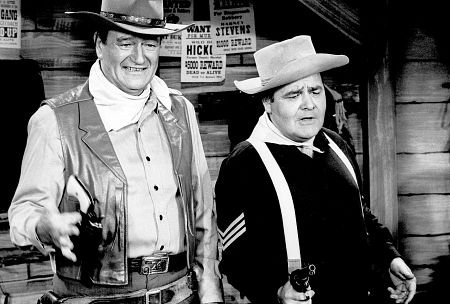
Jonathan Winters cameo Jonathan Winters John Wayne Jonathan Winters and Muppets

A giant passed away yesterday; a man of unsurpassed talent the likes of whom may never be seen again.

Other people practice improv. Jonathan Winters was improv and so much more.

The man could literally make me wet my pants with laughter. He could not be stopped once he hit his stride, which was usually on his second step, and the more you threw at him, the funnier he became.

He wasn’t funny for the sake of being outrageous, as so many improv people can be. He said things. Implied things. Made you think long after you stopped laughing, but without being on-the-nose or preachy. Every character he created was someone you knew, you’d met, you’d watched.

He made everyone around him try harder, to raise their game, whether he intended it or not.

In a famous Letterman interview, Winters and Robin Williams began to play. You want to see love? Look at the expression on Williams’ face. That is love, adoration, worship, friendship and a ship-load of other emotions all balled into one irrepressible face.

Winters had his demons, as most comedic and artistic talents do, but those demons made his talent that much bigger.

I love you Jonathan Winters for the joy you brought to my life. And as with Robin Williams, I too wanted to and still will do better, strive higher, reach further for having had you in my life, if only through a television or movie screen. I want to make you proud, even if you never knew I existed.

I will miss you.

(these images are used without permission)

Whither Spring in Toronto?

Previous post was obviously a false alarm…my apologies to all.

After several days of rain, freezing rain and a touch of hail, I thought it would be nice to remind Torontonians and people in a like weather scenario what Spring and Summer look like.

Do you feel a draft? It’s time to revise your manuscript

Like Meg Ryan pounding on a table in a diner: Yes! Yes! Yes!

Ned's Blog's avatarNed's Blog

Do you feel a draft? Whether writing a 500-word column or 400-paged manuscript, there comes that satisfying moment when you hit the final keystroke. The sound echoes, in slow motion, reverberating through your body and outward, catching anyone within a three-mile radius in its ripple effect.

Outside your window, traffic comes to a stop. Drivers and pedestrians join together, taking time from their day to cheer, applauding so loud and hard their hands turn pink.

And wait — is that a tear I see glistening in the eye of the Fed-Ex driver?

It’s embarrassing, really.

But who can blame them?

View original post 871 more words

Songs of Washington

Okay…with this last batch, I promise that I have officially run out of photos of birds (hehehe) from my trip to Washington, DC…but they’re so beautiful.

Dara Marks at Toronto Screenwriting Conference 2013

Engaging the Feminine Heroic

Dara Marks

In a follow-up to her very popular Transformational Arc talk of previous years, Dara Marks took us through another aspect of character development, something she calls the feminine heroic. A counterpart to the well known hero’s journey, the feminine heroic completes the hero’s character and thus is not necessarily tied simply to female heroes. Rather, it encapsulates the feminine side of everyone’s natures.
Transformational Arc

She explains, as writers, we are constantly trying to understand the narrative in which we are living, but we experience that narrative from a very personal perspective. Thus, in her canonical transformational arc, there is both an outer realm, where external forces act upon the hero, and an inner realm, the more personal influences. We grow, she says, only in relationship to demands on us to grow, and the external realm stimulates the internal reckoning.

The union of the feminine and masculine brings about wholeness in the character. It is a combination of the masculine spirit, which represents all that we can be, and the feminine soul, the deepness of our authentic self. Marks offers the example of a tree, which may reach toward the sky, but is only as strong as the root system that provides it nutrients.

Everything we are in life is what comes from deep within ourselves.

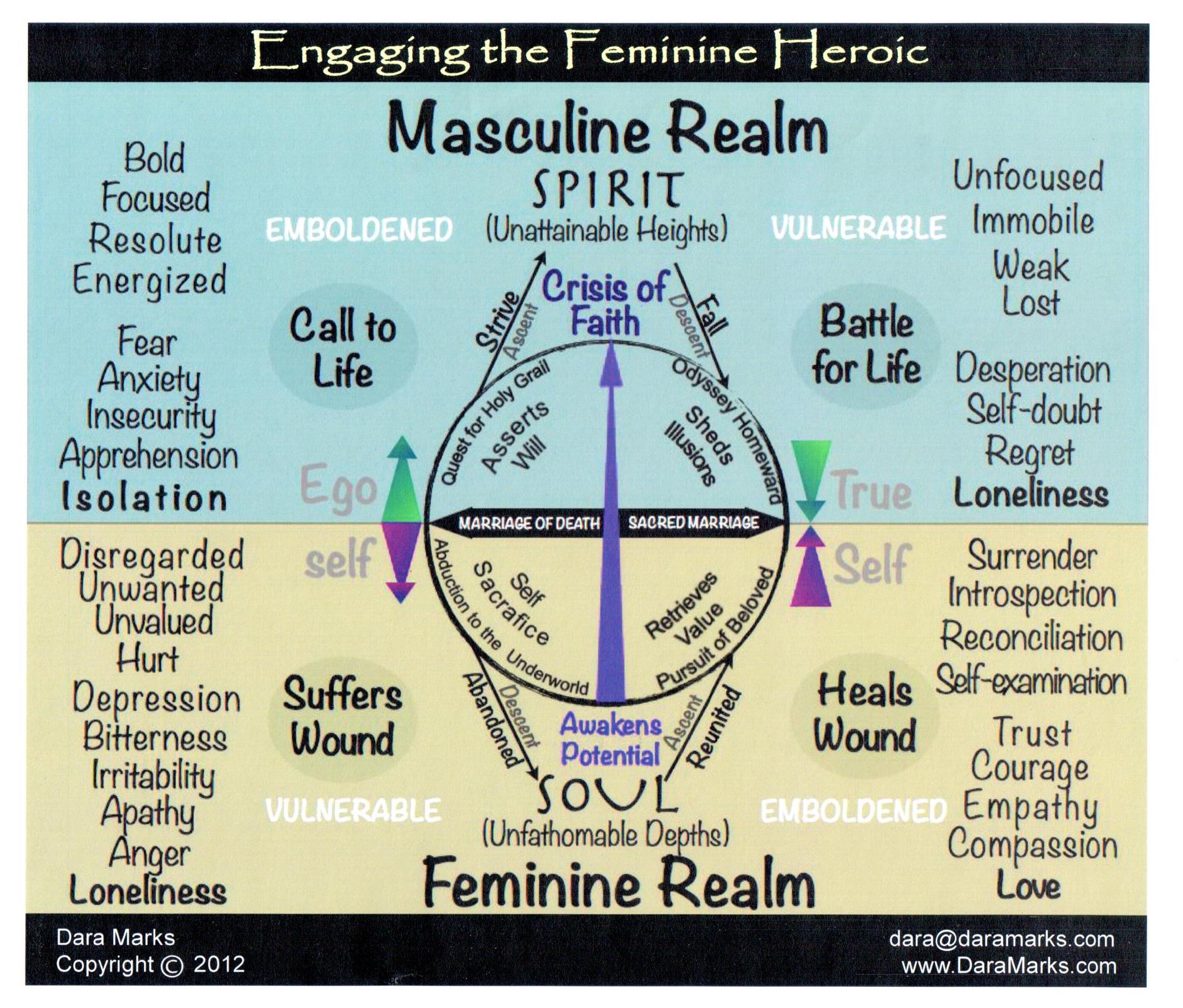
Marks presented this relatively complicated diagram that illustrated the hero’s external and internal journey (and in many ways, reflects our own journey through counseling or life itself). To the left, we find the Ego Self, where the onus is on my aspirations and beliefs of me. To the right is the True Self, which is understood after reflection and denotes my understanding of myself in the universe.
The union of the masculine and feminine sides of a character creates a wholeness

The union of the masculine and feminine sides of a character creates a wholeness

Ego Self: All early development, even that of a child, relies very heavily on the development of the Ego, a sense of will and determination. We believe that we’re in charge, despite all evidence to the contrary.

So if we start the journey in the Ego Self realm, we can look at the External or Masculine side and the Internal or Feminine side of ourselves.

Masculine Ego: In the top left quadrant, we have the Call to Life, the external mission that demands we strive or ascend to a greater level. We assert the force of our will on the universe. This area therefore is associated with a youthful and energetic quality. We have to move forward. We cannot let fear hold us back. To do this, we must sacrifice our feminine side, pushing those feelings down, or we cannot move forward.

Marks suggests that the tragedy of Hamlet was that he couldn’t get beyond his feminine side when he needed to move forward. She also gives the very literal example of Agamemnon, who was forced to sacrifice his daughter Iphigenia before the Greek ships would be allowed to voyage to Troy.

Feminine Ego: In the lower left quadrant of the diagram, we see the influence the masculine decision has on the feminine ego. We suffer a wound because part of us is no longer valued. We are literally abandoning a key part of our self and this will have a lingering effect. While we appear invincible externally, we are very vulnerable internally.

Thus, the feminine side needs to be rescued by the proverbial knight on a white charger. Marks is quick to point out that this is no time for political correctness as at this stage in our development, we just don’t have the internal skills to rescue ourselves.

She goes back to Greek myth to show how this works, focusing on the story of Demeter and her daughter Persephone, the latter of whom was abducted to the underworld by Hades to become his wife. Demeter was distraught at the loss of her daughter and journeyed to the underworld to bring her back to the surface.

The underworld experience may be difficult, but it is educational and we need to journey through it to come out more whole in the next stage.

Marriage of Death: The combination of the masculine and feminine ego is what Marks calls the Marriage of Death. Anytime we strive to become something new, it means the death to other aspects of our being. We just can’t strive at all things at the same time. But this marriage is not designed to last.

As Marks points out, the problem with striving is that it is doomed to failure. We can’t be rich enough, strong enough, famous enough, whatever enough. And it is at the moment of realization that our dreams are doomed that we have a Crisis of Faith (masculine side), which leads to an Awakening of Potential (feminine side). We move closer to the discovery of our true self, the right hand side of the diagram.

Masculine True Self: As the masculine ego passes through its crisis of faith, it suffers a fall from the unattainable heights, which converts the Call to Life into a Battle for Life. For self-renewal, it is essential that our delusions and illusions are shed during this descent, such as the belief that we are in control of our lives. And thus, at this stage, it is the masculine self that needs rescuing.

Marks offers the example of Odysseus (a popular subject at TSC this year) and the knowledge that his journey home was his great undoing as he loses more and more of his ego self (including his ships, crew, etc). The second half of his journey is literally the journey homeward toward his true self.

Feminine True Self: And who rescues the masculine true self? As the masculine side becomes more vulnerable, the feminine side becomes emboldened. We heal our wounds and reunite, turning pain and suffering into love and creativity.

The way out of our self-imposed purgatory is through compassion. We have to hear the story and then feel and acknowledge the pain. And it is only when the pain is given voice that it can move back from the underworld into life.

Marks exemplifies this aspect with the myth of Inanna and Erishkegal (which I do not know as well and so simply provide a link).

Sacred Marriage/True Self: It is at this point, through the sacred marriage of the masculine and feminine that we finally achieve the true self.

NOTE: All images and illustrations are property and copyright of Dara Marks and are used here without permission.


Know when it’s over

Writing a screenplay or novel is a lot like being in a long-term relationship as you largely go through the same steps.

At first, you’re unfailingly passionate about your partner, flush with love for an incredible idea. You dive into her with a zeal you have never felt before and are certain you will never experience again. You embrace every inch of her, her very essence and when finally forced to surface, you just want to show everyone how happy you are.

As time goes on, however, the initial zeal diminishes, if not in scale, at least in monomaniacal focus. You become more comfortable with her. You spend more time contemplating her rather than just diving in. You are caring, loving, nurturing. And even if not everything proceeds as smoothly as it once did, those are just the little maturities that slip into life.

Eventually, you grow into each other. There is love, there is care, but it’s mellower, more set in its ways. She isn’t as all-consuming as she once was, but you’re both okay with that. You might spend time with other couples, sharing common bonds and then making fun of them on your way home. Life is good, it’s right, it’s comfortable.

Now, if you’re fortunate, this goes on for the rest of your time together. You mature with each other. You fulfill her needs until that fateful day when she passes on to the other side. You’re wistful, but satisfied that you had a good life together.

Not every couple is so fortunate, however.

Sometimes little inconsistencies or minor difficulties can inflate in importance. What was once just a tiny tic, becomes this really aggravating feature that just drives you up the wall. Oh, you try to work through it. You try to convince yourself it’s nothing, that you’re just being paranoid, but after a certain point, she just seems to do it all the time and damn it, on purpose.

You soon find yourself coming up with excuses to go out for a little bit to clear your head, but the moment you leave the house, you find your mind wandering off to sexier screenplay ideas. You’re fantasizing and you can’t help it. And damned if, the minute you walk back into the house, there she is, staring right at you like she can read your mind.

“What do you expect?” you scream. “You knew I was an artist when we started.” And she just lay there, letting you stew in your self-incriminating guilt. It’s the silence, the inertness that just gets under your skin.

If you’re lucky enough to calm down, you may decide that you just need a little time apart. Both of you. A little time to remember why you came together in the first place. A month, six months, a year later, maybe those petty little problems won’t be so big. Hell, you might even have found a way around them. But right now, you just need some space.

Time goes by and maybe you do get back together to solve your differences. But maybe you don’t. It’s tough, but you realize it’s over. It’s time to move on.

It’s okay. You’ll live. You can’t beat yourself up over it. You tried and it just didn’t work out.

You may not think it right now, but there’ll be others. You’ll try again and maybe that one will work out differently.

You didn’t fail. You’re not a bad person. It just wasn’t meant to be.

You have to know when it’s over…but nothing says you have to know any sooner than is absolutely necessary.


PS If screenplays and novels are long-term relationships, I guess that makes sketch comedy a quickie in the alley. No wonder they’re so much fun, but rarely fulfilling.

Doubt

I have doubt.

Not in my skills, thank goodness, or the belief that with the right guidance, I can improve them steadily, but I have doubt.

I have doubt that I will find the right people to see the merits of those skills and help me to convert them into something meaningful. A video, a television program, a film, a novel, a photo exhibit. Something that I can share with all the world. Something that will touch the souls of others as the gestation and creation of the work has touched mine.

I have doubt that I can hold on to my new fantasy life and that reality, oh harsh reality, won’t poke its head into the mix and throw me back to where I was. That I will need to find resources to live, and that the need will draw me away from my art. Perhaps irreparably tearing me from it and setting me back upon the course I once journeyed of discontent and pain.

I have doubt that I won’t continue to find supporters and friends—my oh so wonderful friends—who will hold my hand on this journey. Who will provide a tether to keep me connected and yet free enough not to anchor me to the world.

I have doubt about what is around the next corner. About the shadows in the darkness. About the approaching ground in my free fall through life.

I have doubt.

But I will not let that change what I am doing. I cannot allow my doubt to prevent me from living the life I have finally discovered.

If around the corner is an oncoming train, in the shadows lay a vicious monster, and on the approaching ground shards of glass, I will not allow doubt to slow or still me.

I may not succeed in achieving my goals, but in overcoming my doubt, I will have succeeded in my journey. And for that, I will be eternally grateful and find peace.