Warmly welcoming – La Sala review

La Sala

(photo not mine)

A relative newcomer to The Beaches neighbourhood in East Toronto, La Sala is an Italian restaurant that bridges the gap between family dining and fine dining.

Hosted in a renovated home just off Queen Street, La Sala offers a cosy, welcoming environment akin to visiting the home of a good friend. Decoration is subtle and the yellow walls both inside and out bring warmth to the dining experience.

While offering a variety of dishes, the menu is clean and simple, covering only a single page of $12 appetizers, $16 pastas and $20-$24 main courses that should please any palate.

For an appetizer, I opted for the eggplant parmesan (Parmigiana di Melanzane), which was generously portioned and nicely featured baked eggplant rather than what I expected to be fried. The surprise was my own fault, however, as the menu actually states the eggplant is baked. Baking the eggplant meant that you still got the full flavour of the vegetable while it retained its body (frying often seems to turn them into mush), and the eggplant nicely stood against the generously portioned tomato sauce, providing distinct mouth-feel and compartmentalized flavours.

My dining companion ordered the Romaine fennel and kale salad, which was generously accompanied by avocado dressing, bacon and croutons. Nicely, the salad did not appear to be drowned in dressing and the bacon was short strips rather than crumbles, giving my guest something to bite into.

(BTW: I know I am using the word generous a lot…you are not going home hungry.)

Dining room

Warm, inviting atmosphere (photo not mine)

As a main course, I ordered the butternut squash ravioli, my go-to dish when available both because I like the dish and because it affords me an opportunity to compare between restaurants. Covered in a beautiful butter and sage sauce that was very subtle both in flavour and weight, the ravioli were slightly undercooked, the pasta being a bit chewy. For its part, the butternut squash puree was nice, but could have stood with a bit more spice for my tastes, although my dining partner had no problem with it. For me, the challenge was that the puree struggled to compete with the strong saltiness of the parmesan shavings, and so the dish ended up being somewhat one-note.

More of a seafood fan than me, my partner ordered the seafood linguine (Linguine Frutti di Mare), which looked amazing and I am told was even better. La Sala did not scrimp on the seafood in this dish, the large plate being almost overwhelmed by the mussel and clam shells. And according to my companion, the calamari and octopus were cooked to perfection. Add in some shrimps and my friend spent the better part of the meal picking through the linguine to make sure she got all of the seafood available in the dish before digging into the pasta. To quote her: “This is the best seafood linguini I have ever eaten in my life.”

Jazz Festival

La Sala’s warmth fits nicely with The Beaches eclectic vibe

Having filled up on her salad and main course, my companion could not manage dessert, whereas I had little choice but to order the chocolate mousse with crispy almonds and whipped cream. The full-bodied mousse was delicate on the palate and yet offered plenty of flavour. And nicely, the portion size was large enough to share, but not so large as to leave this well-fed diner in distress.

As to the service, La Sala seems to pride itself on being very attentive to its customers as rarely did our water glasses empty before someone offered to refill them. Likewise, as we finished each course, the next one arrived dutifully. One of the staff was perhaps a tad too diligent with replacing our cutlery and napkins, as we almost ended up with a third napkin by the arrival of dessert, but as much as anything, I put that down to a half-filled house with a full staff—people had time on their hands.

Overall, the evening was a wonderful success and despite the minor setback with my main course, I will quite eagerly return to enjoy what is sure to become a neighbourhood favourite and as good a reason as any to visit The Beaches neighbourhood of Toronto.

Criminal should be more Self/less

criminal-selfless

Ryan Reynolds is a hot commodity in Hollywood, these days. Unlike so many starlets, however, they want him more for his brains than his body…quite literally.

Or at least that’s the only way I can explain why twice within a year they have tried to scramble his brains: first with that of Sir Ben Kingsley, and more recently with Kevin Costner’s.

In Criminal—recently released to Netflix (trailer)—Reynolds is CIA agent Bill Pope trying to protect a hacker called the Dutchman (Michael Pitt) who has managed to wormhole his way into the American defense system, enabling him to launch missiles at will. But before he can bring his man in, Pope is captured by the evil rich anarchist Xavier Heimdahl (Jordi Mollà) who tortures Pope to find the Dutchman.

When his CIA handlers, led by Quaker Wells (Gary Oldman), find Pope dead, they enlist the help of neuroscientist Dr. Franks (Tommy Lee Jones) to essentially transfer Pope’s memories into the world’s most cold-blooded killer Jerico Stewart (Kevin Costner), a man completely devoid of conscience.

(Did these people not see Young Frankenstein?)

costner

Give a psychopath super-spy skills and knowledge? What could go wrong?

As expected, shit goes to pieces and the hunt is on—by the CIA, Heimdahl and even the Russians—for both Jerico and the Dutchman.

Despite being an action-thriller with plenty of gore—Jerico kills and maims indiscriminately—Criminal ultimately asks philosophical questions about who we are, how we got that way and can we be redeemed.

As the movie progresses, we witness the influence of Pope’s good-guy neurological engrams on the social and moral chaos of monster Jerico. Something is wrong, Jerico explains as he grasps his head; something is seriously interrupting his thoughts and actions.

In a humorous moment, Jerico learns he is experiencing something the rest of the world calls emotions, possibly for the first time in his life. He is unimpressed.

costner-reynolds-mirror

Requisite internal conflict moment

Given the stellar cast, which also includes Gal Gadot as Pope’s grieving and confused wife, the performances are mostly passable, especially given the woodenness of the dialogue—the screenplay was written by Douglas Cook and David Weisberg, who previously penned The Rock and Double Jeopardy. This is an action film, so we shouldn’t really expect much.

To my mind—and friends disagree—the deepest performance is offered by the coldest, most heartless character Jerico, much as the same could be said for Boris Karloff’s Frankenstein and Michael Fassbender’s robot David in Prometheus. In a very dark turn, Costner embues his merciless killer with dark humour and ultimately, as Pope’s neural influences and memories kick in, a confused heart that many of us can understand.

Assuming you can leave your credulity in a drawer, the story is minimal but passable. That an action film makes any attempt to ask lofty questions is laudable.

cast

Largely wasted stellar cast who spent movie doing exactly this

Unfortunately, as I alluded at the start, Criminal suffers in comparison with another brain transfer film: Self/less, released in 2015 and also starring Ryan Reynolds (trailer).

In that film, Kingsley plays billionaire industrialist Damian Hale at the end of his life but desperate for more time. Meeting with a neuroscientist who essentially offers him immortality, Hale arranges his own “death” and has his neurological patterns transferred to Reynold’s brain, assuming a new identity as Edward Kidner. Reynold’s character volunteered for the experiment to raise money to rescue his daughter from life-threatening disease.

selfless

Requisite internal conflict moment

Again, chaos ensues as Reynold’s memories invade Kidner’s consciousness, and the neuroscientist and his mob race to capture their subject, destroying everything in their path to maintain their secret.

Like Criminal, Self/less asks questions about what defines our identity. But it delves even deeper, going into questions about one’s right to an identity and the ultimate costs of consuming another’s. And for all characters, it is a story about sacrifice.

selfless-movie-natalie-martinez-jaynee-lynne-kinchen

Dead husband finds grieving widow and daughter

Given this backdrop, Criminal might have been seen as a better movie if only for what it tried to do. But on the heels of Self/less, it simply looks like a pale imitation that made a valiant, if ultimately doomed, attempt at significance.

Ironically, it reflected its own plot.

See also:

MovieReview360 w/ Shannon Leahy (YouTube)

Criminal (RogerEbert.com)

Criminal: Film Review (The Hollywood Reporter)

Kevin Costner steals the show in far-fetched but entertaining crime thriller (Deadline)

Self/less (RogerEbert.com)

Not too Bad Santa 2

bad_santa_2_poster

As a cynic, particularly around the holidays, it seems strange that I have never seen Bad Santa, but then I am not much of a fan of Billy Bob Thornton, the titular character. Thus, as I headed out to see Bad Santa 2, I had few expectations and simply held out hope that I wouldn’t be completely bored.

Surprisingly, I actually enjoyed myself while watching this seriously flawed but nonetheless funny movie.

I suspect the new edition seems very much a reprise of the original with the main characters Willie (Thornton) and Marcus (Tony Cox) getting together to pull off yet another caper; in this case, the robbery of a Chicago charity run by scheming Regent Hastings (Ryan Hansen) and his almost pure wife Diane (Christina Hendricks). Complicating matters this time is the presence of Willie’s mom Sunny (Kathy Bates), the woman who raised Willie to be the miserable, alcoholic, criminal shit that we see today.

In many ways, the movie becomes one long series of double-crosses and opportunities for Willie to do the right thing, particularly by the doting man-child Thurman Merman (Brett Kelly), but failing to live up to the moments.

badsanta2_bates

Mommy dearest Bates is guaranteed to let you down

To say that Bad Santa 2 is dark and cynical is to cope with a language that simply cannot catch the nihilism of these characters and their life choices. Thurman is the only redeeming character in this story and that is likely only because he is a clinical moron, incapable of guile and oblivious to sarcasm. As the title indicates, this is the anti-Christmas Christmas movie that would drive even Jesus Christ himself to suicide (likely some time around Easter).

And annoyingly, this is exactly why I liked this film. It was so dark and treacherous, so cynically funny, that I could not help but find the darkness endearing. This is a seasonal film for the purely jaded and given the language and adult scenes, should not be viewed with a broader family.

As no doubt in the first film, Thornton’s Willie continually finds himself let down by the people around him, feeding his suicidal neuroses. Bates is a delight as Kathy Bates under the pseudonym Sunny Soke, a woman devoid of tenderness except when it is part of a larger scheme to screw someone over. And Hendricks is the inveterate do-gooder who has her baser side, Christian charity coupled with carnal itches that need Santa’s attention.

charms

Hendricks allows her libido to cloud her better judgement

There are so many things about this story that don’t work as a story, and the ending is a complete waste of celluloid, the screenwriters Shauna Cross (who also wrote Whip It) and John Rosenthal in his debut feature film seeming to have simply typed until they ran out of toner. And yet, for all of the short-comings, you don’t really care because that is largely life. Nothing ends where it should and never satisfyingly.

If you aren’t at least intrigued by the idea of setting your nearest nativity scene ablaze or mounting Rudolph’s head on your front bumper, I am not sure you should see Bad Santa 2. But if you were not repulsed by either of those ideas, you may find some dark dark pleasure in this film.

See also:

MovieReview360 w/ Shannon Leahy (YouTube)

Same old dirty tricks (The Guardian)

Bad Santa 2 works through mommy issues (New York Times)

Movie Review: Bad Santa 2 (Danny F Santos)

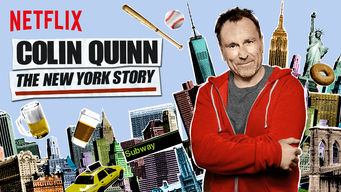
Colin Quinn kills w/ The New York Story

new-york-story-poster

I can only assume that Colin Quinn spends the hours before his comedy shows scarfing down industrial-scale oxygen tanks. This has to be true, if only to explain how he can spend an hour hilariously recounting the history of New York City without ever inhaling…although perhaps projectile vomiting the Big Apple’s history is more accurate.

Ask pretty much anyone who knows me and you will learn that I am a comedy snob. It takes a lot to make me chuckle, let alone laugh out loud.

I not only laughed out loud at Colin Quinn’s latest Netflix special The New York Story (trailer), I actually clapped while laughing out loud at several observations…and this was from my futon, not sitting with a theatre audience.

And before the laughter from one bit reached its crescendo (forget fading), you were already two bits behind, such was the ferocity with which Quinn delivered his perspectives of New York.

quinn

The first two thirds of the show were the best, as Quinn explained and contextualized the arrival of each ethnic group to the city as a way of explaining why the attitudes of New Yorkers are unlike those of any other city in the world.

The last third, where Quinn took shots at political correctness and white guilt, was less funny but still had its share of laughs. This was the part of the show that seemed more like every other show I have seen that touches on race and ethnic relations.

But it is when Quinn becomes the people he describes, taking on mannerisms and recalling each culture’s absurdities, that he is at his best. His is less the vocal mimicry of a Russell Peters and more a distillation of their essence.

And his portrayals were made all the more engaging by the stage itself, which was decorated with settings familiar to New Yorkers—a deli counter, the docks, a front stoop, a corner bodega, an Irish bar—Quinn inhabiting each as he told the story of another group’s arrival in the city.

Colin Quinn Comedy Special

Quinn’s special was directed by long-time friend Jerry Seinfeld

This choreography makes The New York Story more a one-man stage play than a stand-up comedy routine. Not surprising, given the show first got its legs in a run off-Broadway.

In broader terms, whereas I have thought for several years that Quinn is funny—in particular, I miss his panel show Tough Crowd—I think he has really hit his stride in the last couple. What this special did for New York City, his last special Unconstitutional did for American politics, and with just as much humour and wisdom.

Perhaps, however, it is less that Colin Quinn is just now hitting his stride, and more that I have finally reached a place where I can appreciate him and his humours more fully.

Either way, I am glad we have reached this place and I hope we stay here for a while.


See also:

In The New York Story, Colin Quinn looks to stereotypes for wisdom—and finds some (A.V. Club)

Immigrants put the new in The New York Story for Colin Quinn’s newest Netflix triumph (Decider)

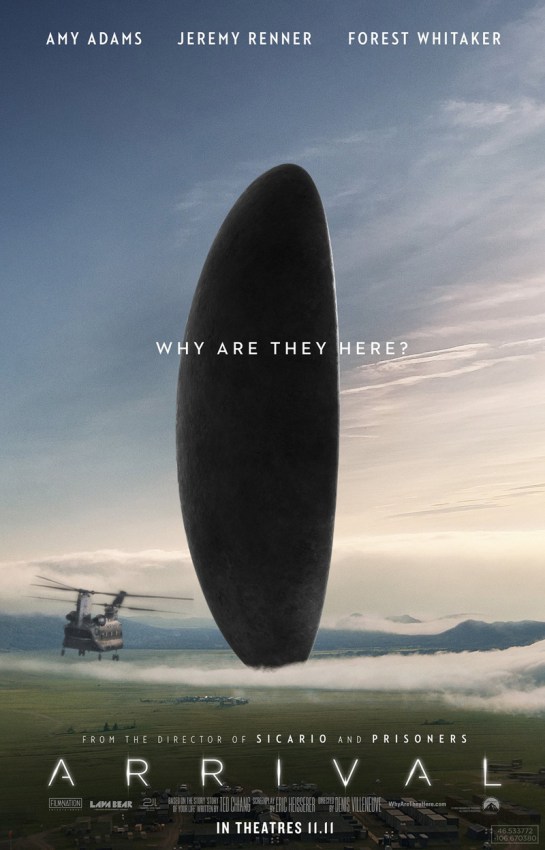
Close Encounters with Arrival – a review

arrival-poster

Although Star Wars will remain the apex of my formative years as a young writer and dreamer, Close Encounters of the Third Kind plays a close second. At the risk of blasphemy, the latter film was significantly superior to the Lucas’ space western, offering insights into humanity and our possible place in the Universe that I couldn’t begin to fathom until later in life.

Such films are rare.

Arrival, which premiered at the Toronto International Film Festival and opened widely this week, is one of those films and is a worthy successor to Close Encounters.

Directed by Denis Villeneuve and written by Eric Heisserer, a man better known for horror films like the reboots of The Thing and A Nightmare on Elm Street, Arrival opens with the arrival of 12 alien space craft—looking a bit like fat Pringles—at strategic positions around the globe.

Almost the entire story is told from the perspectives of linguist Louise Banks (Amy Adams) and physicist Ian Donnelly (Jeremy Renner) and shows their efforts to communicate with the aliens under the watchful eye of military commander Colonel Weber (Forest Whitaker), as scientists and military commands near the other 11 craft attempt the same.

While the trio works to simply comprehend the existence of the aliens, let alone try to communicate with them, the outside world falls apart as fear and a sense of insignificance grasps at the hearts of populations being told largely nothing, feeding the paranoid darkness that resides within all of us.

Without giving key aspects of the story away, the movie deals with broad metaphysical questions about existence and time, while at the same time, providing insights into our species at both its greatest apex and deepest nadir. And at its very base, it encapsulates the importance of trust in our evolution as individuals, as a society and as a species.

arrival-adams-dreyfuss

Amy Adams channels Richard Dreyfuss in her awe at the miracle before her

This is Amy Adams’ movie, and so all of these concepts are displayed through her fears and growth. She must learn to trust her human colleagues. She must learn to trust her alien counterparts, adorably nicknamed Abbott and Costello. And most importantly of all, she must learn to trust herself despite flashes of what seems like madness.

To tie back to Close Encounters, Adams is this movie’s Richard Dreyfuss, and she embues her character with both the same manic trepidation and child-like wonder as Dreyfuss’ Roy Neary.

Renner and Whitaker, for their parts, are incredibly subdued in this film.

Renner’s Donnelly is an emotional anchor for Adams. Coming from the academic world, his tone is at once familiar and playfully combative.

arrival-duo

The photographic focus on Adams is representative of Renner’s role in this film.

Whitaker’s Weber is authoritative and yet unthreatening. He is the calm in the intellectual storm, grounding the two academics for what they are about to witness and becoming increasingly appreciative of the miracle that unfolds before him.

What I found particularly interesting about Heisserer’s story was that the antagonist of the film was Fear.

Fear of the unknown. Fear of mortality. Fear of our own insignificance. And more importantly, our deepest fear that as individuals, we simply don’t measure up.

And breaking the rules of screenwriting, this fear was not embodied in a single antagonist, but in all characters, and it was only in fleeting moments that any individual character acted upon his or her fear. And yet, as fleeting as those moments were, each was vital to the evolution of the story and the critical relationships to their next stages.

arrival-trust

Connection relies on trust

Again, these moments fed back to the question of trust, particularly in the face of betrayal.

To assure everyone that this film isn’t simply a cerebral exercise—although it is beautiful in what it does accomplish—there is also a very deep emotional thread that runs through this movie, again centering on Adams. And from the opening, it seems like this personal journey is completely disconnected from the sci-fi plot.

But as the story unfolds and we begin to explore what is possible in an infinite cosmos, we begin to realize that the external and internal journeys are one and the same. There is no distinction. The line between physical and emotional is an artifact of our choices as humans and society.

arrival-2001-close

Arrival continues the saga that started with 2001: A Space Odyssey and Close Encounters of the Third Kind

Will Arrival be to adolescent minds today what Close Encounters was to mine in 1977?

Probably not.

It is a much more adult film that its predecessor, with many fewer action sequences to engage the eye. And Villeneuve’s views and sensibilities are very different from Steven Spielberg’s.

But Arrival is the closest thing to those seminal films that we have seen in a generation or more. And for the more engaged child or adolescent, it will open a window to another plane of storytelling.

See also:

Movie Review: Arrival (Danny F. Santos)

Amy Adams supplies emotional core of alien invasion film “Arrival” (Richard Crouse, CTV News)

Amy Adams has a sublime word with alien visitors (The Guardian)

Doctor Strange quite ordinary – a review (UPDATED)

doctor-strange-city-bending-179855

As a disclaimer, you should know that I have grown weary of comic book movies and the various universes involved. Thus, I understand if some of you stop reading here.

Are they gone? Is anyone left?

Doctor Strange is the latest entrant to the ever-expanding Marvel universe. In this origin movie, it is the story of a brilliant, ego-driven neurosurgeon (Benedict Cumberbatch) who suffers a debilitating accident that destroys his career and therefore his reason to live. In trying to regain use of his hands, he finds a mystical Eastern retreat and begins a journey into magic, multi-planed realities and lessons in humility through the guidance of the Ancient One (Tilda Swinton).

The arrival of Strange might not be totally of his choosing, however, as he reaches the retreat at a time when it is facing its greatest threat, a former student (Mads Mikkelson) who has moved to the Dark Side and wants to feed the Earth to a Dark Entity (Dormammu) that swallows universes whole. And so the battle ensues, Dark vs Light (well, mostly Light), with weapons of magic, shifting realities, and literally shifting buildings that hearken back to the movie Inception.

And this is where I struggle with this movie. There is little here that is in any way original.

For me, this is The Shadow (look back in the archives for that one) meets Inception, with a soupçon of Kung Fu Panda and Harry Potter And The Who Gives A Damn, each of which I felt were better movies than Doctor Strange.

strange-bendy-streets

From Inception to Strange with little improvement

On the plus side, Cumberbatch is perfectly suited to this role, his droll delivery of cornball one-liners perfectly pitched—a la Robert Downey, Jr.’s Tony Stark. And the visual paintings of colour, perspective and sound are insanely rich and dazzling, worthy of the best recreational pharmaceuticals (so I am told).

But that is really all that this movie has going for it: big-screen kaleidoscope and Tony Stark 1.1 (can’t even manage 2.0).

The story is pretty linear with zero twists or turns. And even with that, the writers felt they needed to explain the story every 30 minutes or so with long streams of exposition. Apparently, all of the budget was spent on special effects and so they were forced to break the “show, don’t tell” writers’ convention. These aren’t reveals; they’re explains.

And aside from Cumberbatch’s waltz through ego and bon mots, all of the performances by the supporting actors are largely wasted.

Tilda Swinton’s Ancient One couldn’t hold the chopsticks of Dustin Hoffman’s Master Shifu (Kung Fu Panda). Mads Mikkelson’s Kaecilius is totally silly-us and I don’t recall any explanation as to why he chose to leave the school and work for the Dark Side.

And what the hell happened to Rachel McAdams’ career? Here, she plays Strange’s estranged love interest Christine Palmer and is given nothing to do aside from roll her eyes, squeal at loud noises and apply defibrillator paddles every half-hour or so.

mcadams-strange

Sometimes, it is just about cashing the cheques (Benedict Cumberbatch, Rachel McAdams)

As my friend and Movie Review 360 partner Danny suggested (see link to his review below), origin stories are throwaways, their only job being to set up the characters for the following movies and cross-overs. I can’t disagree with him on that point…this movie should have been thrown away.

As just the latest piece in the Marvel cinematic universe, the real meat of Doctor Strange will come as he begins to interact with all of the other tight-wearing, planet-razing whackos—and stick around through the credits for the first hints of that.

So, why even bother with this movie?

Nothing in Doctor Strange was necessary for any of what follows, I am confident.

Okay…comic book fans can come back in the room!

If you’re looking for some dazzling eye candy and a few choice ripostes worthy of Tony Stark, Doctor Strange is the perfect popcorn muncher. For everyone else, check out 1994’s The Shadow…it really is better than it should be.


See also:

Movie Review: Doctor Strange (Danny F. Santos)

Lively Doctor Strange breathes new life into Marvel Universe (CTV News)

This is the champagne of Marvel movies (Global News)

Movie Review 360 (reviews Doctor Strange & Fury)

Movie Review 360 (or don’t plan drunk)

mr360

Like many of you, I hang with a group of friends who watch movies and then argue in a bar afterwards. And like many of you, all of my friends are “visionaries”.

Over beers, one of my friends said “We should record this”…but whereas the rest of us sobered up, he kept pushing this idea, adding a 360-degree camera to the alcoholic mix.

This past week, Movie Review 360 was born.

Watch two goofballs and a guest (balled, bald or otherwise) talk about the latest releases from Hollywood and Netflix while drinking to excess on a limited budget (we are nothing, if not Canadian).

This week–ably assisted by documentarian Liza Vespi–our thoughts on:

  • Ron Howard’s Inferno
  • Man vs Snake (on Netflix)

Our thanks to Ginger & Russ for hosting us at The Edmund Burke in Toronto.
See also:

Inferno(t) – a review

Man vs Snake – a review

Slaughter Nick for President (trailer for Liza Vespi doc)

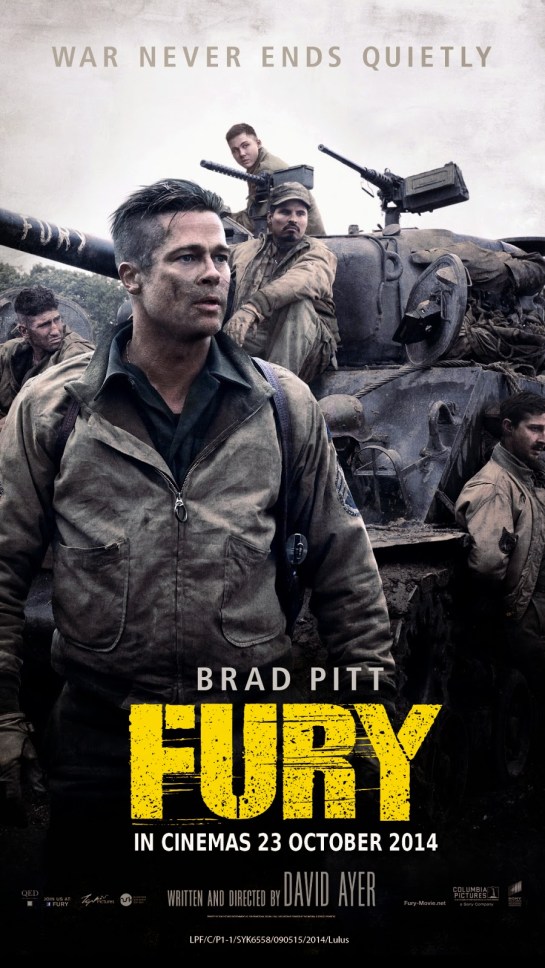
“Fury” and futility – a review

fury-movie-poster

Rarely am I stumped by a movie. Usually, I like the film, it is okay or it is bad.

But every now and again, a movie makes me work at an opinion. David Ayer’s Fury is one of those films, the 2014 film being released this week on Netflix.

Starring Brad Pitt, Shia LaBeouf and Michael Peña, Fury tells the story of an American tank crew in the last year of World War II, pushing deep into Germany but heavily outgunned by German Tiger tanks.

And there is my challenge with this film. I have now explained the entire movie to you, because there is no real point to the plot.

It is seriously as though a camera crew showed up on a battle site one day and followed a tank crew for a few days as it wound its way through various other battles into the belly of the Nazi beast.

Thus, I cannot really tell if this movie is an amazingly stunning metaphor for the futility of war—there is no glory here—or if it was just a badly penned film.

logan-lerman-and-brad-pitt-in-fury

Ideals clash with reality

To be fair to Ayer, who not only wrote, but also directed and produced this film, there is a human interest side to this story as the war-weary, battle-hardened tank crew is joined by doe-eyed recruit Norman  Ellison (Logan Lerman) who just days earlier was a typist for the military bureaucracy.

Thus, as the tank—the titular Fury—lurches from battle to battle, we witness the corruption of a pure heart by atrocities committed not only by the enemy, but by his fellow soldiers. And we see the toll this corruption takes on the boy’s tank commander Don “Wardaddy” Collier (Brad Pitt) who personally starts that downhill process.

But again, to what purpose?

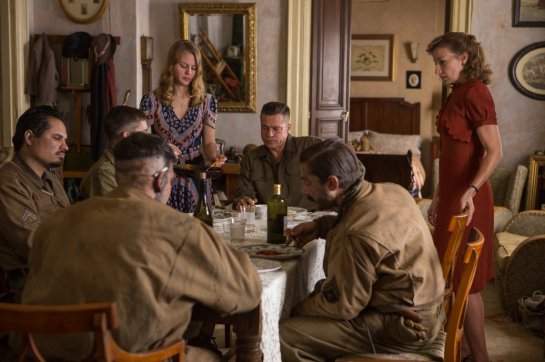
fury-respite

War taints even the most peaceful moments

Almost all war films seem to be based on men fighting toward a higher purpose, whether it is a battle that turns the tide of the war—e.g., Sands of Iwo Jima; Tora, Tora, Tora—or a moment of humanity amidst chaos—e.g., Saving Private Ryan—or men fighting for sanity within that chaos—e.g., Good Morning, Vietnam; Catch 22; Apocalypse, Now.

For me, Fury had no such pretense.

Yes, the Americans are the “good” guys and the Germans were the “bad” guys, but neither side in this film was any nobler than its counterpart. Within the confines of this movie, this was carnage and hatred purely for the sake of same.

As to the film itself; all of the actors did an admirable job, wearing the carnage of war on their faces and in their souls. Brad Pitt at his harshest expressed an internal dignity if not nobility. Shia LaBeouf was restrained. And Michael Peña really didn’t have much to do.

fury-movie

Truthfully, this film might have been stronger as a silent movie, as it was the facial expressions and battle scenes that told this story. The dialogue offered little to the visceral impact of this film (emotions are drained pretty early).

Beautifully shot, this is a grisly film and not for the faint of heart or stomach. Bullets and bombs don’t just pierce a body; they rip it wide open. The fallen remain fallen, to be ground into the mud by jeep tires and tank treads.

For all of these reasons—and it was a slow burn for me—I am coming down on the side of Fury being the embodiment of the ultimate futility and barbarism of war.

In this movie, even if you saved the person of Private Ryan or Ellison, the soul is long gone.

Remember

A good choice for Remembrance Day, highlighting purposeless sacrifice

The Man Who Knew Infinity – a review

the-man-who-knew-infinity-poster

In another life, I might have been a mathematician; in part, because I prefer to contemplate my universe in solitude, but perhaps more importantly, because there is a simplicity and elegance in math that simply cannot be matched by any other discipline.

It is the voice of God. It is the description of all existence and all possibility.

Thus, I greatly look forward to films like The Man Who Knew Infinity, which opened at the 2015 Toronto International Film Festival and this past week on Netflix.

Based on true events, it is much like A Beautiful Mind, in that it tells the story of a man who could see things intuitively that others could not even with the greatest of effort, but in this case, without the mental health issues.

Srinivasa Ramanujan (Dev Patel) is a poor mathematician living in Madras, India, burdened with an overwhelming fountain of knowledge and understanding of the maths. As one movie character so aptly put it, every positive integer is Ramanujan’s friend.

Frustrated by an oppressive society in India that sees him as an over-reaching Wog, Ramanujan reaches out with the aid of an understanding British diplomat to mathematicians in the United Kingdom. And he eventually catches the notice Cambridge University professor G. H. Hardy (Jeremy Irons), who brings Ramanujan to England.

As exciting as this is for the younger man, Ramanujan quickly becomes frustrated with his mentor. Rather than explore the mathematical cosmos, Hardy reins Ramanujan in, forcing him to develop mathematical proofs for his grand visions. Why, the younger man asks, do you need to prove the truth, the very word of the gods?

It is in answering this question that the movie becomes a love story between two driven men. These men change the face of mathematics, their work echoing to this day.

jeremy-irons-i-the-man-who-knew-infinity

Jeremy Irons is achingly poignant as mathematician G. H. Hardy

Despite the title of the film, this movie is more about Hardy than it is Ramanujan, who interestingly remains something of a mystery even into the story’s epilogue.

Intellectually brilliant in his own right, Hardy yet has to work to understand the universe, whereas Ramanujan is “given” the answers to great mathematical concepts. And despite any overt signs of jealousy, you have to wonder if this isn’t part of the reason Hardy fights so hard to rein in his mentee.

That said, as their relationship slowly blooms, Hardy risks his own expulsion from the college to push for Ramanujan’s acceptance at Cambridge as a fellow. So again, it is about Hardy’s relationships with his colleagues and the university establishment with Ramanujan as his raison d’etre.

The movie is visually beautiful and the story amazingly told.

Irons continues to be an actor of outstanding elegance no matter how curmudgeonly the character. His portrayal of a man who achingly wants to reach out to touch the face of God and yet cannot, is emotionally wrenching. This is a man who is afraid to believe in anything, but is presented with a glory that comes but once in a lifetime.

patel

Dev Patel portrays the anguish of Srinivasa Ramanujan, a man who speaks the voice of the gods only to find ignorance

Patel, likewise, offers a stirring performance. His confusion at the insanity of the world around him is palpable. He knows that he stands upon a great mountain, spouting the wisdoms of heaven, and yet finds himself spat upon and held back. He is very much a Christ figure to Irons’ Saul of Tarsus.

But as beautiful as this film is, I found it lacking in one very big way.

I never felt like I got to understand the titular character Ramanujan.

I have not read the similarly titled book on which the movie is based to know if there is more about Ramanujan there (its subtitle would suggest yes), but the film starts with fully formed Ramanujan scraping mathematical formulas on the stone floor of a temple. In looking for work to support his mother and new bride, he presents his efforts to bureaucrat after bureaucrat, only to be rejected.

infinity-book

What is never explored or explained, however, is how this supposedly lowly man learned how to write in the language of mathematics, and because of this, I feel like I watched only part two of a much larger story.

There is a beautiful moment late in the film between Ramanujan and Hardy that touches on the divine spark of mathematics, and we see the two men finally express their common love and fears. But for me, this wasn’t enough. It fulfilled an emotional requirement, but not the intellectual. I want to better understand Ramanujan and his gift.

Despite this rather large gap, however, this is a movie that I could watch again and again for its sheer beauty. And I can only hope that it just one of many such films—math-centric or otherwise—to be made in the coming years.

Man vs Snake – a review

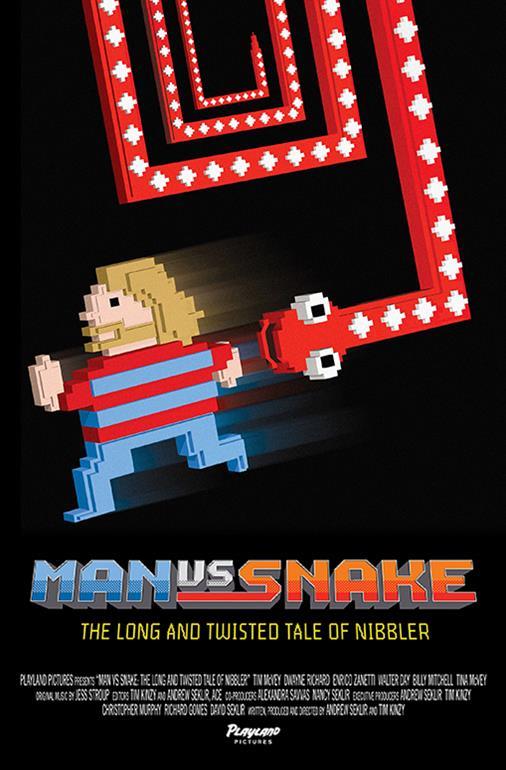
man-vs-snake-the-long-and-twisted-tale-of-nibbler

I like pinball. I played Pong when it first came out. And I can count on one hand the number of video games I have played in my life…including Pong (others involve Star Wars or strip poker).

Thus, when I was asked by a friend to review the documentary Man vs. Snake: A Long and Twisted Tale of Nibbler—recently released on Netflix—I seriously questioned our friendship.

nibbler

If Centipede and Pac-Man had a child

For the uninitiated, like me, Nibbler looks like the bastard love-child of Centipede and Pac-Man, and essentially involves an ever-lengthening snake that courses around obstacles gobbling energy packets while trying not to bite its own tail. In short, a joy-sticker’s wet dream and yet a game from the heyday of arcades that few knew existed.

What set this game apart from the others, however, was that its scoreboard included nine digits, so a score of one billion was possible. Yeah, this set my spine tingling as well.

The man in question is actually four men.

Back in the early 80s, teenage Tim McVey—not the terrorist, the documentary points out—played two days on one quarter and broke the billion-point barrier, under the watchful eye of local oddball and arcade owner Walter Day. Woohoo!! And for years, that was the end of the story; McVey’s singular claim to fame.

Until an Italian man claimed to have broken McVey’s record as a boy, holding the unofficial record for 25 years. Day refused to acknowledge the record. McVey refused to acknowledge the record. But to clear the slate, McVey determined to break the Italian’s score and make the whole argument moot.

And this is where the meat of the documentary takes place…McVey’s desperate attempt to reclaim his title, and quickly coming to grips with the fact (and joy-stick) that his body is not what it was as a teenager.

Oh, and the fourth man is Canadian gamer Dwayne Richard, who kind of joins McVey’s journey as sparring partner.

As documentaries go, this one is pretty well constructed. It has a strong narrative stream in the redemption story and the sparring that becomes a bit more personal. It has strong personalities in the four men and their support networks.

Unfortunately, it was too reminiscent of my own late teens/early 20s watching friends play Mario Brothers, Pac-Man, Donkey Kong, etc. Boring.

It was like the movie 127 Hours, but with your hand stuck on a joy-stick rather than under a boulder.

Intellectually, I get the various stories here…the archetypes. But I cared not a single whit as to whether these guys broke the records, and therefore never invested in the players emotionally. They were simply too abstract and surreal for me to care, and the stakes were meaningless.

Note: The documentarians did a very good job of highlighting these eccentricities while being respectful of the people.

then-v-now

Game competitions have changed in 20 years

I understand that the video game world has completely changed in the last decade to become very much an international spectator sport. Nibbler is very much NOT of that era.

But if you want to watch a handful of middle-aged men obsess over an arcade console for 90 minutes or so, this might just be a documentary for you.