Few are the creatives who do not want the world to love, or at least like, their work. We pour our heart, our soul, our tears into our art, and live in the dread that it will not find a receptive audience.
But are we dreading the wrong reaction?
Meaningful creative, to my mind, should evoke a reaction, and ideally one that is visceral and emotional before it is intellectual.
I want the viewer or reader to react instinctively, involuntarily to my creative, long before reason steps in and helps him or her modulate the response to more socially acceptable forms.
Thus, I fear less the angry or violent response to my work. Express those emotions and tell me why you revile my work. What is it in the creative that elicits such primitive, basal responses?
And if you find the work itself primitive, crude or malformed, the work of an unseasoned hand, then tell me how better to season it. What skills do I lack and how can I add them to my repertoire?
No, it is not rejection I fear. It is indifference.
It is the thought that my work is so devoid of meaning that it leaves you without any feeling whatsoever. It is simply not worth considering.
An emotional response, whether positive or negative, enhances my creative because the energy you expend to respond adds meaning to my work. Indifference, however, renders me and my creative effort void (collectively speaking, of course).
When we create, we should worry less about eliciting a positive reaction, and more about striking something at the very core of our audience. Something that they cannot ignore because it touches unnervingly close at their very essence.
For more on ways to improve your storytelling, visit:
Despite being a single species—Homo sapiens—humanity is a diverse and eclectic group of individuals. And yet, so often, when writers develop characters for their stories, they tend to stick pretty close to the mirror.
Sure, few of us have likely committed murder or adultery. Perhaps a handful have fought in war or garnered celebrity status. And I am confident that none have visited another planet or lived in the time of dinosaurs.
Despite this diversity of action, however, the main characters of these stories continue to largely reflect what the writer sees when he or she looks into the mirror or scans his or her living room. And because the majority of working writers—at least in the West—are heterosexual white men, our stories are largely told from the heterosexual white male perspective.
I am a heterosexual white man, and for the longest time, my lead characters and the perspectives of the stories I wrote came out of that mirror. I know my glass house.
In the last couple of decades, there has been a move by women, by visible minorities (I hate that phrase) and by the LGBTQ community to create more stories from those perspectives. I think that is wonderful.
But it doesn’t have to stop there, particularly as it risks promoting the same problem, if from a previously underserved voice.
What if, instead, we all took the time to look beyond the mirror when developing our characters?
You don’t have to write a woman’s story to choose a woman as a lead character.
You don’t have to write a story about the gay community to choose an LGBTQ lead character.
You don’t have to write a story about race to choose a black, East-Asian or indigenous lead character.
You can already have a story clearly established in your head that fundamentally has nothing to do with those themes, and still make those choices for your lead characters.
We’re all looking for interesting characters. We want voices and thoughts with depth and texture.
And it is entirely possible to do that looking in the mirror.
But if that is all we do, we miss out on so many interesting voices and our texture risks becoming monotonous.
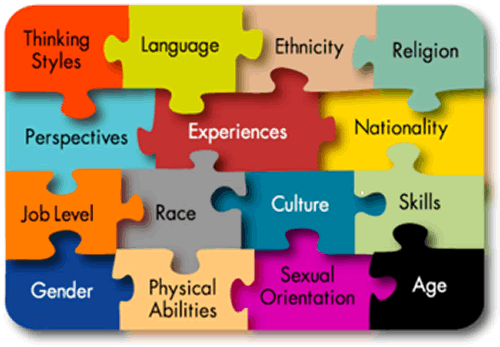
So many facets inform a character.
You have to ask yourself:
How, if at all, does the story change if my lead character is a woman—protagonist or antagonist? Even without becoming a women’s issue story, how does the choice of a woman influence action, themes, dialogue or plot?
What about a character of a different race or culture, reminding ourselves that there is heterogeneity within racial communities? Without falling into stereotypes or turning your concept into a race story, what impact does social experience bring to a character’s actions and reactions, dialogue and style?
That story is universal suggests there is a common thread that holds us all together in this world, a thread that intercalates our DNA.
But as much as our characters are about the Every Man—note the phrasing—characters are about nuance and individuality.
Looking beyond the mirror will necessitate some research to avoid the prejudices and erroneous beliefs to which we are all prone (see, I just judged everyone there).
But that is what writers and storytellers do.
We seek the truth of the moment or the situation in hopes that we skim but the surface of the greater truth.
And to do that, we must explore the whole of our universe, not just what we find in the mirror.
To learn more about developing better stories, check out:
Few, if any, writers have practiced the craft of storytelling their entire lives.
Sure, almost all of us have written since we first learned how, but few saw this expression as anything more than personal amusement or a passing phase. And when we completed our last essay in high school or college, most put the quill aside for more socially acceptable vocations.
In my case, it was a life in Science, getting first a degree in zoology and then a degree in molecular biology. Others went to law school or into medicine. Yet others worked a production line or took up a trade.
In any event, we all largely dismissed writing from our lives or at best, saw it as a hobby on par with doodling.
And yet, despite putting our pens away and mothballing our creative tendencies, these years were not lost. Quite to the contrary, these years have been invaluable to making you the writer and storyteller that you are today.
Friends will sometimes ask me to speak to their adolescent and college-aged children who have expressed an interest in writing. They want their offspring to understand both the opportunities and challenges of the lives they desire. And I am happy to oblige.
Where the kids are willing to share with me, I listen to their interests and goals, offering insights where I can. But in almost every conversation, my ultimate piece of advice is the same.
Live a life and experience your world.
This is not to say you should give up on your writing, even for a brief period. Dear god, no.
Write. Write. And keep writing.
My point is more that your writing will be so much deeper, richer and more meaningful when you have life experience under your belt. Your greatest asset as a writer is the time you’ve spent interacting with your world, even when only as an observer.
You write the people you know, the lives you’ve led
Life exposes you to the amazing diversity of people and perspectives that populate this planet.
Life teaches you about human interaction, in terms of both relationships and conflict.
Life unveils the subtleties and nuances in communication, and the insane power of silence and subtext.
Life is how you instinctively know what to write next. How your character will respond to an event or statement. Why your stories will resonate with others who have similarly lived lives.
And because my life has been different from yours—at least in the minutiae—we will write different takes on a story even when given the exact same starting material.
As you can imagine, the advice is not always welcomed. Life can feel like a delay to the gratification of self-expression.
And yet, not only is it not a delay, a life lived is the embodiment of the self in self-expression.
Your life lived is your truth, and good storytelling (even fictional) is about truth.
My friend Jarrod Terrell, whom I met through Kevin Scott‘s Effortless Alphas group, recently challenged his fellow Alphas to share their goals and dreams for life in a Facebook video.
In part, the idea was that verbalizing your dreams made them real for you, but it also opened the door to others in your community who might be able to help make those dreams come to fruition.
Here is my video.
How can I help you discover, explore and share your passion?
Human beings connect through story. We define our individual selves by story. We even define our universe in terms of the stories we tell ourselves.
And despite often sharing experiences with others, my understanding and interpretation of those experiences—my personal Truth—is the story that I build around those experiences.
If I see something I have never seen before, I immediately construct a story. I give it context from items around it or its location or its presence at this time of day.
And remarkably, if I came upon this same thing tomorrow rather than today, the story I construct then might be entirely different from the one I build today.
Thus, story is malleable. It lives and breathes as we take in new information from our surroundings and incorporate that information into the story, making tweaks and adjustments to ensure that everything continues to make sense.
When the story doesn’t make sense, when congruence is lost, we get upset, and in some cases, put up hostile blinders. This is when human beings lose connection.
Because story is such a personal thing, the Creative—whom I define as anyone who pursues a task with passion—is faced with an essentially insurmountable challenge: How do I share my story through myriad personal filters?
Ultimately, you cannot control how another receives and interprets your story.
What is my story for this work? What story did the Creative intend?
Even if the Painter tells me her intent in painting a portrait or landscape, the Novelist types out in no uncertain terms precisely what he means to convey, the Musician strikes notes and chords to instill specific feelings, I can remain oblivious to those intents, consciously or un-.
This simply is; and we can only hope that it does not negatively influence the passion to create.
That passion, the drive to create, must be given voice, however; and so the Creative moves forward, doing his or her best to share (much as I am doing now in writing this).
A dedicated Creative struggles on, regardless of the insurmountable barriers, and strives to convey the most effective story he or she can, looking for ways to layer thoughts and emotions and spiritual energies onto the personal stories of others.
We practice what we know. We experiment with the unknown. We seek guidance and critical analysis.
And most importantly, we accept that we will never achieve 100% success instilling our stories in others, and yet push ourselves and our Art as if it were possible.
As Creatives, as people of passion, that is central to our stories.
*****
If you’re interested in learning how to build stories more effectively, seeking guidance for nascent projects or critical analysis of existing works, feel free to check out my website So, What’s Your Story or reach out to me here or via my Facebook page.
In the meantime, I wish you all the success in the world.
I had my reservations before purchasing a ticket for Manifesto, a film that seeks to manifest the great thinkers and philosophers of the modern age through the mouths of 13 archetypal characters. I mean, how can you go wrong with a 90-minute Learning Annex lecture?
Honestly, the selling point for me was Cate Blanchett playing all 13 roles.
As we waited for the film to begin, the Nashville Film Festival host (emcee?) gushed about his chills on seeing the film at Sundance. My first clue that I had bitten off more than I could chew.
He then laid his bet that Cate was a shoe-in for an Oscar nomination. Put your money down now and plan that dream vacation.
Then the lights went down, the film illuminated the screen, and 13 Shakespearean soliloquys rolled out. Except, these thinkers were not Shakespeare and even Shakespeare put his soliloquys within the context of a narrative; something completely lacking here.
There was so little context for any of these scenes that I have no idea, no memory of any of the speeches less than 24 hours later.
Although the Great Cate did manage to inhabit her many and varied characters—vapid news host, drunk punk rocker, deranged homeless man, etc.—dissolved in my brain as quickly as she spoke the words.
There was humour. We laughed at the odd comment—mostly non-sequiturs—and tittered like children when the gentile sacred mouth of Ms. Blanchett uttered words like “shit” and “fuck”, but I’d be surprised if anyone other than a philosophy major could name 10 of the 13 thinkers reflected.
This was less Art Film than Performance Art, and ironically, it may have suffered from the transformations by Blanchett, whose visual distraction allowed my ear to remain confused. Perhaps with a lesser performer, the words would have had a fighting chance.
Was Blanchett’s transformation enough for that Oscar nod? Unlikely, as the complete lack of over-arching narrative will keep it off most Academy lists.
This is truly a festival film, where manifestos and pointlessness not only thrive but are lauded for their unintelligibility by audiences afraid to not “get it.”
[How’s that for inverse snobbery?]
In some ways, Manifesto is reminiscent of Lily Tomlin’s The Search for Signs of Intelligent Life in the Universe, which was also a series of pointed commentaries on modern society, all performed by the same artist.
Where Tomlin went right was in presenting each commentary within a powerful story of a nuanced character with a unique perspective. Manifesto, sadly, chose a verbal sledgehammer over story, eliminating any opportunity for nuance no matter how well Blanchett performed the characters.
A damned shame, really, as she lived up to her billing. If only Academy voters could see it through all the rest.
So, Netflix Canada has started showing Bill Nye Saves the World, a science series designed for adult audiences, and in the first two episodes, he has tackled issues such as climate change and alternative remedies. The premise of the show is that Nye will use the scientific method to debunk the myths.
In theory, I am all for this approach. Unfortunately, the entire show is theory. In two episodes, I have seen nothing of a scientific method.
Episode 1: We’re going to heat a liquid to show you that heat causes things to expand. We’re going to tell you that CO2 is a greenhouse gas and that things get hot because the gas traps heat energy. The rest of the episode is mostly just people yelling about how silly deniers are.
Bill Nye, the gimmick guy
Episode 2: Magnetic patches don’t cure disease because there is nothing to magnetically attract in the body. Oh, and this is how clinical trials work. But we’re not going to test magnetic patches in a clinical trial because we don’t have to. There was one scientific experiment to show that Milk of Magnesia neutralizes acid while a Whole Foods purchased stomach remedy did nothing to neutralize acid. Thing is, there is more to upset stomach than acid neutralization, and we don’t know the mechanism of action of a lot of FDA-approved medications. The rest of the episode was Nye yelling “that’s stupid” (not literally).
Despite his self-proclaimed mission, Nye seems to be playing into the hands of the anti-science faction by trying to cram complicated subjects into 30-minute windows of reality-style television that is more Jerry Springer than Mr. Science.
Ridiculing the other side with unsupported taunts and name-calling is NOT good science. Shoddy, make-shift experiments that don’t actually prove your point are NOT good science.
If you say claims have not been supported by scientific evidence or clinical trial, then run those studies to prove the claims aren’t true. THAT is good science. But it is lousy television.
So, Bill Nye; are you a television personality or a science advocate?
If you remain the latter, then cut the bullshit and get back to the method.
If you are the former, then take off the lab coat, and I’ll go back to Thomas Dolby.
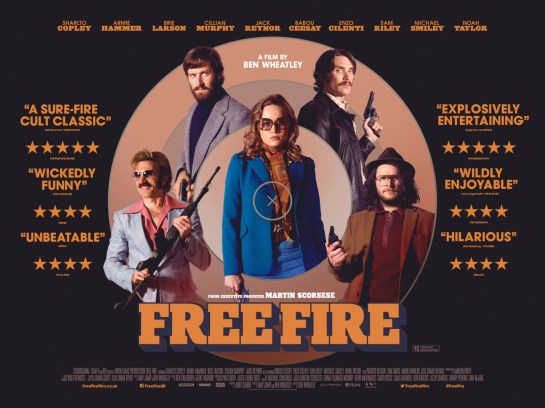
It seems I am cursed to see the lesser works of great film artists. Such was the case last night as my friends and I discussed Ben Wheatley’s latest release.
My friends spent much of the evening telling me how much I should have seen High Rise and Kill List. Sadly, we saw Free Fire, a 90-minute exploration of how many bullets the human body can take…seriously, that is the movie.
In 1976 or so, IRA terrorists arrive at a derelict warehouse to buy guns, but things suddenly go wrong and a shootout ensues. The End.
Lots of shooting. Lots of bleeding. Lots of “witty” banter. For 90 minutes.
This is The Good, The Bad and The Ugly if all we saw was the Mexican stand-off.
It is every Quentin Tarantino film without the Shakespearean nuance for which Tarantino is known (*sarcasm*).
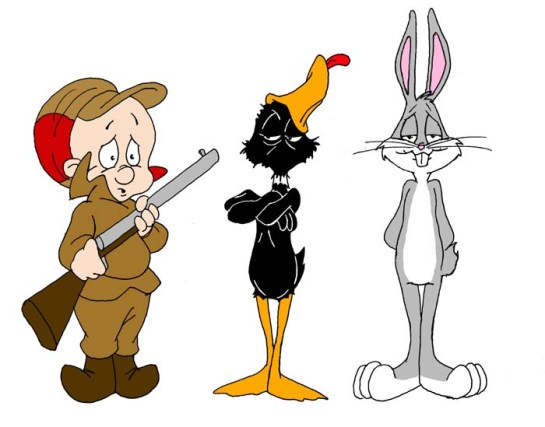
It is Bugs and Daffy arguing over whether it is rabbit season or duck season.
And like a young child’s game of Cops & Robbers or Cowboys & Indians—or whatever other culturally and socially incentive games the kids get up to these days—no one really suffers for the ballistic barrage that enters their bodies. This might as well have been paint ball.
I am told Ben Wheatley (writer and director here) is a very creative artist, whose earlier works bordered on the metaphysical. Free Fire didn’t manage physics, let alone metaphysics.
The entire film was one beat repeated over and over and over again, much like this review.
Running out of shooters or bullets? Let’s simply insert a couple of new shooters. Wow, that was so much fun, let’s do it again.
The movie had a really good cast, including the likes of Brie Larson (The Room), Sharlto Copley (District Nine), Armie Hammer (The Man From U.N.C.L.E.) and Cillian Murphy (you know; the guy that was in that movie).
And there were a few funny one-liners (whatever they made, nobody wants to buy it anymore).
But let me save you $13 and simply suggest you watch the trailer 37 times.
I’m generally not a fan of autobiography. Similarly, I am not a fan of retrospective panels where the topic of the retrospective is the guest.
Although the thinking behind such efforts is who better to tell us the truth of past events than the person who lived them, I find that the idea rarely manifests into a reality. Too often, we are merely presented with a series of events or facts, rather than any real insights into whom these people are and how those events both fed into and were products of those individuals.
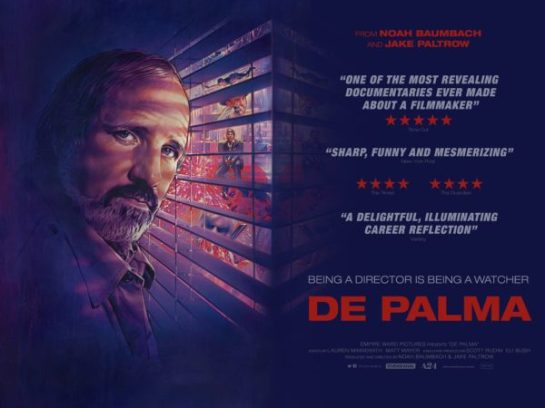
This turned out to be the case with the 2015 documentary De Palma, recently released on Netflix.
Over a span of 110 minutes, we hear every thought that famed film director Brian De Palma has about pretty much every movie he ever made, from his days as a film student up to his most recent contributions. And yet, despite all of this exposition, I feel like I am no closer to understanding De Palma than I was when the almost two-hour odyssey began.
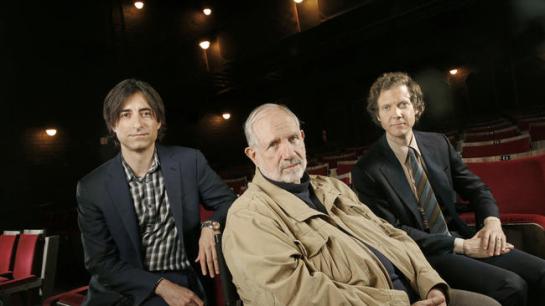
For film buffs and film students, there is plenty to like about this documentary, directed by Noah Baumbach and Jake Paltrow. De Palma discusses his many influences as a cinematographer and director, offering lovely homages to older films through examples of his own.
And the film is a nice reflection on a period of time in American cinematography, when the likes of Scorsese, Lucas, and Spielberg were establishing their imprints on film. We get a taste of what it was like to always be on the cusp of the studios, and the struggle to live up to your artistic vision and hearing crickets chirp in empty theatres.
But I didn’t just want a taste. I wanted to understand the artist and his art.
A few years ago, at the Austin Film Festival, I sat in a session where Chris Carter discussed the genesis and ongoing development of The X Files, a series I quite enjoyed for its first few seasons. But rather than learn anything insightful or useful—which is the norm at Austin—I felt like I was sitting in a Comic-Con session, where a lot of the questions began: “Remember that episode where…”
I’m not belittling Comic-Con or fan worship. It has its place.
I just didn’t think that a screenwriters’ conference was that place.
This is why I don’t like autobiographies, in general. Rare is the book or documentary where a subject is required to delve deep into their experiences, to explore how those experiences moulded them during moments of personal evolution.
Instead, the documentarians tend to be fanboys or -girls, who start every segment with the question: “Remember that movie where…”
[For context, think back to a Chris Farley character on Saturday Night Live.]
Ironically, in discussing the camera work on Carlito’s Way, De Palma kind of summarized my problem with the attempt to catalogue every film in his filmography:
“The thing you learn about the long take is that you can document the emotion happening on the screen in real time,” he explained. “And once you start cutting things up, you lose the emotional rhythm of things.”
This is my issue. There was no emotional center to this documentary. It was too technical or mechanical and lacked almost any sense of humanity and therefore artistry.
And I say almost, because De Palma finally touched on a subject that I wish the entire film had documented as he summed up his thoughts.
“The thing about making movies is every mistake you made is up there on the screen,” he said, almost wistfully. “Everything you didn’t solve, every short-cut you made you will look at it the rest of your life. So, it’s like a record of the things that you didn’t finish, basically.”
And more powerfully:
“People in your life can be threatened by your intense concentration, your complete immersion in what you’re doing,” he continued. “My true wife is my movie, not you.”
Ironically, I am left thinking the same thing at the end of De Palma. What might have been?
As I sat in Toronto’s Hot Docs Ted Rogers Cinema, munching my popcorn and sipping my soda, I started to get the sneaking suspicion I had accidentally seated myself in a Synagogue, such was the nature of the audience who slowly closed in around me.
And as the theatre lights dimmed, I realized that they were here to see a documentary about the Holocaust, while I was here to see one about comedy. We were both in the right place.
For me, the central theme of The Last Laugh is the question: Is there any topic that is off-limits to comedy?
For the others, it was probably more a question of whether any humour could be found in something as horrific as the wholesale slaughter of 6 million Jews.
Through a series of interviews with comedians—most Jewish—and Holocaust survivors, centering on the thoughts of Renee Firestone, The Last Laugh pivots back and forth between heavy discussions about survival under unreal conditions and light-hearted attempts to understand the dark humours arising from those conditions as expressed by the generations of comedians that followed.
As Mel Brooks pointed out, if he had tried to produce “The Inquisition” sequence of History of the World, Part I back in the late 1400s, he probably wouldn’t have fared as well in 1981. Likewise, other comedians pointed out that when The Producers was released in 1968, the concept of “Spring Time for Hitler” was scandalous, whereas people seeing the Broadway musical now are apt to sing along with the music.
For many, it was a matter of timing. How much time had passed since the original horror? For others, it was a bit more complicated, and it was generations more than years that needed to pass, citing examples where the children of Holocaust survivors—people who themselves did not experience and therefore release the horrors—were more apt to get upset about Holocaust jokes than their parents.
Interestingly, Brooks himself was quick to note that the Holocaust was a line he could not cross himself, but that if someone else made a funny joke, he could laugh at it.
Going back to survivor Firestone, it was very interesting to see her perspectives on this question and the various attempts by comedians like Sara Silverman to touch the subject. For Firestone, none of the jokes seemed to come across as funny, but some she acknowledged were very close to the truth of the experience or how society now thought of it.
Writer/director Ferne Pearlstein (centre) with survivors Elly Gross and Renee Firestone
And she could see in hindsight the humour of some of the camp activities as the prisoners (I am at a loss for a better word to describe those held captive) tried to maintain a grip on sanity within the camps, whether it was preparing imaginary dinner parties or performing musical revues.
Countering opinions also entered the fray as people debated the merits of the film Life is Beautiful, most of the comedians considering it terrible and an ironic whitewashing of the horror, or bringing in other recent events such as Jim Crow racism or the events of 9/11.
Ultimately, while I’m not sure the question of off-limit topics was ever really answered, everyone who watched the documentary was affected by it.
Where your heart was broken by a recounted memory, it was shortly thereafter mended by quip.
Where your breath caught in your chest at a recalled horror, it quickly burst forth in a gush of laughter.
After 88 minutes riding waves of conflicting emotions, the audience was neither depressed, nor bemused, but likely to a person, they had asked questions they had never considered before. Can’t really ask more of a documentary.
Mother, Nehiyaw, Metis, & Itisahwâkan - career communicator. This is my collection of opinions, stories, and the occasional rise to, or fall from, challenge. In other words, it's my party, I can fun if I want to. Artwork by aaronpaquette.net