OverTime finds truth under artifice (a review)

When all else is stripped away, only truth remains

When all else is stripped away, only truth remains

“Being naked and too honest makes you predictable and maudlin,” chided one of the characters early in OverTime, which premiered tonight at the Robert Gill Theatre for the Toronto Fringe Festival. And for the next 85 minutes or so, the cast proved the exact opposite was true.

In some ways, watching OverTime was like redecorating a home, peeling back the decades of paint one layer at a time. As each coat is removed, you uncover the laughter and tears of that moment in time. And once the last layer is gone and the history is revealed, all that’s left is the truth.

It is only as the play deepens that we learn that truth is what retired school teacher Carla (Elva Mai Hoover) feared most when she uttered that line to her protégé Darby (Timothy Eckmier). As Carla mentored Darby to become the next great playwright, she argued that mystery must be maintained.

Truth was also the motivation behind the other plotline of the play as young blogger and photographer Jewel (Andrea Brown) struggles to pull her father Linus (Tufford Kennedy) out of the safe environs of the hockey rink. A successful coach on the outside, Linus is a wreck inside, and Jewel wants to ease that burden.

Mentor Carla (Elva Mai Hoover) advises protégé Darby (Timothy Eckmier)

Mentor Carla (Elva Mai Hoover) advises protégé Darby (Timothy Eckmier)

OverTime playwright Romeo Ciolfi did an amazing job weaving these two story lines together. With each passing moment, it felt like another layer of paint was removed to reveal a bit more of the truth. And at least for me, the story was anything but predictable.

Sure, I felt Ciolfi could get a little heavy-handed with the metaphors. I would not have been surprised, on occasion to have seen a surtitle card reading “Metaphor here”, but I never felt they detracted from the increasingly tightly woven story.

What impressed me even more, however, was how the same layered revelations arose from each of the characters. With each passing moment, the characters became deeper and darker. Part of this richness was the writing, but I also credit the cast.

Daughter Jewel (Andrea Brown) struggles to help her father Linus (Tufford Kennedy)

Daughter Jewel (Andrea Brown) struggles to help her father Linus (Tufford Kennedy)

Rarely do I praise an entire cast of a production, but I could not find fault with any of the performances. And no single actor deserves loftier praise than any other. To me, this was an ensemble performance. Remove any one of these actors and I don’t think this play would have been as good.

As with the play, there were times when impassioned performance became overwrought melodrama, but I largely felt these moments were the exception. These actors and their descent into raw truth had me mesmerized for 90 minutes, and I found myself praying we would go into overtime.

Without hesitation, I would watch this performance again and again, just to make sure I didn’t miss anything.

[Adapted from a review that first appeared in Mooney on Theatre.]

Big Love a big challenge at Toronto Fringe

Big Love

When you first walk into the Randolph Centre for the Performing Arts’ Annex Theatre, you are struck by a musty darkness. One deep breath and you could be forgiven for thinking you’d mistakenly walked into a derelict used-book store.

Tonight was a little different though. Although the smell was still there, the stage was not barren. Rather, it was populated by a half-naked DJ, pumping the jams in high heels and a gold lame mask, ready to celebrate Big Love. And that’s when the party started.

Big Love tells the story of 50 reluctant brides, who escape to Italy to avoid marriage to 50 cousins. As they try to talk their way into an estate, the cousins arrive to claim their women. The battle of wills–both within and between the camps–has begun.

As someone who likes a lot of story in my drama, this very much felt like a 20-minute play stretched out over 70 minutes. The other 50 minutes? Long-winded soliloquies about sex, gender and conflicting agendas for the hard-of-thinking.

50 brides for 50 cousins

50 brides for 50 cousins

There was a moment, however, when I thought the playwright (Charles L. Mee) might reach for something more than a steroidal rendition of Seven Brides for Seven Brothers. A couple times, the speeches floated to the plight of refugees and women pushed to the edge, abandoned by their families, communities and countries.

For that fleeting moment, I wondered if the mass marriage was a metaphor for a larger message about slavery and subjugation. I walked away disappointed in this regard.

That being said, the actors’ performances were generally quite good. In particular, I tip my fedora to Matt Lacas (Piero) who I felt did a wonderful job as the perpetual salesman and host, stuck between the warring camps and knowing no one could ever be happy.

I also greatly enjoyed Rosie Callaghan (Olympia) who I felt gave a scintillating performance as a young woman struggling with a personal civil war of self-identification versus the need to be loved.

The choreography feels like a work in progress, however, the many numbers feeling slightly or grossly out of step. And although the women seemed to move smoothly enough, I saw little synchrony in the men’s numbers.

And then the unexplained flinging of bodies to the ground completely baffled me. I can only hope it was a metaphor for something, but goodness knows.

What I thought the actors lacked in coordination, however, I felt they more than made up for in vocal skills. Each of the handful of songs felt like a masterpiece in harmonies, most sung acapella. For me, these were the magical moments in the performance and left me wishing the entire play had been set to music.

Had Big Love been even a third shorter, I might have enjoyed it. But I didn’t feel my dissatisfaction was for lack of effort on the parts of the performers. This fell squarely on the shoulders of the playwright and director.

Case in point was the play’s ending, which felt like a complete cop-out.

Big disappointment

Big disappointment

[Adapted from a review that originally appeared in Mooney on Theatre.]

Hamlet…A Puppet Epic! at Toronto Fringe (a review)

Zip & Shakes make Hamlet approachable for kids

Zip & Shakes make Hamlet approachable for kids

Your dad just died. Your mom married your uncle, who stole your crown. Your girlfriend went bonkers. And your best friends are trying to kill you.

You thought being an 8-year-old was tough.

Who in their right minds would try to turn Shakespeare’s Hamlet into a puppet show for kids? Shakey-Shake and Friends would, offering  Hamlet…A Puppet Epic! at Toronto FringeKids! 2015.

Before you even step into the theatre, you know that the producers understand the challenge they’ve set for themselves.

“We’re doing the whole thing (deaths and all), but in a light-hearted way,” reads a sign outside the theatre. “Everyone who dies gets a very silly ghost sheet and continue to comment on the action! (It’s not too scary.)”

And as far as I’m concerned, they deliver on their promise. From the moment the lights come up to the second they finally drop, the puppeteers put everything they have into entertaining their audience.

Whether it’s one of the characters, or the erstwhile hosts Shakes and Zip (pictured above), somebody always steps forward to help the kids understand what’s going on. And they do it without ever coming across as teacher-y, or at least, not for very long without a heavy dose of silliness hard on its heels.

What does the “to be or not to be” speech mean? Why does Hamlet’s mom not clue in to what’s going on? It’s all explained, gently and sweetly, to the kids without ever being condescending.

And nicely, the cast knows that their audience extends well beyond the 6- to 10-year-olds. Throughout the play, there are jokes for all ages and references from popular events and news items from last week, last year and last century.

This appears to be a very good decision, because about 85% of the capacity premiere crowd was well beyond puberty.

Having spent some time as a puppeteer, I didn’t think the puppetry technique was particularly solid, but I’m pretty sure I was the only one who cared. It didn’t seem to stop the wall-to-wall smiles and laughter that held the audience from start to finish.

I thought all of the performances were quite strong, but the show was absolutely stolen—if laughter volume is any indication—by Shakes/Polonius. Even in death, this character managed laughs that literally stopped the show.

Hamlet…A Puppet Epic! is easily the most entertaining hour I have spent in years.

[Review first appeared in Mooney on Theatre.]

Whiplash and soul crushing (a review)

Whiplash-Movie-Poster-6

Good guys not only finish last, but they also end up in tears, sitting in abandoned hallways, facing a life devoid of love ones.

Or at least that’s the moral of the movie Whiplash, which tells the story of a young jazz drummer (Andrew Neiman, played by Miles Teller) attending a prestigious music school in New York. Neiman’s lone dream is to become the next Buddy Rich.

(Warning: The following contains teasers of spoilers…tried my best.)

While practicing late one night, Neiman finds he is being observed by Terrence Fletcher (played by JK Simmons), the god-like instructor of the school’s top band, which has won both national and international acclaim. The interaction doesn’t go well.

But the erstwhile Svengali sees something in Neiman and eventually invites him to join his class, which is where the student begins to see the master less as a dedicated and willful but nurturing teacher and more as the manipulative, malevolent force striving for an unreachable ideal.

Perfection or death is Fletcher’s creed, and if you’re not willing to kill yourself over your failings, he is willing and eager to do it for you. You are using up valuable oxygen.

The beast will be satisfied (JK Simmons, Miles Teller)

The beast will be satisfied (JK Simmons, Miles Teller)

Even in the face of this unending physical and emotional torture, which includes an airborne chair, however, Neiman is willing to sacrifice everything to become the Charlie Parker of the drums. And that sacrifice extends to his budding romance as well as his family.

Nothing will stand in the way

Nothing will stand in the way

But even that is not enough for Fletcher and we watch Neiman self-immolate while the monster emotionally fiddles with everyone’s lives. Unsatisfied with Neiman’s ashes, however, the master lures the student back with a siren song of greatness in a move that only the audience can see is designed to destroy Neiman yet again.

Perfection is everything (Miles Teller)

Perfection is everything (Miles Teller)

But just when Satan achieves his final triumph, he is surprised to learn that his fallen Angel has learned a few things. And this is the ultimate Fall of Man of which we hear in poetry.

The final moments of the film are like watching Luke Skywalker take Darth Vader’s offered hand on the catwalks of Cloud City and unite to rule the Empire, destroying both the Emperor and the Rebellion in one moment.

Throughout the film, the heart palpitates until threatening to arrest from the crushing weight of the increasingly up-tempo music (think frenzied, not dancing) and Fletcher’s relentless pounding on Neiman’s soul. By the end of the movie, you will be exhausted and sated by the ecstasy of what has been achieved.

It will only be later, in the calm aftermath of normal life, that you will begin to understand the dreadful cost of that achievement, not just for Neiman but also for humanity.

If the documentary Blackfish drove people away from marine parks, it wouldn’t surprise me if Whiplash drove parents away from music schools.

Simmons won Oscar, BAFTA, Golden Globe & SAG

Simmons won Oscar, BAFTA, Golden Globe & SAG

Simmons won the Academy Award for Best Supporting Actor (and Golden Globe, BAFTA and SAG) for his performance as Fletcher, although as crucial to the story as his role was, it could be argued he was a co-lead. And although I admit to not seeing the films of any other performers in this Oscar category, I am surprised the award was given to Simmons.

The man’s performance was quite good—he played Fletcher so malevolently, I would probably take a swing at Simmons if I saw him—but it didn’t feel like the character required a lot of the veteran actor aside from pushing the portrayal beyond anyone’s comfort zone.

Where the film definitely deserved its Oscar and BAFTA wins was for sound. The music was amazing and despite being constantly interrupted, it still managed to deliver its power and its physical toll on mere flesh and blood. Each piece became its own rush toward a climax that never arrived, pushing you until your body screamed for catharsis and was instead met with a cut to the next scene. (Editing was pretty impressive.)

Again, however, despite all of these wonderful facets, it was the moral Fall of Man in the face of all this magnificent music that bothered me. For if nothing else, it made me question the purity of artistic expression and whether it was worth the exorbitant cost of another human soul.

The moment of our greatest achievement, writer/director Damien Chazelle tells us, is also the moment of our greatest loss. I find that sad.

Hot Girls Wanted documentary (a review)

Hot_Girls_Wanted

Watched Rashida Jones‘ documentary Hot Girls Wanted about the amateur porn industry and can honestly say I have no idea what I think of it.

Part of the challenge is I have no idea what the point of it was other than to document the experiences of several young women (18-25 y) as they approach and experience the lifestyle. We can argue day and night about whether the lack of an overt agenda or POV is a good thing, but to my mind, it presented the women as neither victims nor empowered…simply as women who made a choice.

https://www.youtube.com/watch?v=qTkEIGsNXu4

To be blunt: These women chose to go to Fuck Camp to make money and escape home.

It is interesting to watch the impact of their decisions on their lives and particularly their relationships with families and boyfriends. And I had to laugh at the irony of one woman who was clear in her rationale about her decision until it came to talking to her father about it.

And I must admit that I was surprised at how cavalier (my biased standards, not theirs) the women were about what they were doing, the potential hazards of the situations they found themselves in, and any thoughts as to how this might impact future life decisions beyond the 3-6 months they made money (not a typo…a woman’s “marketability” typically only lasts 3-6 months).

One of the few images I'm willing to show

One of the few images I’m willing to show

Over its 82-minute span, the documentary drags a little in places and often covers the same ground, no doubt to reinforce some of the more graphic elements. And it is graphic, stopping short of showing the actual sexual acts, but giving you enough of the rest (e.g., nudity, bondage, choking, vomiting) to bring across the essence of what these women are doing.

And in the end, the take-away is whatever you take away from this story.

No matter what your opinion going in, this will only reinforce that opinion. It doesn’t seem to be aimed at making you change your mind about the merits or evils of this industry. The same woman who feels exploited in one scene expresses a sense of empowerment in the next, and in some cases, about the same act.

Adult women making adult decisions about the adult industry. Good or bad is for you to decide for yourself.

An actress and a producer discuss the documentary

An actress and a producer discuss the documentary

MacKay away in Canada, eh

Parliamentarian MacKay can carry a tune

Parliamentarian MacKay can carry a tune

In honour of the announced departure of Canadian Parliamentarian Peter MacKay from political office, I would like to call back to a musical number I wrote almost 10 years ago for a Second City Training Centre sketch comedy show in Toronto entitled Da Tory Code.

The parody is sung to the tune of Gilbert & Sullivan’s Modern Major General  from HMS Pinafore and features current Canadian Prime Minister Stephen Harper with his right-hand man MacKay.

MacKay blows kisses as PM Harper stares on lovingly

MacKay blows kisses as PM Harper stares on lovingly

Enjoy.

Harper

I am the very model of a primo ministerial;

Appointing every office, even got myself a Liberal.

I run a mighty fearsome ship,

I won’t allow a tongue to slip,

The press thinks that I give a shit,

Your primo ministerial.

MacKay

He runs a mighty fearsome ship,

He won’t allow a tongue to slip,

The press thinks that he gives a shit,

Our primo ministerial.

Harper

I am the very model of a sovereign most invincible;

Why wouldn’t I, my party is the only one with principles.

My gang and I will legislate

Who gays and lesbians can mate;

I’ll make Quebec a po-lice state

Your sovereign most invincible.

MacKay

Our gang and he will legislate

Who gays and lesbians can mate;

He’ll make Quebec a po-lice state

Our sovereign most invincible.

Harper

I am the very model of a ruler quite imperial;

Destroy all opposition like a killer almost serial.

I rule with all supremacy,

From sea to sea to fucking sea,

So screw your old democracy.

Your ruler quite imperial.

THE MUSIC CHANGES TO DARTH VADER THEME

MacKay

All hail the Harper!

EXIT

Da Tory Code poster

Ex machina – a review

ex_machina

Ex machina tells the story of Caleb (Domhnall Gleeson), a young computer programmer slaving for a large unnamed corporation that we eventually learn is somewhere between Facebook and Google. As the movie starts, Caleb’s computer flashes that he has won a company contest to visit the mountain-retreat home of recluse company founder Nathan (Oscar Isaac).

https://www.youtube.com/watch?v=XYGzRB4Pnq8

Upon confused arrival, he is welcomed warmly by Nathan and escorted through a labyrinthine maze of non-descript hallways where Caleb learns he has access to some rooms and not others based on his ID card. As Nathan explains, the austere design reflects the space’s use not as a home but rather as a research facility.

Nathan explains his AI breakthrough to Caleb

Nathan explains his AI breakthrough to Caleb

Nathan eventually divulges that he has been working on building an AI or artificial intelligence, and that Caleb’s role during his week at the retreat is to apply the Turing Test to the AI; that is, through a series of questions to elucidate whether the interviewer is speaking with a human or a computer.

Which brings us to Ava—played by Alicia Vikander—the ingénue AI that Caleb is to test. As she sits before her inquisitor, Ava is mostly metal and wires, but that hasn’t kept Nathan from endowing her with sexuality in her form, a soft approachable voice, and a human-like face.

Caleb becomes Ava's inquisitor through plexiglas

Caleb becomes Ava’s inquisitor through plexiglas

Through a series of conversations—between Nathan and Caleb, and Caleb and Ava—the film explores questions of identity, freedom, inalienable rights and love. But therein lies my primary problem with the movie: It is a stage play performed as a film.

Without giving too much away [doing my best to avoid spoilers], the interactions between the characters are almost as sterile as the environment in which they occur. Simply put, damned little happens aside from a series of conversations.

A labyrinthine maze of halls and locked doors

A labyrinthine maze of halls and locked doors

I am confident that this was done on purpose by writer/director Alex Garland—best known for the films 28 Days Later and 28 Weeks Later. I have no doubt that the minimalism of film is in itself a metaphor for the lifeless character of the AI.

But whereas minimalism is expected in a live theatre, it feels off-putting in a cinema. Ex machina engages the conscious mind but not the eye, unless your eye is drawn to beige. In fact, given the lack of action in this film, it would even work–possibly better–as a radio drama.

Domhnall Gleeson, Alicia Vikander and Oscar Isaacs (L to R)

Domhnall Gleeson, Alicia Vikander and Oscar Isaacs (L to R)

The performances were good, but I didn’t feel like the actors were given a lot to work with.

As I found so ironic with the movie Prometheus, the character of the android Ava was the most deeply developed (compare Ava to Michael Fassbender’s David). You could actually see her character evolve as the movie progressed at its leisurely pace. And full marks to Vikander for being able to imbue so much internal communication through subtle verbal intonations.

Subtle intonations and expressions bring Ava to life.

Subtle intonations and expressions bring Ava to life.

The character of Nathan showed the most potential, however, as you could see a brooding darkness within him that vacillated between wilting depression and disturbing malevolence. But as with so many aspects of this film, the potential was never really explored and we were left with a subtextual emptiness.

And Caleb proved to be the type of antagonist that I find least appealing—the victim—mostly bobbing like a cork on the eddies and currents outside of its control. He is neither hero nor anti-hero and so leaves me cold and uncaring, and if I don’t care, I am not engaged.

Ex machina is a very cerebral movie, dealing with deeply philosophical questions about humanity and self-awareness, and to a lesser extent about emotional connection. And in many ways, it is only because of Ava that the film does not devolve into an Open University lecture.

There is little doubt that the robotics and artificial intelligence enthusiasts will get a hard-on from Ex machina, a biological function that forms a humorous sidebar in the story.

But for those who like these subjects and want to be entertained by a gripping story, I suggest you take another look at Ridley Scott’s Blade Runner, where identical questions are discussed in a backdrop of a film noir story line.

Ex machina is not completely without mystery, and I did find myself asking questions about the characters, including wondering if the audience wasn’t part of some Turing Test. But if I ever opened my mouth in anything approximating a “wow”, it was merely to yawn at the film’s glacial pacing.

There are small moments of tension, but they dissipate quickly and rarely result in any shocking revelations. There are moments that are squirm-inducing to start but do not really linger or pay off.

But for all my complaining, the ending of the story was satisfying. Although, for my money, that’s when the story finally got interesting.

Like Transcendence before it, Ex machina had a lot of potential, but failed to deliver.

Perhaps an AI film director will do better.

It (tediously) Follows – A review

It Follows

We all remember the dire warnings from health class or worried parents: If you have unprotected sex, you run the risk of coming down with an STD.

Well, for the kids in the movie It Follows, the itch of crabs or the need for antibiotics would be a welcomed distraction from the STW they risk by having sex with the wrong partner.

Choose your partners wisely

Choose your partners wisely

STW? Sexually transmitted wraith.

It Follows tells the story of Jay, a sexually active late-teen who finally succumbs to the charms of her newest beau Hugh, only to learn that not only did she accept his penis, but she also accepted a curse that involves a plodding ghost trying to kill her.

As long as Jay stays alive, the ghost leaves Hugh alone. The best advice, he suggests, is for Jay to pass the curse onto someone else as soon as possible, hooking up like he did with her. If the wraith gets Jay, it then comes after Hugh and then continues up the line of transmission.

Complicating life is the fact that only the cursed can see the wraith, which can transform from a urinating half-naked mutilated woman to a senior citizen to someone you know. Thus, even when Jay enlists her sister and friends to help her, they are largely useless other than as a source of comfort and uncontrolled screaming and running.

Crazy kids hatch a plan

Crazy kids hatch a plan

Now, I don’t like horror movies. I am a jumpy person by nature, and so sudden surprises bother me. Thus, when my horror-loving friends suggested we see It Follows, I was reluctant. But I am trying to expand my genre repertoire and so joined in.

As it worked out, there was no reason to worry.

(HEREAFTER THERE WILL BE SPOILERS.)

Throughout the entire 100 minutes of the movie, I jumped only once, and as it turned out, at nothing that had anything to do with the story.

None of the appearances of the wraith (okay, maybe one) were particularly startling or unexpected. And aside from the musical cues to the audience to become anxious—music that would not have been out of place in any classic 80s horror—the movie offered little suspense. And after more than a few musical feints, even that ceased to make me uneasy.

Aggravating the lack of tension was an excruciatingly plodding pace to the story, which triggered more yawns in me than shudders. The only thing slower than the pace was the plodding approach of the wraith.

My friends—the horror aficionados—suggested that this gave the demon (and the movie) a relentless feel…the wraith was often shown slowly approaching from a distance in wide-angle shots. But to me, the movie was relentless in the way a train travelling at one mile per hour is unrelenting.

It will crush you…eventually…once it reaches you…assuming you don’t simply step off the tracks.

What I will admit was relentless was that truthfully the story could only end one way. (I am trying not to tell you how the movie ends.)

Because the wraith will always move up the chain of transmission, Jay is fated to die. Even if she passes the curse onto another. She will die. It is simply a matter of when.

Not taking the news well

Not taking the news well

The writer and/or director essentially painted themselves into a corner from the outset.

This is not to say that the kids only run away, but they also had no information to help stop the wraith…if possible. And no one seemed interested in determining what is was or why it was.

This is yet another reason why I could not engage in the movie. It gave me nothing to do but wait, and watch the kids attempt roughly the same actions time and again.

Maika Monroe

Maika Monroe as Jay

Given the nature of the beast—horror movies, that is—the performances were solid. The acting was quite good—Maika Monroe as Jay was quite effective—and the relationships between the characters felt real. Aside from a few subtextual set-ups that had no payoff, most of the character interactions satisfied.

Sadly, the actors were completely let down by the writer and/or director.

With the wraith largely incapable of harming her sister or friends (it only wants the cursed), all of Jay’s (our hero’s) actions were self-serving. Simply put, Jay did everything not to die.

And while this is understandable and even compelling early on—again, Maika Monroe is very likeable—it eventually lacks nobility. There were no other stakes, and how do you raise the stakes from gonna die? After a very short period, I was ready for Jay to die simply so my friends and I could get to the pub.

I appreciate that I am in the minority here (and at the pub).

It Follows will inexorably spawn a sequel—no doubt entitled It Still Follows—and possibly a third (Yep, Still Following) and fourth (Hunh, Where’d It Go? Oh, Jesus, There It Is) chapter.

For me, however, I’ll just go back and watch Poltergeist (the original, thank you) and have nightmares about clown dolls.

Now THAT is scary

Now THAT is scary

Now, if you want a good (and shorter) counterpoint to my antipathy for It Follows, check out a post written by another friend Danny F Santos, which can be found here.

Fading Gigolo faded too slowly (a review)

fading-gigolo-poster03

Writer. Director. Lead performer. Possibly the most critical functions in defining how well a movie will do, and often one individual will play more than one role with varying degrees of success. But when a single person plays all three, look out.

For some reason, the movie that results from the triple play rarely seems to work in my experience. And 2013’s Fading Gigolo falls right into that category. (Citizen Kane is one of the few successes I can think of.)

The triple play of Hollywood stalwart John Turturro, Fading Gigolo tells the story of two friends, second-hand bookstore owner Murray (Woody Allen) and florist Fioravante (Turturro), who are both going through some financially tight times. So when Murray’s dermatologist (Sharon Stone) suggests she and her girlfriend (Sofia Vergara) are considering a ménage á trois, Murray immediately thinks about his good looking buddy and suddenly it is American Gigolo for the middle-aged.

Boobs and bums but no climax (Stone, Vergara)

Boobs and bums but no climax (Stone, Vergara)

Oh, and all of this happens in the first two minutes of the movie.

One after another, Murray lines up customers for Fioravante, whose kicked-puppy facial expressions and old-world charm sweep the women off their feet and money out of their wallet. To his credit, Fioravante feels some guilt over taking advantage of the lonely women, but he gets past that with the help of Murray’s nebbish logic.

Life becomes more complicated, however, when he meets the widowed Hassidic Jew Avigal (Vanessa Paradis) and in helping her come out of her shell, finds himself developing feelings for the woman.

Fioravante helps draw Avigal out of herself (Turturro, Paradis)

Fioravante helps draw Avigal out of herself (Turturro, Paradis)

When I first saw the trailer for this movie, I thought it would be a beautifully sweet film about human relationships with the comedic backdrop of Woody Allen as a pimp. And to be sure, there are moments of beauty in the film. But only moments.

Unfortunately, there are no moments of conflict in the film. Nothing against which the characters can really push and grow, with the exception of Avigal, and so the movie feels like the emptiest of emotional calories. You feel good while it is in front of you, but the minute a scene is over, you don’t remember a single moment of it.

Woody Allen still has it, although somewhat sparingly, and there were moments in the story reminiscent of his characters in Bananas or Sleeper, but in some respects, he has just become an older caricature of those characters. Sharon Stone has one or two moments where you can see some vulnerability in her character, but those dissolve pretty quickly. And Sofia Vergara is simply boobs with an accent, as with every role I have ever seen her perform.

A little Hassidic slapstick (Allen, Liev Schrieber)

A little Hassidic slapstick (Allen, Liev Schrieber)

As mentioned earlier, Vanessa Paradis’ Avigal is the only character with an arc in this story, the only character who is transformed, and the actress does a pretty good job with a relatively straightforward character. Unfortunately, against a backdrop of nothing characters, I can’t tell if she did a good job or just a less bad job.

But again, all of my irritation is focused on Turturro and his failings. Fioravante is a sweet man but has all the internal conflict of Michael Landon’s angel character Highway to Heaven, i.e., too good to be true.

As a writer, Turturro missed every opportunity to enrich a flat screenplay. In the writing vernacular, there was no inciting incident (the reason to become a prostitute is weak), no turning points, no crisis and no climax except in the sexual sense.

And because the writer Turturro seemed satisfied with the screenplay, the director Turturro had nothing to offer to improve a moribund story comprised of high-fructose corn syrup.

So much talent. Such a beautiful concept. Such potential for humour and pathos.

Such a let down.

Movie should have worked just on this line alone

Movie should have worked just on this line alone

The job you hate is killing your creative spirit

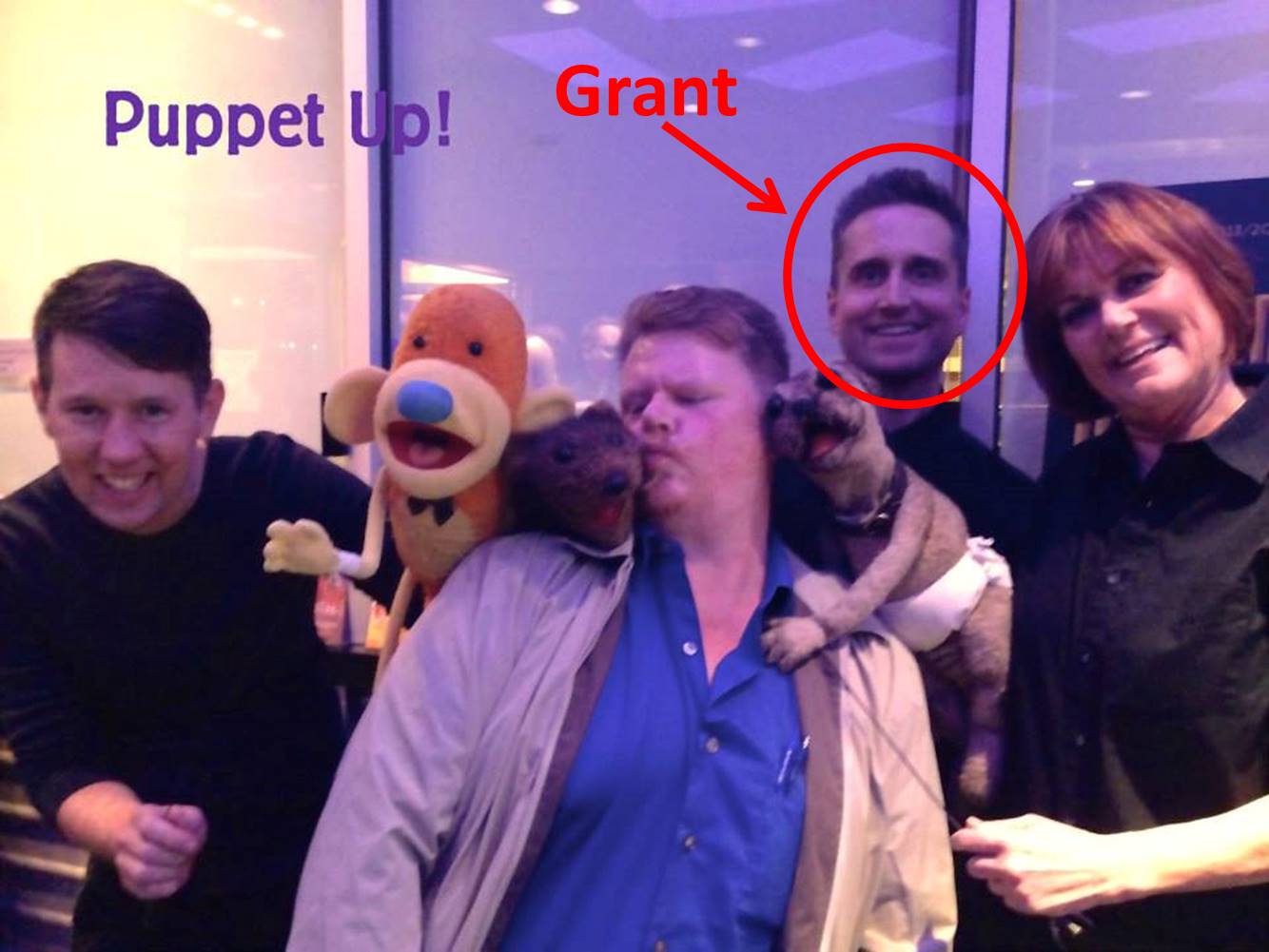
The wonderful Grant and his weasel buddy join me for a post-show photo (also shown Peggy Etra and Brian Clark).

The wonderful Grant and his weasel buddy join me for a post-show photo (also shown Peggy Etra and Brian Clark).

Grant Baciocco is an amazingly talented actor and puppeteer I had the good fortune to meet online and then in person when he came to Toronto with the improv puppetry show PuppetUp! (about which I have raved extensively elsewhere).

Well, aside from his amazing talent, he also has a wonderful creative spirit, both in the sense of what he creates and how he tries to inspire others to be open to their own inner creative spirit. To this latter point, he has a wonderful blog Grantblog: Ruminations & Pomposity that I heartily recommend.

At the beginning of each week, he posts Creative Mondays and today was no exception. Today he talked about “A job you hate”, which I excerpt below:

For years after college, about ten in fact, I worked as a substitute teacher.  It was an okay job, certainly flexible enough and I was making money, but by the end of those ten years I was starting to burn out because it was not the job I wanted to be doing.  I was good at it and several times I was told I should get my teaching credential because I was such a good teacher.  But deep inside of me I could feel a darkness building up because I was doing a job I absolutely hated.

The moment I made the decision to stop subbing and focus on The Radio Adventures of Dr. Floyd, it felt like a weight was instantly lifted from my chest.  I attempted, for the millionth time, to lose weight and it was actually working (lost 80 pounds).  I was just a million times happier than I was when I was subbing.  And guess what?  I became more creative!  This was the creative boom era for Dr. Floyd, because I was doing something I love.

Grant’s is a lesson too many of us learn very late in life (NOTE: I did not say “too late in life”…it is NEVER too late).

In my case, I was fortunate enough to have a series of occupations I loved for a period…scientist, science writer, media relations, advertising copywriter…but with each, I stayed in the occupation long after I had fallen out of love with the choice. I had to be a certain amount of miserable before I was brave enough to jump.

But two years ago, I completely jumped ship to pursue my true love: story telling (screenplays, novel, sketches, short stories). I’m still not making money off any of this, so I live on freelance magazine writing and ad copywriting. But to Tiffany’s point, it is what I do to eat and sleep under a roof.

If you are fortunate to know your passion—it can take time to figure out what it is—then you must make it happen to find happiness (hunh, “happen” and “happiness”…so similar).

And if you haven’t fully defined your passion yet, go with your gut until you do. Explore the universe of opportunities, until you do. You may not end up the financially richest person on the planet, but you’ll definitely be one of the spiritually richest.

If you don’t want to take it from me, then take it from Grant. Find your happiness and pursue it with everything you have. Despite appearances, you really do have nothing to lose and everything to gain.


You can follow Grant on Twitter: @ToasterBoy