I had no idea

Ideas are everywhere, but they don't always look like ideas

Ideas are everywhere, but they don’t always look like ideas

“How the heck did you come up with that?”

It’s a common question I get when talking about my latest ideas, and for years, my answer was a resounding “I dunno…just came to me.”

To a limited extent, the response is correct, but it suggests the process of ideation is much more passive or deus ex machina than it really is.

Ideas surround me, as they do you. They are in the nouns, verbs, adjectives and adverbs that make up our moment-by-moment reality. They are in the streetcar in which I presently ride, the streets down which I presently travel.

In the dark-haired beauty two rows before me who is fixated on adjusting her hair rather than close the window through which the hair-mussing breeze blows. And in the armada of free-range humans who occupy the parkette we just passed, proving themselves houseless rather than homeless.

The challenge for many would-be writers is that these are starting points for ideas rather than fully fledged stories or subjects. These are the writers who wish to be reporters or chroniclers rather than explorers.

Think instead of these idea kernels as pieces of clay, as something that can be moulded into any of a thousand other shapes. Take the kernel and play with it for a while. Give yourself a chance to see what it feels like, smells like, sounds like, tastes like.

Twist it. Turn parts of it over. Reverse its halves.

What is something were feasting on Toronto’s homeless? Imagine a mobile service that will do your hair and makeup while you commute to work. What if a terrorist planted a bomb on a streetcar and it had to travel no slower than 50 mph? Or an aesthetician to the deceased in From Hair to Eternity.

All of these are probably bad ideas, but the ideas have evolved.

Twist it again. Mould it again. Press it onto something else, like so much Silly Putty, and see what sticks.

Keep the good. Set aside the bad. But keep working it until something you really like begins to show itself.

You have no idea the wonders you will discover.

The word was cat – an exercise

Image

“Cat killer,” Anthony thought to himself, ruefully. He was now going to be forever known as the cat killer of Borden Street.

To be fair, it was an accident. At worst, negligent manslaughter. Catslaughter?

Yes, if Anthony had gotten his car tuned up as he’d been promising himself for weeks, he might have noticed the strange sound emanating from his motor. But a “rowr” sounds an awful lot like a “rawr”, so it was hardly his fault.

Why would a cat crawl on the engine block in the first place? And it’s not like Anthony held its tail against the fan belt.

No. It was a mercy killing. Clearly, living in a house with 17 other cats had taken its toll on Snowball. She had lost the will to live and decided to end her days.

It was Old Lady MacGillvary’s fault. Nobody needs 18…17 cats. A sign of mental defectiveness on a grand scale.

Hell, Anthony was lucky it wasn’t the old woman herself who flung around his engine like a piñata on heroin.

Anthony liked cats. Well, he tolerated them. He’d never killed a cat before. Two dogs, a ferret and a budgerigar, sure, but never a cat.

It was a bad year for pets in his neighbourhood.

As he recalled, the Great Dane was an automotive accident, his hood still bearing the scars, and the chow was proof that you shouldn’t buy electric garden lamps from a guy in a van on the highway.

The ferret shouldn’t have been loose while he mowed the lawn, and why the bird was anywhere near his barbecue while he was using his leaf blower is anyone’s guess.

It had gotten so bad that Anthony had to beg off a trip to the petting zoo with his nephew for fear of dropping a horse on the kid.

You’d think Anthony’s job as a taxidermist would come in handy here, but apparently a stuffed pet is considered poor compensation for a loss.

The point was moot where Snowball was concerned. All the King’s horse and all the King’s men, you know?

Oh well, Anthony shrugged, no use crying over eviscerated Persian. If he took the highway to work, most of the fur would probably fall out and cooked flesh is so much easier to extract from metal.

Anthony turned the motor over, listening for the familiar “rawr”, and then put the car in reverse.

Thump.

Give up or surrender

Image

You’ve hit a wall. You’ve banged your head on your desk for an hour; two; ten. Staring out the window—your go-to maneuver for the last decade—has gotten you nowhere. Is it time to give up?

Might I recommend surrendering instead?

In case this sounds confusing, there is a difference between the two options.

Giving up is about accepting failure. It’s the belief that there is no solution to your problem or if there is a solution, you’re not the one who will come up with it.

Giving up is about telling yourself that you’re not good enough, strong enough, smart enough to solve your problem. It is defeat.

Surrender is different. Rather than giving up, you’re giving over; ceding control of the situation to whatever power you are most comfortable with—God, time, the elements, the universe.

Surrender is about believing that not only is there an answer to the problem, but also you are capable of delivering that answer—just not without help.

We all know what giving up looks like. It’s turning off the laptop with a frown, and maybe a sigh with drooping shoulders. And almost always, it comes with a fear or reluctance to turn the computer back on.

Surrender is calmly closing the laptop of letting it go idle while you take a walk, read a book or vegetate in a coffee shop. It can even including reviewing your work-to-date if you focus on what’s working, what you’re happy with.

The answer is there for you to pluck, but it’s waiting for you to drop your focus. Like that white spot on the inside of your eyelid that moves every time you try to look at it, the answer doesn’t like your stare, so it hangs in the periphery.

That may actually be source of some of your frustration: the knowledge or sense that the answer’s nearby, but you can’t see it.

Don’t give up. You can do it.

You just need to have faith in your universe and surrender the control you never really had.

Indirect influences

Image

I naturally speak with one voice. If pressed, I can speak with a second, more professional voice; the one that presents concepts to advertising clients or interviews corporate executives for a magazine. But most of the time, I speak with one voice that uses a vocabulary and attitude established over my many decades of life.

I think this is largely the case for everyone, which is why it is not surprising that people tend to write stories with a series characters that can largely sound the same. The protagonist is typically quite distinct. The antagonist is often distinct. But after that, I don’t know that I could tell who was speaking if I didn’t read the names.

These secondary characters, by their very nature, are not our focus as writers, so they tend to have the least developed back stories even in our heads. Other than age or gender, what makes the paperboy different from the local sheriff from the school teacher?

The same thing that makes you different from me. Our experiences, past and present.

One of the tricks for informing a character that I learned in improv was to endow a character with a trait that only you as the performer knew, and ideally a trait that had absolutely nothing to do with the scene that was developing.

In one exercise, I decided that my character had a bad right ankle, so that every time I took a step, my ankle would cause me pain. I didn’t hobble or verbally express the pain with either an “Ow” or “Would you slow down, my ankle hurts”.

The pain was expressed, however, in how my character responded to his environment and the other characters in the scene. What might have been a middle-of-the-road character suddenly became a terse character, someone in a hurry to get things over with, quick to anger or frustrate, less apt to engage in activities.

The bonus aspect of the exercise, for me, was that my fellow improv performers quickly got and responded to my character, but when pressed, could not exactly say why I behaved as I did.

Now change that ankle pain to a foot orgasm (read about it this week online) and see where that character would go (probably jogging).

The sore ankle had no impact on what role the character played in the scene, but more in HOW that character performed that role. And this made the character stand out from all of the others.

I go back to this exercise often, when I find myself creating secondary or tertiary characters that aren’t differentiated from the background. A little something to make them stand out, however briefly, in their scene.

If you find yourself stuck, give it a shot. What could it hurt, other than possibly your ankle?

(Image is property of owners and is used here without permission, because it makes me happy/indifferent/snarky/hot.)

I can explain

Image

Michael (Jeff Goldblum): Don’t knock rationalization. Where would we be without it? I don’t know anyone who could get through the day without two or three juicy rationalizations. They’re more important than sex.

Sam (Tom Berenger): Ah, come on. Nothing’s more important than sex.

Michael: Oh yeah? Ever gone a week without a rationalization?


Many of us struggle to accept feedback, and in saying that, I put the emphasis on the word “accept”.

It is easy to receive feedback, but to accept feedback takes a certain degree of confidence that most of us struggle to achieve, and the earlier we are in the development of our Art, the worse our ability. It is a cruel irony that this struggle is at its zenith when we most need the feedback.

It seems that the minute someone offers feedback, even if we’ve requested it, our initial response is to explain why the work is the way it is or why the feedback provider is wrong. As Jeff Goldblum’s character in The Big Chill put so eloquently, we rationalize.

Now, before you try to explain why you rationalize or try to convince me that you don’t—you know you were going to—let me tell you that it is a natural response that was bred into us from our earliest days.

As a child, if you came home late or missed an appointment, you were likely met with an angry parent asking where you were. Unfortunately, for the most part, parents don’t actually hear the answer, because with the rarest of exceptions, your answer is unlikely to ameliorate the punishment.

And any attempt on your part to simply accept responsibility with “I am sorry, Mummy. That was disrespectful of me and I shall try to be more thoughtful in the future.” (all 5-year-olds talk like that, right?), was met with continued pressure to explain yourself.

Fast-forward 20, 30, 40, 50 years. A classmate, instructor or colleague has just read your manuscript and has trouble with one or two things. The instinctive reaction—thanks Mom and Dad—is to respond “Uh-huh. Well, you see…”

We immediately want to explain why we made such an astounding choice. We feel we need to prove we’re not stupid or crazy, and in some cases, to prove that our readers are. And this instinct is even worse when we either can’t remember why we made that specific choice—the “I dunno” scenario—or we thought it was a bad choice but felt we had no better ideas—the “I’m a talentless hack” scenario.

If we can just suck all of the oxygen out of the room, the reader will suffocate and no one need know of our disgrace.

STOP! BREATHE! RELAX!

Shut up and listen. Don’t respond other than to indicate that you’re following what the person is telling you.

You’re not being attacked. They don’t hate you. They’re not trying to convince the world that you’re a terrible human being.

Fight the urge to explain yourself and instead think about what you are being told. You may not understand right away, so feel free to ask for clarifications (not offer rebuttals). Take the input away and mull on it.

This is an opportunity to learn something about your work, your abilities and yourself. Take advantage of that.

You likely asked for the feedback, either implicitly or explicitly, and your reader has something to tell you. They may be right. They may be wrong. Annoyingly, it is likely to be somewhere in between. Regardless, they have had a reaction to your work, and you must respect that.

You do not, however, have to act on their feedback. If, after sober reflection, you feel that the feedback is not for your work, then move on, confident that you have heard and considered what they said.

Ahhh.

See? There is still air; you’re not choking. The skies have not darkened. Wagner does not play. You need not walk into the light.

It is tempting rationalize, to try to explain away our feared shortcomings. It has been programmed into us.

Rationalization is a natural reaction, but it isn’t necessary.

(Image used without permission due to alien infestation.)

Onward creative spirits

Image

Once more unto the breach, dear friends, once more.Henry V III, i, 1

In his thrilling speech to his troops (see excerpt below), who stood exhausted before the walls of Harfleur, Henry V challenges them to try yet again to take the city, that now is not the time to back off. Keep moving forward.

As it was expressed dramatically about war, so it is with Art and with life itself. It is vital that once you gain some momentum, you should do everything in your power to maintain that momentum.

Several years ago, I took up running. I hated it. I hated every living moment of it. But I was trying to improve my health and I knew that it was important. And so every couple days, when I would head out for my run, I had but one thought in my mind: keep moving forward. I knew that if I stopped, I might never run again.

As it was with running, so it is with writing. I write because I desire to, but also because I fear that if I stop, there is every chance that other aspects of life will creep in and keep me from it. My fear of losing writing is bigger than my fear of writing crap.

If I’m working on a screenplay and hit a creative sticking point, I try to move around it rather than dwell on it and lose the forward momentum. Sometimes, moving around it means writing another scene elsewhere in the same screenplay, but more often, it means jumping to another screenwriting project, developing another blog post or riffing wildly on Twitter or Facebook. My poor keyboard owes me nothing.

Even when I am simply writing some notes for a scene yet to be written, I do not allow the “correct” word choice to block me from writing…I simply add a placeholder where the right word should be and keep the thoughts flowing onto the page. The placeholder can be a blank underline (fill it in later) or a close enough word so I will know what I meant later, or it can be the word “shit”. It doesn’t matter.

It’s the artistic version of Newton’s First Law of Motion: An object at rest remains at rest unless acted upon by a force. An object in motion remains in motion, and at a constant velocity, unless acted upon by a force.

In this case, the object in question is me and/or my creative spirit.

In fact, forward movement doesn’t even have to be the same art form. I often use photography to keep me going. But you can also read a book, see a movie, sit in a park. Do whatever it takes to keep the creative parts of your brain and soul moving forward.

But how will I ever get anything done if I keep flitting back and forth from distraction to distraction?

Unless you’re specifically working to a deadline for your creative project—and there will be times when this is true—creativity is about the process, not the product.

Most artists (and we are all artists) live and act to create, not to have created.

And even if you are working to deadline, forcing your way through a challenge will likely result in a work that requires significantly more reworking than if you had simply let the creative spirit take you where it would. Thus, I don’t know that you’ve really gained much by pushing on something that isn’t coming naturally.

The natural direction of the universe is forward. You have it in you to continually move forward. Why would you give that up?


In peace there’s nothing so becomes a man
As modest stillness and humility:
But when the blast of war blows in our ears,
Then imitate the action of the tiger;
Stiffen the sinews, summon up the blood,
Disguise fair nature with hard-favour’d rage;
Then lend the eye a terrible aspect;
Let pry through the portage of the head
Like the brass cannon; let the brow o’erwhelm it
As fearfully as doth a galled rock
O’erhang and jutty his confounded base,
Swill’d with the wild and wasteful ocean.
Now set the teeth and stretch the nostril wide,
Hold hard the breath and bend up every spirit
To his full height.
– Henry V III, i, 3-17

(Image used without permission.)

Take notes

Image

Dear Diary: I couldn’t believe that this type of thing would happen to a guy like me, but when that woman got out of the pool, she wasn’t wearing any…

Oops. Wrong diary.

We are all incredibly talented, witty, sophisticated, creative people. Unfortunately, for most of us, we are incredibly talented, witty, sophisticated, creative people who would have trouble remembering our names if they weren’t on our drivers licenses.

I personally have a brilliant memory. I remember that the most common form of cockroach in the United States and Canada is Periplaneta americana. I recall that the parasitic Paragonimus westermani is a lung fluke. And I am quite certain that Tycho Brahe had history’s first rhinoplasty, however involuntarily on his part.

I also remember that I had three really good ideas for blog posts yesterday…I just can’t remember today what they were.

We never know when the creative spark will light us up, but as often as not, it is likely to happen when we are least prepared to act on it. A mall parking lot. Dinner with the family. Police interrogation. And inevitably, because we’re in the middle of that distraction, we forget the idea.

Carry a note book and pen or pencil at all times. Capture that fleeting moment, no matter how (in)conspicuously. Whether you’re a writer, sculptor, painter, musician, whatever your art, the important thing is to give yourself some form of reminder that you can use for inspiration later.

As I believe I’ve mentioned in earlier posts, my first screenplay grew out of a four-word pun (a song parody) that I wrote in a note book several years earlier.

When the pun occurred to me, I had no idea what to do with it, but I wrote it down any way. Over the next two years, when I would struggle for inspiration, I would flip the pages of my notebooks, and one day, I read the pun and an idea began to ferment. 18 months later, I had the first draft of my first screenplay.

Too often, I fear, we let these moments of inspiration slip away, and while we may kick ourselves momentarily on realizing we’ve lost something, we shrug our shoulders and simply move on. Fine, move on, but don’t keep repeating the mistake.

We all know how hard to come by moments of creative insight can be. Those moments are precious gifts, even if we can’t see the application today. So, the last thing we need to be doing is simply letting them float by and be lost.

Write it down. Save it for later, when you have the time or creative inclination to turn the idea into something special.

In any event, I just had to get this off my chest before I forgot it too.

(Image is the property of Biodiversity Explorer and is used here without permission.)

My Creative Journey – Part Two

Picking up from my first realization that my passion might also be a gift, as explained in Part One.

Image

Over the years, I’ve had opportunities to display my creative demons before an audience. An effective little soap opera episode in Grade 12. Geeky science humour in my own magazine. Heart-wrenching poetry following the end of a close friendship that might have been much more.

I worked my way into the magazine world, writing interesting stories about interesting discoveries and advances, but it wasn’t the same. The words poured forth and the story-telling skills improved, but I was always a chronicler of someone else’s story.

Creativity expressed itself in my approach to the story. In seeing a story that no one else saw. In context that was invisible to everyone else. Creativity manifested itself in identifying authors and writers from all walks of life to fill gaps in the magazines. I may not have been the best project manager, but I was definitely the most creative.

As I matured in my jobs, I extended this creativity to everything I did. Looking for effective solutions to seemingly intractable problems. But it wasn’t enough. That voice within me cried out to be heard. And the more I worked—and overworked—to distract it, the louder it screamed. So loudly, that even my wife could hear it.

While sitting in an Orlando hotel bar one night, she finally challenged me and my workaholic tendencies, demanding that we come up with a hobby for me. When pressed, I admitted that I had always felt like I’d been born 30 years too late. That if I could have any miracle in my life, it would be to work on those old sketch comedy shows from the 1950s as a comedy writer. Sid Ceasar’s Show of Shows came to mind. Imagining myself in the writers’ room with Mel Brooks, Larry Gelbart, Woody Allen and Neil Simon.

Neither of us knew how to make that happen, but my wife challenged me to find something at home that would set me up in that direction. The next week, I signed up for my first improv class at Second City.

Although it still wasn’t where I wanted to be—more performance than writing—the improv classes were amazing; therapeutic on a variety of levels. Eventually, though, I stumbled onto their sketch comedy writing program and that’s when I hit my stride. A wonderful instructor, talented zany fellow students.

The words flowed incredibly quickly. Within weeks, I had dozens of sketches and felt like I was making serious headway in my education of what worked and why. If there was a problem with the class, it was that my production vastly outstripped the need. I tried new things. I broke out of my comfort zone. I pushed my limits. My only goal was funny.

As I honed my sketches, I prepared for the reality of rehearsals with actors, when all of this work would really come true; when my efforts became more than an academic exercise. Rehearsals went well. Out actors seemed genuinely grateful to be performing our work. I saw what worked and what didn’t, even in the work of others.

Interestingly, I wasn’t in control of the process and I was okay with that. There’s something to be said for being so far out of your element that you recognize the limitations of your control. I had complete faith in the director and our actors. I believed they too wanted this to work as badly as I did.

And then the day of the performance arrived. Nervous energy ran through my body and I couldn’t sit still. I could barely communicate. There was no fear. Only anticipation and potential validation. Was I funny?

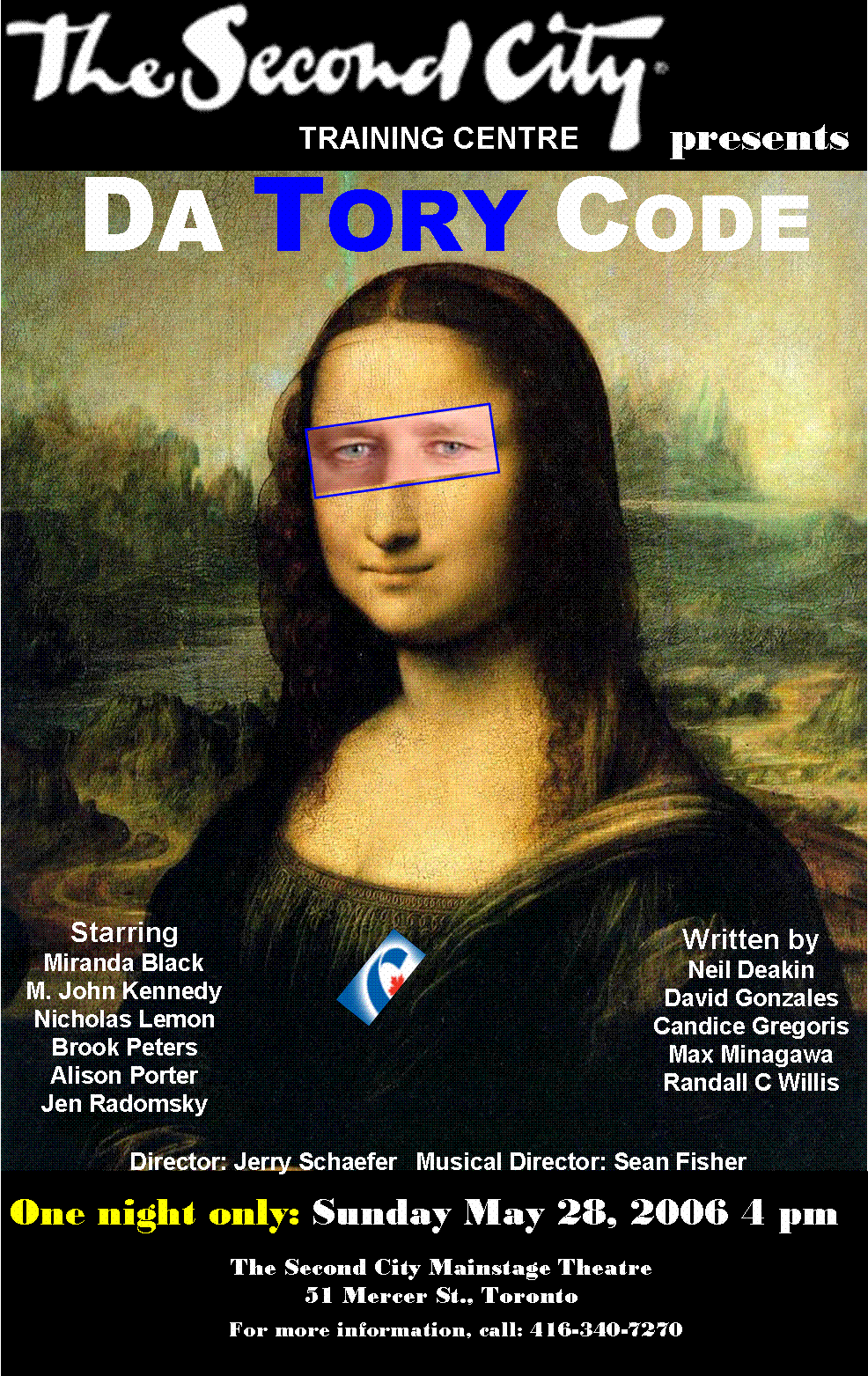
The day we premiered Da Tory Code was easily one of the best days in my life. The audience laughed. Not at everything, which was a valuable lesson, but they laughed at enough to validate my talent.

Image

My Creative Journey – Part One

What follows are a few thoughts on why I write…the moments in my life that led me to embrace my passion. It is an incredibly personal story and I hope it doesn’t make anyone uncomfortable, but rather helps them reflect on why they embrace their own passions.

Image

I need to be creative on my terms.

When I was younger, it was all about acquiring knowledge and being recognized for having acquired that knowledge. In hindsight, I’m not exactly sure what I was planning to do with that knowledge.

In some respects, it was about solving a puzzle, which could range from how does this alarm clock work to how does the universe work. On another level, I think it was about control. Knowing how the universe worked meant knowing that there was a broader sense of organization out there; that the laws of physics and mathematics still held even when my own life seemed in constant flux. The subtle irony of entropy only occurred later.

But it was also about control in the sense that I couldn’t be expected to come up with answers, with solutions, until I had all the information I needed to make that decision. The aggravating reality of that method of control is it only works when you’re the one asking the questions. Nobody else is willing to wait until I have all of the info I need.

At the same time, I needed the safety of analysis and knowledge, I’ve also had a need to be creative. A need that has only recently blossomed as a regular part of my life.

When I was young, I was constantly creating new worlds through my stories. First, as play scenarios and then as the written word. I constantly developed short stories that took me in a million directions. Again, this might have been an attempt at control.

When I wrote, I was the master of my universe. I was the one who decided who lived and who died, who was allied and who was the enemy. I was the protagonist and the antagonist.

It was in 1977, as I started high school, that I first noticed the strength of my writing. That summer, my life changed with the release of Star Wars. So deeply effected was I by the characters and the story, that I immediately went home and started working on the sequel. My version took a very different turn than George Lucas’s—although there were some subplot overlaps—but over the next few weeks, I hand wrote 400 pages of dialogue.

I shared the script with my Grade 9 English teacher, who was impressed with the volume if not the content (my words, not hers). It was in her class that I first realized the power of my words to still and disturb an audience.

On day, Ms. Philp gave us a writing assignment that started with the sentence “I couldn’t believe it when I heard that sound.” It was supposed to be an in-class assignment, but I was onto something and asked if I could take it home to finish it. I guess she sensed something—that this was important to me—and she said yes. While I didn’t finish the story, I did hand her several pages the next day.

After reading the story herself, she decided to read it to the class. Whereas most people had written stories about funny sounds, spooky sounds or weird sounds, I had written about a man who comes upon a murder in an alleyway, first by the sound of bone and sinew breaking, and then by sight. I wrote about the fear and indecision in the witness’s heart as the murderer sees him and he flees for his life.

As Ms. Philp read the story aloud, there was silence in the room—a room of 14 and 15 year olds. No one said a word until she was done reading. It was magical for me.

I wish I could say that there was a rousing round of applause at the end and that this was the day that I decided to become a professional writer. There was no round of applause—although my class seemed to appreciate my story—and Ms. Philp continued to be supportive of my efforts, but there was no effort to foster this creative desire in a young boy struggling to define his world.

The opportunity was there. Everything was laid out for someone to recognize, but nobody tapped into it. Writing continued to be a strange little quirk of my life. I guess it was just easier to find ways to support my interest in science and history by buying me more books, taking me to the Science Centre.

What do you do for a budding writer? Get him a pen and a notebook? Buy him a typewriter?

Eventually, someone did buy me a typewriter—a vehicle to do my homework. But it quickly became the vehicle for my creative outlet, much to my mother’s chagrin. The muse hits me when I have time to be alone with my thoughts. When my day isn’t cluttered with requests for attention and responsibilities. Unfortunately, in my childhood home, those times only tended to occur when my family was asleep.

Routinely, my mother would yell down from her bedroom for me to stop wailing away at the keys. Loudly pounding them into submission. Watching the letter hammers get stuck because the thoughts occurred to me and be translated through my fingertips faster than the typewriter could accommodate. She wanted to be supportive, but not at the cost of a good night’s sleep.

It took no time at all before I had an incredible portfolio of work—half-finished thoughts, short stories—but they languished unread by anyone other than me. I had given voice to the creative urges in my soul but no one heard that voice. It was the proverbial tree in a forest. With no one to even acknowledge the existence of my efforts, did they really exist.

Where was my mentor to guide me through this process? Someone to help me hone my voice. To make my stories better. To help me get my voice heard.

To be continued…

Thinking outside the balks

Image

If you’re reading this blog post, then you’re probably something like me—that wasn’t meant as an insult—and you’re looking for opportunities to express your true creative self.

Unfortunately, whenever you visit the Want Ads looking for employment, you are met with hundreds of ads all touting their desire for an outside-of-the-box thinker and yet doing so in the most boring way. Talk about making a bad first impression.

So here is my call to all companies: If you want outside-of-the-box thinkers, don’t approach them from inside the box.

Boxes scare creatives because boxes are scary. In hockey, it’s the penalty box. In mythology, it was Pandora’s box—okay, technically jar, but let’s not dwell on semantics. The Boxer rebellion. Boxing Day shopping. Johann Sebastian Box. You get the idea.

To some extent, I blame Human Resource departments, whose job it is to protect the company from legal repercussions rather than actually identify resourceful humans. But senior managers are also to blame, as the majority of them hold their jobs by propping up the walls of their box—often with the corpses of the peons below them.

Several years ago, as Creative Director of a medical advertising agency, I had the opportunity to hire a medical writer.

Now, I am nuts. And the job of medical copywriter in Canada is nuts, because the regulations in Canada are nuts. And working for me is nuts. So when I wanted to hire someone, I needed candidates who were…well…nuts.

Below is an excerpt from the ad I posted on a variety of web-based job sites to get just the right candidate:

We have needs (many of them in fact). But today our biggest need is for a full-time Scientific and Medical Writer to help us create amazingly compelling advertising for our healthcare clients…. 

What type of person are you?

You’ve always been smart—annoyingly so, if we talk to your siblings. You’re just as comfortable talking to a doctor, as you are an artist. You’re always looking for new ways to do things—especially mundane things. You not only dream up big ideas, you can also figure out how to execute them. You are able to convince others to buy into your ideas. You find yesterday’s successes to be today’s challenges. You don’t like taking “no” for an answer. You really want to re-write this ad and send it back to us. And you’ve never met an acronym you didn’t like, including PAAB, RRR, CME, ASC, BID, PM, PI, and ASAP.
Here are some must-haves:
Science degree (BSc. minimum, but dazzle us if you don’t)
Ability to distill clinical data into amazing copy (other distillation expertise will be considered)
Knowledge of the pharmaceutical industry (aside from your medicine cabinet)
A sense of humour in stressful situations.
Nice-to-haves: Did we mention the sense of humour?

Think your skills meet our needs? Then startle us with your creativity. Forward your resume (boring), 3 writing samples (better), and anything else we may find entertaining (don’t worry, we’re easily entertained) to:

I got some amazingly milquetoast applicants, but I also got some incredibly creative applicants and eventually hired an amazingly brilliant writer—who may be reading this and the Canadian market is too small not to constantly ass-kiss.

Like attracts like. So if it looks like you wrote your job ad with a pencil shoved firmly up your backside, you’re not likely to attract the kinds of candidates who think outside of the box. They’re more likely to be outside of your league.

You need to show that creative thinking already flourishes within your company because damned few creatives are willing to be the first and possibly only person who thinks creatively. Without the right amount and type of bullshit, we wither and die in such environments.

Spare the box, hire the creative genius.


PS The job boards to which I posted included:


(Image is property of Robert Mann Packaging and is used her without permission.)