Rogue One clearly satisfies (no spoilers)

rogueone_one-poster

The latest in the Star Wars galaxy of offerings launched last night to rousing applause, and I was there, in the audience, wearing my 3D goggles.

What did I think of the movie? I’m not really sure that it matters.

Like so many movie franchises out there, if you have bought into the Star Wars series, you are going to see this movie and there is damned little that any number of reviewers could say to dissuade you from that. Personally, I have been invested in this cultural icon since it first launched almost 40 years ago.

So, what is the point of reviewing the movie? None, other than an effort to satisfy my own self-importance.

This was a good movie that opens slowly, offers little in the way of character development, fulfills all of the expected (demanded?) tropes of battles and mentors and silly robots, and essentially adds nothing to the canon of Hollywood history or the art of filmmaking. I don’t know that the movie ever had the opportunity to be great, but if it did, it certainly walked the other way.

That said, the audience applauded or cheered several times throughout the movie, and I think it is fair to say that pretty much everyone left the theatre satisfied with their experience.

And there is my problem with the series, as much as the movie: satisfied.

[Hereafter, I will talk more about specifics within the movie, so you may wish to stop reading now. I will avoid spoilers, speaking more in generalities out of respect for movie-goers.]

star-wars-universe

Ep IV and V changed movies forever. Everything else was merely adequate.

Movies have evolved extensively since the launch of A New Hope in 1977, especially in the area of special effects. With franchises like Alien and Star Trek getting complete reboots, comic book universes unfolding in myriad interwoven ways, and standalones like Interstellar and Inception dazzling the eye, it is becoming increasingly difficult for individual movies to stand out from the crowd, to chart new ground.

If for no other reason, this is why I raved about the recently released Arrival (my review), which stands apart not through its special effects, but rather the execution of its central theme. There is great intelligence behind a beautiful film.

When A New Hope arrived on the scene, it changed the game of movie-making by bringing the scale of a biblical epic to hokey old Westerns and WWI dog fight movies. If Jaws initiated the summer blockbuster craze, A New Hope solidified the idea. And if that’s where it stopped, this crazed then-teenager would have been quite satisfied.

But then came The Empire Strikes Back, which somehow managed to make A New Hope look hokey and dated, although I still contend that the first movie had a better, more complete story. For a young movie goer, The Empire Strikes Back was like riding in a bullet train only to have someone throw on after-burners; it was a whole new level of acceleration that pinned me to my seat.

That feeling has never been duplicated by a Star Wars movie since.

[In fairness, there is one interesting technical achievement in Rogue One, but to describe it would be to spoil a couple of moments in this film.]

Hollywood, instead, has caught up and moved past the franchise. And perhaps even more broadly, entertainment has surpassed even Hollywood in the form of immersive video games, which I do not play.

For its part, the Star Wars universe struggles to achieve the bar, if it really even tries. And each successive movie feels like it was designed with a check list of tropes George Lucas did not invent, but that he executed perfectly in the early films.

Thus, for a Star Wars film, Rogue One is completely adequate.

rebel-crew

Adequate to their task, offering little more

Character development has largely been dispensed with. As the movie opens, we are presented with a seminal moment in the life of Jyn Erso (Felicity Jones), the central character of this movie, and then we catapult ahead 10+ years to find her in imprisoned, where our adventure begins. And with the exception of the odd note dropped into the dialogue, we have no idea what happened in those lost years.

The same is true for almost all of the other characters. Each offers the briefest allusions to why they have arrived in this place at this time, but there is little to hold onto as the story careens forward. Cassian Andor (Diego Luna) has done some bad things in the name of the Rebellion. Chirrut Imwe (Donnie Yen) clings to his belief in the Force like a child clutching a blanket, while his partner Baze Malbus (Jiang Wen) scoffs good-naturedly, mourning his lost faith.

And I have to say that I have no idea why rebel renegade Saw Gerrera (Forest Whitaker) is even in this movie. If his subplot had been written around, the story would not have suffered one iota. Like so many other movie franchises these days, I will put this choice down to something in the cartoon, novel or comic book series.

Perhaps this reveals something about me, but much as I did with Prometheus, I found the robot character to be the most evolved. In Rogue One, K-2SO (Alan Tudyk) stole the show, having the best lines of dialogue and routinely offering broader perspective on the chaotic stumblings of the inferior humans around him.

And as with the original movies, the villains proved the most exciting element of the story.

krennic

Mendelson’s Krennic brings life and depth to this movie

Somehow, the writers and director managed to make Darth Vader even more imposing than he was in any of the other movies. This was something between the uncontrolled fury of Anakin Skywalker in Revenge of the Sith and Lord Vader’s iron control in The Empire Strikes Back. Here, Vader was a cold-hearted menace who toyed with his food as time allowed, but was also happy to get his light saber dirty.

And then we have Orson Krennic (Ben Mendelson), the man charged with the construction of the Death Star and who, but for an inability to tap into the Force, might have made a delicious challenger to Darth Vader. If they do more parallel timeline movies in the future, I would love to see the evolution of this character.

Aside from these few characters, however, the movie was merely passable as a Star Wars film. The plot was straightforward, if a little padded in places, with well-choreographed battles and requisite deaths (no spoilers).

And there must be at least 837 easter eggs in this movie, tiny moments that tie in to the other movies in the series, and as my friend Danny tells me, into the cartoons, as well. While a younger me might have been enthralled by these inserts, the present day me found them distracting, particularly as they almost always served no purpose to the plot and jerked me out of the story as I realized, “Hey, those are the guys from…” (no spoilers).

But as I said at the beginning, none of this likely matters to you if you are a Star Wars fan. You will see this movie, enjoying some parts and complaining about others. It is just what Star Wars has become…and I find that a little sad.

Criminal should be more Self/less

criminal-selfless

Ryan Reynolds is a hot commodity in Hollywood, these days. Unlike so many starlets, however, they want him more for his brains than his body…quite literally.

Or at least that’s the only way I can explain why twice within a year they have tried to scramble his brains: first with that of Sir Ben Kingsley, and more recently with Kevin Costner’s.

In Criminal—recently released to Netflix (trailer)—Reynolds is CIA agent Bill Pope trying to protect a hacker called the Dutchman (Michael Pitt) who has managed to wormhole his way into the American defense system, enabling him to launch missiles at will. But before he can bring his man in, Pope is captured by the evil rich anarchist Xavier Heimdahl (Jordi Mollà) who tortures Pope to find the Dutchman.

When his CIA handlers, led by Quaker Wells (Gary Oldman), find Pope dead, they enlist the help of neuroscientist Dr. Franks (Tommy Lee Jones) to essentially transfer Pope’s memories into the world’s most cold-blooded killer Jerico Stewart (Kevin Costner), a man completely devoid of conscience.

(Did these people not see Young Frankenstein?)

costner

Give a psychopath super-spy skills and knowledge? What could go wrong?

As expected, shit goes to pieces and the hunt is on—by the CIA, Heimdahl and even the Russians—for both Jerico and the Dutchman.

Despite being an action-thriller with plenty of gore—Jerico kills and maims indiscriminately—Criminal ultimately asks philosophical questions about who we are, how we got that way and can we be redeemed.

As the movie progresses, we witness the influence of Pope’s good-guy neurological engrams on the social and moral chaos of monster Jerico. Something is wrong, Jerico explains as he grasps his head; something is seriously interrupting his thoughts and actions.

In a humorous moment, Jerico learns he is experiencing something the rest of the world calls emotions, possibly for the first time in his life. He is unimpressed.

costner-reynolds-mirror

Requisite internal conflict moment

Given the stellar cast, which also includes Gal Gadot as Pope’s grieving and confused wife, the performances are mostly passable, especially given the woodenness of the dialogue—the screenplay was written by Douglas Cook and David Weisberg, who previously penned The Rock and Double Jeopardy. This is an action film, so we shouldn’t really expect much.

To my mind—and friends disagree—the deepest performance is offered by the coldest, most heartless character Jerico, much as the same could be said for Boris Karloff’s Frankenstein and Michael Fassbender’s robot David in Prometheus. In a very dark turn, Costner embues his merciless killer with dark humour and ultimately, as Pope’s neural influences and memories kick in, a confused heart that many of us can understand.

Assuming you can leave your credulity in a drawer, the story is minimal but passable. That an action film makes any attempt to ask lofty questions is laudable.

cast

Largely wasted stellar cast who spent movie doing exactly this

Unfortunately, as I alluded at the start, Criminal suffers in comparison with another brain transfer film: Self/less, released in 2015 and also starring Ryan Reynolds (trailer).

In that film, Kingsley plays billionaire industrialist Damian Hale at the end of his life but desperate for more time. Meeting with a neuroscientist who essentially offers him immortality, Hale arranges his own “death” and has his neurological patterns transferred to Reynold’s brain, assuming a new identity as Edward Kidner. Reynold’s character volunteered for the experiment to raise money to rescue his daughter from life-threatening disease.

selfless

Requisite internal conflict moment

Again, chaos ensues as Reynold’s memories invade Kidner’s consciousness, and the neuroscientist and his mob race to capture their subject, destroying everything in their path to maintain their secret.

Like Criminal, Self/less asks questions about what defines our identity. But it delves even deeper, going into questions about one’s right to an identity and the ultimate costs of consuming another’s. And for all characters, it is a story about sacrifice.

selfless-movie-natalie-martinez-jaynee-lynne-kinchen

Dead husband finds grieving widow and daughter

Given this backdrop, Criminal might have been seen as a better movie if only for what it tried to do. But on the heels of Self/less, it simply looks like a pale imitation that made a valiant, if ultimately doomed, attempt at significance.

Ironically, it reflected its own plot.

See also:

MovieReview360 w/ Shannon Leahy (YouTube)

Criminal (RogerEbert.com)

Criminal: Film Review (The Hollywood Reporter)

Kevin Costner steals the show in far-fetched but entertaining crime thriller (Deadline)

Self/less (RogerEbert.com)

Not too Bad Santa 2

bad_santa_2_poster

As a cynic, particularly around the holidays, it seems strange that I have never seen Bad Santa, but then I am not much of a fan of Billy Bob Thornton, the titular character. Thus, as I headed out to see Bad Santa 2, I had few expectations and simply held out hope that I wouldn’t be completely bored.

Surprisingly, I actually enjoyed myself while watching this seriously flawed but nonetheless funny movie.

I suspect the new edition seems very much a reprise of the original with the main characters Willie (Thornton) and Marcus (Tony Cox) getting together to pull off yet another caper; in this case, the robbery of a Chicago charity run by scheming Regent Hastings (Ryan Hansen) and his almost pure wife Diane (Christina Hendricks). Complicating matters this time is the presence of Willie’s mom Sunny (Kathy Bates), the woman who raised Willie to be the miserable, alcoholic, criminal shit that we see today.

In many ways, the movie becomes one long series of double-crosses and opportunities for Willie to do the right thing, particularly by the doting man-child Thurman Merman (Brett Kelly), but failing to live up to the moments.

badsanta2_bates

Mommy dearest Bates is guaranteed to let you down

To say that Bad Santa 2 is dark and cynical is to cope with a language that simply cannot catch the nihilism of these characters and their life choices. Thurman is the only redeeming character in this story and that is likely only because he is a clinical moron, incapable of guile and oblivious to sarcasm. As the title indicates, this is the anti-Christmas Christmas movie that would drive even Jesus Christ himself to suicide (likely some time around Easter).

And annoyingly, this is exactly why I liked this film. It was so dark and treacherous, so cynically funny, that I could not help but find the darkness endearing. This is a seasonal film for the purely jaded and given the language and adult scenes, should not be viewed with a broader family.

As no doubt in the first film, Thornton’s Willie continually finds himself let down by the people around him, feeding his suicidal neuroses. Bates is a delight as Kathy Bates under the pseudonym Sunny Soke, a woman devoid of tenderness except when it is part of a larger scheme to screw someone over. And Hendricks is the inveterate do-gooder who has her baser side, Christian charity coupled with carnal itches that need Santa’s attention.

charms

Hendricks allows her libido to cloud her better judgement

There are so many things about this story that don’t work as a story, and the ending is a complete waste of celluloid, the screenwriters Shauna Cross (who also wrote Whip It) and John Rosenthal in his debut feature film seeming to have simply typed until they ran out of toner. And yet, for all of the short-comings, you don’t really care because that is largely life. Nothing ends where it should and never satisfyingly.

If you aren’t at least intrigued by the idea of setting your nearest nativity scene ablaze or mounting Rudolph’s head on your front bumper, I am not sure you should see Bad Santa 2. But if you were not repulsed by either of those ideas, you may find some dark dark pleasure in this film.

See also:

MovieReview360 w/ Shannon Leahy (YouTube)

Same old dirty tricks (The Guardian)

Bad Santa 2 works through mommy issues (New York Times)

Movie Review: Bad Santa 2 (Danny F Santos)

Movie Review 360 (or don’t plan drunk)

mr360

Like many of you, I hang with a group of friends who watch movies and then argue in a bar afterwards. And like many of you, all of my friends are “visionaries”.

Over beers, one of my friends said “We should record this”…but whereas the rest of us sobered up, he kept pushing this idea, adding a 360-degree camera to the alcoholic mix.

This past week, Movie Review 360 was born.

Watch two goofballs and a guest (balled, bald or otherwise) talk about the latest releases from Hollywood and Netflix while drinking to excess on a limited budget (we are nothing, if not Canadian).

This week–ably assisted by documentarian Liza Vespi–our thoughts on:

  • Ron Howard’s Inferno
  • Man vs Snake (on Netflix)

Our thanks to Ginger & Russ for hosting us at The Edmund Burke in Toronto.

See also:

Inferno(t) – a review

Man vs Snake – a review

Slaughter Nick for President (trailer for Liza Vespi doc)

“Fury” and futility – a review

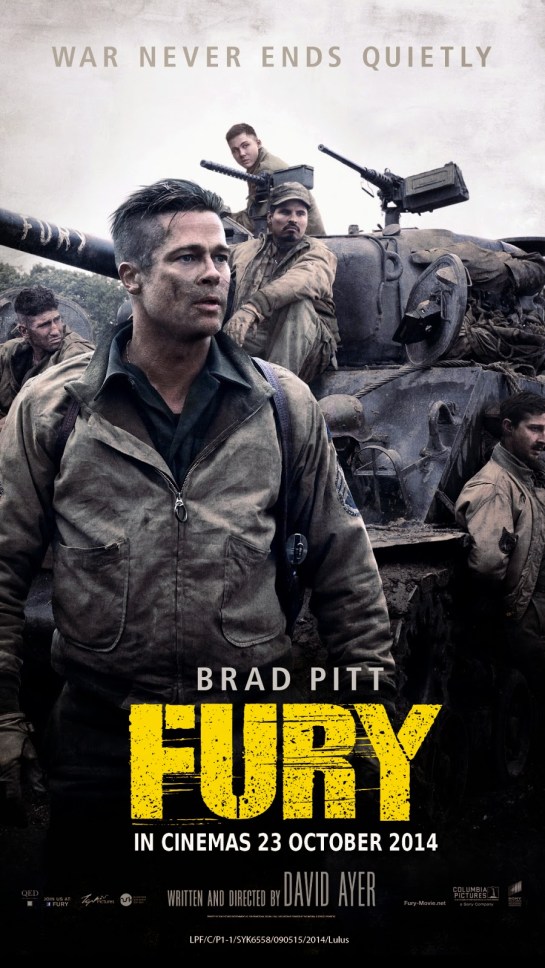
fury-movie-poster

Rarely am I stumped by a movie. Usually, I like the film, it is okay or it is bad.

But every now and again, a movie makes me work at an opinion. David Ayer’s Fury is one of those films, the 2014 film being released this week on Netflix.

Starring Brad Pitt, Shia LaBeouf and Michael Peña, Fury tells the story of an American tank crew in the last year of World War II, pushing deep into Germany but heavily outgunned by German Tiger tanks.

And there is my challenge with this film. I have now explained the entire movie to you, because there is no real point to the plot.

It is seriously as though a camera crew showed up on a battle site one day and followed a tank crew for a few days as it wound its way through various other battles into the belly of the Nazi beast.

Thus, I cannot really tell if this movie is an amazingly stunning metaphor for the futility of war—there is no glory here—or if it was just a badly penned film.

logan-lerman-and-brad-pitt-in-fury

Ideals clash with reality

To be fair to Ayer, who not only wrote, but also directed and produced this film, there is a human interest side to this story as the war-weary, battle-hardened tank crew is joined by doe-eyed recruit Norman  Ellison (Logan Lerman) who just days earlier was a typist for the military bureaucracy.

Thus, as the tank—the titular Fury—lurches from battle to battle, we witness the corruption of a pure heart by atrocities committed not only by the enemy, but by his fellow soldiers. And we see the toll this corruption takes on the boy’s tank commander Don “Wardaddy” Collier (Brad Pitt) who personally starts that downhill process.

But again, to what purpose?

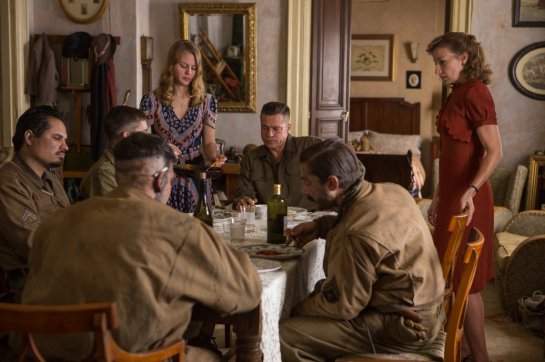
fury-respite

War taints even the most peaceful moments

Almost all war films seem to be based on men fighting toward a higher purpose, whether it is a battle that turns the tide of the war—e.g., Sands of Iwo Jima; Tora, Tora, Tora—or a moment of humanity amidst chaos—e.g., Saving Private Ryan—or men fighting for sanity within that chaos—e.g., Good Morning, Vietnam; Catch 22; Apocalypse, Now.

For me, Fury had no such pretense.

Yes, the Americans are the “good” guys and the Germans were the “bad” guys, but neither side in this film was any nobler than its counterpart. Within the confines of this movie, this was carnage and hatred purely for the sake of same.

As to the film itself; all of the actors did an admirable job, wearing the carnage of war on their faces and in their souls. Brad Pitt at his harshest expressed an internal dignity if not nobility. Shia LaBeouf was restrained. And Michael Peña really didn’t have much to do.

fury-movie

Truthfully, this film might have been stronger as a silent movie, as it was the facial expressions and battle scenes that told this story. The dialogue offered little to the visceral impact of this film (emotions are drained pretty early).

Beautifully shot, this is a grisly film and not for the faint of heart or stomach. Bullets and bombs don’t just pierce a body; they rip it wide open. The fallen remain fallen, to be ground into the mud by jeep tires and tank treads.

For all of these reasons—and it was a slow burn for me—I am coming down on the side of Fury being the embodiment of the ultimate futility and barbarism of war.

In this movie, even if you saved the person of Private Ryan or Ellison, the soul is long gone.

Remember

A good choice for Remembrance Day, highlighting purposeless sacrifice

Inferno(t) – a review

inferno-2016-film-movie

In a follow-up to The Da Vinci Code and Angels & Demons, Tom Hanks returns as famed symbologist Robert Langdon, the only man capable of solving the great riddles of today with clues left by our medieval artists and thinkers. In this case, it is the location of bioengineered microbes designed by mad billionaire Bertrand Zobrist (Ben Foster)—think Elon Musk with microscopes instead of rocket ships—to eradicate 95% of the world’s population.

And as the adventure starts, it appears that Langdon may be involved more directly in this mystery than even he thought possible. Along the way, he battles officials from the World Health Organization (WHO), zealous followers of the billionaire and the crafty dealings of a security firm.

As a fan of the previous two movies and puzzle-focused stories in general, I was looking forward to this latest installment. Hanks was back. Ron Howard was back as director. And Dan Brown, the novelist on whose books the movies are based, never tells a boring story.

Unfortunately, this latest venture simply does not live up to the mysteries developed in its predecessors. Simply put, the puzzle is missing and the action is merely serviceable.

To watch the trailer for this movie is to assume that the riddle of this story is wrapped up in Dante’s Divine Comedy, source of our Western vision of Hell. And, for about two minutes, it is.

michelino_danteandhispoem

Dante couldn’t have predicted this new level of Hell

But unlike the earlier movies where clue was found buried in clue, each one linking together in an almost mystical way and tapping into the deep-seated paranoia of conspiracy freaks like me, here it was merely a token gesture. Dante’s masterpiece and the elements that followed it felt completely contrived, mere window decoration for the modern mystery that wasn’t much of a mystery.

And even the characters surrounding Langdon were largely throw-away, none showing the intricate twists and turns that kept you guessing throughout the earlier movies. In almost all cases, the functions of the characters were obvious from the outset (to explain more would be to serve spoilers).

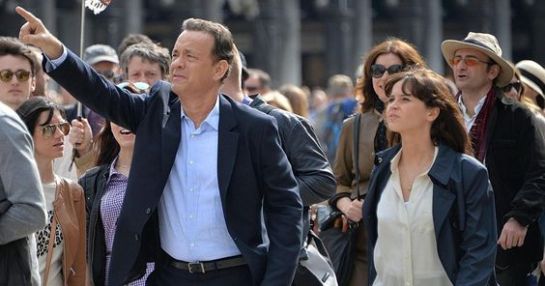
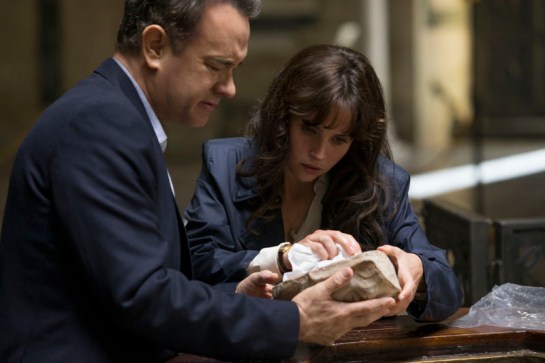
hanks-jones

Tom Hanks and Felicity Jones spend a lot of time sight-seeing

And I think screenwriter David Koepp (Jurassic Park, Mission:Impossible, War of the Worlds, Angels & Demons) suspected as much as he littered the screen with small red herrings that suggested insights to the characters but never amounted to anything afterward.

One character, in fact, who appears vital from the story perspective effectively disappears from the story completely, factoring in no way into the ending of the story despite being involved in the precipitating events.

In the absence of medieval puzzles and ambiguously motivated characters, we are left with a barely passable action film that trots its merry way across the Mediterranean to the pretty unspectacular climax. Even the summary denouement is uninteresting and a bit saccharine.

1271033 - THE WALK

Entire screenplay written on back of Dante’s head

This is not a terrible movie, but I’m not sure I would even recommend it as an entry point to the Dan Brown pantheon, instead recommending you stick solely to the other two.

For me, Inferno never really got beyond a cold ember.

See also:

Tom Hanks returns as Robert Langdon in Inferno (Associated Press)

Say hello to the 10th circle of Hell (The Guardian)

A devil of a time making sense (Wall Street Journal)

The Man Who Knew Infinity – a review

the-man-who-knew-infinity-poster

In another life, I might have been a mathematician; in part, because I prefer to contemplate my universe in solitude, but perhaps more importantly, because there is a simplicity and elegance in math that simply cannot be matched by any other discipline.

It is the voice of God. It is the description of all existence and all possibility.

Thus, I greatly look forward to films like The Man Who Knew Infinity, which opened at the 2015 Toronto International Film Festival and this past week on Netflix.

Based on true events, it is much like A Beautiful Mind, in that it tells the story of a man who could see things intuitively that others could not even with the greatest of effort, but in this case, without the mental health issues.

Srinivasa Ramanujan (Dev Patel) is a poor mathematician living in Madras, India, burdened with an overwhelming fountain of knowledge and understanding of the maths. As one movie character so aptly put it, every positive integer is Ramanujan’s friend.

Frustrated by an oppressive society in India that sees him as an over-reaching Wog, Ramanujan reaches out with the aid of an understanding British diplomat to mathematicians in the United Kingdom. And he eventually catches the notice Cambridge University professor G. H. Hardy (Jeremy Irons), who brings Ramanujan to England.

As exciting as this is for the younger man, Ramanujan quickly becomes frustrated with his mentor. Rather than explore the mathematical cosmos, Hardy reins Ramanujan in, forcing him to develop mathematical proofs for his grand visions. Why, the younger man asks, do you need to prove the truth, the very word of the gods?

It is in answering this question that the movie becomes a love story between two driven men. These men change the face of mathematics, their work echoing to this day.

jeremy-irons-i-the-man-who-knew-infinity

Jeremy Irons is achingly poignant as mathematician G. H. Hardy

Despite the title of the film, this movie is more about Hardy than it is Ramanujan, who interestingly remains something of a mystery even into the story’s epilogue.

Intellectually brilliant in his own right, Hardy yet has to work to understand the universe, whereas Ramanujan is “given” the answers to great mathematical concepts. And despite any overt signs of jealousy, you have to wonder if this isn’t part of the reason Hardy fights so hard to rein in his mentee.

That said, as their relationship slowly blooms, Hardy risks his own expulsion from the college to push for Ramanujan’s acceptance at Cambridge as a fellow. So again, it is about Hardy’s relationships with his colleagues and the university establishment with Ramanujan as his raison d’etre.

The movie is visually beautiful and the story amazingly told.

Irons continues to be an actor of outstanding elegance no matter how curmudgeonly the character. His portrayal of a man who achingly wants to reach out to touch the face of God and yet cannot, is emotionally wrenching. This is a man who is afraid to believe in anything, but is presented with a glory that comes but once in a lifetime.

patel

Dev Patel portrays the anguish of Srinivasa Ramanujan, a man who speaks the voice of the gods only to find ignorance

Patel, likewise, offers a stirring performance. His confusion at the insanity of the world around him is palpable. He knows that he stands upon a great mountain, spouting the wisdoms of heaven, and yet finds himself spat upon and held back. He is very much a Christ figure to Irons’ Saul of Tarsus.

But as beautiful as this film is, I found it lacking in one very big way.

I never felt like I got to understand the titular character Ramanujan.

I have not read the similarly titled book on which the movie is based to know if there is more about Ramanujan there (its subtitle would suggest yes), but the film starts with fully formed Ramanujan scraping mathematical formulas on the stone floor of a temple. In looking for work to support his mother and new bride, he presents his efforts to bureaucrat after bureaucrat, only to be rejected.

infinity-book

What is never explored or explained, however, is how this supposedly lowly man learned how to write in the language of mathematics, and because of this, I feel like I watched only part two of a much larger story.

There is a beautiful moment late in the film between Ramanujan and Hardy that touches on the divine spark of mathematics, and we see the two men finally express their common love and fears. But for me, this wasn’t enough. It fulfilled an emotional requirement, but not the intellectual. I want to better understand Ramanujan and his gift.

Despite this rather large gap, however, this is a movie that I could watch again and again for its sheer beauty. And I can only hope that it just one of many such films—math-centric or otherwise—to be made in the coming years.

Mascots more a misscots

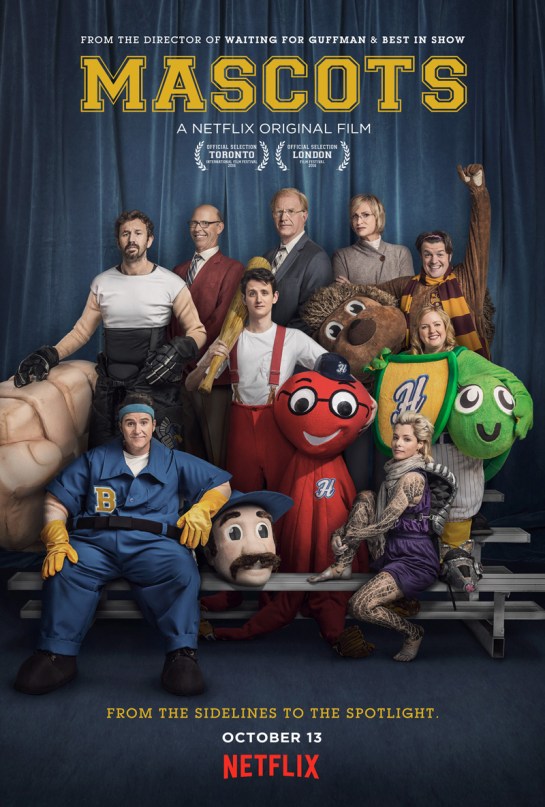
mascots_poster

After opening at the 2016 Toronto International Film Festival, Christopher Guest’s latest mockumentary Mascots was released to Netflix this past week. As a fan of his many earlier efforts—from This Is Spinal Tap to A Mighty Wind—I greatly looked forward to his take on the surreal world of sports mascots.

Unfortunately, this might have been a mistake, as the bar set by those movies was pretty high.

Mascots revolves around the struggles of five teams competing for the Gold Fluffy, the highest achievement of the Professional Mascots Association. One team is a feuding couple, trying to maintain a brave face while on-camera, but killing each other behind the scenes. A second subplot involves a son trying to live up to his father’s and grandfather’s legacies in a hedgehog costume.

Then there is an aging dancer who sees this as her last chance to go all the way, as well as a solo act simply trying to up his game, and an Irish bad boy whose story never really fleshes out.

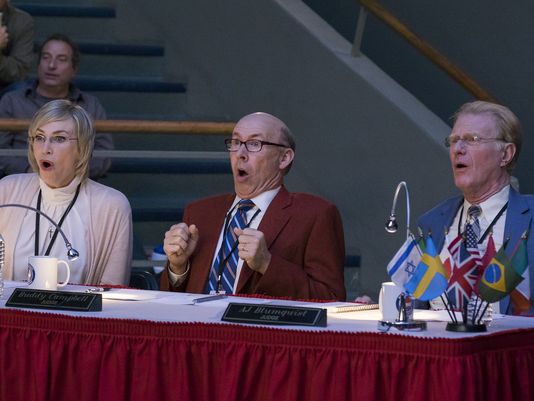
judges

Pretty much sums up some of the stories in this film

As these five subplots buzz around, we also get to see behind the curtain as competition organizers try to hold everything together while vying for a broadcast contract with a fourth-tier cable company, and two former champs feud while trying to judge the contest.

Still with me?

Now, throw in a few more secondary characters and cameos, and you have an ensemble of about 25 characters pushing for air time.

Now as confusing and thin as this might seem, Guest has been able to make it work before in pieces like A Mighty Wind and Best in Show, using many of the same amazing actors: Jane Lynch, Ed Begley Jr., Bob Balaban, Fred Willard, Parker Posey, etc.

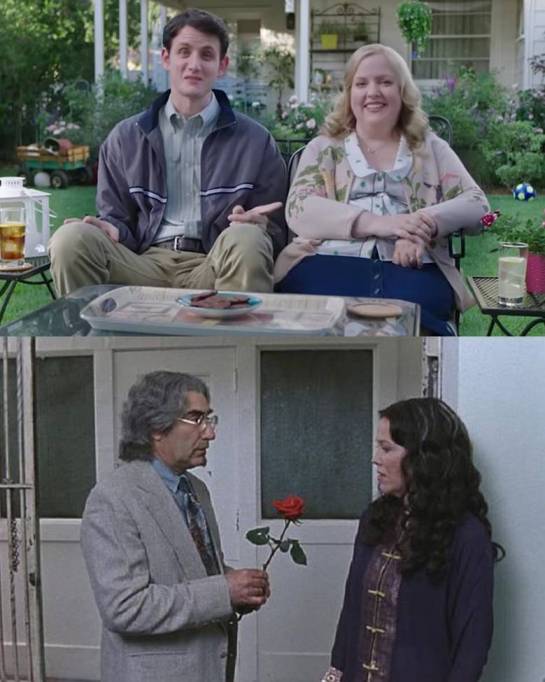
Unfortunately, things don’t seem to gel as nicely in Mascots, and the whole film seems to lack the heart of the earlier efforts. I mean, how do you compete with the simple love-story of Mitch & Mickey?

pathos-challenge

Not really a fair comparison (Mascots, top; A Mighty Wind, bottom)

This isn’t to say, however, that there aren’t poignant moments in many of the subplots or that the actual mascot performances during the competition weren’t spectacular. But rather than being more than the sum of its parts, this film was surprisingly less.

This is where I think my expectations are part of the problem.

Viewed through a virgin lens, Mascots is somewhat entertaining and not a bad way to spend 89 minutes. It would make a great appetiser to tease the palate for a main course of the other meatier films. But as a dessert, it is significantly lacking.

Of individual note, Parker Posey’s interpretive dance student is painfully poignant and outrageously funny. Chris O’Dowd’s bad-ass sex fiend is completely wasted, however, and largely amounts to nothing. And I found the bickering couple—Zach Woods and Sarah Baker—completely distasteful, and the longer I saw them, the worse it got.

30-parkerposey-w529-h529

Perfectly pathetic (Parker Posey)

Jane Lynch and Ed Begley Jr. were great but underused. Fred Willard was the only character Fred Willard has ever played. And the rest of the core ensemble barely managed more than cameos.

Mascots isn’t bad, but sadly could have been so much better.


See also:

Christopher Guest’s ‘Mascots’ fails to really cheer (Associated Press)

Latest from Spinal Tap’s Christopher Guest does not go up to 11 (The Guardian)

Jack Reacher? Yes, he did

jr-poster

Never has a movie been more aptly subtitled than the newest Tom Cruise action thriller Jack Reacher: Never Go Back. I really wish he hadn’t.

In the tradition of Jason Bourne and Taken, this is yet another dip into the former military man living life off the grid, but ceaselessly being drawn back in to save the world or a daughter; and in the case of this film, both.

There are two basic plots in this movie. First, Tom Cruise rescues and then helps Cobie Smulders (How I Met Your Low Expectations) find out who killed soldiers under her command, ultimately uncovering what looks like an arms-dealing conspiracy with its fingers in the U.S. military.

jack-reacher-2-movie-images

Back to TV for Smulders after this stinker

Complicating matters, however, is the idea that Cruise may have a daughter, played by Danika Yarosh in what appears to be her first major role. And in keeping with the schtick of man who is invulnerable because he has no ties, Cruise reaches out to his erstwhile daughter only to have the bad guys see this and take advantage.

Now, whenever watching a movie billed as Action-Thriller, you forgive a lot. If everyone did the right thing, this would be neither active, nor thrilling. But in this movie, the two supposedly smartest people in the room—Cruise’s Jack Reacher and Yarosh’s street-wise Samantha—behave incredibly stupidly, routinely telling the world “Hey, we’re over here!”

danika-yarosh-samantha-dayton-jack-reacher-2

Maybe Yarosh can act…not given a chance in this movie.

But again, this is all about the action, right?

Well, it would be if the action were more than a mere nod to those better films involving Jack Ryan, Jason Bourne, James Bond, and Rob Roy (okay, maybe the better Liam Neeson parallel is Taken). Instead, the action is sparse, predictable and formulaic. Cruise may be known for doing his own stunts, but he was at little risk of being injured on this set.

Okay, but it has thrills, right? Twists and turns that constantly kept you guessing?

The only thing that kept me guessing in Jack Reacher: Never Go Back was what time it was and how close we were to the end of the movie. From almost the opening moments, you knew exactly who the bad guys were and how they were connected to each other.

This was a film that was totally devoid of reveals and reversals. It played out exactly as you thought it would, and in some cases, the dialogue was so telegraphed that the climactic (if only in where it occurs in the movie) scene bored you because you knew exactly how it was going to play out.

How bad could it possibly have been?

With about 10 minutes left to play, the theatre in which I watched the movie brought the houselights up. It was as though they wanted to protect everyone who worked on this movie from being outed by keeping us from seeing the credits clearly.

As my friend Danny and I discussed the movie (video to come), we agreed that this was a wink or two away from becoming a very fun satire of action-thriller movies. Sadly, those ocular gestures never arrived and the movie remained a sad reflection on the genre.

It’s movies like this that will send Cobie Smulders back to television and sadly, may stunt the career of Danika Yarosh. That it won’t crush Tom Cruise’s career is a sign that he probably is Lestat.

lestat

See also:

Movie Review – Jack Reacher: Never Go Back (Danny F. Santos)

Sentimentality and Spinal Injuries (Richard Crouse)

Jack Reacher is a family guy thug in Never Go Back (Toronto Star)

Jason Bourne should have stayed home (review)

bourne poster

Super-assassin Jason Bourne is trying to figure out who he really is. In doing so, he falls into a web of deceit and potentially world-crippling black ops, including the one that gave birth to him. People try to neutralize him…silly people.

Cars race through crowded streets. Shots are fired from every direction. People die just as they start to provide answers. More shots are fired. Bourne gets answers but no real resolution or peace.

If you expected any more from a Jason Bourne movie, then you will be seriously disappointed with the latest installment of the series based the lead character of the novels by Robert Ludlum. In fact, if you want more from a Jason Bourne story, read the novels by Robert Ludlum because they are insanely better than any of the movies.

[Some SPOILERS hereafter]

In the latest installment of the series, Matt Damon’s titular character is brought out of hiding by his former nemesis-turned-ally Nicky Parsons (Julia Stiles), who has hacked into the CIA server and stolen the complete dossiers of the agency’s Black Ops. She wants to turn the information over to a Julian Assange kind of character, but asks for Bourne’s help, enticing him with information about his father’s involvement in his creation as super-killer (think X-Files Fox Mulder).

After a momentary “I’m getting too old for this shit” and some personal sacrifice on the end of a bullet, Bourne is alone again and we are off to the races.

Bourne cast

The CIA Director (Tommy Lee Jones) wants him dead, relying on another super-assassin The Asset (Vincent Cassel) to get the job done, while IT-savvy CIA analyst Heather Lee (Alicia Vikander) sees an opportunity to advance her career and maybe replace her boss by bringing Bourne in. Oh, and in the background, there is something about the CIA having access to the personal information of everyone on the planet via the Internet and a Sergey Brin-like character.

Unless this is your first Jason Bourne movie, you know how this all plays out…and if it is your first Jason Bourne film, why should I spoil it for you?

If you are looking for 123 minutes in which to simply check your brain at the door, then this is an entertaining way to do that. Stuff blows up, people fight, lots of car chases. But nothing really happens that hasn’t happened in the previous movies. Much like a roller coaster, the ride can be exhilarating at moments, but once the ride stops, so does the exhilaration.

And that was my problem with the movie…the thrill is quite literally gone for me. Jason Bourne has become his own cliché, and the writers and directors of this series are simply repeating moments from the other incarnations.

Where they had an opportunity to do something truly interesting with this story—the moments we spend exploring Bourne’s relationship with and confusion about his father—the writer-director Paul Greengrass and writer Christopher Rouse give us the barest taste and scurry back to blowing shit up. Rather than offer any sense of discovery and revelation, they simply have a former agency hack fill in the background under threat of death.

Is toady ex machina a thing?

In the earlier incarnations of this series, I never knew what to expect. In this incarnation, I knew exactly what to expect and it was delivered each and every time with a pretty pink ribbon. Or was that faded red tape?

I’m going back to the books. At least Robert Ludlum knew how to write.

As for shit blowing up, back-stabbing political conspiracy, and disquieting Internet voyeurism, 123 minutes of Jason Bourne just can’t compete with 20 minutes of CNN.

Bourne books