Judging Amy…Schumer…in Trainwreck (a review)

poster

I need to disclose that I adore Amy Schumer. I think she is an amazingly funny and talented comedian who has a knack for finding every nerve in every situation. Thus, I was petrified when I heard she was going to write and star in a movie.

Obviously, it’s not that I didn’t think she was talented. More that the talent to pull off a movie is very different from the talent to perform stand-up or biting sketch comedy.

Most comedians do not make the transition smoothly, and when they do, it is largely because they have completely reinvented themselves, often after several rocky outings. And many simply make the not-particularly-safer jump to sitcoms.

There is a lot to like about Schumer’s Trainwreck, so in that sense, I am happy that she didn’t completely self-immolate. On the other hand, the film had a lot of weaknesses that simply highlighted the challenge of writing a 122-minute sketch.

The movie had a lot of funny lines and several funny moments, based on the laughter that surrounded me and periodically fell out of my own face. And the humor was classic Schumer for those familiar with her comedy.

Anatomical jokes. Sexuality jokes. Feminine hygiene jokes. A bit of racism here and there. And crap loads of jokes about what a giant slut Amy is—note that she followed long-standing comedian tradition of naming her character after herself.

And Bill Hader was amazing in the role of the sports surgeon-boyfriend Aaron, particularly as he largely played the entire movie straight. This was not one of Hader’s million oddball characters. This was Hader being a regular human being who hangs out with multi-million-dollar sports figures.

Where the movie fell down for me was in the story. In short, it was a pretty stereotypical romcom.

In this case, they didn’t go with the “I hate you, I hate you, I can’t live without you” model of Nora Ephron. This was more the increasingly familiar “I don’t know about this, gee this is nice, what the hell, I hate you, never leave me” model.

Now, as a romcom, that is perfectly fine. If you came looking for a romcom, you will leave satisfied. It’s classic Judd Apatow, who directed Trainwreck.

But this was hailed as the anti-romcom (not necessarily by Schumer). The movie that turns romcoms on their head. Yes, the commitment-phobe in this story was the woman and not the man, but Schumer couldn’t seem to commit to that, ironically enough.

Adorable couple...cue trainwreck in 3...2...

Adorable couple…cue trainwreck in 3…2…

After establishing her character as the wham-bam-thank-you-sir kind of girl, she almost effortlessly falls into a relationship with Hader. There is token resistance, but it is overwhelmed simply by Hader saying he doesn’t agree and thinks they should be dating. This isn’t edgy; it’s sweet. Even her voiceover admits that.

Not to give anything else away, but conflict, crisis, lesson learned, gritted teeth, redemption and I love you, I love you too.

Again, if you want a romcom to match all romcoms, you got it. For those of us waiting for the Amy Schumer jab-twist combo, it was meh.

As to all of those other amazingly funny performances that everyone was raving about, I must have blinked through those scenes. It was a bigger shock seeing Tilda Swinton as a woman (and not David Bowie) than seeing her crack wise. Colin Quinn largely played Colin Quinn, who I like but did nothing spectacular here. Dave Attell wasn’t even funny.

Tilda Swinton and Tilda Swinton

Tilda Swinton and Tilda Swinton

And the various sports dudes like LeBron James and John Cena were your typical variety show variants of athletes…mostly cartoonish feminized versions of their personas.

Schumer had moments of real pathos here, so kudos to her acting chops. This wasn’t the joke-a-minute machine of her show. There is definite potential there for a film career, but like all the others who came before her, it will likely mean reinventing herself, and I’m not too sure that she’s finished inventing herself on stage or in sketch.

In fact, I sure as hell hope not, because that’s the Amy I adore.

Lady gonna do whatever she damned well pleases!

Lady gonna do whatever she damned well pleases!

Inside definitely Out (a review)

poster

Earlier today, I had the opportunity to see the latest Pixar movie Inside Out in the company of one of the film’s writers and its story supervisor Josh Cooley (a very nice man). And aside from receiving a lovely lecture about story development at the famed animation house, the connection afforded me an opportunity to appreciate the movie much more than I did on simple viewing.

To briefly bring everyone up to speed, Inside Out tells the story of the emotions that rattle around inside the mind of 11-year-old Riley as she struggles with a move across the country. Although we are introduced to 5 main emotions in Riley Headquarters (get it?)—Joy, Sadness, Anger, Disgust and Fear—there is no mistaking that Joy is numero uno in this space.

https://www.youtube.com/watch?v=zkBSRadEv8A

Joy (voiced by Amy Poehler) sucks the oxygen out of any room she’s in and proves that even the best intentioned of assholes is still an asshole. Her goal in life is to make every moment of Riley’s life a happy one and is not worried about shoving aside the others (ever so happily) to ensure that.

But where Joy has developed a respectful détente with Anger (Lewis Black), Disgust (Mindy Kaling) and Fear (Bill Hader), she firmly but gently has no use for Sadness (Phyllis Smith), practically ostracising the poor creature to the periphery.

With the upset of the move from Minnesota to San Francisco, though, Sadness seems to want to be more involved and in a fracas with Joy, the two get sucked out of headquarters and into the long-term storage hinterlands of Riley’s brain.

At this point, the story basically turns into the Odyssey as the two emotions struggle to return home before Riley falls completely apart at the hands of the others. (To say much more would be to offer spoilers.)

Joy and Sadness wander the hinterlands of long-term memories

Joy and Sadness wander the hinterlands of long-term memories

The challenge I had was in trying to figure out exactly at whom Pixar was targeting the movie.

Superficially, this is a pure kids movie (ages 6 to 10, maybe), unlike many previous Pixar concoctions, which had elements for both kids and adults. Inside Out doesn’t have the depth of Toy Story or The Incredibles to truly speak to adults, much as the most mature 11-year-old isn’t ready for the adult world.

I’m not saying there aren’t adult-focused jokes interspersed throughout the film, but rather exactly that. They are interspersed, like small granules of sugar designed to feed the parents accompanying the kids to the theatre.

Up talked about loss and aging

Up talked about loss and aging

There is no real adult storyline to this film to touch adults as there was in Up or Wall-E. Instead, the film has sweet, adorable moments of baby bums and first goals that might tug at a parent’s heartstrings but never engage the soul.

But as a friend suggested, it is not strictly a kids flick either because it touches on esoteric aspects of the psyche that kids that age would never be able to comprehend, such as abstract thought and the concept of forgotten memories. The problem is these aspects are more conversations of the mind and not the soul. So even here, the adult is largely passed over unless they have an interest in neurology and psychology.

Wall-E dealt with issues of love and environmental destruction

Wall-E dealt with issues of love and environmental destruction

And as a writer, perhaps the biggest sin with Inside Out is there is no sense of what’s at stake.

Sure, Joy is losing her cool as she fights to get back to headquarters. For her, Riley having a down moment is a disaster.

And Sadness isn’t exactly having a picnic as she is routinely sideswiped or ignored by Joy in their efforts to get home. If anything, she increasingly takes the blame for everything onto herself.

But what’s at stake? What if they don’t get back to headquarters?

Does someone die? Is life no longer worth living?

I don’t know because that was never a question on the table. And without stakes, I find it difficult to root for the hero.

And this challenge is made all the more difficult by the fact that the hero (Joy) is also the villain, albeit passively. She is truly her own worst enemy, and so I quickly find myself irritated by her with no great concerns about the outcome.

The six hour conversation and lesson with Cooley helped me see a lot more of what the writers, animators, editors, directors and producers were trying to accomplish. And that did help me understand the movie better. The thing is, few others were going to get this kind of help.

The movie will do well at the box office. Of that I have no doubt. It is a wonderful vivid distraction for young kids.

But it won’t have the staying power of Pixar’s earlier efforts and likely won’t be spoken of again in a few years other than in possibly hushed whispers.

Hot Girls Wanted documentary (a review)

Hot_Girls_Wanted

Watched Rashida Jones‘ documentary Hot Girls Wanted about the amateur porn industry and can honestly say I have no idea what I think of it.

Part of the challenge is I have no idea what the point of it was other than to document the experiences of several young women (18-25 y) as they approach and experience the lifestyle. We can argue day and night about whether the lack of an overt agenda or POV is a good thing, but to my mind, it presented the women as neither victims nor empowered…simply as women who made a choice.

https://www.youtube.com/watch?v=qTkEIGsNXu4

To be blunt: These women chose to go to Fuck Camp to make money and escape home.

It is interesting to watch the impact of their decisions on their lives and particularly their relationships with families and boyfriends. And I had to laugh at the irony of one woman who was clear in her rationale about her decision until it came to talking to her father about it.

And I must admit that I was surprised at how cavalier (my biased standards, not theirs) the women were about what they were doing, the potential hazards of the situations they found themselves in, and any thoughts as to how this might impact future life decisions beyond the 3-6 months they made money (not a typo…a woman’s “marketability” typically only lasts 3-6 months).

One of the few images I'm willing to show

One of the few images I’m willing to show

Over its 82-minute span, the documentary drags a little in places and often covers the same ground, no doubt to reinforce some of the more graphic elements. And it is graphic, stopping short of showing the actual sexual acts, but giving you enough of the rest (e.g., nudity, bondage, choking, vomiting) to bring across the essence of what these women are doing.

And in the end, the take-away is whatever you take away from this story.

No matter what your opinion going in, this will only reinforce that opinion. It doesn’t seem to be aimed at making you change your mind about the merits or evils of this industry. The same woman who feels exploited in one scene expresses a sense of empowerment in the next, and in some cases, about the same act.

Adult women making adult decisions about the adult industry. Good or bad is for you to decide for yourself.

An actress and a producer discuss the documentary

An actress and a producer discuss the documentary

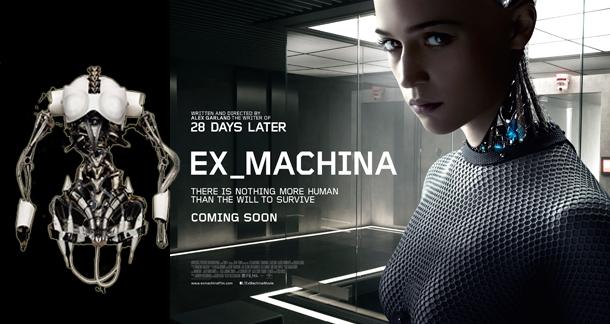
Ex machina – a review

ex_machina

Ex machina tells the story of Caleb (Domhnall Gleeson), a young computer programmer slaving for a large unnamed corporation that we eventually learn is somewhere between Facebook and Google. As the movie starts, Caleb’s computer flashes that he has won a company contest to visit the mountain-retreat home of recluse company founder Nathan (Oscar Isaac).

https://www.youtube.com/watch?v=XYGzRB4Pnq8

Upon confused arrival, he is welcomed warmly by Nathan and escorted through a labyrinthine maze of non-descript hallways where Caleb learns he has access to some rooms and not others based on his ID card. As Nathan explains, the austere design reflects the space’s use not as a home but rather as a research facility.

Nathan explains his AI breakthrough to Caleb

Nathan explains his AI breakthrough to Caleb

Nathan eventually divulges that he has been working on building an AI or artificial intelligence, and that Caleb’s role during his week at the retreat is to apply the Turing Test to the AI; that is, through a series of questions to elucidate whether the interviewer is speaking with a human or a computer.

Which brings us to Ava—played by Alicia Vikander—the ingénue AI that Caleb is to test. As she sits before her inquisitor, Ava is mostly metal and wires, but that hasn’t kept Nathan from endowing her with sexuality in her form, a soft approachable voice, and a human-like face.

Caleb becomes Ava's inquisitor through plexiglas

Caleb becomes Ava’s inquisitor through plexiglas

Through a series of conversations—between Nathan and Caleb, and Caleb and Ava—the film explores questions of identity, freedom, inalienable rights and love. But therein lies my primary problem with the movie: It is a stage play performed as a film.

Without giving too much away [doing my best to avoid spoilers], the interactions between the characters are almost as sterile as the environment in which they occur. Simply put, damned little happens aside from a series of conversations.

A labyrinthine maze of halls and locked doors

A labyrinthine maze of halls and locked doors

I am confident that this was done on purpose by writer/director Alex Garland—best known for the films 28 Days Later and 28 Weeks Later. I have no doubt that the minimalism of film is in itself a metaphor for the lifeless character of the AI.

But whereas minimalism is expected in a live theatre, it feels off-putting in a cinema. Ex machina engages the conscious mind but not the eye, unless your eye is drawn to beige. In fact, given the lack of action in this film, it would even work–possibly better–as a radio drama.

Domhnall Gleeson, Alicia Vikander and Oscar Isaacs (L to R)

Domhnall Gleeson, Alicia Vikander and Oscar Isaacs (L to R)

The performances were good, but I didn’t feel like the actors were given a lot to work with.

As I found so ironic with the movie Prometheus, the character of the android Ava was the most deeply developed (compare Ava to Michael Fassbender’s David). You could actually see her character evolve as the movie progressed at its leisurely pace. And full marks to Vikander for being able to imbue so much internal communication through subtle verbal intonations.

Subtle intonations and expressions bring Ava to life.

Subtle intonations and expressions bring Ava to life.

The character of Nathan showed the most potential, however, as you could see a brooding darkness within him that vacillated between wilting depression and disturbing malevolence. But as with so many aspects of this film, the potential was never really explored and we were left with a subtextual emptiness.

And Caleb proved to be the type of antagonist that I find least appealing—the victim—mostly bobbing like a cork on the eddies and currents outside of its control. He is neither hero nor anti-hero and so leaves me cold and uncaring, and if I don’t care, I am not engaged.

Ex machina is a very cerebral movie, dealing with deeply philosophical questions about humanity and self-awareness, and to a lesser extent about emotional connection. And in many ways, it is only because of Ava that the film does not devolve into an Open University lecture.

There is little doubt that the robotics and artificial intelligence enthusiasts will get a hard-on from Ex machina, a biological function that forms a humorous sidebar in the story.

But for those who like these subjects and want to be entertained by a gripping story, I suggest you take another look at Ridley Scott’s Blade Runner, where identical questions are discussed in a backdrop of a film noir story line.

Ex machina is not completely without mystery, and I did find myself asking questions about the characters, including wondering if the audience wasn’t part of some Turing Test. But if I ever opened my mouth in anything approximating a “wow”, it was merely to yawn at the film’s glacial pacing.

There are small moments of tension, but they dissipate quickly and rarely result in any shocking revelations. There are moments that are squirm-inducing to start but do not really linger or pay off.

But for all my complaining, the ending of the story was satisfying. Although, for my money, that’s when the story finally got interesting.

Like Transcendence before it, Ex machina had a lot of potential, but failed to deliver.

Perhaps an AI film director will do better.

It (tediously) Follows – A review

It Follows

We all remember the dire warnings from health class or worried parents: If you have unprotected sex, you run the risk of coming down with an STD.

Well, for the kids in the movie It Follows, the itch of crabs or the need for antibiotics would be a welcomed distraction from the STW they risk by having sex with the wrong partner.

Choose your partners wisely

Choose your partners wisely

STW? Sexually transmitted wraith.

It Follows tells the story of Jay, a sexually active late-teen who finally succumbs to the charms of her newest beau Hugh, only to learn that not only did she accept his penis, but she also accepted a curse that involves a plodding ghost trying to kill her.

As long as Jay stays alive, the ghost leaves Hugh alone. The best advice, he suggests, is for Jay to pass the curse onto someone else as soon as possible, hooking up like he did with her. If the wraith gets Jay, it then comes after Hugh and then continues up the line of transmission.

Complicating life is the fact that only the cursed can see the wraith, which can transform from a urinating half-naked mutilated woman to a senior citizen to someone you know. Thus, even when Jay enlists her sister and friends to help her, they are largely useless other than as a source of comfort and uncontrolled screaming and running.

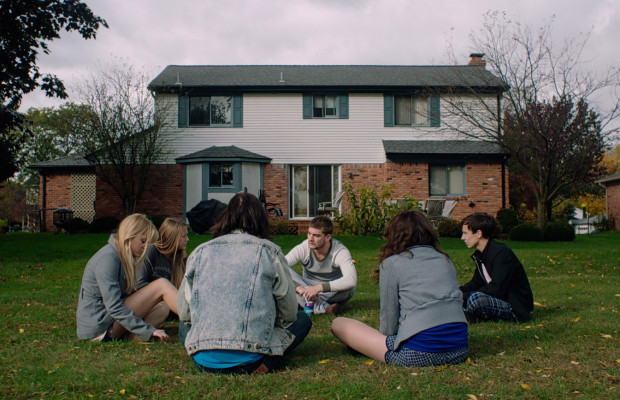
Crazy kids hatch a plan

Crazy kids hatch a plan

Now, I don’t like horror movies. I am a jumpy person by nature, and so sudden surprises bother me. Thus, when my horror-loving friends suggested we see It Follows, I was reluctant. But I am trying to expand my genre repertoire and so joined in.

As it worked out, there was no reason to worry.

(HEREAFTER THERE WILL BE SPOILERS.)

Throughout the entire 100 minutes of the movie, I jumped only once, and as it turned out, at nothing that had anything to do with the story.

None of the appearances of the wraith (okay, maybe one) were particularly startling or unexpected. And aside from the musical cues to the audience to become anxious—music that would not have been out of place in any classic 80s horror—the movie offered little suspense. And after more than a few musical feints, even that ceased to make me uneasy.

Aggravating the lack of tension was an excruciatingly plodding pace to the story, which triggered more yawns in me than shudders. The only thing slower than the pace was the plodding approach of the wraith.

My friends—the horror aficionados—suggested that this gave the demon (and the movie) a relentless feel…the wraith was often shown slowly approaching from a distance in wide-angle shots. But to me, the movie was relentless in the way a train travelling at one mile per hour is unrelenting.

It will crush you…eventually…once it reaches you…assuming you don’t simply step off the tracks.

What I will admit was relentless was that truthfully the story could only end one way. (I am trying not to tell you how the movie ends.)

Because the wraith will always move up the chain of transmission, Jay is fated to die. Even if she passes the curse onto another. She will die. It is simply a matter of when.

Not taking the news well

Not taking the news well

The writer and/or director essentially painted themselves into a corner from the outset.

This is not to say that the kids only run away, but they also had no information to help stop the wraith…if possible. And no one seemed interested in determining what is was or why it was.

This is yet another reason why I could not engage in the movie. It gave me nothing to do but wait, and watch the kids attempt roughly the same actions time and again.

Maika Monroe

Maika Monroe as Jay

Given the nature of the beast—horror movies, that is—the performances were solid. The acting was quite good—Maika Monroe as Jay was quite effective—and the relationships between the characters felt real. Aside from a few subtextual set-ups that had no payoff, most of the character interactions satisfied.

Sadly, the actors were completely let down by the writer and/or director.

With the wraith largely incapable of harming her sister or friends (it only wants the cursed), all of Jay’s (our hero’s) actions were self-serving. Simply put, Jay did everything not to die.

And while this is understandable and even compelling early on—again, Maika Monroe is very likeable—it eventually lacks nobility. There were no other stakes, and how do you raise the stakes from gonna die? After a very short period, I was ready for Jay to die simply so my friends and I could get to the pub.

I appreciate that I am in the minority here (and at the pub).

It Follows will inexorably spawn a sequel—no doubt entitled It Still Follows—and possibly a third (Yep, Still Following) and fourth (Hunh, Where’d It Go? Oh, Jesus, There It Is) chapter.

For me, however, I’ll just go back and watch Poltergeist (the original, thank you) and have nightmares about clown dolls.

Now THAT is scary

Now THAT is scary

Now, if you want a good (and shorter) counterpoint to my antipathy for It Follows, check out a post written by another friend Danny F Santos, which can be found here.

Heart of Coppola

Zeotrope

Francis Ford Coppola likes me! He really likes me!

So, no sooner do I finally get around to posting my laurels from Nashville than I find out that my screenplay The Naughty List was selected as a semifinalist in the 12th Annual American Zeotrope Screenwriting Competition, an organization run by Francis Ford Coppola (I seem to recall he was a director of geopolitical documentaries).

I had started to wonder if the screenplay was going to see any love in the competitive world…this is good!

Coming to a theatre near you (please, please, please)

Coming to a theatre near you (please, please, please)

So, what is the story of The Naughty List?

What would you do if you learned decisions you make every year ruin the lives of millions of children?

Oh, and your name is Santa Claus.

After a brush with death just days before Christmas, Santa rescinds the Naughty List only to learn that for some kids, the lump of coal started a life-long downward spiral. In fact, two kids—now warlords—are about to unleash hell on each other and their people.

With a loving heart and snowy balls, child-like Santa dives into the fray. But his magical meddling only makes things worse.

He greases the wheels of war. More children suffer, including a girl desperate to save her family. As his magic fails, Santa knows he must face the oncoming storm as a mortal.

One man. Two armies. Can Santa stop the madness and save a crumbling Christmas?


From Equalizer to minimizer (a review)

equalizer movie poster

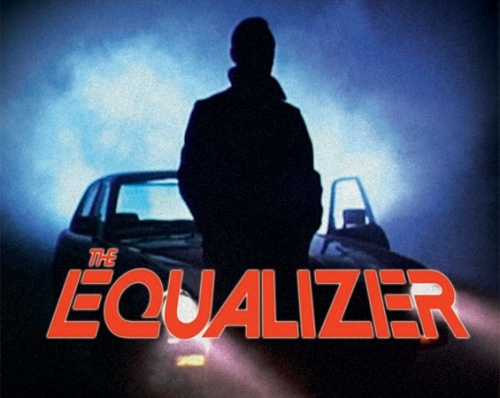
Eighties are the new teens…as in everything you loved about the 1980s is coming to a theatre near you. As the latest example, we have Denzel Washington in the role of Robert McCall in a revisit (can’t really call it a reboot) of the television series The Equalizer.

The central conceit of both the film and television series is that McCall is a retired special forces agent (think CIA) who tries to help people out when they get run over by criminals, corporations or malevolent government forces.

Whereas in the TV show, we see his mission fully formed, the movie is a bit more of a prequel, showing us the transformation of McCall from quiet man to vigilante.

The movie opens with McCall being the happy guy working at a Home Depot, jovially chatting with co-workers and providing something of a father figure to his younger compatriots. But away from the job, we see that he is a loner, a man with a heavy psychological burden that keeps him from sleeping.

And it is this insomnia that links him to young prostitute Teri (aka Alina, played by Chloe Grace Moretz) who is fascinated by this man who sits in a diner at 3 am, drinking tea (he brings his own bag) and reading classic literature (we open with The Old Man and the Sea…the books are a metaphor for the character). Again, the father figure comes into play as McCall is one of the few men who treat her as a human being and challenge her to be the woman she wants to be, not the victim she is.

denzel-washington

And it is this bond that causes McCall to act when Teri is hospitalized by her Russian mobster pimp. A noble man, McCall offers to literally buy Teri’s freedom, but when the mobsters simply laugh him off, a life of brutality surfaces in the scarred knight and the world dissolves into chaos.

To give you any plot details beyond this would be to potentially spoil the movie.

Denzel Washington is an amazing actor and is wonderful in the role of Robert McCall. Offering a very different take on the character than his television predecessor Edward Woodward, the two actors share the ability to display a man who is outwardly in control of all situations but at the expense of always holding onto an inner torment that they are afraid to acknowledge, let alone unleash.

But whereas the TV equalizer rarely got his hands or his clothes dirty (compare TV poster below with film poster above), the film equalizer is willing to release a storm of martial arts and weaponry on the bad guys. Thus, the film is much more action packed than the TV show.

The-Equalizer-TV-Poster

To the credit of director Antoine Fuqua—who also directed Washington in Training Day—despite at least a dozen scenes of intense violence and blood-letting, he does an amazing job of minimizing the amount of actual blood that reaches the screen. In part, he accomplishes this by shooting the most violent scenes in darkness such that you only really see light reflecting off dark puddles. Likewise, when McCall does resort to using make-shift weapons (remember, he works in a Home Depot), the camera often switches to McCall’s face as he uses the weapon rather than to weapon and victim.

Unfortunately, McCall is such a cool and controlled customer that I never really worry about him. I cheer his victories when he vanquishes the dragon, but I find it difficult to really attach myself emotionally to the man. I like the quiet man, but I find the killing machine to be just that, a machine; an automaton that does not touch my heart. And with the exception of a handful of moments, we never really get a chance to appreciate the toll these actions take on him.

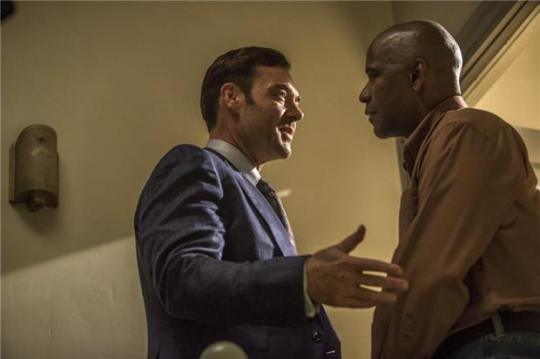
The other place I feel the story falls down is in the use of the Russian mobster sent to clean up the mess that McCall started, a man simply known as Teddy. Played by Marton Csokas, Teddy and McCall are equals. The same side of the same coin. Equally smart. Equally charming. Equally viscious. And as such, the only real threat in the entire film to McCall.

The-Equalizer-13-Marton-Csokas

(As a side note, if this role is any indication, we want to keep our eye on Marton Csokas. He will do amazing things.)

There are a couple of scenes where the two men literally face each other and calmly discuss the situation. One scene in particular is the best thing in this movie from my perspective. While on one level being the calmest moment in the movie, it is also the most chilling because of that calm. You really don’t know what’s going to happen.

And that’s where my problem lies.

Having set up the perfect opponent for McCall, the writer Richard Wenk (who also penned The Expendables 2) doesn’t really deliver. The audience was promised an epic show down between these two characters, but while they do clash, it is anything but epic (photo below is not from clash).

the-equalizer-marton-csokas-and-denzel-washington

The Equalizer is entertaining. It is a wonderful diversion that requires little thought of its audience. It is Jason Bourne for the middle-aged set (but with enough carnage to keep the young’uns interested). It should, however, have been better.

But when it comes right down to it, the studios don’t really care if you like it, because they are already working on the sequel.

No parity in parody

Parody

Mel Brooks is a god! Carl Reiner is a god! Carol Burnett is a god! Mike Myers is a really funny Toronto boy, who flew pretty close to the sun. (He may yet be a god, but he has to get back on his feet.)

And among their many talents, these people share the amazingly delicate talent of creating parody…a talent I have yet to seriously attempt beyond the scale of sketch comedy.

Delicate talent? Seriously attempt? Isn’t parody just a matter of picking a genre and inserting dirty jokes and/or completely ham-fisting its various tropes in the mathematical assumption:

Absurd + Puns + Dirty = Funny

I increasingly understand why people think this as I watch more of the recent fare of parodic films that appear to have taken this equation to heart.

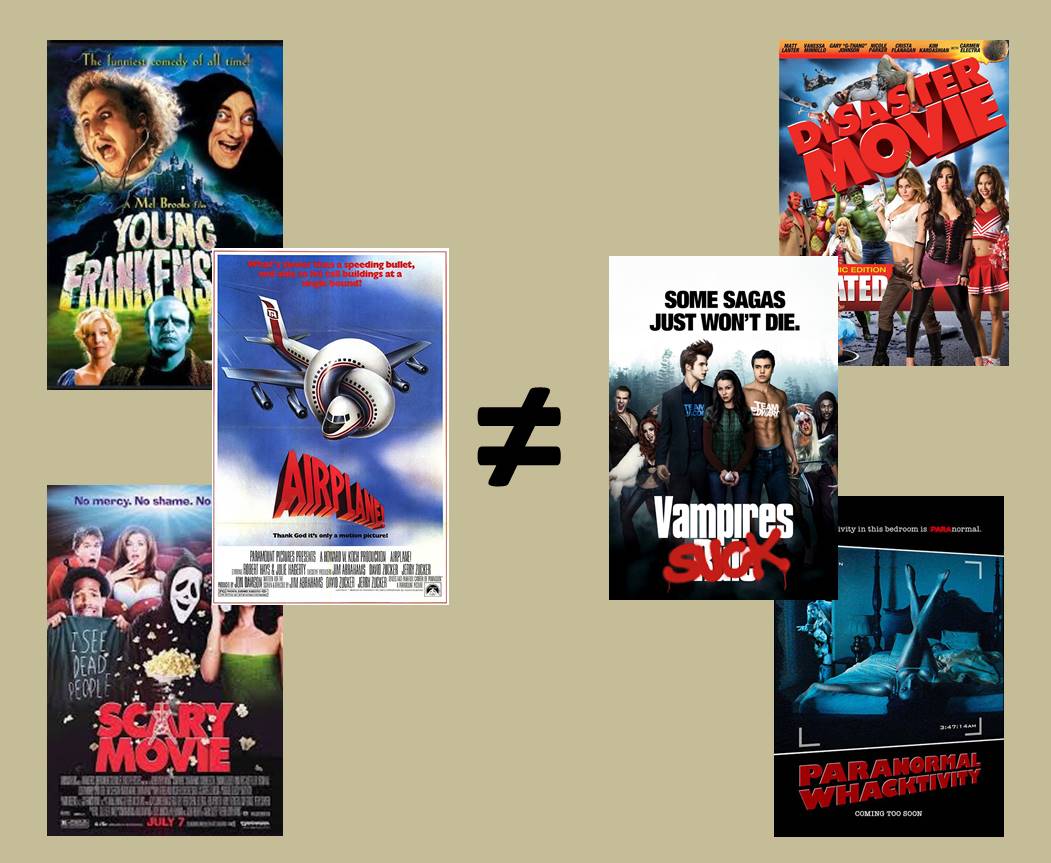
Last night, for example, I watched Paranormal Whacktivity, a sexed up romp through the found-footage haunted-home segment that includes films such as Paranormal Activity and Blair Witch. This film was horrific, but not in a good way…nor was it particularly funny or sexy. And it wasn’t very good as a parody because it didn’t even stick to its genre, mixing Paranormal Activity with Ghostbusters, which both involve spirits but are hardly cinematic siblings.

It was useful, however, to my understanding of parody.

When I compare Blazing Saddles, Airplane, Dead Men Don’t Wear Plaid, and Austin Powers: International Man of Mystery to Disaster Movie, Not Another Teen Movie, and Breaking Wind, I realize that the truly classic parodies have something that the new ones don’t: a strong central story.

Somewhere in the evolution of parody films, the movies became less about story and more about ripping off as many genre clichés as possible, offering no firmer links between these scenes than bad jokes, fart noises or perky breasts.

Blazing Saddles wasn’t about taking a bunch of classic scenes from Westerns and simply linking them. It was more about taking iconic characters from the Westerns and creating a classic, if twisted, story. The sheriff abandoned by the town folk, the washed up gunslinger, the evil cattle rustler, the crooked politician.

Similarly with Shrek; although this film has such a strong central story that I’m not sure whether I should even include it in a list of parodies. Yes, it played up almost every fairy tale gimmick, but the story really didn’t model itself on any given style or pre-existing story.

Dead Men Don’t Wear Plaid is another odd case. With a strong through story led by Steve Martin and Rachel Ward (directed by Carl Reiner), it takes parody to a whole new level by incorporating actual scenes from noir films within the scenes with live actors. Thus, Martin’s character may find himself playing across from Barbara Stanwyck or Edward G. Robinson. Now, that is great film writing and editing.

http://www.youtube.com/watch?v=jAzV-BM3h5Q

Interestingly, the Wayans’ brothers first entry into this genre—Scary Movie—offers another lesson about parodies: the challenge of dipping into the same well too often.

Although horror/slasher movies are not to my personal tastes, I thought the first one or two films of this series were particularly well done. But as the series continued, picking on more films from within the horror/slasher genre, it started to become a parody of itself. The jokes were no longer fresh. All the best tropes had been used up in the first two movies and so the later films just seemed to be running in place.

Six Star Wars films, one Spaceballs. That works. (NOTE: Spaceballs is one of my least favourite Mel Brooks movies, much to the chagrin of many friends.)

Even the much stronger series of Austin Powers and Police Squad films showed this sense of comedic fatigue.

The original film is a surprise. The first sequel may be enjoyable. Anything after that is milking a dead cow.

I have no doubt that bad parodies will continue to be made…if nothing else, they seem to require little writing and typically have poor production values, and are therefore inexpensive.

My hope, however, is that another Mel Brooks, Keenan Ivory Wayans or Mike Myers comes along to raise us from these creative and comedic doldrums. (NOTE: At present, my money is on Keegan-Michael Key and Jordan Peele, who have the comedic talent and the Hollywood clout to do it right.)


A few personal favourites (hyperlinked to trailer or favourite scene, where available):

Dead Men Don’t Wear Plaid

Airplane

The Cheap Detective

Austin Powers: International Man of Mystery

Hot Shots (not so much the sequel)

Rustler’s Rhapsody

Shrek

Scary Movie

Blazing Saddles

Silent Movie (I may be only person who likes this one)

Young Frankenstein (all time favourite)


Nebraska: Bumpy lives, flat land (a review)

poster

Much like the Big Sky prairies that serve as its backdrop, Alexander Payne’s 2013 film Nebraska takes a little bit to get going, but when it hits its stride, there is no stopping it.

An irascible old drunkard Woody (Bruce Dern) thinks he’s won a $1,000,000 lottery and is determined to collect his prize in person, walking if he must from his home in Billings, Montana to the prize centre in Lincoln, Nebraska. When his youngest son David (Will Forte) realizes there is no stopping the senile old coot, he takes a few days off work and offers to drive.

Along the way, they stop for a few days in his father’s home town of Hawthorne, Nebraska, where they are joined by his mother Kate (June Squibb) and older brother Ross (Bob Odenkirk). But almost as quickly as the townsfolk and extended family realize the old man has struck it rich, the hands reach out for their cut, led by Woody’s former business partner Ed (Stacy Keach).

As I said, the movie starts out slow. Woody has nothing to say to any of his family, at times appearing to have dementia. David meanwhile faces an empty life and just wants to communicate on some level with his family, never having felt like he could talk to them. Thus, when the two men with nothing in common aside from chromosomes take to the road, it feels very much like the start of an opposites-connect buddy film.

NEBRASKA

The dialogue is excruciatingly simple in the early going, rarely more than one or two syllable conversations. Despite occupying the passenger seat of the car, Dern’s Woody is never really there, only being forced into human contact by having everything repeated louder. Forte’s David, meanwhile, has a perpetual pout of a puppy begging to be patted on the head.

Eventually, though, if only out of frustration, David begins to take control of the situation and his life. Through his own explorations and by observing his father interact with the home townfolk, he begins to see that there is so much more to his father, and this is where I really started to take note of Forte as an actor, as something more than his MacGruber caricature.

I would say that Dern turns in a solid performance, but his dialogue is so short and his stare so vacant that only once in a while do we get a real glimpse of the tormented soul within the husk of a man. June Squibb’s Kate is something to behold, however (her voice and attitude remind me of Shelley Winters). Starting more as a screeching shrew, she really comes into her own in the latter half of the film with some of the funniest lines and the staunchest defense of her messed up husband. Odenkirk is solid, but isn’t really given much to do here…this is Forte’s movie.

http://www.youtube.com/watch?v=OHw_WbVtZio

My strongest reaction, however, is reserved for Stacy Keach, who yet again, plays the charming, smarmy bully asshole for which he is famous (think Papa Titus on the sitcom Titus). I can’t remember a role for which Keach didn’t deliver. The man eats up the screen. You can’t not watch him.

Nebraska-Dern-Forte-Keach

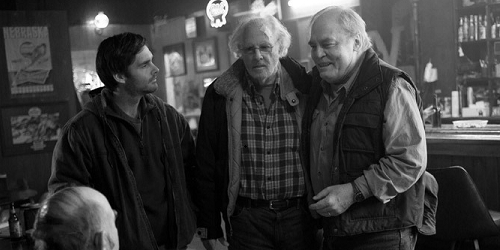
In terms of cinematography, Payne chose to film the entire movie in black and white, giving the whole story a sense of being trapped in another time, and adding to the sense of desolation exhibited by both the geography of the region and the simplicity of the town of Hawthorne, with its barren sidewalks and seemingly abandoned businesses. The whole thing feels like an emotional dead zone and the lack of human spark in all but a few citizens reflects that.

Bob Nelson’s screenplay is a simple one, devoid of plot twists or anxious moments. There are no great moments of revelation, but rather subtle hints at who Woody was when he was a young man. As such, the characters can come across as superficial and on-the-nose. But again, I think this was on purpose rather than a failing. I think he wanted to show us shallow people in a shallow land.

Toward the end, the movie started to take on a bit of a Hollywood ending feel, but although Nelson did start us down that road, he thankfully stopped himself before the point of schmaltzy no return.

All-in-all, I liked Nebraska, although I didn’t think it deserved the accolades it received at Cannes (Palme d’Or nomination, best actor for Dern), the Golden Globes (5 nominations) or the Oscars (6 nominations). It’s just not that deep a film, in my eyes.


You can find a PDF of the screenplay for Nebraska here.