The word was “lemon”

A short piece written at a local Flash Fiction show.

That old beater my dad kept in the barn hadn’t run in all the years that I could remember, but it made a hell of a playground for the kids in the neighbourhood.

One day, it was the Batmobile, screaming out of the Batcave as the Caped Crusader and his gender-neutral sidekick were off to feel all funny down there at the sight of a leather-clad Catwoman.

Other times, it was Sir Francis Drake’s Golden Hind, plying the English Channel looking for Spanish galleons or sliding on the breeze through the Caribbean, searching for buccaneer plunder.

But most of the time, it was just my dad’s old beater, sitting there year after year, slowly filling up with mouse droppings or owl scat.

I remember one summer—I was about six—when my dad and grandfather tried to get the old car running. I learned a whole new language that summer, although it was about four years later before I found out that motherfuckingsonofabitchdickwadcrankbitch wasn’t one word.

That was the summer that we found out that cats like to crawl under the hood of a car and nap on the motor. You wouldn’t think it would be hard to get cat fur out of a fan belt, but you’d be wrong. Mom never really liked Mr. Wiggles anyway.

That was also the summer that dad went away. Whenever I would ask my mom about it, she would just cry, and my grandmother would try to distract me with cookies. So now, not only do I not know what happened to my father, but I am also a 300-pound diabetic.

Maybe that’s why I kept the car, as a reminder of the man I never got to know. Mom just shakes her head and my wife wonders why I don’t get rid of that old lemon. I dunno. Maybe they’re right.

All I know is that sometimes I’ll go out late at night to sit in the car and if I’m really still, I can still hear the sounds of the wind rippling in the sails and the sailors pulling on the rigging. You know, I never noticed how much my dad looks like Sir Francis Drake.

Drake protects the shores of Toronto from marauding pirates

Drake protects the shores of Toronto from marauding pirates

Gotta let it out

Do you ever feel like there is an idea inside you just waiting to burst forth? Like you can’t control the energy that is welling up?

It is there, just below the surface, and no matter how much you try to suppress it–it’s not ready; I’ll embarrass myself; what will others think–you really have no choice but to show it to anyone who passes by.

Congratulations, you’re an artist. Welcome to the club. Oh, and you might want to stand back…someone else is ready to explode.

(Photos taken at Geyser, Iceland.)

You might be a writer

(Inspired by a post on The Writing Corp blog and of course, Mr. Jeff Foxworthy)

If you’ve ever freaked out because your partner loaned your pen to someone and neglected to get it back…

If you own 17 notebooks and still have a house littered with random pieces of paper containing ideas…

If your friends won’t tell you anything anymore for fear it’ll end up in your next novel, screenplay or comedy sketch…

If you’ve heard voices in your head and your first thought was grab something to write with…

If you go on a tropical vacation and only the back of your neck gets sunburned…

If you’ve developed the skill to write coherent notes to yourself without removing your eyes from the person sitting across from you…

If every jacket you own and every room in your house contains a writing pad of one size or another…

If you instinctively know what inks will smear and which pens write upside down…

If you’ve ever found yourself looking forward to a long bus or train ride…

If reaching a crisis is as satisfying as achieving a climax…

(Personally, I’m still working on the writing while looking someone in the eye, otherwise, I’m good.)

The Devil’s in the detales

Attention to detail is craftsmanship.

Fixation on detail is neurosis.

It’s important to be diligent when working on a project, but not so diligent that the project is dead before it starts.

Relax. Let your natural skills and energies flow through you as you explore your art.

It is those little quirks that make the piece yours and not the same as every other piece ever produced.

The ceiling of the trophy room of the Hockey Hall of Fame, which used to be a bank. (Toronto)

The ceiling of the trophy room of the Hockey Hall of Fame, which used to be a bank. (Toronto)

Writer’s Block-ed – Part Two

In Part One, I discussed the idea that the only difference between creatives and non-creatives or people who are blocked is a psyche filter that has become clogged; a filter that sits between thoughts generated deep within and expression of those thoughts to the outside world.

Below, I offer some thoughts on what I have found effective in unclogging that filter.

Step over it or go around it. Nowhere is it written that you must solve this problem right now. Depending on the nature of the project in which you find yourself stuck, is there an opportunity to simply mark a placeholder for where you’re stuck and move to the next part? Personally, in any creative endeavour, forward momentum is key and once lost is hard to regain. It’s easier to push a car that is already rolling than to get one rolling. A number of my manuscripts contain notes to myself along the lines of [something exciting happens here].

Likewise, for a written work, don’t feel like you have to solve all of the plot details early on. I had one screenplay that required my protagonist be in disguise. I had no idea how to do this logically, but proceeded as though it would come to me later…and it did. If you’re in a good space, the spirits will guide you and you will find your answers. But you have to be open to those answers.

Walk away. For most of us, these are very personal projects the only deadlines for which we hold internally. So, screw the deadline. Walk away from the project for a bit. Go see a movie. Read a book. Listen to music. Go for a run.

The longer you focus on the problem, the more inflamed it becomes until it becomes a creative cancer. Let it rest. Give the rest of your brain something to do. Let it do the heavy lifting for a bit. You may just find that the rest of the brain has ideas your creative centre wasn’t able to deal with and those ideas may just sneak past the filter (so have a notebook in your pocket, just in case).

Move to another project. I think a mistake a lot of new writers make is only having one project, as that blows the importance of the project way out of proportion. At any given moment, I have at least a dozen different creative projects on the go, at various levels of completion. That way, the minute I see the first signs of boredom or frustration with a project, I can move to another one to maintain my personal forward momentum. Perhaps the one thing that clogs a filter quickest is creative fallowness as lack of movement breeds insecurity.

The nice thing about working on multiple projects is that the creative act on one project often stimulates the creative response on another. You may have your answer to project one; you may not just be able to see it until you work on project two. Which leads me to…

Try another creative activity. Creativity breeds creativity. For me, photography stimulates writing (I suspect it works the other way, too). When I’m taking pictures, I am focused on the task at hand, the object on the other side of my lens, but because I am a storyteller, part of my brain is applying context to that image. You may have seen examples of this in some of my other blog posts. It allows me to visually tap into other emotions and contexts not previously obvious in my mind and those may inform my writing dilemma.

The key is to actively engage your brain. If you want to do something more passive like reading a book, as suggested earlier, try reading it aloud. Forcing yourself to actually engage with the written material will stimulate different parts of your brain, including your auditory centres. Responding to the movie screen, however, will likely get you thrown out of the theatre.

Hang with other creatives. First off, I don’t think there is anything inherently wrong with a pity party. It can be good to commiserate and share war stories from the trenches. It helps us to understand that we are not alone and that there is another side to the current blockage. And who better to help you with that than fellow members of the society.

Likewise, simply sharing your dilemma opens the floor to multiple brains with filters at various stages of clogging. Hopefully, around the table, there is enough creative force to blow the walls of those filter pores and clear things out. Yes, it’s your project, but you don’t have to do it alone.

If you think screaming at the gods will help break your writer's block, give it a go! (Photo taken in Hope, BC, ironically enough)

If you think screaming at the gods will help break your writer’s block, give it a go! (Photo taken in Hope, BC, ironically enough)

Writer’s Block-ed – Part One

Anyone who has stared at a blank page or screen and been incapable of adding words to it understands the living nightmare that is writer’s block. The whiteness of the sheets or the blinking of the cursor mocks you as you struggle before it, desirous of wondrous expression but incapacitated and mute. You feel incapable, devoid of ideas, and worry that your creative ju-ju will never return.

But are we correct in feeling this way? What is writer’s block?

To my mind, the only difference between creatives and non-creatives is a willingness to create. We all have it within us; it is just that some of us move unbridled to the fore while others linger back. It is as though there is a psyche membrane or filter that separates us, or perhaps, to be more granular, it separates thought from expression.

Think of any filter in your house. The air filter in your car, for example. The filter keeps particulate matter—dust, dirt, debris—from damaging your engine while still allowing air to reach the combustion cylinders that convert fuel to power. When that filter gets clogged, however, less air can reach the cylinders and therefore the car underperforms or does not run at all.

I think the psyche filter works similarly but with a twist. In creatives (and likely in children), the filter is clear and wide open, allowing thoughts generated deep within to pass through freely and find expression in the outside world.

In non-creatives and people experiencing writer’s block, it is less that the pores of the filter have become clogged, so much as the pores have shrunk to microscopic size—a self-clogging filter, if you will. This prevents almost all of the generated thought from reaching the surface to be expressed.

You are generating ideas, but for whatever reason, your filter is keeping you from letting them free.

Alternatively, the filter works more like the car filter in that your psyche requires stimulating input to convert brain energy to creative power. In creatives, the filter lets in everything (or a large part of everything), whereas in non-creatives, again, the pores are too small to let anything more than the rudimentary information needed for survival enter and so the creative engine stalls.

In either case, the capacity to generate thought and to express those thoughts is the same in both groups of people. It is the nature of the filter that distinguishes us.

I wish I could present you with the secret answer for unblocking that filter when it becomes troublesome, but the working mechanisms of each filter are unique, yours attuned to your psyche.

In Part Two, I’ll offer some thoughts on what I have found effective in dealing with a clogged filter. They don’t always work, but by having multiple outlets, I hedge my bets that something will work.

The following gallery explores colour at one of my favourite buildings in Montreal, the Palais des Congres.

Great distances

I sat down recently to come up with some of the great distances in the known universe and think I have discovered the one that trumps them all.

Riding the elevator on Toronto’s CN Tower? Like falling off a log.

Leaping the chasm of the Grand Canyon? Pfft, nothing!

Swimming the Pacific Ocean? Like taking a bath.

Visiting the Oort Cloud at the edge of our solar system? A walk on a foggy day.

No, my friends, none of these is even close to the Greatest Distance in the Universe. That title goes to the space between the nib of a pen and the paper beneath it. I know this, because I have spent hours of my life watching people who cannot traverse this great gap.

The pen sits poised. Ink tantalizingly and agonizingly close to realizing its dream of spreading through the fibres of the paper. You can practically hear the Siren call of the note pad, seducing the ink to come join it in creative matrimony.

And yet, nothing.

The muscles of the hands tighten. The forearm presses harder into the table. The blood accelerates through the capillaries. Neurons in the brain fire in all directions. The spirit wails in unfulfilled lust.

And yet, nothing.

The gap is too large. The rewards uncertain. The risks too high.

Like a supportive father-to-be, I want to scream “Push!” and remind them to breathe.

Like a bicycle-training parent, I just want to nudge their hand to the paper and trail alongside it as it wends its way across the page, releasing just as it seems they have the hang of it.

Like a police psychologist, I just want to talk them down, let them know it will be okay.

But I am powerless in this process. This is something they have to do for themselves, much as I did for myself. When they are ready, they will write.

Until then, as a friend, I will stand with them at the edge of the abyss and imagine what is on the other side, awaiting them.

Any journey is an individual one, no matter how many people come along. (View from Mt. Baker in Washington State)

Any journey is an individual one, no matter how many people come along. (View from Mt. Baker in Washington State)

Giving Feedback – The Reviewer Strikes Back

Okay. So, now that we’ve discussed asking for and receiving feedback, is there anything we should consider before giving feedback.

We’ve all been on the other side, awaiting a kind word or a withering criticism from a respected compatriot or senior, so we should all be aware of the power of the right word at the right time. You have been given an honour by the recipient and should give him or her and the work the respect they deserve.

Below, I offer some thoughts on how to approach the feedback process when asked, but (sorry for the broken record) I want to hear what you think too.

Feedback is personal. It reflects who you are, what you believe and how you feel. Don’t try to make it otherwise, lest you lose any value it provides. The writer asked you for very specific reasons. To give them anything less than you is a disservice.

Make sure, however, that your feedback is more than just opinion, even though that forms the basis of it. There is a world of difference between superficial criticism and thoughtful critique. Criticism is about saying what you feel. Critique is about asking yourself why you feel that way and discussing what it means with the writer.

Ask questions. Be sure to ask questions both before and after you’ve completed your analysis. What kind of feedback are you looking for? Is there anything you specifically want me to keep an eye out for? What was your thinking behind this scene or character?

Without knowing the answers to these kinds of questions, I don’t think you can offer the most effective feedback. Likewise, the answers may provide you with a framework on which to build your feedback or tell if you’ve misunderstood something significant.

Be honest. Never be afraid to tell the truth, no matter how brutal. You’re the best judge of what you think the writer can handle, but by the same token, they’ve asked for your help and holding back may be counterproductive. It’s possible to be honest without crushing someone, and I don’t mean making a shit sandwich (good news-bad news-good news). Rather, walk them through your thinking as you read their stuff and, even if they don’t beat you to the conclusion, at least they understand your reasoning.

And wherever possible, don’t leave them hanging. Offer suggestions as to how the work could be improved or fixed. If you have no ideas pre-emptively, brainstorm it with them. If nothing else, it will show the writer that you’ve invested in his or her work.

DON’T COPYEDIT. That’s not feedback, it’s copyediting. Unless the spelling of a word or the punctuation of a sentence significantly impacts the meaning of a sentence, leave it alone. It ends up being a distraction from the important conversations. If their climax sucks (you’ll want to be more specific), who cares that they should have used a semi-colon or incorrectly used “its” instead of “it’s”?

Put it in writing. Even the most seasoned writer will miss important tidbits of information while scrambling to take notes on your feedback. By writing your feedback out, preferably within the manuscript itself, you give the writer the chance to follow what you’re saying and how you’re saying it, rather than focusing on the details of the feedback, which they can do at their leisure.

Look for the bigger picture. As you compile your feedback, look for trends or commonalities. As with receiving feedback, ask yourself if any groups of notes refer to the same issue; e.g., a lot of scenes take too long to get started or could be started later without losing the story. Be ready to provide examples, of course, as the bigger picture is typically less obvious, but try to avoid getting stuck in the weeds.

Besides, if there are fundamental issues with the story or its presentation, then all of the nitpicky stuff is unimportant and you’ll be wasting your and the writer’s time.

Your feedback; the writer’s work. Even if you inscribe your comments on stone (see “burning bush”), the writer does not have to agree with you. It is important as you analyze someone’s work that you remember it is their work. Although you can help them develop their voice and style, it is not your task to change their voice or style. Likewise, and more importantly, it is not your job to convert their work to your voice.

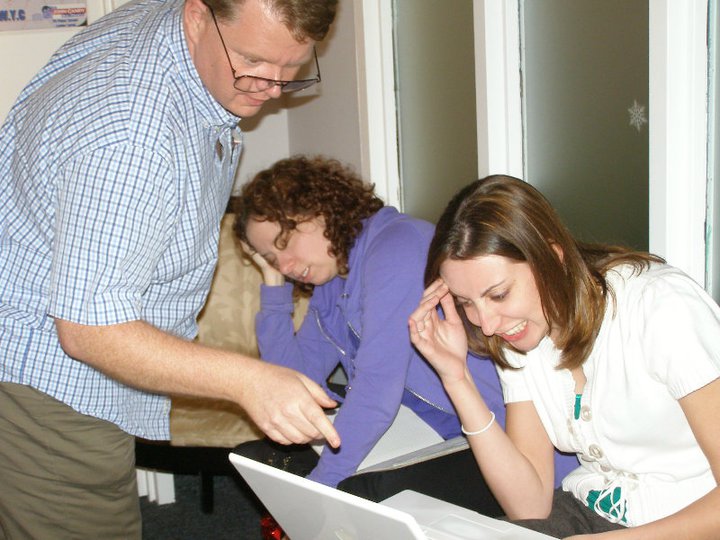
Me acting like I could ever teach anything about comedy to the very funny ladies Nicole Rubacha and Megan Mack


Me acting like I could ever teach anything about comedy to the very funny ladies Nicole Rubacha and Megan Mack

The match

As I strolled through the streets of Washington, DC, I came across this amazing sculpture, although to call it simply a sculpture or statue was to short-change the artist.

Before my eyes (and the lens of my camera) a small scene played out despite the participants’ inanimacy.

(Yes, I make words up. I’m a writer, it’s what I do. Same relationship as intimate to intimacy.)

Spring has sprung – Alexandria, VA

Despite the snow showers that kept spitting in my face, it appeared Spring had arrived on the East Coast of the United States…or at least, it had according to the birds in the area.

A few images from a wander around the Old Town section of Alexandria, VA.