InterOkay – review of Interstellar

interstellar-movie-banner

I can forgive writer-director-producer Chris Nolan for naming his movie Interstellar as few would be inclined to go see a movie entitled InterOkay and yet, that is what I thought of the movie. It was okay.

Not brilliant. Not amazing. Not a cinema-changing moment. Just okay.

Set in the near future, the Earth has suffered through a variety of crop blights and other unnamed disasters that has humanity at the brink of extinction. As one school principal puts it, the human race has become a caretaker generation, simply trying to manage the status quo in the hopes that something better might show up later.
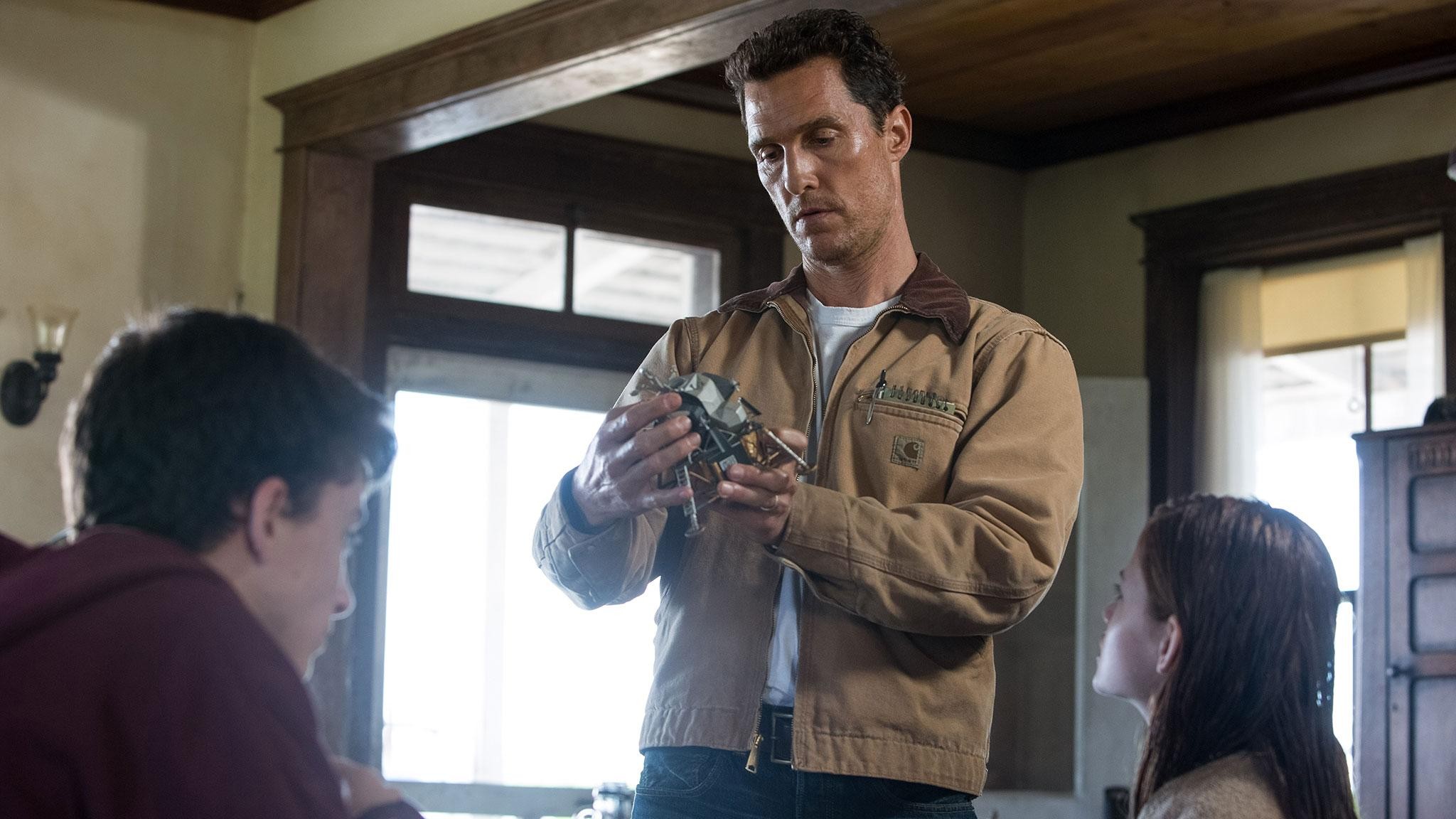
Failed astronaut Cooper struggles to keep his family whole

Failed astronaut Cooper struggles to keep his family whole

Drop into this failed world the character of failed-astronaut now failing farmer Cooper (Matthew McConaughey) who struggles to protect his family—dutiful son, frustrated pre-scientist daughter, sage father-in-law—from the ravages of dust storms and drought. Through a series of odd events, driven by daughter Murphy, Cooper learns of a mission to explore planets in other galaxies in hopes of finding a new home for humanity. They will get there via a wormhole that suddenly appears near Saturn, sent by a mysterious ‘They’.

To get deeper into the plot of the movie here would be to trip all over spoilers and I don’t want to do that. It would also require that I better understand the various plot points, which would likely take a second or third viewing…call me when Interstellar makes it to Netflix.

In an acknowledged homage to every movie that has come before it—Grapes of Wrath meets Top Gun meets 2001: A Space Odyssey meets Close Encounters of the Third Kind meets The Right Stuff meets Waterworld meets Prometheus meets The Black Hole meets…you get the idea—Nolan and his cowriter brother Jonathan Nolan have woven together a vision of human spirit that is broad in scope, deep in meaning and soul-defining in spirit. Or at least that seemed to be their intention.

The ones left behind search for a way out (Jessica Chastain)

The ones left behind search for a way out (Jessica Chastain)

On paper, the most meaningful speeches seem to come across as cliché, trite or in the most offensive cases, Pablum. And it is only because the Nolan boys have put these speeches into the mouths of some great actors—e.g., John Lithgow, Michael Caine, Jessica Chastain—that the movie is not laughed off the screen. Only actors of this quality could breathe life into these leaden lines and hoary speeches.

For me, possibly the worst example of this is scientist-cum-astronaut Amelia Brand’s (Anne Hathaway) attempt to explain love as a higher dimension of existence, as something that transcends space and time and should thus be counted as at least an equal in making logistical decisions. I’m not saying that her argument is wrong (or right) but rather that the material comes across as angst-riddled teen melodrama, made all the worse because it’s coming out of the mouth of an adult.

Ferris Bueller with lipstick? (Anne Hathaway)

Ferris Bueller with lipstick? (Anne Hathaway)

Where I have to give the movie massive credit, however, is in the visual treatments. (Thank you, Director of Photography Hoyte van Hoytema and Production Designer Nathan Crowley.)

This is a visually stunning film where each image is inspired. You feel parched while witnessing the death of the American heartland and your eyes itch with the approaching dust storm. The other worlds are crafted with such realism that you sense the dampness or the cold. And for all its darkness, a black hole seems anything but black.

Without getting into spoilers, I found the story line challenging in some respects because it felt like the Nolans wrote a relatively short screenplay and then every time they asked someone to read it, they were asked “Yeah, but what about…?”

At least three times during the film, I caught myself thinking that this must be the end, only to have Nolan scream “plot twist” and have the movie spiral in another direction to tie up a loose end. Even as the credits rolled, I had the sneaking suspicion they would get half-way done and we’d have more scenes.

And the very last scene before the credits was either “Oh shit, we forgot about…” or was a ham-fisted attempt to set up the sequel (of which I have heard nothing).

bridesmaids_screenplay02

As friend and fellow blogger Danny F. Santos suggested to me recently, he thought the movie might have been better served by converting it to a mini-series and I can definitely see his point. Some aspects of the film seemed rushed, despite its lengthy running time of 169 minutes. (Danny’s blog)

Given the importance of the replacement Earths to the conceit of the story, however, amazingly little time was spent on these worlds. I appreciate that the Nolans may not have wanted to make it longer, but that just lends credibility to Danny’s idea (or they could have done a Peter Jackson-Hobbit impersonation).

To their credit, the Nolan boys have woven an incredible tapestry of plots and subplots, tapping into several deep questions about humanity, the explorer’s heart, interpersonal commitment, abandonment, the purpose of science and complicity in our own demise.

Unfortunately, they used so many strings that they seem to have suddenly found themselves with a lot of loose ends that they either tied off with a bow or tied to another string. For the latter of those methods, I am confident that they wanted me to experience a revelatory “Oooooh!” but too often I was left with a confused “Eh?”

For all my issues with plot points and dialogue, however, I do have to admit that the movie passed my butt test. At no point did I find myself squirming uncomfortably. As the credits rolled, I found myself comfortably rested and satisfyingly entertained.

Unfortunately, for a movie of the scale and scope of Interstellar, “rested” and “entertained” are an indictment, not praise.

From Equalizer to minimizer (a review)

equalizer movie poster

Eighties are the new teens…as in everything you loved about the 1980s is coming to a theatre near you. As the latest example, we have Denzel Washington in the role of Robert McCall in a revisit (can’t really call it a reboot) of the television series The Equalizer.

The central conceit of both the film and television series is that McCall is a retired special forces agent (think CIA) who tries to help people out when they get run over by criminals, corporations or malevolent government forces.

Whereas in the TV show, we see his mission fully formed, the movie is a bit more of a prequel, showing us the transformation of McCall from quiet man to vigilante.

The movie opens with McCall being the happy guy working at a Home Depot, jovially chatting with co-workers and providing something of a father figure to his younger compatriots. But away from the job, we see that he is a loner, a man with a heavy psychological burden that keeps him from sleeping.

And it is this insomnia that links him to young prostitute Teri (aka Alina, played by Chloe Grace Moretz) who is fascinated by this man who sits in a diner at 3 am, drinking tea (he brings his own bag) and reading classic literature (we open with The Old Man and the Sea…the books are a metaphor for the character). Again, the father figure comes into play as McCall is one of the few men who treat her as a human being and challenge her to be the woman she wants to be, not the victim she is.

denzel-washington

And it is this bond that causes McCall to act when Teri is hospitalized by her Russian mobster pimp. A noble man, McCall offers to literally buy Teri’s freedom, but when the mobsters simply laugh him off, a life of brutality surfaces in the scarred knight and the world dissolves into chaos.

To give you any plot details beyond this would be to potentially spoil the movie.

Denzel Washington is an amazing actor and is wonderful in the role of Robert McCall. Offering a very different take on the character than his television predecessor Edward Woodward, the two actors share the ability to display a man who is outwardly in control of all situations but at the expense of always holding onto an inner torment that they are afraid to acknowledge, let alone unleash.

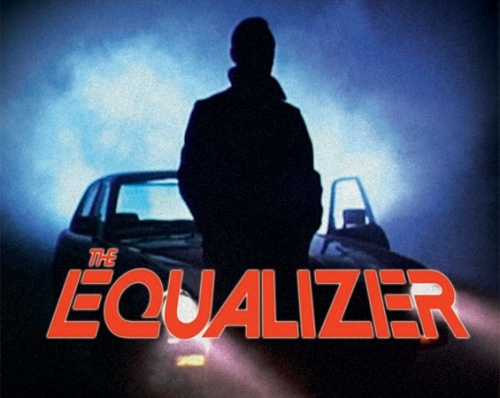
But whereas the TV equalizer rarely got his hands or his clothes dirty (compare TV poster below with film poster above), the film equalizer is willing to release a storm of martial arts and weaponry on the bad guys. Thus, the film is much more action packed than the TV show.

The-Equalizer-TV-Poster

To the credit of director Antoine Fuqua—who also directed Washington in Training Day—despite at least a dozen scenes of intense violence and blood-letting, he does an amazing job of minimizing the amount of actual blood that reaches the screen. In part, he accomplishes this by shooting the most violent scenes in darkness such that you only really see light reflecting off dark puddles. Likewise, when McCall does resort to using make-shift weapons (remember, he works in a Home Depot), the camera often switches to McCall’s face as he uses the weapon rather than to weapon and victim.

Unfortunately, McCall is such a cool and controlled customer that I never really worry about him. I cheer his victories when he vanquishes the dragon, but I find it difficult to really attach myself emotionally to the man. I like the quiet man, but I find the killing machine to be just that, a machine; an automaton that does not touch my heart. And with the exception of a handful of moments, we never really get a chance to appreciate the toll these actions take on him.

The other place I feel the story falls down is in the use of the Russian mobster sent to clean up the mess that McCall started, a man simply known as Teddy. Played by Marton Csokas, Teddy and McCall are equals. The same side of the same coin. Equally smart. Equally charming. Equally viscious. And as such, the only real threat in the entire film to McCall.

The-Equalizer-13-Marton-Csokas

(As a side note, if this role is any indication, we want to keep our eye on Marton Csokas. He will do amazing things.)

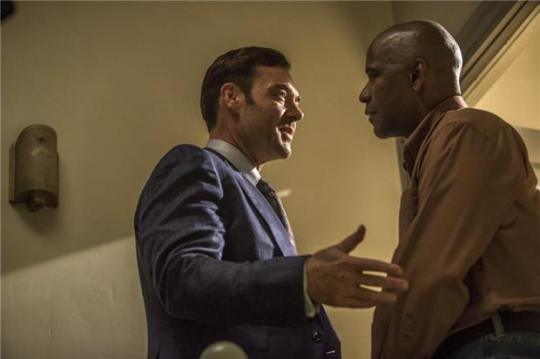
There are a couple of scenes where the two men literally face each other and calmly discuss the situation. One scene in particular is the best thing in this movie from my perspective. While on one level being the calmest moment in the movie, it is also the most chilling because of that calm. You really don’t know what’s going to happen.

And that’s where my problem lies.

Having set up the perfect opponent for McCall, the writer Richard Wenk (who also penned The Expendables 2) doesn’t really deliver. The audience was promised an epic show down between these two characters, but while they do clash, it is anything but epic (photo below is not from clash).

the-equalizer-marton-csokas-and-denzel-washington

The Equalizer is entertaining. It is a wonderful diversion that requires little thought of its audience. It is Jason Bourne for the middle-aged set (but with enough carnage to keep the young’uns interested). It should, however, have been better.

But when it comes right down to it, the studios don’t really care if you like it, because they are already working on the sequel.

Nebraska: Bumpy lives, flat land (a review)

poster

Much like the Big Sky prairies that serve as its backdrop, Alexander Payne’s 2013 film Nebraska takes a little bit to get going, but when it hits its stride, there is no stopping it.

An irascible old drunkard Woody (Bruce Dern) thinks he’s won a $1,000,000 lottery and is determined to collect his prize in person, walking if he must from his home in Billings, Montana to the prize centre in Lincoln, Nebraska. When his youngest son David (Will Forte) realizes there is no stopping the senile old coot, he takes a few days off work and offers to drive.

Along the way, they stop for a few days in his father’s home town of Hawthorne, Nebraska, where they are joined by his mother Kate (June Squibb) and older brother Ross (Bob Odenkirk). But almost as quickly as the townsfolk and extended family realize the old man has struck it rich, the hands reach out for their cut, led by Woody’s former business partner Ed (Stacy Keach).

As I said, the movie starts out slow. Woody has nothing to say to any of his family, at times appearing to have dementia. David meanwhile faces an empty life and just wants to communicate on some level with his family, never having felt like he could talk to them. Thus, when the two men with nothing in common aside from chromosomes take to the road, it feels very much like the start of an opposites-connect buddy film.

NEBRASKA

The dialogue is excruciatingly simple in the early going, rarely more than one or two syllable conversations. Despite occupying the passenger seat of the car, Dern’s Woody is never really there, only being forced into human contact by having everything repeated louder. Forte’s David, meanwhile, has a perpetual pout of a puppy begging to be patted on the head.

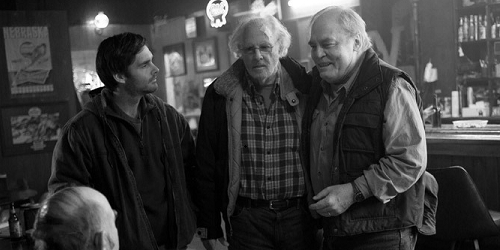
Eventually, though, if only out of frustration, David begins to take control of the situation and his life. Through his own explorations and by observing his father interact with the home townfolk, he begins to see that there is so much more to his father, and this is where I really started to take note of Forte as an actor, as something more than his MacGruber caricature.

I would say that Dern turns in a solid performance, but his dialogue is so short and his stare so vacant that only once in a while do we get a real glimpse of the tormented soul within the husk of a man. June Squibb’s Kate is something to behold, however (her voice and attitude remind me of Shelley Winters). Starting more as a screeching shrew, she really comes into her own in the latter half of the film with some of the funniest lines and the staunchest defense of her messed up husband. Odenkirk is solid, but isn’t really given much to do here…this is Forte’s movie.

My strongest reaction, however, is reserved for Stacy Keach, who yet again, plays the charming, smarmy bully asshole for which he is famous (think Papa Titus on the sitcom Titus). I can’t remember a role for which Keach didn’t deliver. The man eats up the screen. You can’t not watch him.

Nebraska-Dern-Forte-Keach

In terms of cinematography, Payne chose to film the entire movie in black and white, giving the whole story a sense of being trapped in another time, and adding to the sense of desolation exhibited by both the geography of the region and the simplicity of the town of Hawthorne, with its barren sidewalks and seemingly abandoned businesses. The whole thing feels like an emotional dead zone and the lack of human spark in all but a few citizens reflects that.

Bob Nelson’s screenplay is a simple one, devoid of plot twists or anxious moments. There are no great moments of revelation, but rather subtle hints at who Woody was when he was a young man. As such, the characters can come across as superficial and on-the-nose. But again, I think this was on purpose rather than a failing. I think he wanted to show us shallow people in a shallow land.

Toward the end, the movie started to take on a bit of a Hollywood ending feel, but although Nelson did start us down that road, he thankfully stopped himself before the point of schmaltzy no return.

All-in-all, I liked Nebraska, although I didn’t think it deserved the accolades it received at Cannes (Palme d’Or nomination, best actor for Dern), the Golden Globes (5 nominations) or the Oscars (6 nominations). It’s just not that deep a film, in my eyes.


You can find a PDF of the screenplay for Nebraska here.

Snow White more an off-grey (a review)

Snow_White_and_the_Huntsman_Poster

I find it difficult to appreciate a movie in isolation (its, not mine). At the same time that I strive to enjoy the movie, I also try to break down its various elements, ideally without immediate comparison to everything else I have seen.

Some movies make this easier by being truly unique stories (The Voices, for example), whereas others are either so familiar or so derivative that I find it virtually impossible to see it in isolation. The latter situation was the case for Snow White and the Huntsman, the 2012 take of the very familiar Grimm Brothers fairy tale by director Rupert Sanders.

This is not the Disney version, by a mile, but rather a much darker, more sinister take on the story of a young beauty (Kristen Stewart) condemned to death by her vainglorious step mother (Charlize Theron) who fights for her freedom in the dark woods where she meets all kinds of people and mystical creatures, including dwarves. Together, they reach a castle of renegades and Snow leads them into battle against her step mother.

So, we have the check list covered: evil step mother, check; mirror-mirror, check; bring me her heart, check; dwarves, check; poison apple, check; Prince Charming, sorta check.

Doing my best to isolate this movie from everything else, I give it a moderately passing grade. It is a fairy tale, so the dialogue hits the extremes of leaden cliché to screaming cliché.

There is no subtext to this movie…none, zero, nada, zilch. So don’t go looking for any. It is on-the-nose storytelling, which again, makes sense within the context of a fairy tale, but given that the film targets young adults to adults (much too dark for small children), I would have hoped for more.

The screenwriters offered a brief moment, where the huntsman (Chris Hemsworth) begins to let us into why he is so tortured over the death of his wife. But as soon as the moment starts, it slams shut and we are excluded from understanding the character beyond his alcoholic ramblings and Thor-like simplicity. (PS If I hadn’t seen the movie Rush, I might just think this is who Hemsworth is.)

So, where the dialogue wanes, the visuals have to take over and here, the director earns his keep. Special effects do not overwhelm the story, but instead are woven nicely into live action sequences to augment the reality. There was only one scene where I felt the director fell asleep at the SFX wheel and allowed his art director to run amok.

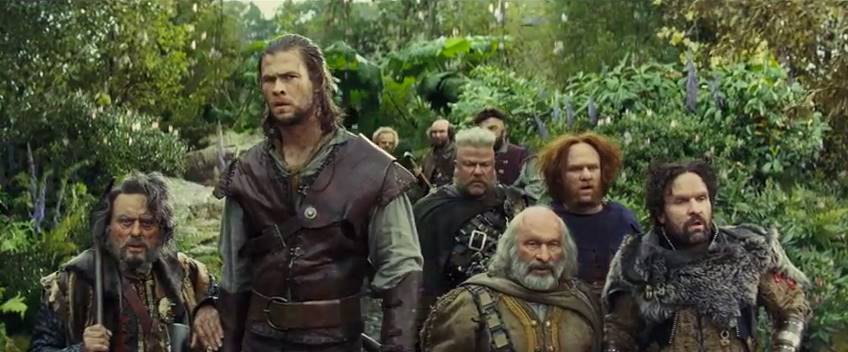
Dwarves huntsman

And perhaps my favourite part of the visual effects was how they took normal sized British actors and turned them into dwarves. Masterfully done. Imagine Ian McShane, Bob Hoskins, Ray Winstone, Nick Frost, Toby Jones, Eddie Marsan all about a meter tall yet perfectly proportioned, standing next to or fighting alongside Hemsworth. Don’t know how they did it…don’t want to know.

Where I found the movie particularly weak, however, was in the development of Snow White. Rather than be the protagonist of the story, I felt she was the victim of the story, literally being dragged across the countryside to avoid capture. While she clearly wasn’t the “Oh my. Dear me” victim of the Disney version, she was also not the “Girl Power” version that I think the movie promised.

Two snows

When she wasn’t being rescued by one or more men, she was being rescued by a mystical inner force of which she was initially unaware and over which she had no control.

I was willing to let her be the victim over the first part of the story, but I needed her to turn around at the midpoint and attempt to kick some ass.

Now, to open the comparative flood gates, this movie has Tolkein written all over it. You’ll see dwarves walking across hill tops. Floating towns will burn. Dark forests will haunt you. Guys with swords and axes will be moody.

Now I appreciate that this is bound to happen, as there are certain pastiches that run rampant throughout fairy tales and epic sagas. I am speaking here more in terms of cinematography, however. In several parts of the journey sequence and the battle scenes, it looked like the director decided to save a few bucks by splicing in rejected footage left behind by Peter Jackson.

For what is it, Snow White and the Huntsman is not the worst 90 minutes I have ever spent watching a movie. It’s just a damned shame that the running time is 127 minutes.

Losing two hours to “The Book Thief” – a review

BookThief

I just finished watching The Book Thief and I must admit that I am quite conflicted.

Released in 2013 with an amazing cast including Geoffrey Rush, Emily Watson and the mesmerizing Sophie Nélisse in the title role, The Book Thief tells the story of a young German girl adopted by aging parents in the months leading up to World War II.

Through Liesel’s eyes, we watch fascism take hold of Germany while good people try to lead simple lives. We watch her struggle to comprehend anti-Semitism through conversations with a young Jewish man her parents are hiding and at the same time, find her own gift for words through her exploration of books. We see the beauty of love and the pain of uncertainty.

All in all, the film was beautiful and heartfelt. And yet, in the end, I feel like I have witnessed a life, not heard a story.

Liesel floats through the world that moves around her. In only the rarest of instances does she actually drive the story forward. Instead, people and the fates make decisions for her at every turn. She is not the protagonist or hero of the story; rather, she is the victim of events.

Adding to my challenge is that, despite its setting in WWII Germany, there is no real conflict in the story. The ideological conflict amounts to Hitler bad, everyone else good. And even here, it’s discussed within isolated groups. There is no—or very little—confrontation between the two camps.

Book-Thief-large

As our hero, Liesel has no goal and therefore nothing stands in her way. She has no need to make a plan and therefore nothing truly thwarts her.

And perhaps because of this—at least spinning out of this—there are never (NEVER) any repercussions of her actions or those around her despite the number of times the screenwriter (Michael Petroni adapting a novel by Markus Zusak) or director (Brian Percival) have set them up.

(SPOILER EXAMPLES)

When the vicious little Brownshirt Franz threatens to expose Liesel and her little friend Rudy for keeping secrets, nothing happens. When Liesel’s friendship with the Burgermeister’s wife causes Liesel’s mother to lose her valuable laundry contract, there are no repercussions. Even her spilling the beans about a Jew hiding in the basement has no impact on the story.

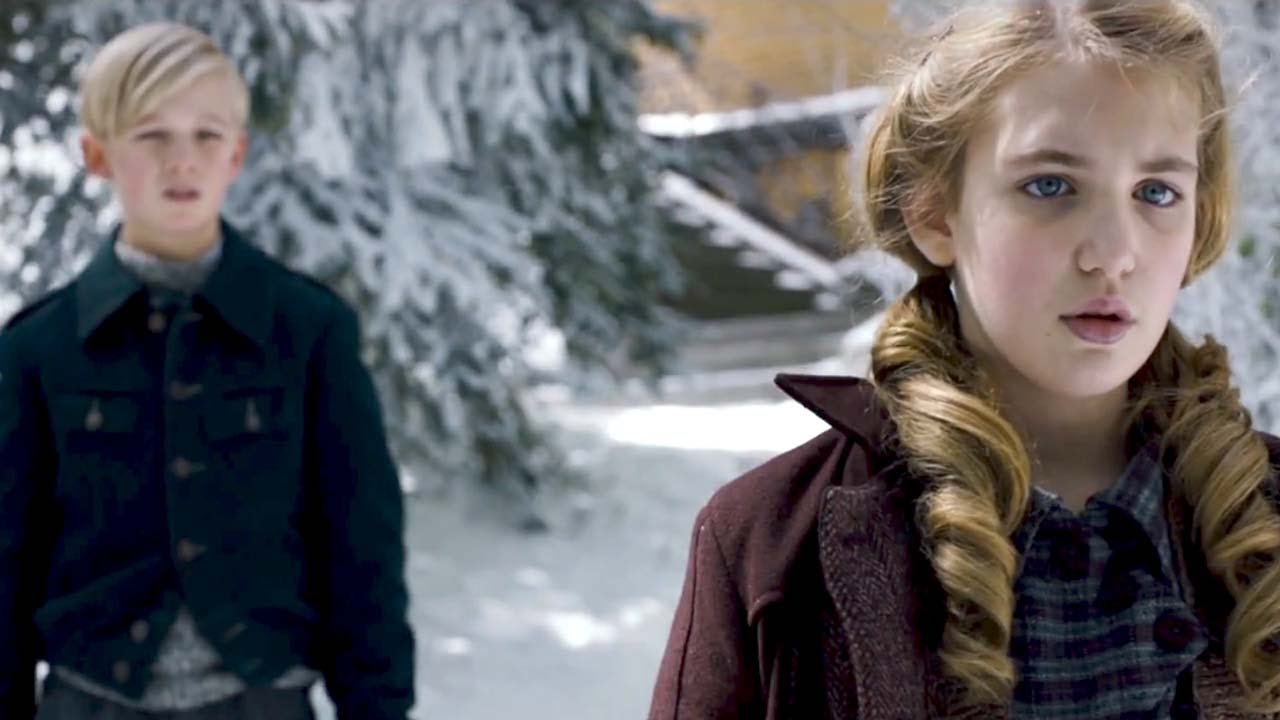
maxresdefault

As we would describe in screenwriting lingo, there were no turning points where the hero has to make a decision, and there was no crisis and therefore no climax to the story.

Thus, my conflict with the movie.

A visually interesting film, acted beautifully, and yet I was unable to invest in the story at all because I never felt anything was in doubt. Where there were the odd surprises, they were telegraphed by the narrator, who popped up so haphazardly, I could never figure out why he was even in the story. And the choice of who narrates is also very odd.

And then, one after another, the loops of the bow-tie formed as the story came to a close, everything being explained away to leave the final screen moments devoid of meaning or feeling.

Sad, really. There was so much to like about this movie.

Unlucky Lucy – a review

lucy_ver21_xlg

What if every time…

Number Line #1

someone tried to tell you something…

Whispering+in+ear_jpg

they inserted a photo or video…

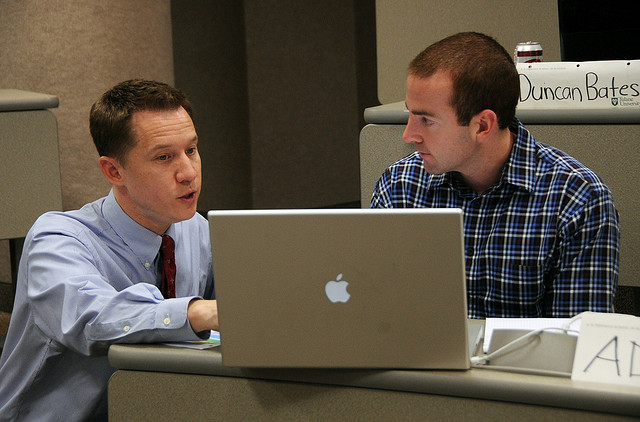
student

that showed the same thing they said?

mirror

Pretty irritating, eh?

Welcome to the first 30 minutes of Luc Besson’s Lucy, released to theatres this weekend.

(I’ve done my best to avoid spoilers, below.)

What could have been—should have been—an amazing sci-fi thriller about the possible repercussions of a young drug mule who becomes exposed to the drug and slowly finds her brain building to 100% functional capacity, was instead a massive disappointment weighted down by a ton of metaphoric sledgehammers and drowning in a sea of over-exposition.

To be sure, there is a really interesting movie somewhere in the middle of the morass that ironically becomes its own metaphor by the end of the movie. But it’s as though Besson the Director didn’t trust the story written by Besson the Screenwriter to simply let the story explore itself.

As the drug takes hold of Lucy, she goes from being an interesting female character (if a little cliché) to an automaton who simply narrates…literally narrates…what is happening inside her.

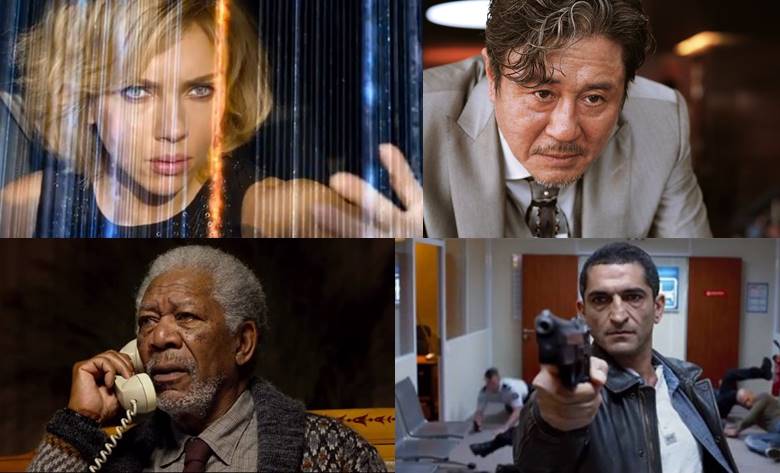
The drug lord Mr. Jang has the emotional range of complete indifference to mild irritation, which no doubt also expresses the feelings of acclaimed actor Min-Sik Choi, who portrayed him.

Even the calming voice and reason of Morgan Freeman’s Prof. Norman quickly gives way to befuddled camera-mugging and WTF?

The only truly interesting character was French police detective Pierre Del Rio, played beautifully by Amr Waked, who clearly functions as the eyes of the audience. As a friend of mine pointed out, even he at one point turns to Lucy and asks “What do you need me for?” What, indeed.

Lucy cast

To be certain, the visual effects in several parts of the movie were stunning, but as with so many movies I’ve seen in the past few years (e.g., Prometheus, Transcendence), the visual effects have become sleight-of-hand to keep you (or try) from seeing the weaknesses of plot and character.

The action sequences highlighted in the trailers take about as much time in the full movie as they did in the trailer, and so little is ever in doubt with the plot that the movie truly cannot be described a thriller.

But perhaps where the movie was most disappointing was in its promise to explore the nature of what it is to be human when faced with super-human capabilities. THIS is what the movie should have been about!

But Besson largely discards the question as quickly as he raises it in two short scenes involving a call home to mom and a simple kiss. And in both cases, Lucy coldly explains her conundrum, her human fears represented by the odd tear drop down an otherwise lifeless cheek. Rather than see Lucy struggle with her transformation, we watch her turn into a robot bent on a mission…a mission that she basically accomplishes without struggle.

But just to be sure we get the great metaphysical concepts behind the story, Besson then reverts to his earlier legerdemain, smacking the audience around with a brutally metaphoric journey through time and space. I give you intergalactic sperm meteors…you’ll know then when you see them.

And all this rancour without even touching on the biochemical, biomedical, anthropological and astronomical issues that run rampant in this mere 90 minutes.

This could have been an amazing movie. It wasn’t.

(Images are property of owners and are used here without permission.)

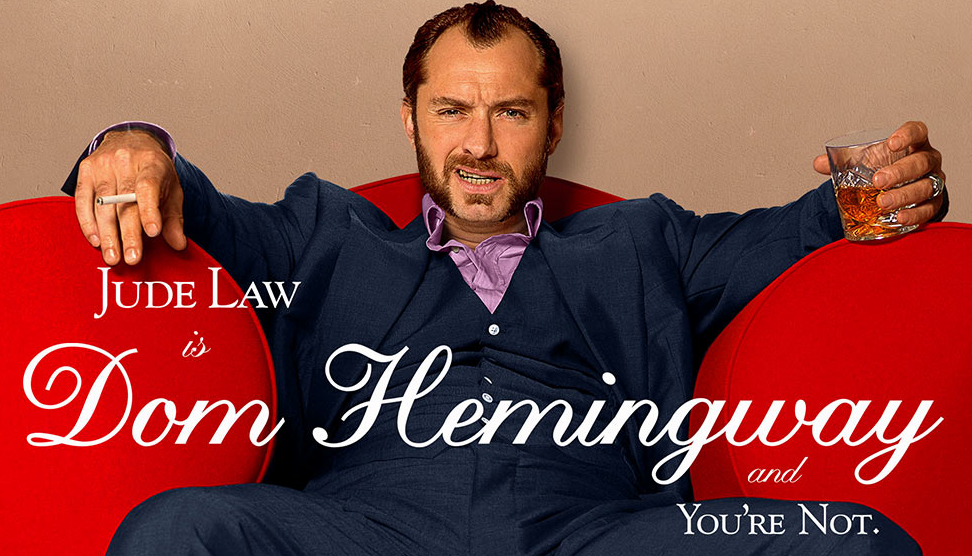
Dom Hemingway – A Review

CN_DomHemingway

A redemption story of a career criminal who has played the game by an unwritten code, who has done his best to do right by people within the criminal world and been screwed at every turn. The only people he hasn’t done right by, in fact, are his ex-wife and daughter, whom he completely screwed over. (Trailer)

Written and directed by Richard Shepard, who brought us The Matador, Dom Hemingway works on so many levels—from its amazing opening soliloquy (no better way to describe it), through astounding montages of decadence that can only be described as balletic, to tender moments of friendship punctuated with foul language.

But sadly, because it works on so many levels, the places where it doesn’t are glaring. And there is perhaps no bigger failure than the actual story.

There is no doubt that Shepard can write. His use of words to express universal ideas and human frailty are musical. Unfortunately, those skills only serve to create islands of poetry in a story that slowly drowns in conflicting tides. The movie bogs down into little more than a series of fortunately/unfortunately vignettes that ultimately don’t go anywhere.

Likewise, the moment we leave the criminal aspects of the story and Dom has to face the wreck that is his life and relationships, the dialogue becomes wooden and cliché.

Even the redemption angle is eventually undercut by additional scenes that suggest Dom has learned little. Not sure what Shepard’s thought was here—that people don’t really change, perhaps—but it might simply be an unverbalized acknowledgement of Shepard’s own limitations.

The performances of Jude Law and Richard E. Grant cover for many of the story flaws. Law’s Dom is a man who can’t get out of his own self-destructive behaviours long enough to actually succeed and let his skills prove himself. Grant, meanwhile, plays the long-suffering conscience who just wants his friend to be happy, but doesn’t have the energy to watch Dom implode in his own fear yet again. Unfortunately, the minute these amazing men leave the screen, the movie flat lines.

(Side note: Just before the movie started, the theatre screened an ad for Filth (trailer). It was amazing how similar the lead characters of the two movies appear, as Law seemed to be channelling his inner James McAvoy at times.)

Perhaps the best way to describe Dom Hemingway is to say you will feel energized watching it, but a little empty of dissatisfied as you leave the theatre.

I wanted this movie to be better. I wanted it to be the best movie I’d seen all year, the most complete movie. Alas, it wasn’t.

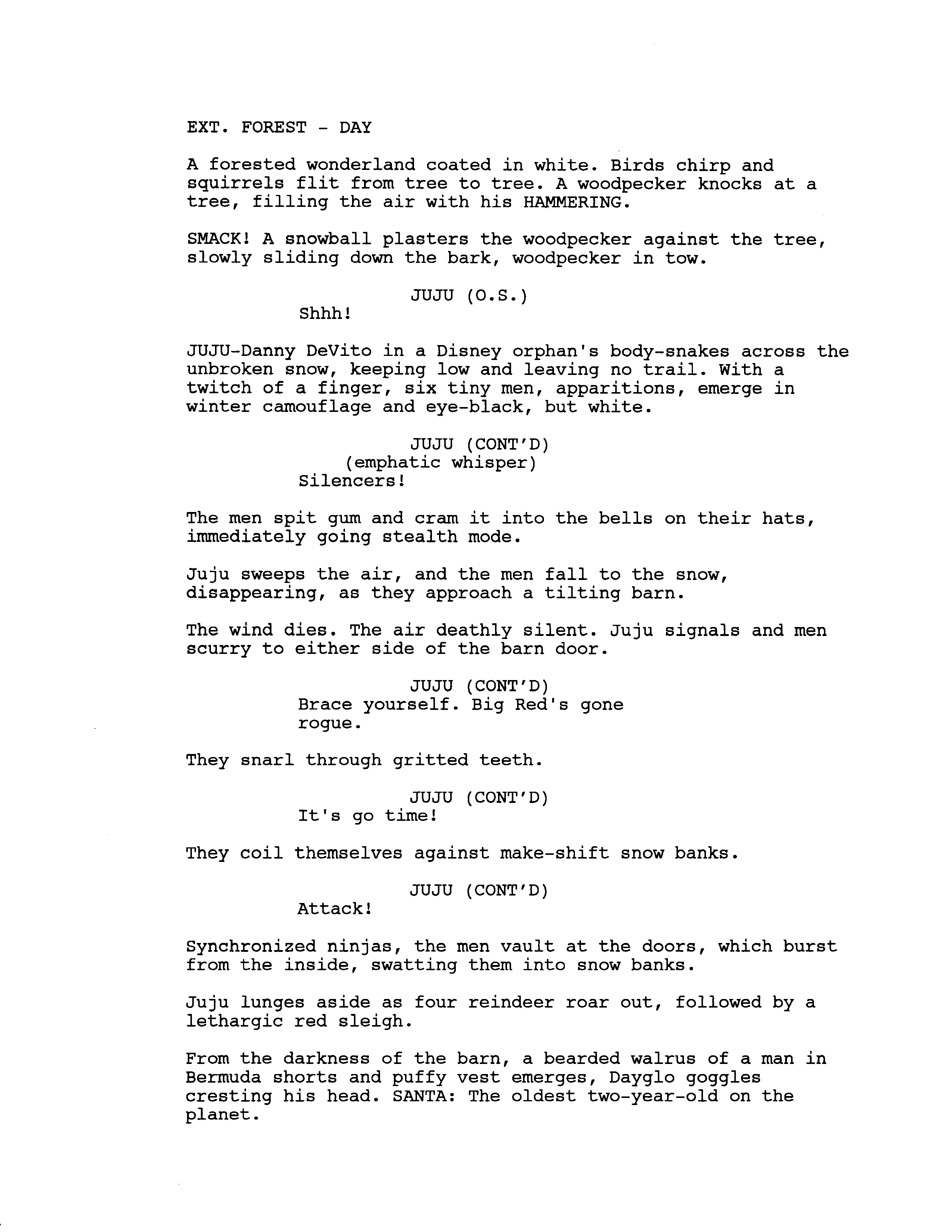
First page of new screenplay (opinions please)

Hey guys,

I am working on a new screenplay and would love your split second reaction to this opening page.

Does it grab your attention? Are you intrigued? Do you want to know what happens next?

Any thoughts…positive, negative, inflammatory…are welcomed.

And so the new story begins

And so the new story begins

Another year, another AFF Second Rounder

20th AFF poster

So, it would seem that rewrites work.

Last year, I entered my screenplay Tank’s into the Austin Film Festival screenplay competition and other than some amazing notes, it went nowhere in the competition. (My spec teleplay of The Big Bang Theory, however, reached the second round before bowing out.)

Fast-forward a year and four rounds of revisions, I just learned that the same screenplay made it to the second round of the competition before bowing out…Tank’s made it to the top 10% of its category, which feels pretty good considering the AFF received more than 8,600 screen- and teleplays this year, its highest submission rate ever.

Aside from the $200+ refund on my registration fee, what makes this really awesome is the esteem in which Second Rounders and higher are held at the screenwriting conference portion of the film festival. You see, the Austin Film Festival is more than just a whack of movie screens and Hollywood A-listers (like my own Toronto International Film Festival; on now). The AFF is also a 4-day screenwriters’ conference and love-fest, as 400+ introverts try to get just drunk enough to come out of their shells and commune with Hollywood screenwriters and film-makers.

If you are a screenwriter and have never been to the AFF, GO! It is worth the money.

Sure, some of the sessions amount to little more than hero-worship where you’ll hear questions like: “Remember that scene in X-Files when Mulder gave Scully that look? Did you write that, because that was awesome?” But most of the sessions are actually helpful discussions and learning opportunities with the film and television world’s elite writers…and best of all, these Gods not only stick around, but they’ll actually talk to you at the BBQ or in the bars. It’s like they give a shit about your shit.

Last year was my first AFF, and I was the introvert amongst introverts looking for the closest corner in which to nurse my beer or G&T. This year will be different. This year, I will move out of the corner and occupy the middle of the room…who knows, I may even talk to someone. (God, I need a drink!)

Oh, the Austin Film Festival runs October 24-31 from the Driskill Hotel.

PS If you think I’m bragging, my prowess is kept in check by a friend I met at AFF who had two Second Rounders and one Semifinalist screenplay in last year’s competition alone.

Not for nothing – REQUEST FOR HELP

ssnolan3

How do you write about nothing?

I know how to not write. In fact, I was very good at that in the past, but gratefully not writing is no longer much of an option for me.

I’m not talking about not writing, however. Instead, I am talking about writing scenes where superficially nothing happens, where a character walks through the mundane actions of life. What they are doing is unimportant to them, a robotic response to an overwhelming thought or scenario. There is an astronomic exchange of information and yet no words are spoken.

In a novel or short story, you can have an inner dialogue, revealing the character’s thoughts, but in a film, you have only silence. Sure, there’s always the trusty voiceover, but I personally think that unless the character is recalling a past statement, voiceovers are a crutch. And a voiceover weakens a scene when you compare it with silence.

Think of the last time you were faced with silence in response to something you said or did. Think of the dis-ease (yes, that’s where “disease” comes from) you experienced as you tried to figure out what the other party was thinking. In many of those situations, I bet that shouting would have been preferable to silence.

In an improv class I took—I am sorry that this is my version of “This one time, in band camp…”—we were doing a status exercise wherein one character would try to take status away from the other one, proving themselves superior through statement or action. While many student pairs would do their best to out-pompous, out-preen or out-bravado each other, I took a different tack. I went completely silent.

No matter what my partner said or did, I faced him stoically or indifferently, deigning to give him the merest glance on occasion while going about my activities. And the louder or larger he got, the less I minded or acknowledged him. The more he talked, the weaker he appeared.

Silence is powerful. And even if the silence is due to idiocy, it comes across as thoughtfulness.

Think of scenes in movies where a character has chosen to deal with a problem by thinking about it. With a good actor, you can see all the thoughts as they play out in his or her mind. The body, the face, the eyes tell you all you need to know about the emotional swells washing through the actor. A single word breaks that tension and weakens the moment. As a storyteller, why would you ever give that up?

Which brings me back to my original question: How do you write nothing?

Perhaps I am delving too far into the domains of the director and actor, but there has to be a way to ensure both those artists know what you, the writer, intend. But I’ll be damned if I know how.

So, I open the question to you, my fellow artists.

What do you do, what have you learned, what have you seen that tells you how to write nothing and yet convey a world of thought and feeling?

Please share your thoughts here as I can’t be the only one who wants to know.