Marlies advance to Conference Finals!

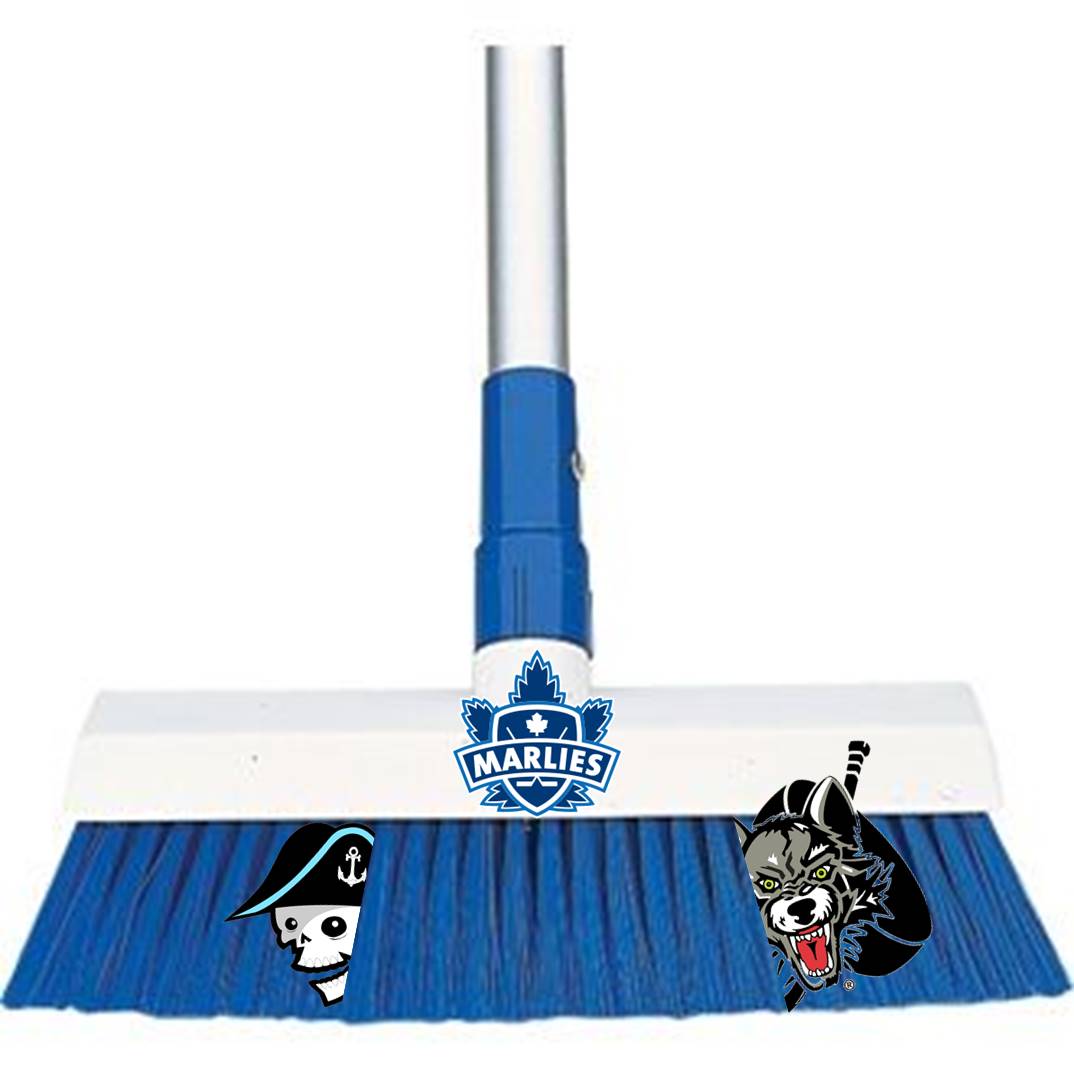
I try not to inject much of my hockey mania into my blog, but I am amazingly excited to announce tonight that the Toronto Marlies, farm team of the NHL’s Toronto Maple Leafs, have advanced to the Conference Finals of the AHL Calder Cup Playoffs.

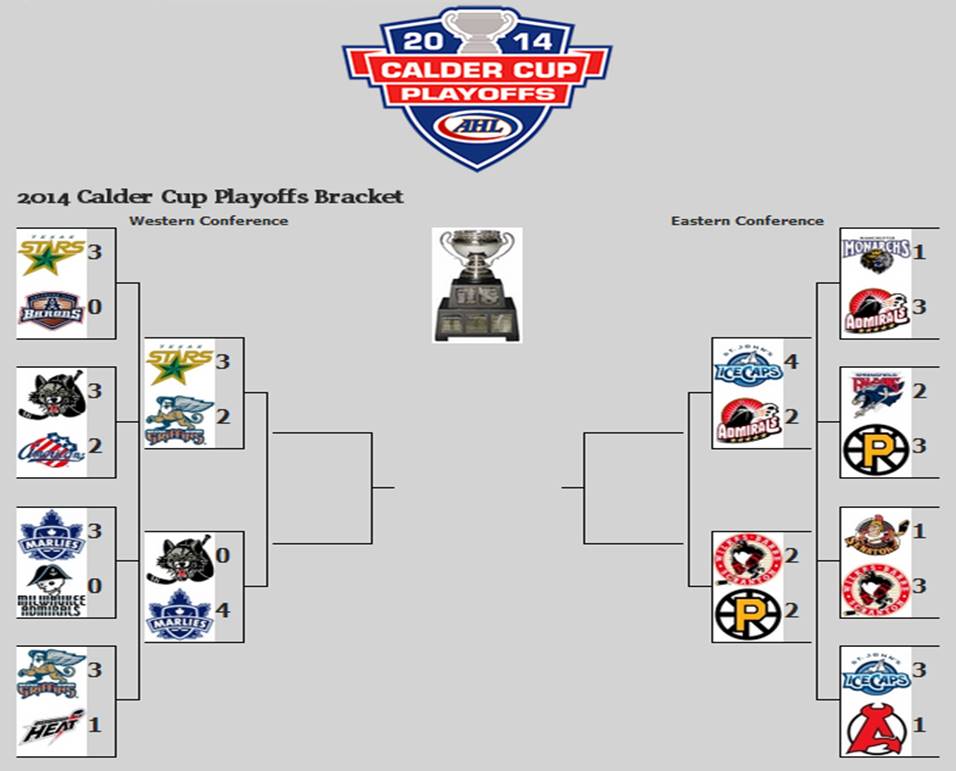
In the first round of the playoffs, they defeated the Milwaukee Admirals 3-0 in a best-of-five series.

In the latest round, they defeated the Chicago Wolves 4-0 in a best-of-seven series.

The Toronto Marlies are 7-0 in the 2014 AHL Calder Cup playoffs so far.

The Toronto Marlies are 7-0 in the 2014 AHL Calder Cup playoffs so far.

In performing the double-sweep, the Toronto Marlies remain the only undefeated team currently in the hunt for the Calder Cup.

Be grateful my blog is the last place I am visiting with this information…I have just spent the last two hours littering my Facebook page and Twitter account with this stuff.

The Toronto Marlies remain the only undefeated team in the hunt for the Calder Cup.

The Toronto Marlies remain the only undefeated team in the hunt for the Calder Cup.

Is writing Art?

Questions you are unlikely to ever hear:

  • How close to the edge of the canvas can I apply acrylic paint?
  • If I’m sculpting the bust of Zeus, at what moment should I work on his nose?
  • Is it okay to drum the body of an acoustic guitar with my fingers rather than pluck the strings?

Painting. Sculpture. Music. Three of the myriad art forms where practitioners typically acquire some degree of training, and then step away from that training to develop  their own style.

Art comes where the rules end

Art comes where the rules end

Questions you can fully expect to hear:

  • In a 90-page screenplay, on what page should the inciting incident occur?
  • In a poem, should I complete a thought within a line or break it up into two or more lines?
  • Can I describe more than one character’s point-of-view within a scene in my novel?

Writing.

Every day, billions of people across the planet write. Post-It notes. Shopping lists. Emails. Love letters. And perhaps because of this ubiquity—perhaps because writing is rivaled only by speech as a form of expression—the world tends to view writing in a different category from all of the other arts, assuming people see it as an art form at all.

Everybody writes, so how special can it be

Everybody writes, so how special can it be

Obviously, there are better writers and worse writers, but more often than not, that reality is viewed as difference in skill, not art or craftsmanship. It is as though the world believes that if we all applied ourselves a little more, we could all write a great novel or play.

If asked, I am confident few would think that the only difference between them and Mozart, Yo-Yo Ma or the guy playing bassoon in the subway (my friend Jeff Burke) was time in.

Certainly, most acknowledge the greatness of Shakespeare, Dickens, Moliere, Hemingway (forgive my Western bias), but those are seen as rare exceptions to the norm.

Art comes where the rules end

Art comes where the rules end

People will buy paintings on the roadside. You will sometimes stop and listen to a musician in the park. But how many of us will stop and buy a novel or collection of poems anywhere other than the bookstore or online?

And sadly, this sense that pretty much anyone can be a writer pervades the writing community itself in insidious ways, and is particularly debilitating to new writer artists timidly trying to develop their craft.

Unlike almost any other art form, to my eye, writers get hung up in the right way to do things, as suggested by the questions above. As an example, this post was prompted by similar questions raised by a novelist blogger I follow.

It is okay to emulate aspects of others’ writings, to follow certain conventions of grammar and syntax. But at the end of the day, you have to ask yourself why you write; because it is a passion within you or to please the universe?

“Write the way you want to write,” was my advice to her questions on acceptable style (my italics). “As your colleagues suggested, this is just your style and will either be liked or not liked by your readers.”

“Never be afraid to be yourself…your readers will respect that in you,” I concluded, “and anyone who doesn’t is frankly not your reader.”

No one questions the difference between the skill of painting a house and the art of painting a landscape. Why should the same not be true for writing a Tweet and writing a poem?

Writing is an Art Form, to answer the title question, and you—the writer—are an Artist.

Learn from those who have come before and who practice now, but be brave and divine your own path.

I don’t hate movies!

This may sound like an unimportant statement, but as a newly minted screenwriter, I was starting to worry that I seemed to dislike every movie I watched in theatres or via Netflix.

Now, I must admit that I have spent much of my life as a hypercritical asshole, a picker of nits most egregious, so it perhaps came as no surprise that a movie had to be pretty solid to impress me…but when you go through dozens of movies and find all of them meh, you start to worry. Or at least, I did.

You see, I slowly began to doubt my own understanding of what makes for a good film, or more importantly to me, a good story. And as someone who has decided to be a professional storyteller that is a worrisome doubt to have.

Movies that I have found lacking despite their acclaim

Movies that I have found lacking despite their acclaim

The recent fare that I had heard wonderful reviews of or that had won awards:

  • Blue Jasmine – good performance by Cate Blanchett in a completely forgettable movie
  • The East – incredibly slow melodrama in which none of the characters was note-worthy and a moral dilemma on which the screenwriter and director refuse to take a position
  • Life of Pi – hated the book, bored by the movie…would have been more likeable as a Disney flick
  • Vicky Cristina Barcelona – boring people with no ties to the real world (like a need for money) screwing
  • Noah – missed opportunity to explore the more interesting character of Tubal-Cain
  • Dom Hemingway – a wonderful portrait of the eponymous character, a terribly flawed story (my thoughts)
  • Enemy – 2014 Cdn Screen Award as Best Picture, thief of 90 minutes of my life (my thoughts)

I have many colleagues who will defend some or all of these movies to the hilt and yet I found each of them somewhere between seriously flawed and downright insulting.

Clearly, I was the problem. In my zeal to craft my own stories, I had become myopic on what a good story is, what good characters are.

And then I watched The Boy In The Striped Pajamas.

Wow. I was blown away, not just by the subject matter, but by the story itself, the unique perspective and the richly drawn characters.

Sure, there were one or two small moments where I tilted my head askew, but they did not linger. Nor did they snowball in my consciousness as they were few and far between.

Movies that have renewed my faith in storytelling

Movies that have renewed my faith in storytelling

Last night, I watched The Reader.

Not as blown away, but still enthralled. Rich characters, slow revelations, palpable conflict both within and without.

I don’t hate movies.

I have no time for movies that fail…and more importantly, I aspire to and am inspired by movies that succeed.

Doubts remain, but thankfully, they have diminished.

Dorothy’s Day

Remembering my grandmother on Mother’s Day

Created by RCW's avatarcreatedbyrcw

Aside from my wife and my mother, the most important woman in my life was my grandmother Dorothy, who encouraged and advised me at every turn in my life. I stayed with my grandparents while I attended college and my first apartment was literally two doors down the same apartment hallway. She has always been my friend.

Dorothy passed away last year. When she did, I was given an old family photo album and as I have this nice little scanner, I thought hmmmm.

In honour of Mother’s Day and because my grandmother’s birthday was May 15th, I offer the following retrospective album of Gram as I have known her and as I wish you all could have.

If she were still alive, I am confident she would be worried all to hell about my current artistic adventures and spirit journey, but I also know she would give…

View original post 20 more words

Most Outstanding Matrons (MOMs)

Because all the cool kids are doing it, I wanted to briefly raise a glass (okay, coffee mug) to some of the MOMs I know.

If you did not make the list, it is probably only because I do not have a photo of you…please know how much respect I have for you and the sacrifices you have made to raise those biohazardous containers of goo more commonly described as children.

…but I know what I like

Congratulations! You’ve landed a paid writing gig. Finally, all of that hard work and practice is going to pay off.

Mind you, unless the person paying you to develop a screenplay, marketing campaign, novel, whatever, is simply giving away his or her money out of some form of altruistic zealotry gone mad, the benefactor is likely to want to participate in the project, to take some degree of ownership, and therefore to weigh in…with notes.

So, you’ve just received your first batch of notes.

And amazingly, they are relatively minor and/or completely in sync with concerns you had about the work and so give you further impetus to make the changes you kind of knew needed to be made.

But seriously, folks. These notes don’t make any sense. The note-giver clearly didn’t understand the nature of the project he or she assigned you. To make most or any of these changes would be to seriously weaken or outright destroy the project.

Now, what the hell do you do?

shock

Step 1: Curse.

Yes, feel free to curse the gods for this tedious torture of your creative soul. How dare these mere mortals give you notes? The audacity to think they could contribute to this work of Art, when the very notes they provide merely highlight their ignorance.

I don’t have a problem with hosting a pity party of one (or a few close friends). The key is keeping the party short, particularly when working to deadline.

You are an Artist, and Art requires Ego and a degree of Hubris. Without hubris, how would any of us ever have the cahones to show our work to others?

The reality, however, is that we have chosen to work for others, so…

unimpressed

Step 2: Set aside your ego and re-read.

Put a tea-cosy on your vision for a moment and really try to understand the notes you have been given. I’ve heard it said often: What is the note within the notes?

I have found that people often can’t identify or vocalize what they specifically find troubling in a piece of Art. But rather than simply give you no notes, they try to identify things that may have some bearing on their issues…the operative word there being “may”.

If you stand back a little further and ignore the specific requests, can you see something in common between the notes, a greater theme or need from the note-givers?

Do your best to step out of your shoes and into his or hers. A change in perspective may give you a greater insight as to the real challenge the note-giver is facing with your work. You’re the writer; you have one need. A director or a marketing manager will have different needs and perspectives. Respect that.

It is possible, however, that you will still be uncertain (or clueless) as to what to do next. In that case…

what

Step 3: Ask questions/seek clarity.

Acknowledging the note-giver’s concerns or comments is not the same as accepting them. It does, however, give him or her a sense that you respect them and are trying to maintain a collaborative relationship. I cannot begin tell you how much this means to people and pays off in the long run.

Offer your interpretation of the issues to confirm you see things the same way as the note-giver. If you do, brilliant. You can now offer alternatives to the less palatable requests that may satisfy the note-giver’s misgivings.

If you don’t, brilliant. Now, you have the opportunity to gain insights into the note-giver’s perspectives. This will allow you to brainstorm new approaches that will satisfy both parties.

You may also find that many of the requested changes are not a high priority for the note-giver or were merely suggestions of things you could do. For all the opinions people offer throughout their lives, most individuals are incapable of giving effective notes and thus, demands, suggestions and brain farts all look alike to the person receiving them. This holds for the Artist, as well. Don’t allow your and their ignorance to drive you crazy.

So, now that you either have an understanding with the note-giver or realize you are working with a control-obsessed ego-maniacal asshole (it happens)…

gotcha

Step 4: Make your changes or rollover.

What you now do with these notes hinges on a cost-benefit analysis.

Are there ways you can bring greater clarity to the story you have written that will address the needs without either incorporating the specific requests or significantly altering your vision of the story?

If yes, then you have not only improved the work, but you’ve established a wonderful rapport with the note-giver that will likely lead to future opportunities for collaboration.

If not, you need to ask what your goal is for this particular project.

If it is your magnum opus, then feel free to stick your heels in and refuse to make the requested changes, but in the knowledge that you may very well be fired and find it difficult to get work in the future. The note-giver and community may respect your stance and in the final analysis, acknowledge you were correct in your refusal, but it doesn’t happen a lot.

If, however, this project is the first step toward a longer term relationship with the note-giver and/or the hiring community, then go back to Step 2 and think harder as to how to make this work to everyone’s advantage. The onus is on you to do your best work within the framework you are given.

In this latter situation, of course, another alternative is simply to rollover and acquiesce to the requested changes. It is completely possible that the note-giver is right and you simply could not see the problems because your ego was in the way (aka you were too close to the project).

On the flipside, of course, if the note-giver was wrong, you may carry the burden of his or her errors and so find future work with that individual unlikely but then why would you want to work with that asshole again. Or, he or she could step up and take ownership of the error, in which case, you may have found a partner who will trust your instincts more the next time.

Getting notes is never easy, but it’s going to happen whenever you leave your Artistic cave. How you deal with them will have a significant impact on how often you get paid to do your thing.
Christ on a float?

Okay, so this post was a few weeks in coming, but a few weeks ago, my neighbourhood hosted an Easter parade. Unfortunately, I didn’t know this was going to happen, so I only managed to get shots of the end of the parade.

This was my first Easter parade, so you can only imagine my disappointment when I got to the end and (SPOILER ALERT) it completely lacked a float dedicated to Jesus Christ.

No crucifixion. No stone-covered cave. No ethereal presence floating above a float.

Clearly, the Godling has a thing or two to learn about marketing from Santa Claus.