Take notes

Image

Dear Diary: I couldn’t believe that this type of thing would happen to a guy like me, but when that woman got out of the pool, she wasn’t wearing any…

Oops. Wrong diary.

We are all incredibly talented, witty, sophisticated, creative people. Unfortunately, for most of us, we are incredibly talented, witty, sophisticated, creative people who would have trouble remembering our names if they weren’t on our drivers licenses.

I personally have a brilliant memory. I remember that the most common form of cockroach in the United States and Canada is Periplaneta americana. I recall that the parasitic Paragonimus westermani is a lung fluke. And I am quite certain that Tycho Brahe had history’s first rhinoplasty, however involuntarily on his part.

I also remember that I had three really good ideas for blog posts yesterday…I just can’t remember today what they were.

We never know when the creative spark will light us up, but as often as not, it is likely to happen when we are least prepared to act on it. A mall parking lot. Dinner with the family. Police interrogation. And inevitably, because we’re in the middle of that distraction, we forget the idea.

Carry a note book and pen or pencil at all times. Capture that fleeting moment, no matter how (in)conspicuously. Whether you’re a writer, sculptor, painter, musician, whatever your art, the important thing is to give yourself some form of reminder that you can use for inspiration later.

As I believe I’ve mentioned in earlier posts, my first screenplay grew out of a four-word pun (a song parody) that I wrote in a note book several years earlier.

When the pun occurred to me, I had no idea what to do with it, but I wrote it down any way. Over the next two years, when I would struggle for inspiration, I would flip the pages of my notebooks, and one day, I read the pun and an idea began to ferment. 18 months later, I had the first draft of my first screenplay.

Too often, I fear, we let these moments of inspiration slip away, and while we may kick ourselves momentarily on realizing we’ve lost something, we shrug our shoulders and simply move on. Fine, move on, but don’t keep repeating the mistake.

We all know how hard to come by moments of creative insight can be. Those moments are precious gifts, even if we can’t see the application today. So, the last thing we need to be doing is simply letting them float by and be lost.

Write it down. Save it for later, when you have the time or creative inclination to turn the idea into something special.

In any event, I just had to get this off my chest before I forgot it too.

(Image is the property of Biodiversity Explorer and is used here without permission.)

You won’t like this

Many of us spend our lives trying to figure out how to do only the things we like, only the things that feel good, while leaving all of the other stuff behind us. An entire industry—retirement planning—has been built on the belief that if we can put up with the stuff we don’t want to do for a bit, then we can spend the rest of our days comfortably doing only the things we want to do.

Thus, what I’m about to ask you may sound crazy or counter-intuitive.

Have you given any thought to doing something you don’t like?

We read books that match our world view of the way things should be. We see movies and watch television shows that fit comfortable patterns. We hang out with friends and in places that work with our vision for ourselves. But with all due respect to those things and people, these choices limit us.

I’ve read a variety of business books over the years, and I found a number of authors who I think are pretty intelligent, so I read everything they produce. But what dawned on me a couple of years ago was that rather than simply expanding my understanding of how things worked, most of these books really just helped rationalize what I already felt to be true—or at least what I felt ought to be true. (I’m looking at you, Seth Godin.)

I first noticed the inverted reasoning when I read a book entitled Be Unreasonable by Paul Lemberg. His basic thesis was that companies run into trouble because they only do things that would be considered reasonable or expected by their peers and their customers. This behaviour, he holds, severely curtails progress and practically kills innovation.

It is the old “madness is doing the same thing over and over again and expecting a different result” scenario.

His response was to be unreasonable, to do the unexpected, to pretend the box doesn’t even exist. He was quite forthright in his demands on his readers to change their habits, demanding we make specific changes in our behaviours, which I will not go into here.

In principle, I agreed with him, but when it came to actually doing these things, I balked. The things he wanted us to do were completely unreasonable. Ahhh. And there it was. His thesis, slapping me upside the head, or perhaps more accurately, holding the mirror of smug superiority to my face.

Most of what I did was within the normal boundaries of my work or family life. And when I did step outside of those bounds—much to the angst of my bosses or family—my actions were still within the bounds of my personal beliefs, and were thus still limited.

In the years since, I have tried to be more unreasonable as a way of expanding my universe, even if it makes me terribly uncomfortable or those around me nervous. On the macro scale, I quit my job to try to become a working screenwriter…still an effort in progress. At a more micro level, though, I have explored new foods, lifestyles, arts and communities.

Image Dance class, hunh.

I recently watched Anime—Japanese cartoon—for the first time. Don’t see the appeal, but I’m willing to try a few more to see if I can understand the art form better. I listen to a broader selection of music and speak with a broader assortment of people to see what makes them tick and understand how they view the same world in which we both live.

So, I ask you to try doing something unreasonable with your life, however large or small.

If you like rock music, take in a live opera performance.

Gather a few coworkers together and brainstorm the hell out of a work problem…and then present your ideas to someone senior in the management chain.

Rather than go on that golfing weekend, run guns with Somali pirates across the Gulf of Aden (okay, I can’t advocate that one with a clear conscience).

Just because you’re dead certain you don’t like something still doesn’t guarantee you won’t or that you can’t do it. And in doing it—whether you liked it or not—you will have opened up another space in your universe and may find ways to expand your Art.
Thinking outside the balks

Image

If you’re reading this blog post, then you’re probably something like me—that wasn’t meant as an insult—and you’re looking for opportunities to express your true creative self.

Unfortunately, whenever you visit the Want Ads looking for employment, you are met with hundreds of ads all touting their desire for an outside-of-the-box thinker and yet doing so in the most boring way. Talk about making a bad first impression.

So here is my call to all companies: If you want outside-of-the-box thinkers, don’t approach them from inside the box.

Boxes scare creatives because boxes are scary. In hockey, it’s the penalty box. In mythology, it was Pandora’s box—okay, technically jar, but let’s not dwell on semantics. The Boxer rebellion. Boxing Day shopping. Johann Sebastian Box. You get the idea.

To some extent, I blame Human Resource departments, whose job it is to protect the company from legal repercussions rather than actually identify resourceful humans. But senior managers are also to blame, as the majority of them hold their jobs by propping up the walls of their box—often with the corpses of the peons below them.

Several years ago, as Creative Director of a medical advertising agency, I had the opportunity to hire a medical writer.

Now, I am nuts. And the job of medical copywriter in Canada is nuts, because the regulations in Canada are nuts. And working for me is nuts. So when I wanted to hire someone, I needed candidates who were…well…nuts.

Below is an excerpt from the ad I posted on a variety of web-based job sites to get just the right candidate:

We have needs (many of them in fact). But today our biggest need is for a full-time Scientific and Medical Writer to help us create amazingly compelling advertising for our healthcare clients…. 

What type of person are you?

You’ve always been smart—annoyingly so, if we talk to your siblings. You’re just as comfortable talking to a doctor, as you are an artist. You’re always looking for new ways to do things—especially mundane things. You not only dream up big ideas, you can also figure out how to execute them. You are able to convince others to buy into your ideas. You find yesterday’s successes to be today’s challenges. You don’t like taking “no” for an answer. You really want to re-write this ad and send it back to us. And you’ve never met an acronym you didn’t like, including PAAB, RRR, CME, ASC, BID, PM, PI, and ASAP.
Here are some must-haves:
Science degree (BSc. minimum, but dazzle us if you don’t)
Ability to distill clinical data into amazing copy (other distillation expertise will be considered)
Knowledge of the pharmaceutical industry (aside from your medicine cabinet)
A sense of humour in stressful situations.
Nice-to-haves: Did we mention the sense of humour?

Think your skills meet our needs? Then startle us with your creativity. Forward your resume (boring), 3 writing samples (better), and anything else we may find entertaining (don’t worry, we’re easily entertained) to:

I got some amazingly milquetoast applicants, but I also got some incredibly creative applicants and eventually hired an amazingly brilliant writer—who may be reading this and the Canadian market is too small not to constantly ass-kiss.

Like attracts like. So if it looks like you wrote your job ad with a pencil shoved firmly up your backside, you’re not likely to attract the kinds of candidates who think outside of the box. They’re more likely to be outside of your league.

You need to show that creative thinking already flourishes within your company because damned few creatives are willing to be the first and possibly only person who thinks creatively. Without the right amount and type of bullshit, we wither and die in such environments.

Spare the box, hire the creative genius.


PS The job boards to which I posted included:


(Image is property of Robert Mann Packaging and is used her without permission.)

Success Stories

Image

About 10 years ago, I had the opportunity to attend a science writers’ workshop outside Boston. In one of the sessions, the speaker spoke on the risks of anecdotal evidence using the following example:

Dolphins are highly intelligent mammals, but also seem to have an inherent sense of humanity (for lack of a better word) as evidenced by the number of stories where dolphins have saved the lives of stranded sailors and fishermen by pushing them toward shore.

Unfortunately, there is a problem with this conclusion based on this evidence, which I will address later in this post.


In learning the craft of my arts—whether business/marketing, science writing or screenwriting—I have relied on various authors to teach me the benefits of specific approaches. And one of the most popular ways to describe these benefits is through the use of success stories.

My most recent read was The Element: How Finding Your Passion Changes Everything by Ken Robinson, a quite enjoyable book that ties nicely with my current thinking on my Art. (Nothing like rationalizing your own opinions with support from books you know to agree with you—but that’s another blog post.)

As Malcolm Gladwell so deftly does for business endeavours, Robinson weaves his discussion of the cross-over point between talent and passion with numerous success stories, most of which take the form of:

  • Young person faces adversity when she goes against the norm
  • Struggling to find her way, she is marginalized by the local community and authorities
  • Through personal tenacity and/or the support and guidance of a mentor, she blossoms in her Art
  • She is now worth bajillions of dollars and/or helps gazillions of people/animals

Who is Robinson talking about? Paul McCartney, Arianna Huffington, Richard Branson, and several others less famous.

These stories are inspiring and uplifting. Everybody enjoys an “against all odds” story.

Tell the same anecdote about a farm boy on Tatooine and you have Star Wars. An addled boxer in Philadelphia, you have Rocky. An addled boxer in New York, you have Raging Bull. Another addled boxer in New York, you have Cinderella Man. Anyways…

One thing that bothers me about these stories, however, is that they establish a linear relationship between individuality and success (which I can buy) at a success rate of approximately 100% (where it all falls down).

What about the individuals who followed a parallel process and didn’t become Paul McCartney, Richard Branson or Arianna Huffington? Who bucked the trend, stood up for themselves and were run over by society?

Failure is an option, friends. It shouldn’t be glossed over. You can theoretically do everything right and still not achieve the success you were looking for.

Again, I agree with the theses these (wow, that’s an odd juxtaposition) books describe—that following our individual strengths/talents/passions and relying on inner fortitude rather than simply conforming to society’s will is our best chance at happiness as individuals—but I balk at anything that smacks of guarantees or promotes unrealistic expectations of success.

Where is the balance? Where are the cautionary tales?

I don’t think any of the authors set out to perpetrate a scam. They’re not trying to pull the wool over anyone’s eyes or sell you snake oil. They’re truly trying to inspire people with feel-good stories, which is commendable. Their audiences, however, are typically so full of hope, so looking for a beacon, that they are apt to see these anecdotes through rouge-hued specs and so mistake proof-of-possibility for proof-of-concept.

It’s a case of reader be aspirational but realistic. Your efforts may not work the first time through, but that doesn’t mean you shouldn’t keep trying.


And the problem with the dolphin anecdote:

We will almost never hear about the times the dolphins pushed the stranded sea-farers further out to sea rather than to shore, because those people probably drowned. Thus, the anecdotal evidence is skewed in favour of success stories.

(Image is the property of its owner and is used here without permission.)

Approaches not panaceas

Image

As I said in Birth of a Reader, I am addicted to books. But even with my addiction, I must admit that every now and again, I wish there were no books on writing and most specific to me, screenwriting.

I say this not because the books available are particularly badly written, but more because they are well written by the author but often poorly understood by the reader; readers who more often than not are looking for the One True Way to screenplay writing.

The same is true in business books. If you tell me your favourite business author, I can tell you how—and possibly what—you think.

Seth Godin. Philip Kotler. Clayton Christensen. John C. Maxwell. Each of these authors has their own approach to various aspects of business, and the more you engage with each, the more your mind thinks in those directions. (It is probably more that they help you rationalize where you were going anyways.)

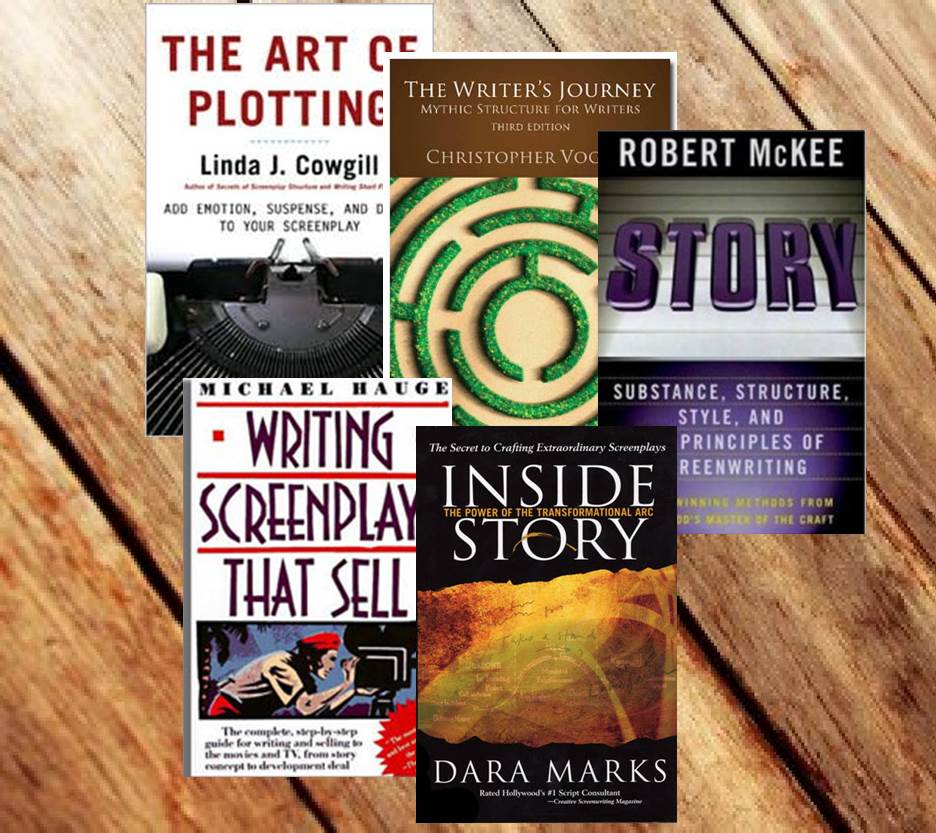
Linda Cowgill. Chris Vogler. Robert McKee. Michael Hague. Paul Joseph Gulino. Dara Marks. Each of these authors also has a trigger onto which student after student latches, like a remora on a shark, looking for their next artistic meal. Each offers an approach to screenplay writing that he or she found particularly useful.

Unfortunately, too many students miss the point that these are approaches or ways of thinking about screenwriting and not road maps to success. Each book offers one or more lessons that a writer can incorporate into his or her work today to make it better, but none of them are the One True Way.

In fact, too close a focus on any one author and you will never find Your True Way.

Too much focus on Dara Marks’ Inside Story and you will find yourself in a tailspin about Theme, as you struggle to force-fit your characters’ actions and dialogue around a theme that may or may not be true to your story.

If you find yourself able to quote Chris Vogler’s The Writer’s Journey, you’re likely describing your characters in terms of mythic archetypes a la Joseph Campbell and drawing parallels with The Wizard of Oz and Star Wars.

I’m not saying that novice writers should avoid these authors. I am simply saying that each should be approached cautiously as the novice writer—or seasoned writer, for that matter—can’t hope to achieve everything these authors discuss. The authors have the luxury of looking at a screenplay as a completed item and so discuss aspects and approaches for which you and/or your screenplay may not yet be ready. There is a reason that you will still find many of these books on the shelves of seasoned screenwriters…because they continue to find new lessons in old books as they develop their craft.

The authors and their tomes are more like a screenwriting buffet, offering you a variety of flavours that hopefully provide nourishment, but can also cause artistic indigestion.

So, sorry folks. The books offer no clues as to the One True Way. It doesn’t exist. And like everyone that came before you and will likely come after, you will continue to struggle as you search for Your True Way.

PS I own and have read books by all of the authors discussed here (and in Book larnin’), and every time I reread them, I find something new to apply to my screenwriting—including, interestingly enough, from the business writers.

Dialogue v Narrative

Image

Yesterday, my friend Marsha posted a short piece on her blog—Why the Face (WTF)—where she discussed her challenges in writing narrative/action for a scene and how she found scene writing to be so much easier if she started the dialogue.

“On its own, free of formatting and figuring out what characters are doing physically,” she wrote, “it lets me really get into what these people are actually saying to each other.”

When I read this, I thought, what a fascinating approach as mine is the complete opposite.

When I start a scene, I can go on ad nauseum about the setting and what the characters are doing or how they are behaving, but I find actually expressing the characters in dialogue to be daunting. When I do start writing dialogue, I find that I am writing exactly what my characters are thinking (on-the-nose) or that their emotions and motivations are incredibly superficial.

When I describe a character’s behaviour, however, his or her emotions surface more slowly through unconscious tics. The tensions that I intone in my mind’s eye then inform the word choice when I start to write his or her dialogue. It is as though I have to psych myself into the character’s body before I can express his or her desires and impulses to the fullest.

What makes this ironic is that while discussing this with Leela, another friend, she reminded me of the days when I first started writing sketch comedy, and all I could seem to manage were a series of “talking-head” sketches. At that time, action was unimportant to me as I felt the only way to bring my point across was through words.

On paper, my sketches could be very engaging, whereas on stage, they were significantly less so. Thus, I needed to learn the power of the unspoken word. Apparently, the pendulum has swung full tilt and I am now in the process of finding a happy medium. (No wonder writing is so tiring.)

Ultimately, like a good Oreo cookie, the best screenwriting comes from the combination of solid narrative (icing) and solid dialogue (cookie), so I am glad Marsha has my back and I have hers.

I am always right (motivation)

Image

If I move into a beautiful New England home with my beautiful family and on our first night, the walls run red with blood and a disconnected voice cries “Get out!”, I go to a hotel and move the next day.

I do not search for an explanation (or at least not that night). I do not instinctively head for the dusty attic, the dank dark basement or that rather nasty looking shed under the menacing weeping willow in the darkest corner of the back yard.

So when I read about characters doing just that in a novel or screenplay or watch actors do it at the movies, I find myself thinking they deserve whatever comes next because they are idiots. What the hell motivated them to have that stupid response? Out of the gate, I disconnect from the character.

Now, despite the title of this blog post, I am not suggesting that only my instincts should be followed in screenplays, novels, etc.—these would be damned short stories if everyone did—but rather it is a call to writers to help me, as a reader or viewer, understand why the character behaved the way he or she did. Until I do, I cannot really bond with the character.

This isn’t easy, but it is necessary.

Whenever a character responds to something or takes an action, you have to ask yourself, why did he or she do that? And over the course of your story, are all of that character’s choices consistent with his or her personal journey from before your story’s opening to its conclusion?

And as if that isn’t difficult enough, you then have to ask yourself, have I written the story in such a way that the audience can see the logic of the choices, even if only in hindsight?

This last point is crucial, because as writers, we often know or understand things about our characters that never make it to the page. Thus, while everything may seem completely consistent and logical to us, it may still be confusing to our audience, who is not privy to the machinations within the head of the writer god.

At the same time, you never want to spell it out for the audience, because then story reading or watching becomes too passive an exercise and the audience doesn’t engage. You need to feed your audience just enough information that it can begin to make inferences about your characters’ behaviours and so become connected with your characters.

The good news is that this is unlikely to happen in your first draft or at best, will happen in drips and drabs.

As you develop your story past draft one, you will find moments of inconsistency or more likely, your trusted readers and advisers will find inconsistencies. Take those in and mull them over. Odds are, fixing those issues will not require a major refocus of your story…just a heavy-brush rewrite. And your story will improve.

So if the walls run red with blood, a disconnected voice cries “Get out!” and your protagonist doesn’t, I better understand why.

Image

(Images are the property of the owners and are used here without permission.)

Fitting a pitch

Image

The line has been drawn in the sand. I’ve painted myself into a corner. It’s time to s#!t or get off the pot. [Insert other cliché expression indicating you’re stalling and we all know it.]

It is time for me to start pitching my television show ideas to production companies. No more fine tuning. No more market analysis. Get out there and sell, boy.

I was at an information session over the weekend where a Head of Development for a local production company was talking to new comedy writers (and me) about what producers are looking for in new sitcom pitches, and perhaps just as importantly, what they do not want to see.

Much of what he had to tell me was very familiar, but one factoid took me quite by surprise and shook me off the procrastination horse. Nobody, it seems, wants to see your pilot script (at least not in Canada).

They haven’t got time to wade through it and really just want to know three simple facts:

  • What’s your story idea?
  • How expensive will it be to make?
  • Can we sell it in the U.S. or in Europe?

And all of this, the producer assures us, can be handled in no more than 3 pages and for some, ideally in one.

What’s your story idea? Tell me about the scenario, the characters and what I can expect to see in a typically episode.

How expensive will it be to make? One or a couple of sets works in Canada…multiple location shoots gets expensive.

Can we sell it abroad? Make it Canadian enough to get government tax incentives but not so Canadian that Americans and Europeans won’t want it. Broad and universal is the name of the game.

No pilot script? Too many changes after everyone has had their hands in your concept…although, if you have one, you can use it as a sample of your writing.

Oh.

Hunh.

Well.

Suddenly, I have gone from having one sitcom ready to pitch to producers to three sitcoms, two animated kids programs, one anthology series (think Quantum Leap) and two educational/lifestyle programs. [This is aside from the sketch comedy show on which I am a writer, but is someone else’s puppy to pitch.]

Time to figure out what production companies develop shows similar to mine and arrange some meetings. Time to make this career leap pay some bills.

Wish me luck (and please check in every now and again to keep me honest).

(Photo used without permission from the delightful blog Picnics in the Park.)

Unintended misogyny

According to the Cambridge Dictionaries Onlinemisogyny (n) Feelings of hating women or the belief that men are much better than women.

Image

Let me state for the record that I do not hate women, but over the last decade or so, I have come to realize the insidious ways in which I felt (or made it appear that I felt) men to be superior to women.

As a male writer, I have historically written stories from the male perspective. My protagonists were male. My antagonists were male. My peripheral characters were predominantly male. And when I did include a female character, she tended to be rather two-dimensional (see also my blog post For my friend Emma).

Several years ago, I had the fortunate happenstance to take a sketch comedy writing class at Toronto’s Second City Training Centre under the guidance of actress and writer Aurora Browne, best known locally as one of the actors from the show Comedy Inc. and former mainstage performer at Second City. Perhaps not surprisingly, the class was mostly comprised of men. And to a man, we wrote sketches about guys.

After the first couple of classes, however, when we had each produced a few sketches, Aurora challenged the men in the room to either rewrite one of their existing sketches or write a completely new sketch with a woman (or several) in the lead.

It was at that moment that I realized my unintended misogyny.

Aurora was tired of trying to find material with strong and/or well-defined female characters. She was tired of simply playing the girlfriend, the ex-wife, the nurse, the teacher. Not that there was anything inherently wrong in playing any of these roles, but more that they were almost always written as two-dimensional…if they could even be said to aspire to a second dimension.

This was her opportunity to put her heels into the dirt in moulding the next generation of comedy writers.

From my perspective, the task was amazingly daunting and very surprising, as I found myself breaking down walls and obstructions I never realized I had put in place. I had to think how might a woman character function differently in this scene, without getting cliché, and how would that change the dynamics of the scene. Or even would it?

In the years since, no matter what I write—sketch, screenplay, teleplay, poem—I watch for places where I might fall into gender bias. The minute I decide on my main characters, I ask myself if the protagonist or antagonist could be a woman (sadly, I still typically default to males). If the answer is yes, then I take a second run at my idea to see which way would make for a better story.

As a result, I have both dramatically increased the repertoire of characters I can bring to life and greatly enriched my stories. In fact, the two most recent screenplays I am developing have female protagonists, as do a couple of my television pilot concepts—not out of a sense of political correctness or fairness, but because those choices made the most sense for the story.

So thanks, Aurora, for the creative kick upside the head.

(Illustration used without permission.)

For my friend Emma

…and all my other female actor friends and colleagues, a simple request to storytellers and writers:

When creating a female character for your story (or any character, for that matter), please describe her in terms that reflect who she is and not in terms of how she relates to another.

Image

Phrases like ex-girlfriend or soccer mom provide only a limited degree of context and tell us nothing at all about your vision for that character.

Is she a psychotic Glen Close type of character or is she a nurturing Barbara Billingsley type of character?

To what does she aspire?

If presented with a spider, she would [fill in the blank].

Around a board room table, her position would be [location], she would be dressed [adjective], her posture would be [adjective] and her eyes would express [noun].

If the character is important enough to move your story along, the character is important enough to be a human being (or whatever species you are dealing with).

If not, then you probably don’t need the character in your story.