Illiterate in 3 languages…all English

canadianEnglish

“That which we call a rose, would by any other name, smell…”

William Shakespeare, Bad Line Break theatre

As many of you know (or have quickly surmised), I am Canadian, and more specifically, Anglo Canadian. Unto itself, that’s a pretty cushy thing to be in this country.

In choosing to live as a writer, however, I added an otherwise unnecessary twist to my life—I forced myself to learn English as a second language.

Wait. Didn’t you just self-identify as an English-speaking Canadian?

Yes, I did. But I’m a Canadian English-speaking Canadian.

And one of the first things you realize when you become a Canadian writer is that you will probably starve for lack of work.

Now, I’m not knocking Canadian writing, whether fiction, for film and television, journalism, what have you. It is easily some of the most beautiful writing available in the English world. But it is often written to (if not for) an incredibly small market, and opportunities to succeed are therefore often few and far between.

If feels like 8 writers encompass the entire Canadian television landscape. And name a Canadian movie. (I’ll wait.)
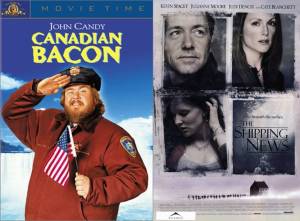
Nope and nope.

Nope and nope.

Okay, now name one not directed by David Cronenberg or Denys Arcand.

I was once offered a job as the Editor of a Canadian biotech magazine—yes, I used to be even more nerdy—for $30kpa. And yet, already on my resume was a job working for an American biotech mag that started around $65kpa.

Bottom line is thank goodness for my passion to write, because my passion for money has taken a beating.

(Side note: This was a choice I made and for which I take full responsibility. I don’t mean this to be a “life is so unfair” rant.)

What this has meant, therefore, is that to make it as a writer, I have had to learn English as a second language. In this case, American English.

Recently, the BBC published a short article that tried to explain Canadian English within the context of its British and American counterparts. Rightly, the author noted that the differences were more than a matter of spelling (e.g., centre v center; honor v honour). Rather, the differences also manifested in idioms, speech patterns and word choice.

As long as everyone's having fun

As long as everyone’s having fun

As with most Canadians, I had a bit of a leg up on learning American as our proximity to the border (mere kilometres and even fewer miles) means we are inundated daily by American film and television programming. But I also had the additional benefit of having been married to an American, and a Southerner to boot (more on “boots” later).

Where I would recommend taking the 401 across north Toronto, Leela would suggest taking 66 from Fairfax into Washington. Luckily, we were both practical enough to set aside arguments about whether we needed to go to hospital or the hospital.

All this to say that although the differences between Canadian English and American English can be subtle, they can easily explode before the eyes of the unsuspecting.

Writing for an American biotech magazine and working with American editors was something of an ESL boot camp. And over the intervening 15 years, I like to think I honed my American skills to the point where you suspect I am from Minnesota or Western New York (hello, North Tonawanda).

In fact, I’m going to rely heavily on my multi-Angloism as most of my writing, whether for money or in my screen- and novel writing, is aimed at American audiences. And although my primary goal remains writing the best story, my secondary goal is writing it in the most innocuous way. I don’t want my writing to “read” Canadian.
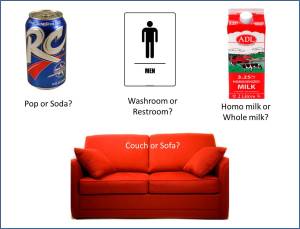
Versus

Truth be told, I don’t want my writing per se to be noticeable at all. If it is, I’ve taken the reader out of the story.

This is not to say that I want my stories to be bland, but rather that I want all of the art to be in the story itself, rather than the more mechanical aspects.

In my Canadian stories (so far a sitcom pilot and screenplay), which are set in Canada, involve Canadians and target Canadian audiences, I write Canadian. For pretty much everything else, I write American.

Should I start targeting British audiences, then I’ll spend more time learning British English, and make fewer spelling changes.

In the meantime, I’ll continue to bounce back and forth between the multiple Englishes like a character out of Monty Python.

What’s it aboot?

Anyone can make fun of how Canadians communicate (or don’t). Goodness knows Canadians do. But I have to admit that I struggle with the whole “oot and aboot” phrasing that American audiences in particular seem to see as a Canadian phrase.

It’s not that I think we pronounce these words correctly so much as we don’t say “oot”. Rather, we say “oat”.

As I mentioned, I was married to a Southerner, and one day, we had a lengthy conversation about the word “South”. Try as she might, Leela could not get me to pronounce the “ou” without it taking on a surreal emphasis akin to “owwwwwww”.

Instead, I would say “Soath”. And instead of “about”, I would say “aboat”. And as I made a point of listening closely to Anglo-Canadians speak, I never heard a single one say “aboot”. It was always “aboat”.

That being stated, I will totally cop to “eh”. It’s us. End of story.

Leadership focuses on others

[See video here…Viacom pulled YouTube video above]

When you have really touched co-workers’ lives, when you have helped people grow by nurturing them and fostering their inherent talents, when you have taught people through example, then and only then can you walk away knowing that you have done a good job.

Anyone can shill the product or service that your organization offers, but it takes a special person to see beyond his or her ego and know that it’s about others and making the world a better place.

Looking forward to your next adventures, Jon. Thank you.

Dream snatcher

dream web

The other day, I engaged in the following conversation on Twitter:

Him: There are a lot of tweets directed towards aspiring filmmakers telling you to “never quit” and “follow your dreams.” That’s terrible advice.

Him: If you met some guy and he said he wanted to be a professional NBA player would you immediately suggest he follow his dreams and never quit?

Me: If that’s where his happiness is, then yes, I would. Who am I to call down his dreams? Would in fact offer to help.

Him: Attention anyone in the world who is looking for someone to help them become a professional basketball player.

Me: If you never try, how will you ever know what you might accomplish? Why live by someone else’s thoughts on what is feasible?

I understand his point.

So often, people express a desire to become something or someone without a good understanding of what it takes to do that. And in a subset of these situations, the aspiring individual isn’t willing to put in the requisite work to overcome their ignorance or skill-set shortcomings.

I’ve known several people who upon seeing how much joy writing brings me express a desire to write. And then do nothing about it. And unlike the professional NBA player quest described above, writing simply requires a computer or pen & paper. And yet, many of these people refuse to write.

But even knowing this, even if I had complete clairvoyance to a future of procrastination or frustration and agony for them, does this give me the right to tell them they shouldn’t try? I don’t feel that it does.

Despite my conversational counterpart’s sarcastic response (I assume it was sarcasm), I am happy to help anyone become a professional basketball player, if that’s what they want. I have no idea what skills I could possibly bring to that quest, but hell, we all need support to follow our dreams.

chase-catch-dream-big

You don’t have to be an expert in a subject to help someone.

You can help them better understand what they’re attempting so they can make informed decisions. You can offer a couch or spare room if they need a safe haven. You can cook a meal or several for them when money is tight. You can cheer at their successes and offer a shoulder in times of frustration or disappointment.

And most importantly, you can let them know that success or failure—whether internal to them or measured by external yardsticks—has absolutely no impact on whether you will be there for them.

To all of my friends and to people I have yet to meet in life, pursue your dreams with everything you have, make your life choices knowing that I will be there to help you in any way I can.

And do your best to ignore the dream snatchers who think they are doing you a favour by talking you out of your dreams.

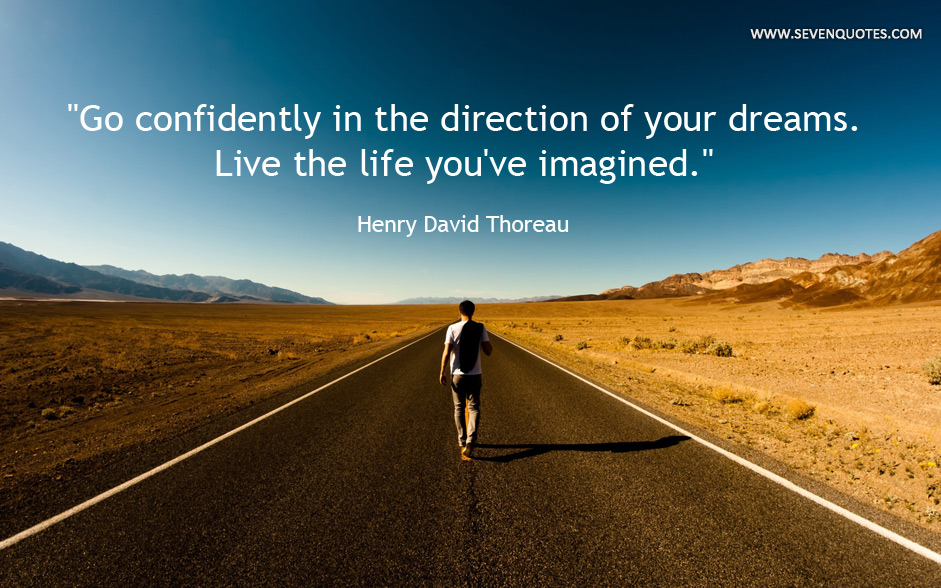
go-confidently

And if you’re tired of watching me live my dreams, check out the blog of a friend of mine who has started living her dream life: Pipe’s Adventure.

The most dangerous F word

Fear

Hate is fear rationalized. Hate is fear acted upon.

Hate is the belief that fear is finite; that if I bestow some of my fear on you, I am unburdened.

But that is a lie.

Fear isn’t of this universe. It doesn’t live by the E=mc2 paradigm. Fear has limitless potential for growth.

Any more than I can relieve myself of a pestilence by giving it to you, my fear remains and may even grow when I pass it along.

Surely a little fear is okay, keeps us from stepping off cliffs or traveling dark paths.

Fallacy.

Fear doesn’t keep us safe. Knowledge does.

Vista

Knowledge keeps you from stepping off the cliff. Fear keeps you from seeing the spectacular view.

Knowledge removes darkness from the alley. Fear keeps you from seizing new opportunities, from discovering new paths.

Fear doesn’t come into existence of its own accord but like a virus, is passed from person to person.

The newborn infant has no fear until startled by a parental “No”, the opening dose of fear.

infection

We do not naturally fear others until given a reason. And rarely is that reason the other we have chosen to fear, because fear rarely approaches face on.

Fear is the demon that eats us from inside, a parasite that controls our minds for its own perpetuation.

But what is worse, what makes it so insidious, is that fear is easy, demanding little of us other than that we close our senses to the truth.

And it is the facility with which so many of us are willing to do this that makes fear the most dangerous F word.

Burden

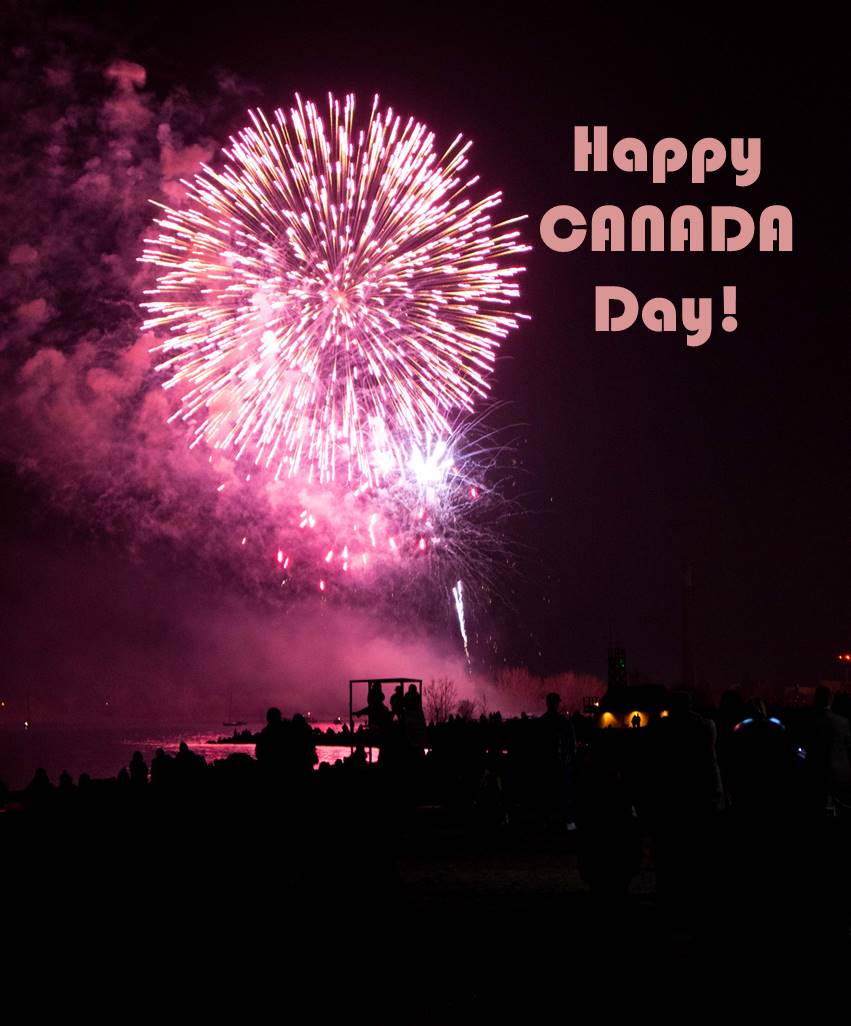
Happy Canada Day

Canada Day

It’s time again to express my gratitude for everything that my home & native land has given me, and to wish you all–Canadian or not, here or abroad–a safe and wonderful year.

My only wish is that you all have the good fortune I have experienced and know the love that I know.

Peace be with you all.

Walking with Pride

Sister Twisted, who invited me to walk with her group. (Credit: Toronto Star)

Sister Twisted, who invited me to walk with her group. (Credit: Toronto Star)

Well that was different. Just spent several hours in a misty rain wandering the streets of downtown Toronto, waving at colourful people on the sidewalk while screaming my head off.

Welcome to Pride 2015 in Toronto, folks.

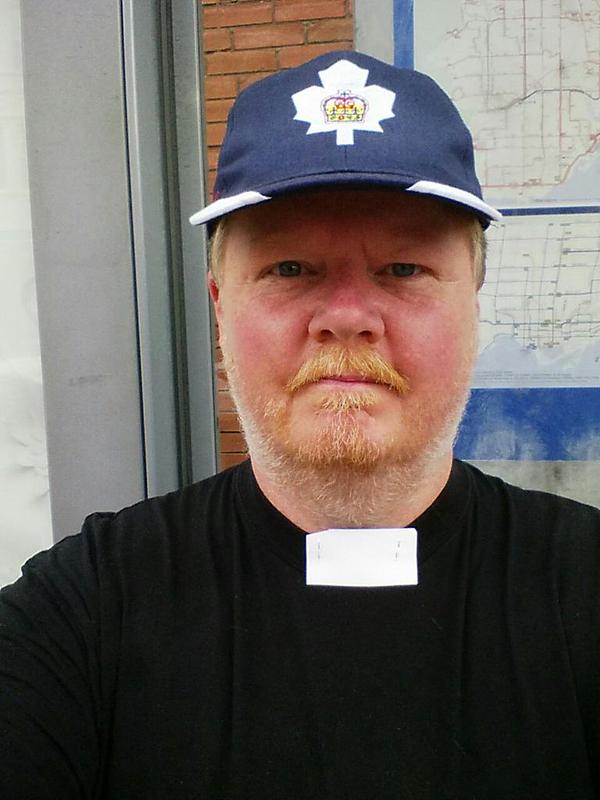
What's a religious theme without my beloved Toronto Marlies?

What’s a religious theme without my beloved Toronto Marlies?

While I have always been a strong supporter of human rights in all forms, I have generally avoided Pride Week in Toronto simply because I don’t like crowds. But this year was different.

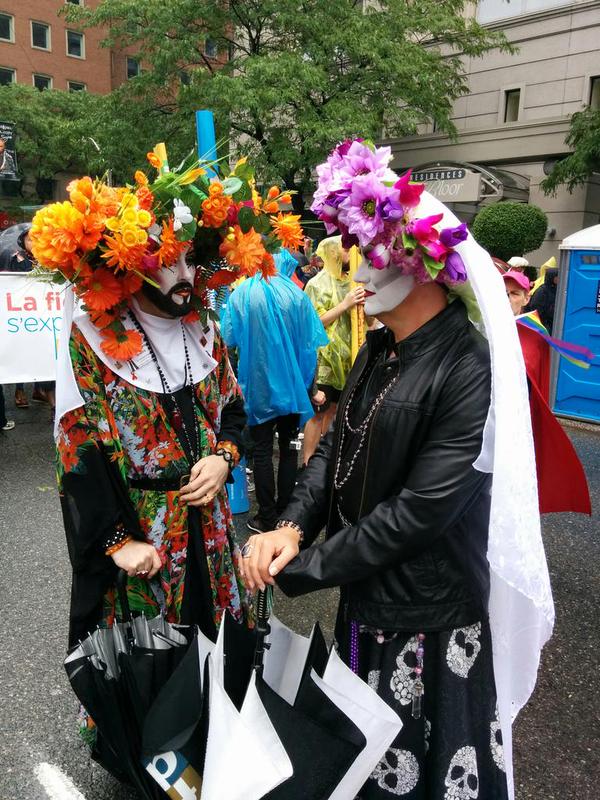
This year, I was invited to participate in the parade itself by my friends The Toronto Sisters of JOY (Jubilant Order of York), a group of amazingly loving, life-affirming people who seem to work from the premise that to be heard, you must be seen (my words, not theirs).

The Sisters pose with their banner

The Sisters pose with their banner

How could I say no? Hell, why would I say no?

So, early this morning, I pulled together a costume of sorts (not my forte) and headed downtown to meet with the Sisters and some of their other disciples, and into the parade we went (news video).

Two Sisters plan the next few hours

Two Sisters plan the next few hours

Well, into the court yard to meet, then into the parade to wander like the 12 tribes to search for our place in the parade, to wait in the drizzle to walk a few blocks and wait some more and then past the float until… well, you get the idea.

But once the parade started, it was so much fun. Never have I ever felt surrounded by so much love. Every colour and every letter in the alphabet came out to show their support of just LOVE and FRIENDSHIP. It was amazing.

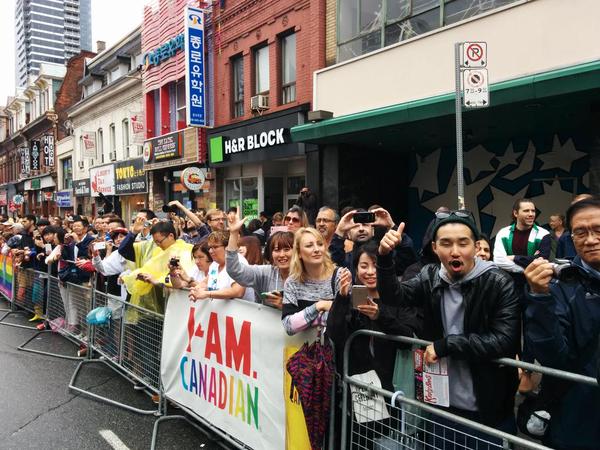
I am Canadian, too.

I am Canadian, too.

Everyone shouted their support.

Everyone shouted their support.

Drizzly day in Toronto didn't dampen spirits

Drizzly day in Toronto didn’t dampen spirits

And when the parade finally ended, I was ready to keep walking…instead, I went to Fran’s Diner for a late lunch.

I am proud to call myself a friend of The Toronto Sisters and of several communities of people whose only requirement for entry is acceptance. That’s pretty cool.

You’ll see the Sisters a couple of times in this video of Saturday’s TransMarch (language).

I also recommend learning more about the You Can Play Project, which promotes inclusiveness in sport.

From tampons to toilet paper

Taxi pads

As of July 1st – Canada Day – women in Canada will no longer be required to pay sales tax when purchasing feminine hygiene products such as tampons and pads. The change comes after many months of Canadians decrying the tax as gender discriminatory, as solely a tax on women (see House of Commons debate).

Having wracked my brain, I was unable to determine an equivalent male-exclusive product and so broadened my thinking to identify products that might be absolute necessities. There are no taxes on groceries, for example – family-size purchases, that is; “junk food” and “individual” purchases are taxed.

And then it struck me: toilet paper.

So yesterday, I launched a faux campaign to remove the taxes from toilet paper, and welcome you all to join what I am calling the #BowelMovement.

Tweet

Feel free to * ahem * pass this along.

TP tax

Hot Girls Wanted documentary (a review)

Hot_Girls_Wanted

Watched Rashida Jones‘ documentary Hot Girls Wanted about the amateur porn industry and can honestly say I have no idea what I think of it.

Part of the challenge is I have no idea what the point of it was other than to document the experiences of several young women (18-25 y) as they approach and experience the lifestyle. We can argue day and night about whether the lack of an overt agenda or POV is a good thing, but to my mind, it presented the women as neither victims nor empowered…simply as women who made a choice.

To be blunt: These women chose to go to Fuck Camp to make money and escape home.

It is interesting to watch the impact of their decisions on their lives and particularly their relationships with families and boyfriends. And I had to laugh at the irony of one woman who was clear in her rationale about her decision until it came to talking to her father about it.

And I must admit that I was surprised at how cavalier (my biased standards, not theirs) the women were about what they were doing, the potential hazards of the situations they found themselves in, and any thoughts as to how this might impact future life decisions beyond the 3-6 months they made money (not a typo…a woman’s “marketability” typically only lasts 3-6 months).

One of the few images I'm willing to show

One of the few images I’m willing to show

Over its 82-minute span, the documentary drags a little in places and often covers the same ground, no doubt to reinforce some of the more graphic elements. And it is graphic, stopping short of showing the actual sexual acts, but giving you enough of the rest (e.g., nudity, bondage, choking, vomiting) to bring across the essence of what these women are doing.

And in the end, the take-away is whatever you take away from this story.

No matter what your opinion going in, this will only reinforce that opinion. It doesn’t seem to be aimed at making you change your mind about the merits or evils of this industry. The same woman who feels exploited in one scene expresses a sense of empowerment in the next, and in some cases, about the same act.

Adult women making adult decisions about the adult industry. Good or bad is for you to decide for yourself.

An actress and a producer discuss the documentary

An actress and a producer discuss the documentary

Thank you

Varied of tradition, but singular in purpose.

Varied of tradition, but singular of purpose.

I just walked to the grocery store without a second thought beyond wondering whether milk would be on sale or if I could get there and back before it started to rain.

Thank you.

Last night, friends and I filmed puppetry vignettes in which we satirized recent political events and social attitudes, laughing freely and openly.

Thank you.

On Saturday, I met a friend for bacon sandwiches and then walked home along the beach, smiling at kids playing in the sand and dogs excitedly greeting each other.

Thank you.

Today, my biggest concern is whether I will get off my backside and walk two blocks to change my cellphone carrier or if I’d rather just bitch about the one I am presently using.

Thank you.

My home hasn’t been destroyed. I’m not worried about my next meal. My family hasn’t been slaughtered. No one will kick in my door because I made a joke online. And you and I can completely disagree on local, national and world politics and social trends.

Thank you.

And even with all that, five “thank yous” is not nearly enough to express my gratitude to the men, women and families who have sacrificed everything so that all of the above is true.

I live in Canada. It is Memorial Day in the United States. And none of that matters. The international boundary does not make any of what I have written less true.

We may choose different days and express our feelings in different ways, yet we have but one purpose: gratitude.

Thank you.

From Ottawa's Parliament Hill to Washington's National Mall to France's Vimy Ridge, we must never forget and always be grateful.

From Ottawa’s Parliament Hill to Washington’s National Mall to France’s Vimy Ridge, we must never forget and always be grateful.

Assumption of malevolence

Good

As I sat at a picnic table near the boardwalk along Lake Ontario, I watched parents pushing children in strollers, local residents walking dogs and chatting, and a squirrel accost me for my choice in sandwiches (seems he preferred nuts over chicken).

It wasn’t long, however, before the gentle peace of wind and waves was broken by an angry tone.

“Hey! Your dog left a package back here!” shouted a woman to people further along the boardwalk.

“Sorry?” came the gentle query.

“And let’s just say it’s a present I wouldn’t want to step in,” the angry woman shouted while mimicking the slide of sneaker on grass.

“He did?” the other woman questioned, turning back down the boardwalk.

“Yeah! You want to get back here and pick up after your dog,” the first woman barked. “It’s over there behind the bench.”

“I’m sorry, I didn’t see him do it.”

“Of course not! You were too busy talking to your friends,” the woman sniped as she stormed across the park to some other destination.

The dog owner reached the bench, and after a few moments of searching, bagged the offending substance and rejoined her friends.

Poop

I appreciate that dog dirt litters our parks and streets and beaches, and that the angry woman was fed up with this happening in her neighbourhood.

And based on the demeanour and response of the accused (woman, not the dog), I am confident that this was not a typical dump-and-run, but rather an innocent oversight.

Sadly, rather than assume any degree of innocence, the angry women immediately jumped to an assumption of malevolent or at least willful ignorance.

She could have approached dog owner calmly with “Excuse me, but your dog seems to have left something behind that you may not have seen.”

Instead, she attacked with a tone that suggested the dog owner herself left the steaming pile.

At least in North America, there seems to be a growing trend to assume malevolent intentions before acknowledging the possibility of innocent ignorance or unfortunate stupidity.

Are there malevolent self-centred people in the world? Certainly.

But should that be our default assumption about anyone who slights us or causes us discomfort?

If the answer is yes, then I want out of this society. It has become too angry for me and I have no desire to be victimized by it.

I wish both of the women in this story well.