Screenwriting, not choreography

Write-dance

In her weekly blog Why The Face, my friend Marsha Mason (more “Hey, there!” than Goodbye Girl) hits briefly on two topics of particular angst in new screenwriters: camera directions and over-written action sequences.

For me, both of these come down to the same issue: the screenwriter’s need to choreograph his or her story so that the reader “sees” the movie as the screenwriter “sees” it.

Below, with permission, I have reproduced Marsha’s original post and my comments on it.
WTF

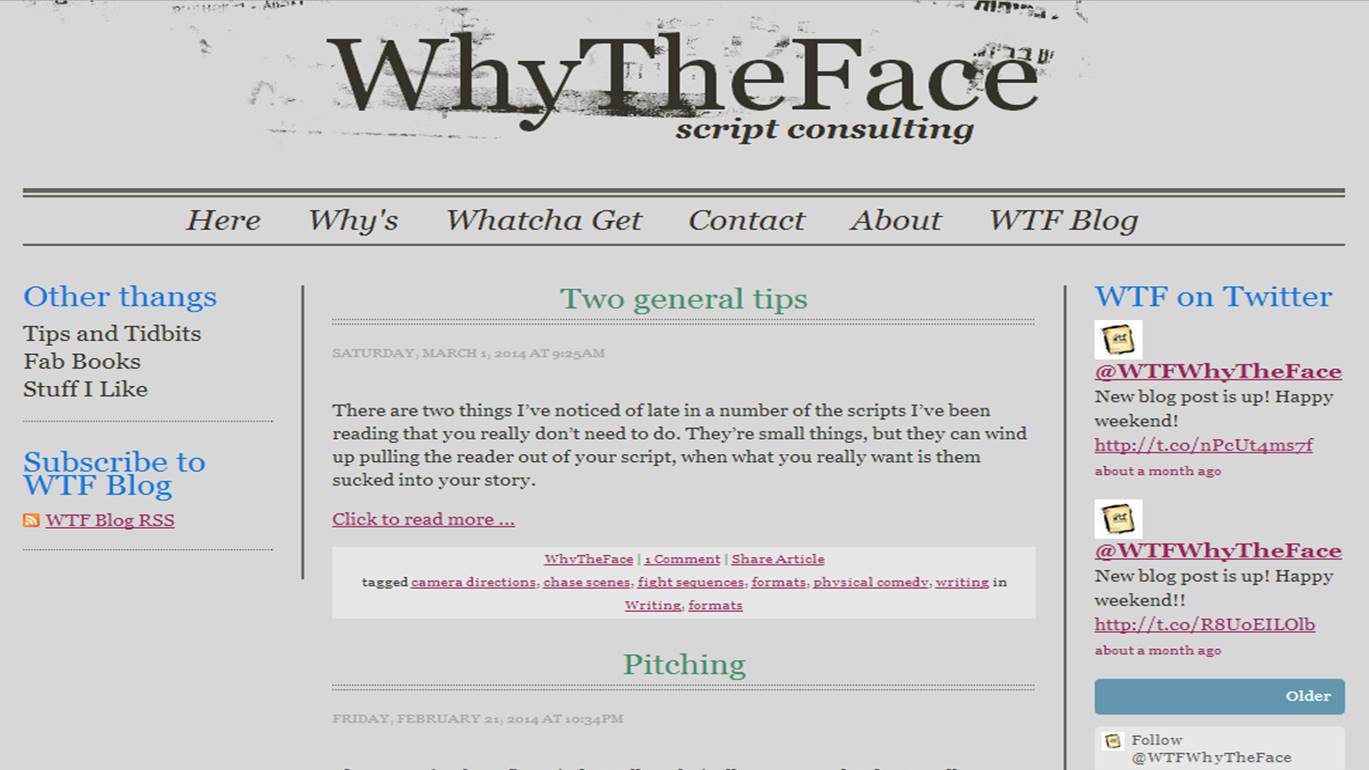
Why The Face, March 1, 2014:

There are two things I’ve noticed of late in a number of the scripts I’ve been reading that you really don’t need to do.  They’re small things, but they can wind up pulling the reader out of your script, when what you really want is them sucked into your story.

1) Camera directions: leave them out. When someone falls in love with your script, the director that attaches to it will be the one to figure out what camera angles they’ll use and when.

And…

2) Detailed descriptions of fight sequences/car chases/long physical comedy bits: once someone falls in love with your script, there will be stunt choreographers, fight directors, and your star actor/comedian, people whose specialty it is to design these sequences for the production, based on the needs/wants of the director/producer/star.

A better idea is to describe the feeling and the tone so the reader knows what you’re aiming for, rather than going on for a page or more.  Ie “An epic car chase ensues.   More Seth Rogen behind the wheel than Al Unser Jr., it goes for blocks, barely missing nuns and orphaned children.”

Essence of, then right back into your story.

My comments:

Couldn’t agree more. Too many people feel they have to direct their screenplay to ensure the reader “sees” what they “saw” in writing it.

In a few screenplays I read recently, the writer went to great lengths to choreograph fight scenes, offering the minutiae of balletic movements.

“Raising his knee, he blocks X’s kick, and then twirls to chop X across the back of the neck. Stunned by the blow, X falls forward but recovers quickly enough to tuck and roll back to his feet. Etc. Etc. Etc.”

A fight sequence should have a sense of energy, urgency. These are people struggling. You want that to play out emotionally. You want the reader to break out in a sweat, his or her pulse elevating while reading the scene.

Instead, you slow down the reading with lengthy descriptions. The reader has to wade through line after line of description.

As Marsha describes, you can offer the fight in broader strokes to elicit feeling or tone.

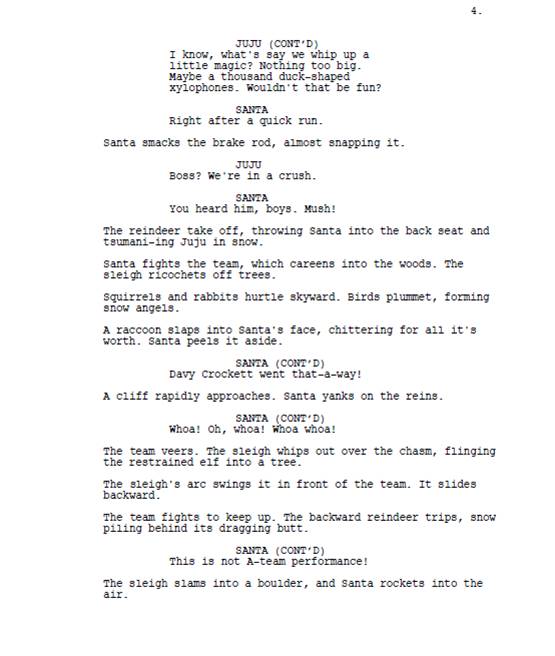
Alternatively, you can present a sequence in short, staccato phrases and sentences. It is like having 20 hockey players firing pucks at you, at will. You become powerless in the onslaught, never precisely sure from where the next shot is coming.

Because the descriptions are short, they take little time for the reader to absorb before he or she moves onto the next one. Each line comes faster and faster, until the reader finds him or herself in the fight.

And then suddenly, it is over and the reader is left drained, but exhilarated.

In action sequences, less is more.
Sleigh


(Note: The above sequence is from my latest screenplay The Naughty List, a holiday-themed film for adults. Think The Santa Clause meets Good Morning, Vietnam.)
First page of new screenplay (opinions please)

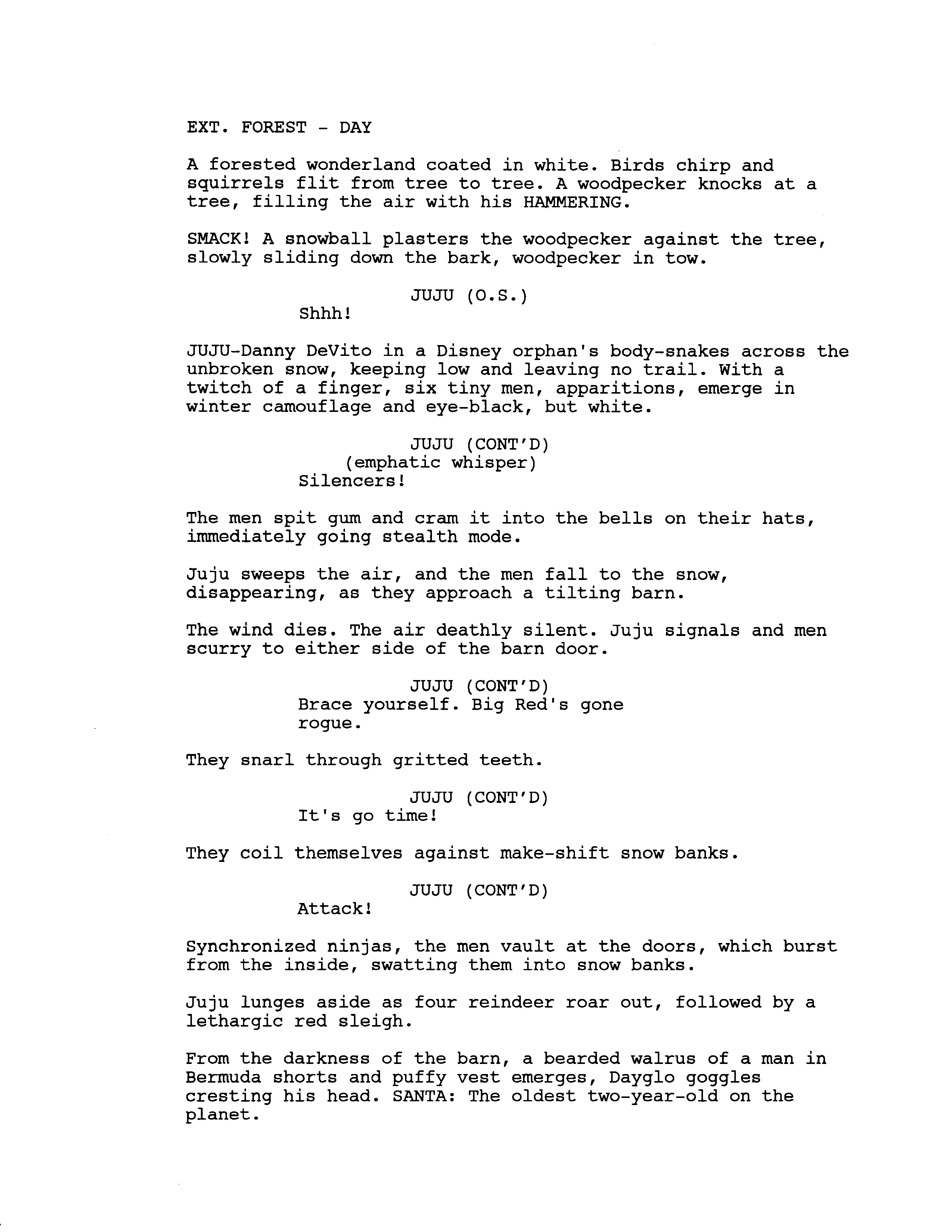
Hey guys,

I am working on a new screenplay and would love your split second reaction to this opening page.

Does it grab your attention? Are you intrigued? Do you want to know what happens next?

Any thoughts…positive, negative, inflammatory…are welcomed.

And so the new story begins

And so the new story begins

Cadence and Orson Welles

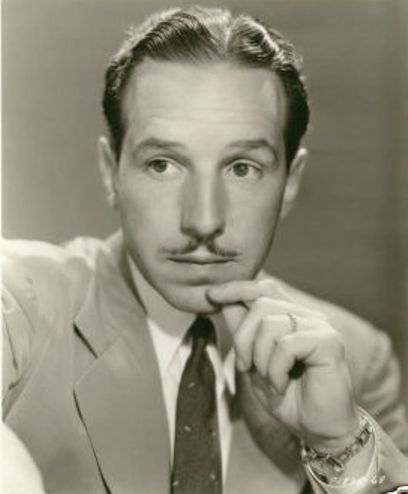
My favourite shot of Welles as I believe that smile and those eyes tell me everything I need to know about the man

My favourite shot of Welles as I believe that smile and those eyes tell me everything I need to know about the man

Being a good writer necessitates having a good eye and a good ear.

The good eye is the attention to details that will help you paint a word-picture of what you have seen with your physical eyes and processed in your mind’s eye. It’s not necessarily about writing long-winded passages of backgrounds or going into minute detail of a character’s physical attributes (I’ve done plenty of that), but rather in choosing the most precise and meaningful words to describe the environment or the person.

The good ear is the attention to how people communication and how they speak, not always the same thing. Again, it involves finding the right words and inflections (at least implied inflections) that give the reader and actor clues as to who this person is. And perhaps just as importantly, it is about finding just the right cadence for your character’s speech patterns.

If you listen really closely to a conversation, you’ll realize that there is little difference between speaking and singing. There is a rhythm, a cadence to speaking. Conversation is an improvised duet sung a capella. But unlike a traditional song which may have a subset of arrangements, each of us sings to our own tune, with our own rhythms and inflections. It is one of the many things that sets us apart from each other.

When writing characters, it is important to keep this in mind as all too often, a group of characters can have a certain monotone, which I use not to imply flatness so much as sameness. Often, I believe, it occurs when the writer neglects to add variety to his characters’ speech patterns and instead writes them with one voice; his or hers.

The best writers don’t make this mistake…or at least minimize its occurrences. Each character he or she presents us is truly unique, jumps off the page or screen, provides his or her own internal musical accompaniment.

One of my favourite writers of the last decade or so is Aaron Sorkin whose overall writing has its cadence but whose characters also tango (or more often tarantella) across the screen. Read the pilot to The West Wing or the screenplay for The Social Network and you will know you’re reading Sorkin.

But for me, perhaps a better example is Orson Welles, the man who would be Kane.

Recently, someone discovered a long-lost unproduced screenplay by Welles called The Way to Santiago, written in 1940-41. Another blogger discussed the find recently, and provided a link to the actual screenplay (see link below). You only have to read a couple of pages to remind yourself (or educate yourself on) how Orson Welles wrote and the energies he imbued in his characters, each one a snowflake of facets and reflections.

The opening page of The Way to Santiago

The opening page of The Way to Santiago

Now, listen to the films or read the screenplays of The Third Man, The Magnificent Ambersons, Touch of Evil. Although you may question the choice of actors, you can clearly hear or see the distinctions in the characters. Bathe in the richness and depth of each one as he or she is captured for this brief moment. This is the stuff of which dreams are made.

It is also interesting to consider that Welles got his start on stage and in radio, where the human voice plays such a larger role in conveying a story than it does in film. There is much less to occupy the mind onstage or in radio and so dialogue carries a significant burden of not only informing but also entrancing the listener.

Although the stories I write are distinctly different from the Wellesian oeuvre, there is much I can and do learn from this master of the written word. He is worth the read and the listen.

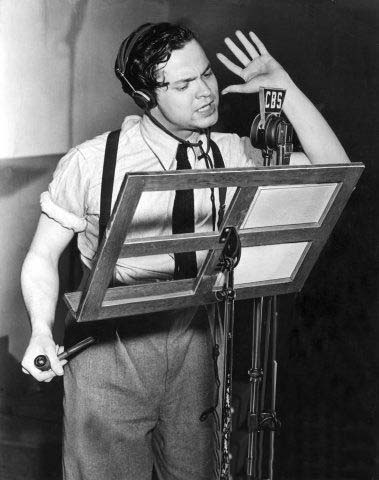
A classic image of Welles in his radio days

A classic image of Welles in his radio days

Links of interest:

The Way to Santiago at Cinephilia and Beyond

The Way to Santiago, starring Howard Hesseman on Vimeo (A valiant but not brilliant attempt)

“Thank You, Mr. Welles: Definitive actor, consummate director, and true auteur” at Curnblog.com

“Screenplays by Orson Welles” (listing) on Wikipedia

Me and Orson Welles A light but adorable movie that probably portrays Welles’ character better than Welles

Another year, another AFF Second Rounder

20th AFF poster

So, it would seem that rewrites work.

Last year, I entered my screenplay Tank’s into the Austin Film Festival screenplay competition and other than some amazing notes, it went nowhere in the competition. (My spec teleplay of The Big Bang Theory, however, reached the second round before bowing out.)

Fast-forward a year and four rounds of revisions, I just learned that the same screenplay made it to the second round of the competition before bowing out…Tank’s made it to the top 10% of its category, which feels pretty good considering the AFF received more than 8,600 screen- and teleplays this year, its highest submission rate ever.

Aside from the $200+ refund on my registration fee, what makes this really awesome is the esteem in which Second Rounders and higher are held at the screenwriting conference portion of the film festival. You see, the Austin Film Festival is more than just a whack of movie screens and Hollywood A-listers (like my own Toronto International Film Festival; on now). The AFF is also a 4-day screenwriters’ conference and love-fest, as 400+ introverts try to get just drunk enough to come out of their shells and commune with Hollywood screenwriters and film-makers.

If you are a screenwriter and have never been to the AFF, GO! It is worth the money.

Sure, some of the sessions amount to little more than hero-worship where you’ll hear questions like: “Remember that scene in X-Files when Mulder gave Scully that look? Did you write that, because that was awesome?” But most of the sessions are actually helpful discussions and learning opportunities with the film and television world’s elite writers…and best of all, these Gods not only stick around, but they’ll actually talk to you at the BBQ or in the bars. It’s like they give a shit about your shit.

Last year was my first AFF, and I was the introvert amongst introverts looking for the closest corner in which to nurse my beer or G&T. This year will be different. This year, I will move out of the corner and occupy the middle of the room…who knows, I may even talk to someone. (God, I need a drink!)

Oh, the Austin Film Festival runs October 24-31 from the Driskill Hotel.

PS If you think I’m bragging, my prowess is kept in check by a friend I met at AFF who had two Second Rounders and one Semifinalist screenplay in last year’s competition alone.

Not for nothing – REQUEST FOR HELP

ssnolan3

How do you write about nothing?

I know how to not write. In fact, I was very good at that in the past, but gratefully not writing is no longer much of an option for me.

I’m not talking about not writing, however. Instead, I am talking about writing scenes where superficially nothing happens, where a character walks through the mundane actions of life. What they are doing is unimportant to them, a robotic response to an overwhelming thought or scenario. There is an astronomic exchange of information and yet no words are spoken.

In a novel or short story, you can have an inner dialogue, revealing the character’s thoughts, but in a film, you have only silence. Sure, there’s always the trusty voiceover, but I personally think that unless the character is recalling a past statement, voiceovers are a crutch. And a voiceover weakens a scene when you compare it with silence.

Think of the last time you were faced with silence in response to something you said or did. Think of the dis-ease (yes, that’s where “disease” comes from) you experienced as you tried to figure out what the other party was thinking. In many of those situations, I bet that shouting would have been preferable to silence.

In an improv class I took—I am sorry that this is my version of “This one time, in band camp…”—we were doing a status exercise wherein one character would try to take status away from the other one, proving themselves superior through statement or action. While many student pairs would do their best to out-pompous, out-preen or out-bravado each other, I took a different tack. I went completely silent.

No matter what my partner said or did, I faced him stoically or indifferently, deigning to give him the merest glance on occasion while going about my activities. And the louder or larger he got, the less I minded or acknowledged him. The more he talked, the weaker he appeared.

Silence is powerful. And even if the silence is due to idiocy, it comes across as thoughtfulness.

Think of scenes in movies where a character has chosen to deal with a problem by thinking about it. With a good actor, you can see all the thoughts as they play out in his or her mind. The body, the face, the eyes tell you all you need to know about the emotional swells washing through the actor. A single word breaks that tension and weakens the moment. As a storyteller, why would you ever give that up?

Which brings me back to my original question: How do you write nothing?

Perhaps I am delving too far into the domains of the director and actor, but there has to be a way to ensure both those artists know what you, the writer, intend. But I’ll be damned if I know how.

So, I open the question to you, my fellow artists.

What do you do, what have you learned, what have you seen that tells you how to write nothing and yet convey a world of thought and feeling?

Please share your thoughts here as I can’t be the only one who wants to know.

Alas, Mel Smith

Image

Today, I would like to commemorate the legendary comic genius that was Mel Smith, who passed away this past week.

And he was a legend…in the sense that his story offers a scintilla of fact ham-fisted into a pasty-white pasty shell of human dung perpetuated by self-immolating vivisectionists with personal hygiene problems and a fetish for peat moss.

For those of you who didn’t know him, Mel Smith was a kind, gentle, giving man who would go out of his way to help the less fortunate.

For those of us who did, however, know him, Mel Smith was a fucking asshole. Wouldn’t give a toss about anyone even if they offered to wank the bugger themselves. As nasty a piece of shit as Britain has ever produced, and remember, these include the Thatcher years.

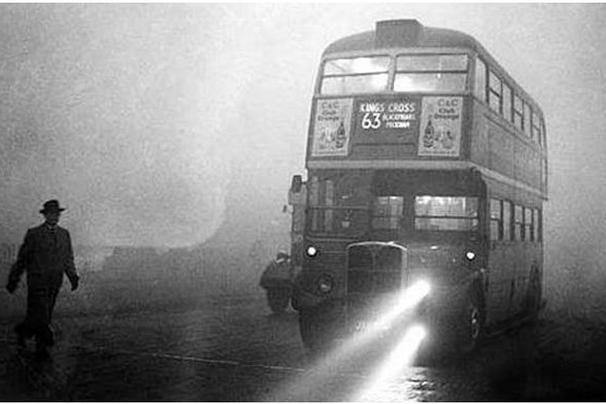
Mel Smith was born in West London on December 3, 1952, presumably from the uterus of a woman who had shagged a large black ram during some pagan ritual the previous March. No one is quite sure why he chose this day, but some have tried to link his birth to the great smog that swept over London the very next day, killing upward of 12,000 people.

Image

A right bloody bastard he was.

Over the next several years, Mel Smith attended a variety of schools where he was considered a bright pupil. Unfortunately, the ability to shoot light from your eyes is not one of the criteria to succeed in A-levels and Smith’s general lack of intellectual acuity—it is rumoured he had the IQ of retarded tapioca—meant he was only able to attend Oxford.*

It was while attending Oxford that Mel Smith learned he had a knack for convincing himself he was funny, and through sheer perseverance—and a gun—he caught the eye of director John Lloyd. Lloyd, who was fond of both of his eyes, immediately gave Smith a role on the hit comedy television series Not the Nine O’clock News.

Image

BBC audiences, however, quickly concluded that this was also Not the Funny Comedy Program.

Blaming everyone but himself for the demise of the careers of people like Rowan “Who” Atkinson, Smith beat up the little Welsh kid on the show—Griff Rhys Jones (talk about your Dumbledork)—and started a hard new series that took a satirical look at Islam called Allah’s Smith and Jones.

Two days into the fire bombings, a slight change was made to the title of the show, now Alas Smith & Jones. The ampersand saved the day.

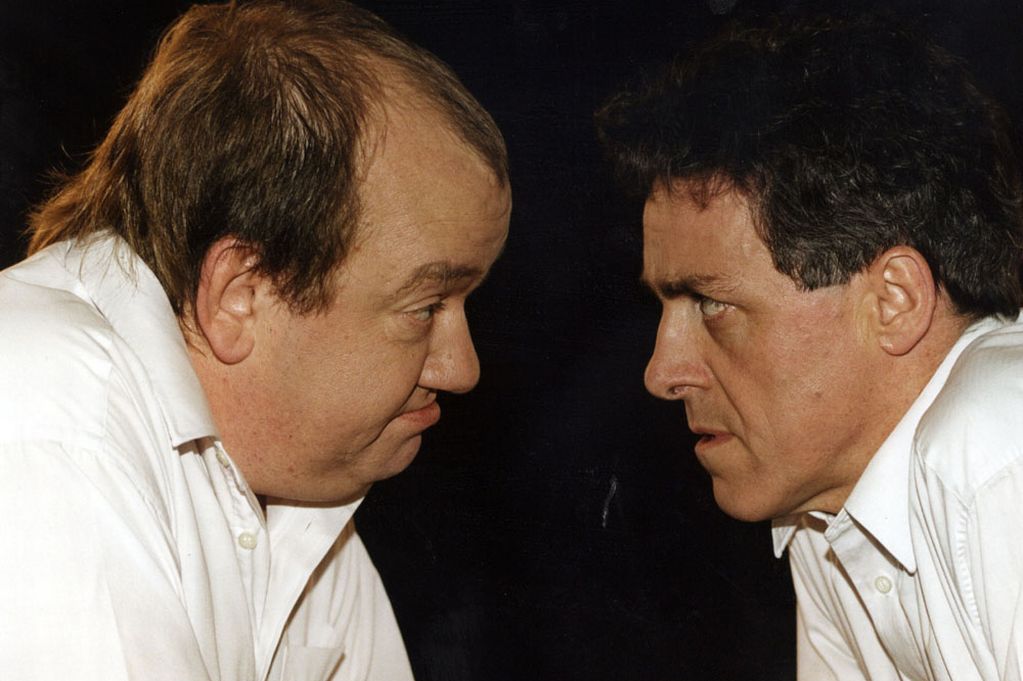
Out of the gate, critics were harsh. “Who are these two wankers who do nothing but mumble to each other from 3 inches?” “Kiss, already.”

Image

But the British public ate it up.

Since the fall of the Empire, they had pretty much been doing the same ruddy thing every night, smugly satisfied in their fetid shanties that they didn’t have to get bloody malaria just to find a decent curry.

When the show finally went off the air—nobody knows exactly when, because to be honest, nobody could stomach more than 20 minutes of that shite—Jones wandered off, never to be heard from again, except as that sad ugly bloke who would masturbate monkeys on Whose Line Is It Anyways?

Smith, however, dragged his bloated carcass to Hollywood, where he was met with rave reviews like “What is that prick doing to my dog?”, “Can human beings really sweat that much?”, and “Did Charles Laughton just take a shit on my lawn?”

On January 7, 2001, Mel Smith’s career was declared dead. His body, however, continued to function until July 19, 2013, when Mel himself passed away from a heart attack. The news sent shock waves through the British comedy community, both of whom expressed surprise that Smith even had a heart.

Smith leaves behind pretty much everybody who didn’t die on or before July 19, 2013.


*Ed.’s note: It has since been verified that even retarded tapioca can gain attendance at Cambridge. We thank Hugh Laurie for the correction and apologize for printing the aforementioned rumour.


Thanks Mel


[Images are property of owners and are used here without permission because that’s what Mel would have wanted…and frankly, I don’t give a toss.]

Selling out versus selling

Image

Over the last few years, I have met a lot of artists of various stripes, and almost to a person, one of the major fears each has is the belief that to become a success and to make a living with their Art, they will have to dilute that art. They’ll have to sell out. Some simply fear it in quaking silence, while others fend it off with flecks of foam like some rabid dog chained in a backyard of their own making. To each, their own.

You have a vision for your Art and you must respect that. It is because you are doing your Art that your Art is different from anyone else’s. By the same token, if you do hope to make enough money to keep at it, you must be able to express your Art in some commercial way.

Admittedly, with technologies such as self-publishing (formerly known as vanity publishing) and phones that offer better cinematography than anything Cecile B could have dreamt of, you can go it alone as no one before you could. You can make all of your dreams come true, but the question is, will those dreams come true? Will anyone beyond your mom, your partner and a few close friends bother with your Art once discovered?

I’m not saying to make a living you have to sell out. Don’t despoil your craft in the name of crass commercialism. If you’re truly an artist rather than a hack, it wouldn’t serve your purposes and you’d come to loathe the thing you once loved.

No, I’m talking about finding a line of compromise between your vision and the market’s.

As this is particularly close to my heart right now, let’s say that you’re writing a screenplay. First, congratulations. There may be thousands of screenplays out there, but I am confident there are billions of unfinished scripts and half-thought ideas.

Having completed your screenplay, however, is only the first step. Now you’ve got to share your creation with dozens of other people, each of whom will want to put his or her stamp on the work.

Story editors, readers, producers, directors, actors, financiers, market researchers. To a greater or lesser extent, each of these people has to buy into what you’re selling before your movie will get made.

Sure, if your film is small with a very modest (miniscule) budget, all of these titles may be handled by 3 to 6 people, but even then, you’ll likely run into issues with distribution.

I’m not saying it can’t be done. History is replete with artists who decided to go it alone. But the unwritten backdrop of that history is swamped with the myriad films sitting idle on bookshelves or hard drives, or competing with cavorting kittens and bad karaoke on YouTube or Vimeo.

If you want to share your Art—and I’m betting that you do—then you want outside thought, you want feedback, you want people to contribute.

Don’t look at barriers, but rather seize opportunities to engage. These people are your first audience. Respect them. Use them. Understand them. Do this and you’ll be well on your way to realizing your vision in their world.


(Image is property of owner and is used here without permission because I refuse to let anyone sell out.)

Adapt or die

Image

Recently, I’ve read a couple of screenplays based on novels, and with this albeit low number of examples, let me start by saying thank goodness I have yet to find a book I wish to adapt for screen. The process, it would seem, is tedious and fraught with perils.

Odds are, especially if you are just starting out as a writer, you’ve chosen to adapt a specific book because you love it.

You love the way it is written. You love the story it tells. You love the characters. You may even love the paper on which it’s printed or its cover art.

Congratulations. You’re doomed.

I say this not to be mean but to point out that the book was written as a book for very specific reasons. The format and structure of a novel is incredibly different from that of a film.

At its simplest, you have the space in a novel to indulge yourself in narrative and character introspection. More simply put, you can describe a setting or reaction in such detail that if linearly translated to a screenplay, it would result in ten minutes of film focused exclusively on waves rolling across a beach or on the angle of an eyebrow raised over the left eye of your heroine.

Even simpler, novels are verbal, ironically, while films are visual.

And unless you’re planning on running a voice over throughout your movie—please say no—I have no idea what your characters are thinking. I can try to guess from their facial expressions, but it is a guess and will have as much to do with how easy it was to find a parking place in the megaplex as it does with the actor’s talent.

The novel could afford to be 500 or 1000 pages. Your screenplay can’t.

I love Kenneth Branagh. I love Shakespeare. Branagh did a very linear interpretation of Hamlet for film. I was bored. Mel Gibson’s Hamlet? Held my attention and was entertaining. [Compare the two “alas, poor Yorick” scenes linked here.]

The difference? A very sharp editorial knife.

So, I am going to ask you to take the thing you love and hack it. Cut it with broad strokes and wild abandon. This is no place for finesse.

This isn’t about trimming paragraphs. It is about slashing subplots or entire chapters. It is about burning away all of the decorative niceties until you reach the essence that turns your crank.

Be cruel. Be ruthless. Be honest.

Take that Sistine Chapel and reduce it to the handful of bricks that make you sweaty; that keep you coming back time after time.

It will feel like murder. In some ways, it is. But it’s murder for the greater good, because once you’ve hit that core, you can begin to rebuild. You can start to rescue some of the elements you set aside earlier or add new ones that are truly unique to your vision.

What is that core? I don’t know. That’s for you to decide.

Maybe it was the setting. Perhaps it was the relationship between two characters.

Whatever it is, find it and make that your story. That is what you love. That is why you keep coming back for more.

Honour that and you’ll have a screenplay worth turning into a movie.

(Image is property of owner and is used here without permission. I’m adaptable that way.)

The writer who… (UPDATED)

As an advertising copywriter, I was constantly called upon to summarize a client’s product with a single line, as few words as possible that would capture the brand essence of the product or service. The almighty tagline.

As a magazine writer, I am also called upon to summarize the stories I write into a sentence or fragment. Something that will give the reader the kernel of the story so they can decide whether they want to read it or move on.

And finally, as a budding screenwriter, I am asked to summarize my entire story in a single sentence so prospective producers can get my idea and see the possibilities, artistic but mostly commercial.

And yet, with all of this practice in concise summarization, there is yet one product that eludes my abilities: me as a writer.

At last year’s Austin Film Festival, during a session on how to work the festival, the Langlais brothers—that’s how they describe themselves, but Gene and Paul, for the record—challenged each of us to define ourselves in a single sentence as “the writer who…”. They suggested that if we could define ourselves as producing one type of screenplay, it would make it easier for producers and directors to wrap their heads around who we were and where to go when they needed that kind of screenplay. Call yourself something and then be the best that you can be.

The challenge for me was that I couldn’t even decide on a medium or genre, let alone determine what types of stories I wrote.

About the only medium I have not yet written for is radio and that’s more the result of lack of opportunity than lack of interest.

I am naturally inclined to write comedy, but my last two screenplays have been family drama and murder thriller with the possibility of a horror on the horizon.

For nine months or so, the question has plagued me. I am “the writer who…”

Recently, however, because of a screenwriting course and completely separate conversations about life with a friend, I have had a bit of a breakthrough, if not an actual answer.

Maybe, I’m looking at this challenge on the wrong level. Rather than focusing on the details of what I have done—genres, media, angles, etc—I need instead to take everything I have done to its most basic level. Stripped of the decorative details, what is the essence of what I create?

What is at the core of my favourite comedy sketches? My screenplays? My television shows? My magazine articles? And what am I doing that makes it mine?

I still can’t tell people I’m “the writer who…”, but I think I’m a little bit closer.

(Image is property of owner and is used without permission, about which I am of two minds.)


UPDATE

Interestingly, the Canadian film organization Raindance Toronto just posted an article called Creating a Personal Genre. Although aimed at filmmakers, the article clearly has overtones of what I presented above. Check it out.

Unintended misogyny

According to the Cambridge Dictionaries Onlinemisogyny (n) Feelings of hating women or the belief that men are much better than women.

Image

Let me state for the record that I do not hate women, but over the last decade or so, I have come to realize the insidious ways in which I felt (or made it appear that I felt) men to be superior to women.

As a male writer, I have historically written stories from the male perspective. My protagonists were male. My antagonists were male. My peripheral characters were predominantly male. And when I did include a female character, she tended to be rather two-dimensional (see also my blog post For my friend Emma).

Several years ago, I had the fortunate happenstance to take a sketch comedy writing class at Toronto’s Second City Training Centre under the guidance of actress and writer Aurora Browne, best known locally as one of the actors from the show Comedy Inc. and former mainstage performer at Second City. Perhaps not surprisingly, the class was mostly comprised of men. And to a man, we wrote sketches about guys.

After the first couple of classes, however, when we had each produced a few sketches, Aurora challenged the men in the room to either rewrite one of their existing sketches or write a completely new sketch with a woman (or several) in the lead.

It was at that moment that I realized my unintended misogyny.

Aurora was tired of trying to find material with strong and/or well-defined female characters. She was tired of simply playing the girlfriend, the ex-wife, the nurse, the teacher. Not that there was anything inherently wrong in playing any of these roles, but more that they were almost always written as two-dimensional…if they could even be said to aspire to a second dimension.

This was her opportunity to put her heels into the dirt in moulding the next generation of comedy writers.

From my perspective, the task was amazingly daunting and very surprising, as I found myself breaking down walls and obstructions I never realized I had put in place. I had to think how might a woman character function differently in this scene, without getting cliché, and how would that change the dynamics of the scene. Or even would it?

In the years since, no matter what I write—sketch, screenplay, teleplay, poem—I watch for places where I might fall into gender bias. The minute I decide on my main characters, I ask myself if the protagonist or antagonist could be a woman (sadly, I still typically default to males). If the answer is yes, then I take a second run at my idea to see which way would make for a better story.

As a result, I have both dramatically increased the repertoire of characters I can bring to life and greatly enriched my stories. In fact, the two most recent screenplays I am developing have female protagonists, as do a couple of my television pilot concepts—not out of a sense of political correctness or fairness, but because those choices made the most sense for the story.

So thanks, Aurora, for the creative kick upside the head.

(Illustration used without permission.)