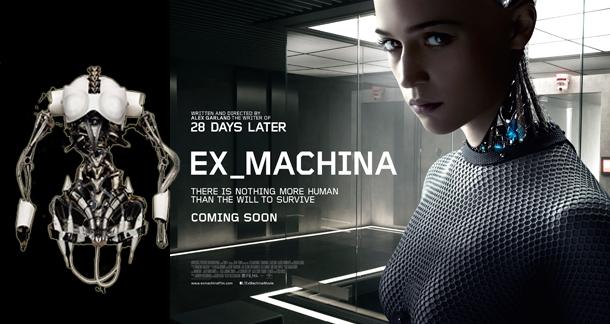
Ex machina – a review

ex_machina

Ex machina tells the story of Caleb (Domhnall Gleeson), a young computer programmer slaving for a large unnamed corporation that we eventually learn is somewhere between Facebook and Google. As the movie starts, Caleb’s computer flashes that he has won a company contest to visit the mountain-retreat home of recluse company founder Nathan (Oscar Isaac).

https://www.youtube.com/watch?v=XYGzRB4Pnq8

Upon confused arrival, he is welcomed warmly by Nathan and escorted through a labyrinthine maze of non-descript hallways where Caleb learns he has access to some rooms and not others based on his ID card. As Nathan explains, the austere design reflects the space’s use not as a home but rather as a research facility.

Nathan explains his AI breakthrough to Caleb

Nathan explains his AI breakthrough to Caleb

Nathan eventually divulges that he has been working on building an AI or artificial intelligence, and that Caleb’s role during his week at the retreat is to apply the Turing Test to the AI; that is, through a series of questions to elucidate whether the interviewer is speaking with a human or a computer.

Which brings us to Ava—played by Alicia Vikander—the ingénue AI that Caleb is to test. As she sits before her inquisitor, Ava is mostly metal and wires, but that hasn’t kept Nathan from endowing her with sexuality in her form, a soft approachable voice, and a human-like face.

Caleb becomes Ava's inquisitor through plexiglas

Caleb becomes Ava’s inquisitor through plexiglas

Through a series of conversations—between Nathan and Caleb, and Caleb and Ava—the film explores questions of identity, freedom, inalienable rights and love. But therein lies my primary problem with the movie: It is a stage play performed as a film.

Without giving too much away [doing my best to avoid spoilers], the interactions between the characters are almost as sterile as the environment in which they occur. Simply put, damned little happens aside from a series of conversations.

A labyrinthine maze of halls and locked doors

A labyrinthine maze of halls and locked doors

I am confident that this was done on purpose by writer/director Alex Garland—best known for the films 28 Days Later and 28 Weeks Later. I have no doubt that the minimalism of film is in itself a metaphor for the lifeless character of the AI.

But whereas minimalism is expected in a live theatre, it feels off-putting in a cinema. Ex machina engages the conscious mind but not the eye, unless your eye is drawn to beige. In fact, given the lack of action in this film, it would even work–possibly better–as a radio drama.
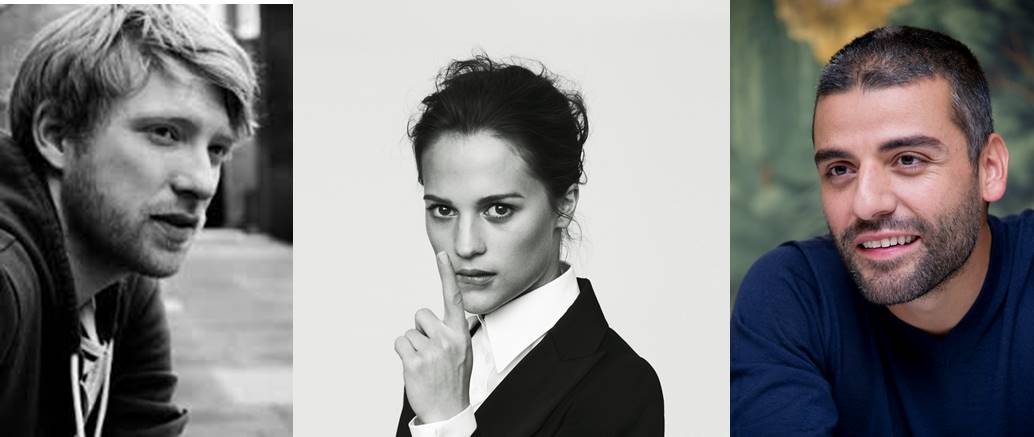
Domhnall Gleeson, Alicia Vikander and Oscar Isaacs (L to R)

Domhnall Gleeson, Alicia Vikander and Oscar Isaacs (L to R)

The performances were good, but I didn’t feel like the actors were given a lot to work with.

As I found so ironic with the movie Prometheus, the character of the android Ava was the most deeply developed (compare Ava to Michael Fassbender’s David). You could actually see her character evolve as the movie progressed at its leisurely pace. And full marks to Vikander for being able to imbue so much internal communication through subtle verbal intonations.

Subtle intonations and expressions bring Ava to life.

Subtle intonations and expressions bring Ava to life.

The character of Nathan showed the most potential, however, as you could see a brooding darkness within him that vacillated between wilting depression and disturbing malevolence. But as with so many aspects of this film, the potential was never really explored and we were left with a subtextual emptiness.

And Caleb proved to be the type of antagonist that I find least appealing—the victim—mostly bobbing like a cork on the eddies and currents outside of its control. He is neither hero nor anti-hero and so leaves me cold and uncaring, and if I don’t care, I am not engaged.

Ex machina is a very cerebral movie, dealing with deeply philosophical questions about humanity and self-awareness, and to a lesser extent about emotional connection. And in many ways, it is only because of Ava that the film does not devolve into an Open University lecture.

There is little doubt that the robotics and artificial intelligence enthusiasts will get a hard-on from Ex machina, a biological function that forms a humorous sidebar in the story.

But for those who like these subjects and want to be entertained by a gripping story, I suggest you take another look at Ridley Scott’s Blade Runner, where identical questions are discussed in a backdrop of a film noir story line.

Ex machina is not completely without mystery, and I did find myself asking questions about the characters, including wondering if the audience wasn’t part of some Turing Test. But if I ever opened my mouth in anything approximating a “wow”, it was merely to yawn at the film’s glacial pacing.

There are small moments of tension, but they dissipate quickly and rarely result in any shocking revelations. There are moments that are squirm-inducing to start but do not really linger or pay off.

But for all my complaining, the ending of the story was satisfying. Although, for my money, that’s when the story finally got interesting.

Like Transcendence before it, Ex machina had a lot of potential, but failed to deliver.

Perhaps an AI film director will do better.

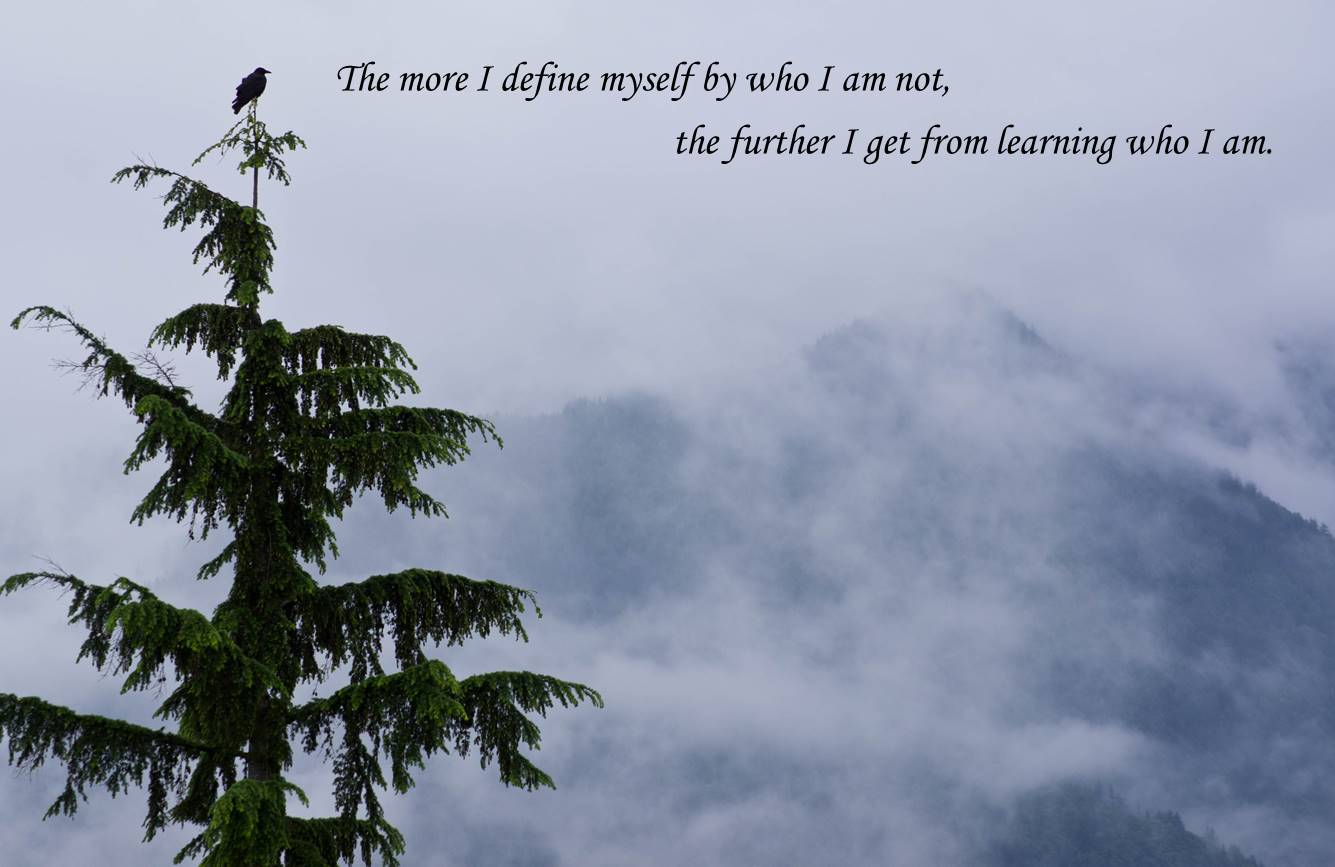
Taking aim

Sunset on Mauna Kea

I aimed for the mountain top, but found only sky.

I aimed for the clouds, but found only air.

I aimed for the moon, but found only coldness.

I aimed for the stars, but found only emptiness.

Head bowed in sadness, I finally looked around,

To find a universe of wonder lying at my feet.

Stargazing on Mauna Kea

Journey, not destination

In the last couple of weeks, I have spoken with many friends about the concept of happiness as it pertains to life’s pursuits, which has forced me to give thought to my past experiences and the reasons why happiness eluded me for so long in my life. The following is the sum of my thoughts.

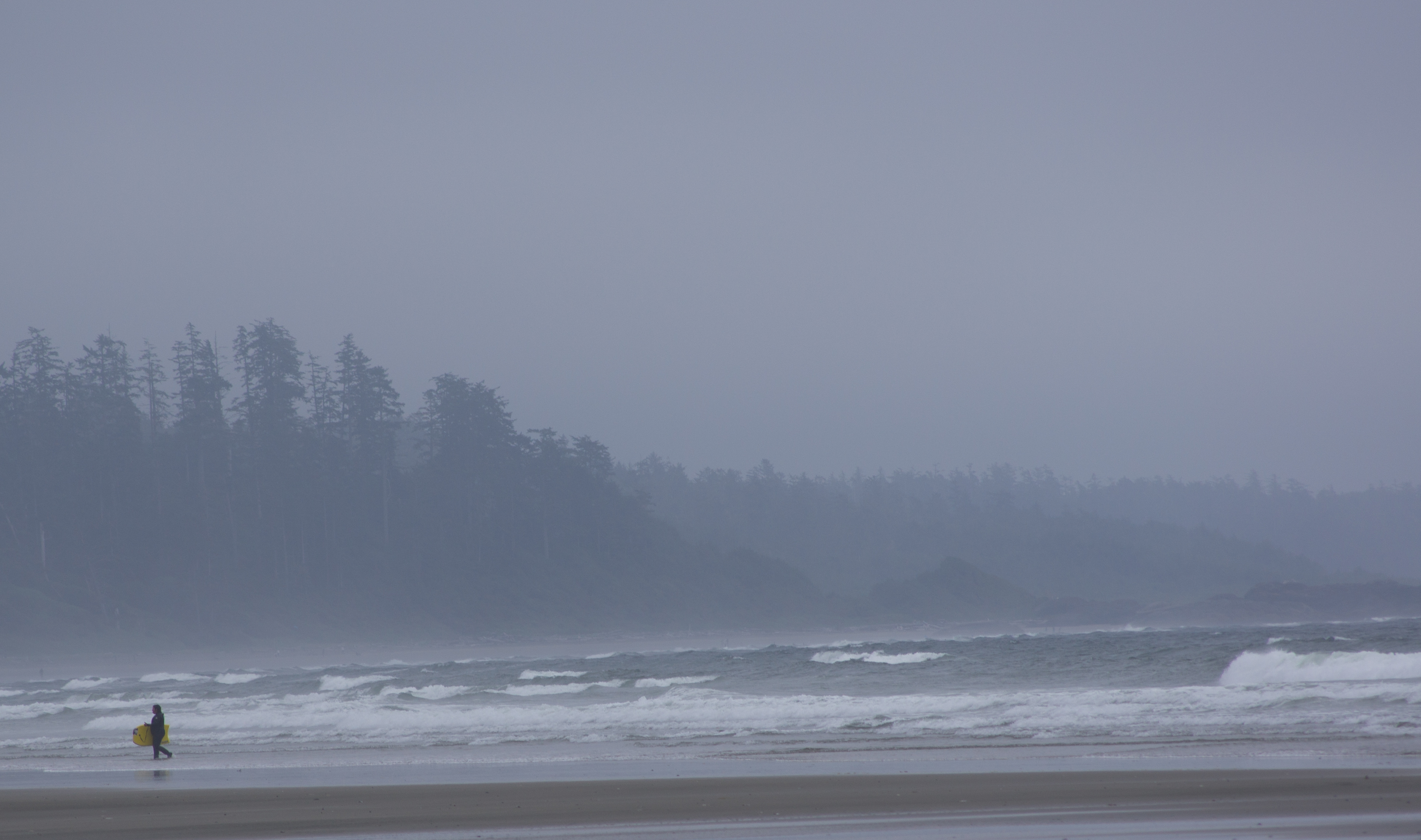
A surfer finds joy on a blustery day in Tofino, BC

A surfer finds joy on a blustery day in Tofino, BC

Life is not about destinations. Or perhaps I should argue that a happy or satisfying life cannot be about destinations, because destinations are temporary at best and completely illusory in truth.

We have been taught that it is important to set goals, to aim for a destination, and to a limited extent, I agree. Where I struggle, however, is in the assumption, the programming that suggests the goal will bring happiness, that at your destination, you can rest.

For most of us, this sets up a couple of problems.

If we do not succeed in achieving our goal or reaching our destination, then not only have we failed, but more insidiously, we see ourselves as failures.

But even in those situations where we achieve our goal, arrive at our destination, we are faced with the daunting and disheartening revelation of “Now what?”

In Costa Rica, when you finish exploring the jungle, there is still the mountain to climb

In Costa Rica, when you finish exploring the jungle, there is still the mountain to climb

For despite the momentary glow of success, we cannot rest. We must seek the next goal, identify the next destination. And the cycle repeats, ensuring that for all but the rarest of us, we will fail, we are failures.

Part of the challenge is that for many people, the idea of a goal or destination presupposes that we are not sufficient in the now, that our lives are incomplete and would somehow be better over there.

We don’t make enough money. We are alone. We have not achieved the heights for which we are destined. We—as we are today—are not good enough.

It is good to push boundaries. It is good to strive.

And while those two statements may sound contradictory to the questions I raise above, to what I have decried, I don’t think they are.

Pushing. Striving. These are actions, not endpoints. And that makes all the difference in the world.

A goal or a destination, a predetermined endpoint, is fine, but only in so far as it gets you moving in a direction. After that, it is meaningless.

Life is in the movement. It is in the process. It is in the journey, regardless of where that journey takes you.

Destinations and goals give us opportunities to shift the direction of that journey, but they are not the point of or the reason for the journey.

We are like photons in the universe of our lives. Without movement, a photon has no mass. When we cease to move, we cease to exist.

It is our movement that gives us life, and our interactions during that journey that gives that life meaning.

Feel free to set a direction, but be prepared for and welcome the changes that come along the way, for it is in that journey that we will truly live and ultimately find happiness.

It is enough to experience the world; you do not need to conquer it (Montezuma, Costa Rica)

It is enough to experience the world; you do not need to conquer it (Montezuma, Costa Rica)

An example from my life:

Early in my writing career, I worked for a magazine in Washington, DC. Every year, my boss and I would set goals for the next 12 months; e.g., 3 features, 10 department articles, 20 short pieces. And being a little Type A, I would accomplish my benchmark within 3 months. At the end of the 12 months, I might have tripled or quadrupled the expected output.

I would demand a promotion, and I would be told no…there were apparently other factors not included in my annual goals before I could be promoted. This pissed me off.

But surprisingly, even when I received the promotion, it was not enough. I needed the next one. I set the goals and again, felt held back despite achieving the goals.

And very quickly, the job I loved, the job I practically ran toward every morning in anticipation, became a leaden weight. I ceased to write for the love of writing. I was miserable.

In hindsight, I can see now how much I learned on that job—not the least of which was “office politics”—but at the time, all I could see was failure. It was the journey that helped shaped the man I am today, not the endpoints. I might have been happier had I realized that then.


The following video is a rather clever summation of my thoughts. Thanks to my friend Agah for pointing me to it!

On Second Thought

Do you think?

Why do we give our second thoughts so much more sway than our firsts? What is so magical about the second thought that makes it more believable, more honest, more sensible?

I had second thoughts about writing this simply because it was prompted by a conversation with a friend who is struggling with a dilemma. Would my friend be upset I was talking about him or her? Making light of his or her dilemma? Sharing secrets that weren’t mine?

I can deal with that.

Rare is the person who completely trusts his gut; who goes with the first thought that comes into his head. To the outside world, such a person is often considered rash or impulsive, perhaps even flighty. Rarely is he described as definitive or confident.

Second thought, in contrast, is seen as considered, rational, reasoned…well, thoughtful (or thought full).

The Senate of Canada’s Parliament has oft been described as the chamber of sober second thought, as though the House of Commons is populated by ADHD-riddled chickens, prone to explode at the slightest provocation.

(The realities of the Canadian Parliamentary system are fodder for a different blog post.)

The concept of sobriety does point to one of the benefits of second thought. The decision not to pursue flights of drunken fancy such as driving home after drinking too much rather than take a taxi. But while this points to the benefits of second thought, it also points to its source: Fear.

We have and listen to second thoughts because we are afraid. We are afraid that our first thought was ill-considered (rash) and might result in failure. And because we don’t want to take responsibility for that failure, we build a rationale for our alternative thoughts, thus making ourselves more confident in our decision.

The harsh truth, however, is that no matter what our final decision, there is always a risk of failure, perhaps catastrophic. The Titanic and Hindenburg were well-considered ventures based on sound and common practices. It was the unforeseen (if not unforeseeable) incidences that doomed the exercises.

To a greater or lesser extent, gut instincts and reactions are You unencumbered by rules and conventions. They represent the way you view the world and yourself without the censorship of social pressures. Thus, I believe, they more accurately represent your goals and desires, and ultimately what will make you happy.

Now, this is not a belief that was reasoned on the basis of careful study. If nothing else, that would defeat my argument. It does, however come from a lifetime of observing others and myself.

I have no reason to lie to myself when under my own control, in the absence of other influences—chemical or human. Thus, my gut instinct is my truth.

This doesn’t mean that I have to follow it—there may be extenuating circumstances to go another way—but I should never deny the instinct.

In denying it, I will never have the opportunity to build faith in it, and ultimately, second thought is a lack of faith in myself.

confident

Lost & Profound

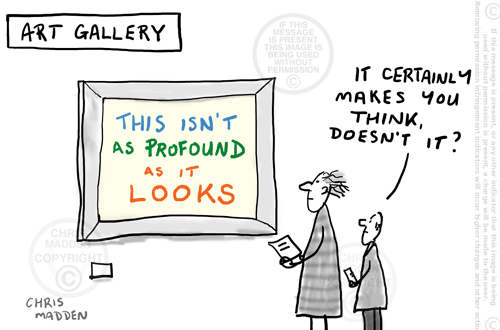
text-art-this-isn't-as-profound-as-it-looks-cartoon-chris-madden

Every once in a while, I like to pretend I am drunk and come up with something profound. These are some examples:

If you want to change the world, you’ll need a lot of diapers!

I don’t live in the past, but I do have a vacation home there

When all is said and done…why don’t people shut up?!

NEVER SURRENDER! Unless the other guy has a gun and bullets…I mean, geesh, you can always start over later

She wore a slinky dress, and proceeded to fall head-over-heels down the stairs

Do you think the first use of the word “typo” was someone incorrectly keying the word “type”?

Never be pedantic…and by pedantic, I mean, being annoying to people by giving too much attention to minor details or by correcting unim…

That which does not kill you, only makes you paranoid that there might be a second one

Insanity isn’t all it’s cracked up to be

If you can’t tell a book by its cover, why’d you put the bloody title there?

Do words ever fail a mute?

I’ve never been a fan of using grate-protected high-speed rotary blades to generate unidirectional currents of air

I find echoes repeat on me

(Image is property of owner and is used without permission until I am profound out)