My thoughts on photography…or any art, really:

Or, as stated so eloquently by Kevin Spacey:
My thoughts on photography…or any art, really:
Or, as stated so eloquently by Kevin Spacey:

It is important to start this review of the movie Warcraft by stating: 1) I do not play video games; and 2) I like fully self-contained movies.
I went into seeing Warcraft with incredibly low expectations (perhaps unfair) and walked out having those expectations largely met and perhaps slightly exceeded.
Based on the video game series of the same name, Warcraft tells the story of Orcs determined to take over a new world because their own has died, possibly due to a malevolent force harnessed by their leader. The residents of the new world—populations of elves, mages, dwarves and humans—however, aren’t willing to lose their world…or at least the humans aren’t, and so fight back with the help of The Guardian, a wizard of immense power who lives in a tower and who is dealing with his own problems.
And while most of the movie is the playing out of this conflict, there is also an underlying mystery of what this malevolent force is, which leads to an Orc chieftain questioning the morality of the proposed genocides, and a couple of father-son/mentor-student relationships to suss out.
You may notice that in this description, I have offered no character names but rather simply archetypes. That’s because none of the characters is particularly memorable, nor is much of the movie. Perhaps if I had a greater familiarity with the game, much of this film would fall into place for me, but without that, the movie is mostly just a series of tropes with dialogue so wooden, the average porn filmmaker would be aghast.
Perhaps this is racist (specie-ist?), but I struggled to tell one Orc character from another, in part, because none of them had any personality much beyond “Hulk smash”. Thus, when an Orc would rampage into a scene, I had no emotional cues and so simply sat as a witness to events rather than being a participant. And even where I could recognize specific Orcs—the aforementioned chieftain and leader—the characters tended to be so two-dimensional (despite shelling out $20 for IMAX 3-D) that again, I was left cold.

Three men and a movie reviewer (also a men)
The human characters weren’t a lot better. All the men look like my friend Danny, with whom I saw the movie, and women were almost non-existent. I do, however, have to give the filmmakers credit on two fronts here. First, although most of the humans were Caucasian, there were several of other ethnicities. And none of the female characters (I repeat NONE) were damsels by any measure. Each of the women, whether Orc, human or somewhere in between, were women of conviction and empowerment.
As to the plot, my biggest beef was that the writers seemed to simply drop in a device whenever they needed it to move the story forward, without any contextualization. I’d like to give you some concrete examples, but any of the major ones would, ironically, be spoilers. Suffice it to say, you are advised to check your credulity when you pick up your 3-D glasses.
Everything that occurs in this story was much better covered in Lord of the Rings, Game of Thrones, Harry Potter and Stargate…and The Ten Commandments.
But, in a strange way, that may end up being Warcraft’s saving grace as it frees the audience from having to participate in the story. Instead, you can just sit back and let the movie dance on your retinas, which is about as deep as it will go.
And this is possibly the one way in which Warcraft actually exceeded my expectations: it was visually captivating. The animation was incredibly good, with the Orc characters seemingly as real as the human actors. The fur of the giant wolves looked soft and the body movements of the griffins entirely plausible. Stylistically, I would put this movie in the realm of Avatar rather than Lord of the Rings.

But back to the second point I raised at the start: self-contained movies.
Everything about Warcraft seemed to be designed to set up the myriad sequels that will be made, a trend in Hollywood blockbusters (and block-blowouts) that pisses me off. If nothing else, it shows complete disdain for the audience as it says “We really don’t care if you like the movie.”
Don’t get me wrong. I don’t have an issue with sequels and spin-offs in general. But when I go to a movie, I want to see an entire story play out, rather than have to wait for the next installment or rely on having seen the previous installment to understand the story (looking at you, Avengers).
This is one of the reasons why I am possibly the only person on the planet (this one, at least) who found The Empire Strikes Back to be lacking. It was a placeholder or bridge to The Return of the Jedi, nothing more.
Will I be back for Warcraftier: Where’s Your Messiah Now?
Not unless someone else is paying me to watch it…and for some reason, my online mahjongg isn’t working…and it’s raining or something.
See also:
Movie review: Warcraft by Danny F. Santos

Nicholas Lemon (left) and Kevin Scott completely ignore the script…again.
After a successful run in the City of Toronto – success measured by lack of lawsuits – SomeTV! is spreading its infectious laughter into the suburbs…specifically Peel and York regions of the GTA.
Don’t know what SomeTV! is?
Imagine a short-armed tennis ball fluffer boxing with your uvula via your rectum. Got it? Well, SomeTV! is nothing like that (but now you have plans for the weekend).

Uvula boxing champion Kevin Scott (with Nicholas Lemon)
SomeTV! is what happens when fans of The Muppet Show and Monty Python’s Flying Circus don’t listen to reason, and go all Andy Hardy with puppets and Canadian actors.
Or perhaps our God-head Nicholas Lemon explains it better in this clip from a Toronto talk show:
In any event, once we scab over and the blemishes stop itching, we are hoping to take this phenomenon worldwide – pending a CDC and WHO investigation. Wish us luck…and ointment.
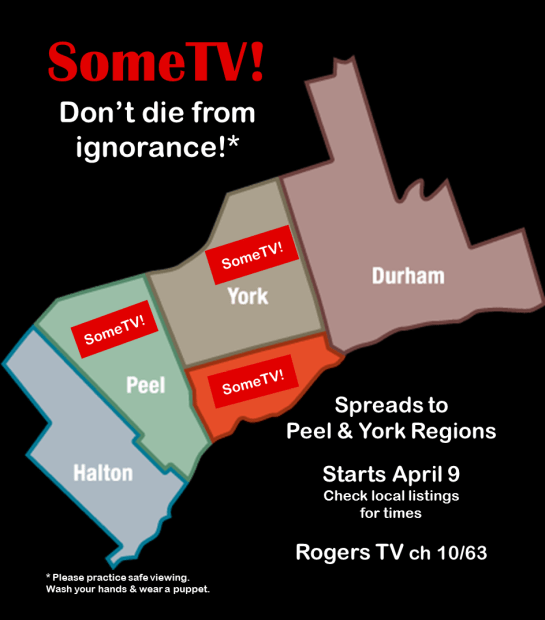
See also:

My friend Agah Bahari is interested in everything, which is one of the things that I love about him.
Not that long ago, he decided to indulge his interests by starting something he calls the NeoHuman podcast (which matches nicely with his NeoHuman blog), inviting many of the interesting people he knows to discuss pretty much anything that comes up.
Well, seems he ran out of interesting people and so he invited me to participate…and we talked about anything: biotechnology, pharma, global healthcare, designer babies, creativity, writing, screenwriting, 9/11, marketing, and the novel he and I are writing about his life.
But my favourite part is the question he asks all his guest, which is roughly:
If you met an intelligent alien life-form, what would you describe as the greatest human accomplishment and as the worst human accomplishment?
Never boring, my friend Agah.

(Photo stolen with love from Kelly Brienz Showker)

Don’t have to climb the mountain to admire its beauty
Where do you see yourself in five years?
It’s a common question at job interviews and often creeps in silently when people reach age or career milestones.
Rephrased more broadly, it is asking: What are your goals?
In most Western societies—the only ones I really know—we are told it is good to have goals; that you need to set your sights on a destination and follow that path to its conclusion. It is how you get ahead. It is how you find happiness, or at least the stuff that brings happiness.
I have spent my life working this way.

Life goals complete
I tell you this not to present my resume—you can find that on my LinkedIn pages (yeah, I have two)—but rather to explain the pattern of my life (and probably yours) in contrast to where I am today.
You see, for the first time in my life, I have no goals. And I am finding it incredibly disconcerting.
Sure, like everyone else, I have daily, weekly, monthly and yearly obligations.
I need money to pay for rent, food, bills, hockey tickets, beer. I have editorial deadlines and the odd gift to buy. But I have no long-term goals. I am living my life without my next destination in mind.
Five years from now? Hell, I sometimes don’t know where I’ll be five minutes from now.
In some ways, I am as close to living in the moment as you can get without living under a tree or in a cave (basement apartment notwithstanding). And it’s freaking me out.
Having a goal is a hard habit to break after 50+ years.

What if I had missed this moment?
To be clear, I’m not looking for a goal—floating freely has some lovely benefits—but I struggle some days to know what the point of my day is or was.
Simply being is really simple—it requires no preparation or gear—but our society has taught us that it is wasteful; that it is selfish; that even our “free” time must be productive.
Having no goals, I find, is entirely selfish. I can only affect change in myself.
But I’ve come to realize that “selfish” isn’t bad in and of itself; only when it negatively impacts others, which I don’t believe I am.
Still, like a good Pavlovian pound puppy, I sometimes find myself whimpering at the window, waiting for someone to throw the stick of destiny, to give my life meaning and purpose.
Is it okay or desirable to lead a purpose-less life? Is that my purpose? [Never met-a-physics that didn’t hurt my brain.]
But then, it’s 7:30 a.m. and the alarm goes off. I turn it off and go back to sleep.
Life without goals definitely has its upside.

I recently saw the following advice from filmmaker and screenwriter Don Roff posted on the Facebook page of the PAGE International Screenwriting Awards:
Always mystify, torture, mislead and surprise the audience as much as possible. — Don Roff
Although I agree with the sentiment, I don’t think it is complete (Note: I was unable to locate the source of the quote to learn if Roff said more on the subject). Thus, I offer the following codicil:
Mislead and surprise, but NEVER lie to your audience. Everything must be possible within the context of the universe you have built in your story. If you lose the trust of the audience, you’ve lost them forever.

For a guy trying to make it as a screenwriter, it takes a lot for me to go out and pay to watch a movie. I think it’s, at least in part, because I don’t deal well with disappointment and particularly when I’ve had to pay for it.
Luckily, my friends had some luck dragging me out of the house this year, so below, I offer one-line critiques of the various films I saw in theatres (with hyperlinks to longer reviews I’ve written).
Taken 3: When the hell did I see this, and more importantly, why?
Paddington: Charming and a lot of fun.
Kingsman: A rollicking good time.
It Follows: It bores me
Ex Machina: Oh My Deus, was this written by a robot devoid of emotions?
Age of Ultron: Miss a movie, lose a thread; think I am out of this series.
Mad Max Fury Road: You will believe a man can drive…that is all.
Inside Out: Underwhelmed, but appreciate I am only one.
Self/Less: Flawed but interesting

Trainwreck: Not one, but Schumer can do better
Ant-Man: Most fun I’d had all year…Rudd is perfect for this
Man from UNCLE: Stylish throwback that I liked more than most people did
The Martian: Surprise hit for me; kudos to all including author of book
Steve Jobs: A metaphor for dysfunction…and sadly, not in a good way
In the Heart of the Sea: More like in the heart of my sleep
Star Wars The Force Awakens: Visually stunning, overly sentimental, disappointingly regurgitated story
Spectre: Good movie with a stupid ending…am I outgrowing Bond?
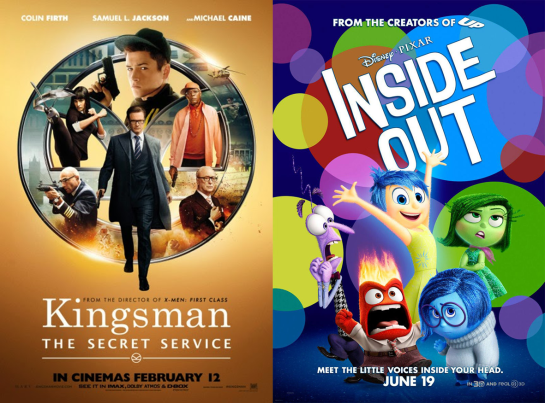

J. J. Abrams is on my shit list.
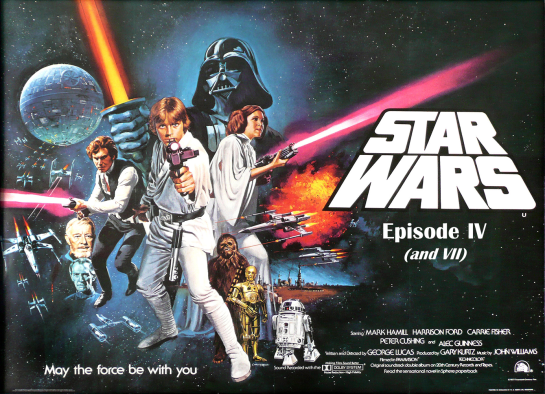
That statement alone should tell you everything you need to know about my experience with Star Wars: The Force Awakens (Ep. VII).
As background: I am old enough to have seen Star Wars: A New Hope (Ep. IV) in theatres as a young teenager. And I was so impressed by the film that I immediately came home from the theatre and wrote a sequel…400 hand-written pages of a screenplay. My first screenplay, in fact, at the ripe maturity of 13 years.
Star Wars is my birthright. I will defend it tooth and nail.
Thus, J. J. Abrams is on my shit list.
After the underwhelming prequels (Ep. I-III), I looked forward to Abrams’ take on the saga. I was a big fan of his reboot of Star Trek, although I had a bit of a nagging doubt after the reboot sequel Into Darkness. But if anyone had a sense of the epic, almost operatic scale of the Star Wars universe, it should have been Abrams.

And to some extent, he fulfilled his end of the bargain.
Shivers went down my spine when we scaled across the vast deserts of Tatooine…I mean Jakku.
I worried when R2…I mean BB-8, was captured by the Jawas…I mean scrap metal scavengers.
I bounced happily with the music of the Mos Eisley cantina…I mean the Takodana cantina.
I cheered when R2 successfully arrived at the Rebel base…I mean BB-8 arrived at the Resistance base with the vital information.
I sat back in awe as I saw the might of the Death Star…I mean Starkiller Base, for the first time.
J. J. Abrams is on my shit list.
To get back to Star Trek: Into Darkness, briefly, we all knew that Abrams was rewriting the story of Kirk’s greatest nemesis Khan Noonien Singh. And the movie didn’t disappoint in its grand opening flourishes and early Starfleet intrigue.
But then, at some point, it was like Abrams had run out of ideas and so simply inserted the last 20 pages or so of the original Wrath of Khan screenplay, hoping we wouldn’t notice.
The least tweaked moment of overlap between the two movies was the scene between Spock and Kirk across the glass as one dies from radiation sickness. Abrams simply swapped the positions of the two characters.
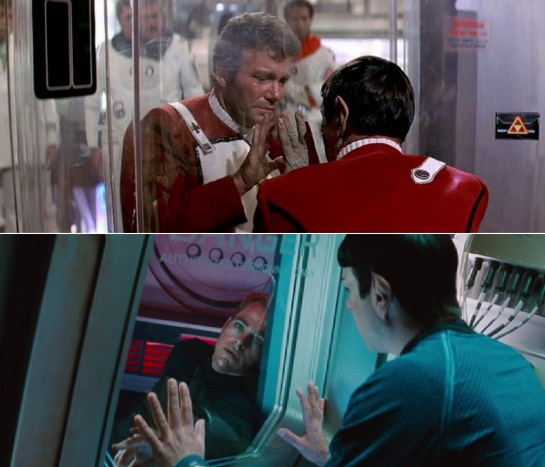
Some might consider this an homage to the original. A friend of mine, in discussing The Force Awakens, called it alt-universe mirroring. I call it bullshit, and lazy bullshit at that.
Now, Into Darkness was not intended to be a prequel to any of the older Star Trek movies, so I can buy into the alt-universe idea a bit. But The Force Awakens is Ep VII of a saga. It is not an alt-universe but the same freaking universe 30 years later.
An homage is the holographic chess set. An homage is NOT a beat-for-beat repetition of Ep IV, even if jumbled up a little bit and with a few scenes from Ep V and Ep VI thrown in.
The spell of childhood memories faded rapidly as The Force Awakens played out on the screen, and I spent much of movie sitting with an attitude of “Really?”
And as I walked home from the theatre…a 40-minute walk…I just got angrier and angrier as the volume and sheer audacity of the parallels continued to sink in.
J. J. Abrams is on my shit list.

“You’re pretty bang on, but it’s what I was expecting,” explained a friend whose ear I bent. “It’s the old ‘the same, but different’.”
“I saw it more as a mirroring of the previous six films; a device to draw in new fans and satiate old fans,” another friend said.
I call bullshit…not of my friends, you understand, but of the idea that The Force Awakens needed to remind us of the saga up to now or reinvigorate fans.
Please, how could anything from the Star Wars saga fail to draw box office records?
I know I’m in the minority here. Most fans won’t clue into any of the parallels but instead simply wrap themselves in the old familiar or marvel at the new spectacle. Cool, I am glad they enjoyed the film.
Even I will likely see it again as my first viewing was in regular 3D—strange to think of that as a thing—and not in IMAX or AVX.
And as much as I would buy Henry IV, Part Three if Shakespeare wrote a sequel to his first two Henry IVs, I will eventually add this movie to my Star Wars collections.
But J. J. Abrams is on my shit list, and I will approach any of his future movies with suspicion and cynicism.
And that, more than anything, I am saddest about.

Bluntly, In the Heart of the Sea was such a disappointing movie that I can’t even come up with a metaphor about a man driven mad by a desire for revenge against a ghostly leviathan. And that statement is made all the sadder by director Ron Howard’s attempt to do just that with almost every character in the movie.
For the under-informed, In the Heart of the Sea is the story of the writing of the novel Moby Dick by Herman Melville. It is also the story of the story that led to the writing of the novel Moby Dick. In short, the film occurs in two timelines that unto themselves cannot disguise the fact that neither plot line is satisfying.
Adding to this sense of disappointment is the fact that my friends and I saw the movie in 3-D IMAX, neither of which was needed to tell this narrative, which is surprising given the majestic concept of a whale attacking ships in the open ocean.
Even the actors couldn’t manage enough dimensions to be considered flat, let alone 3-D. Somehow, stalwarts like Brendan Gleeson, Ben Winshaw and Thor…I mean Chris Hemsworth…failed to bring life to this bilge water. Hell, even the great white sperm whale was unable to add excitement to this movie.

If you want the experience I think Ron Howard was targeting, watch Apollo 13 and every time Tom Hanks appears on screen, imagine him in a cape with a Viking helmet. You’ll have a much more enjoyable experience.
As one of my friends suggested, it was as though Howard was going through a checklist of clichés.
Man vs. inner demons √
Man vs. the elements √
Man vs. society/class system √
Man vs. nature/whale √
Man vs. himself/his past √
Unfortunately, Howard missed the most important one:
Man vs. coherent story with a point to make X
Having read the novel Moby Dick and watched two film versions—Gregory Peck is a God—this version actually did damage to the franchise. It somehow took an exciting tale and examination of the destructive demons that possess us all, and turned it into a melodramatic soulless mess.
The only real positive that I can offer this film was that for all the time spent watching nothing happen, I never reached the bum-squirming phase where I positively itched to flee the theatre.
This was a Hollywood gimme, and yet somewhow they managed to blow it.
Other reviews:
Danny F. Santos (coming)
Less than a whale of a tale (Toronto Star)
It’s Man vs Leviathan (New York Times)

A friend of mine recently wrote a screenplay for a sitcom. Not a spec of an existing show, mind you, but rather an entirely new idea she developed.
In accomplishing this feat, she joined rarified company. For every person who has written a television pilot, there may be a thousand people who have written a spec script and millions who have never put pen to paper (finger to keyboard).
And like any good writer, she wanted her work to be as good as it could be, so she asked a handful of people she knew—including me—to read it and give her feedback.
Unfortunately, as I later learned on sending her my feedback, she was ready to chuck in the writing game because of scathing criticism from another reviewer, who essentially told her that her pilot was complete crap (or worse).
My friend is talented and is in the process of maturing her style. And the feedback I gave her was honest and critical, but it was also designed to help her improve, not make her quit. The pilot was still raw, but there was merit in many aspects of it, and the rest could be easily improved.
Sadly, it seems her other reviewer was less interested in helping her find the gems in her work.
To the writers out there, I say, pick your reviewers wisely, and before you take any of the feedback to heart, consider the source and get input from more than one person.
Feedback that is overly critical or overly praising is largely useless…and potentially lethal.
To the reviewers out there, I say, be honest but be constructive. It does no one any good to rip a work to shreds and leave it in tatters. It doesn’t make you more powerful. This isn’t even about you but about the work.
At the end of this post, I have links to pieces I have written previously on receiving and giving feedback. And below, without giving away my friend’s identity or her concept, I offer the opening of my notes to her.
Good luck and good writing to everyone!
My favourite insight of all time on writing for television is that pilots suck. Let me repeat that:
PILOTS SUCK!
The challenge with a pilot is you have to do soooo much structural heavy-lifting and still try to tell a coherent story.
So, massive kudos to you for writing a sitcom pilot and doing a decent job of it. You’ve covered all of the points above, but you haven’t really nailed them yet. And for me, nailing them hinges on your decisions about point #2…

See also:
PIECES OF ME...
Mother, Nehiyaw, Metis, & Itisahwâkan - career communicator. This is my collection of opinions, stories, and the occasional rise to, or fall from, challenge. In other words, it's my party, I can fun if I want to. Artwork by aaronpaquette.net
Life at any age can be amazing! We only need to grab hold & experience it!
The internet web log of Michael Cedarwood. I used to be a stripper. Now I'm a writer.
Thoughts on creativity, Pharma and whatnot
Mindfulness, Philosophy, Spirituality, Meditation, Awareness, Religion, Nature Photography
Living for Happiness
A perspective from the other side of the hockey ocean
Romance Author
Author of Kritsotopoula, Girl of Kritsa and Rodanthe's Gift
Our opinions don't stink!
Rantings and Ravings on all things Screenwriting and Movies
My Elicits, an Inception... Learning to Live in Perfection
 createdbyrcw