Selling out versus selling

Image

Over the last few years, I have met a lot of artists of various stripes, and almost to a person, one of the major fears each has is the belief that to become a success and to make a living with their Art, they will have to dilute that art. They’ll have to sell out. Some simply fear it in quaking silence, while others fend it off with flecks of foam like some rabid dog chained in a backyard of their own making. To each, their own.

You have a vision for your Art and you must respect that. It is because you are doing your Art that your Art is different from anyone else’s. By the same token, if you do hope to make enough money to keep at it, you must be able to express your Art in some commercial way.

Admittedly, with technologies such as self-publishing (formerly known as vanity publishing) and phones that offer better cinematography than anything Cecile B could have dreamt of, you can go it alone as no one before you could. You can make all of your dreams come true, but the question is, will those dreams come true? Will anyone beyond your mom, your partner and a few close friends bother with your Art once discovered?

I’m not saying to make a living you have to sell out. Don’t despoil your craft in the name of crass commercialism. If you’re truly an artist rather than a hack, it wouldn’t serve your purposes and you’d come to loathe the thing you once loved.

No, I’m talking about finding a line of compromise between your vision and the market’s.

As this is particularly close to my heart right now, let’s say that you’re writing a screenplay. First, congratulations. There may be thousands of screenplays out there, but I am confident there are billions of unfinished scripts and half-thought ideas.

Having completed your screenplay, however, is only the first step. Now you’ve got to share your creation with dozens of other people, each of whom will want to put his or her stamp on the work.

Story editors, readers, producers, directors, actors, financiers, market researchers. To a greater or lesser extent, each of these people has to buy into what you’re selling before your movie will get made.

Sure, if your film is small with a very modest (miniscule) budget, all of these titles may be handled by 3 to 6 people, but even then, you’ll likely run into issues with distribution.

I’m not saying it can’t be done. History is replete with artists who decided to go it alone. But the unwritten backdrop of that history is swamped with the myriad films sitting idle on bookshelves or hard drives, or competing with cavorting kittens and bad karaoke on YouTube or Vimeo.

If you want to share your Art—and I’m betting that you do—then you want outside thought, you want feedback, you want people to contribute.

Don’t look at barriers, but rather seize opportunities to engage. These people are your first audience. Respect them. Use them. Understand them. Do this and you’ll be well on your way to realizing your vision in their world.


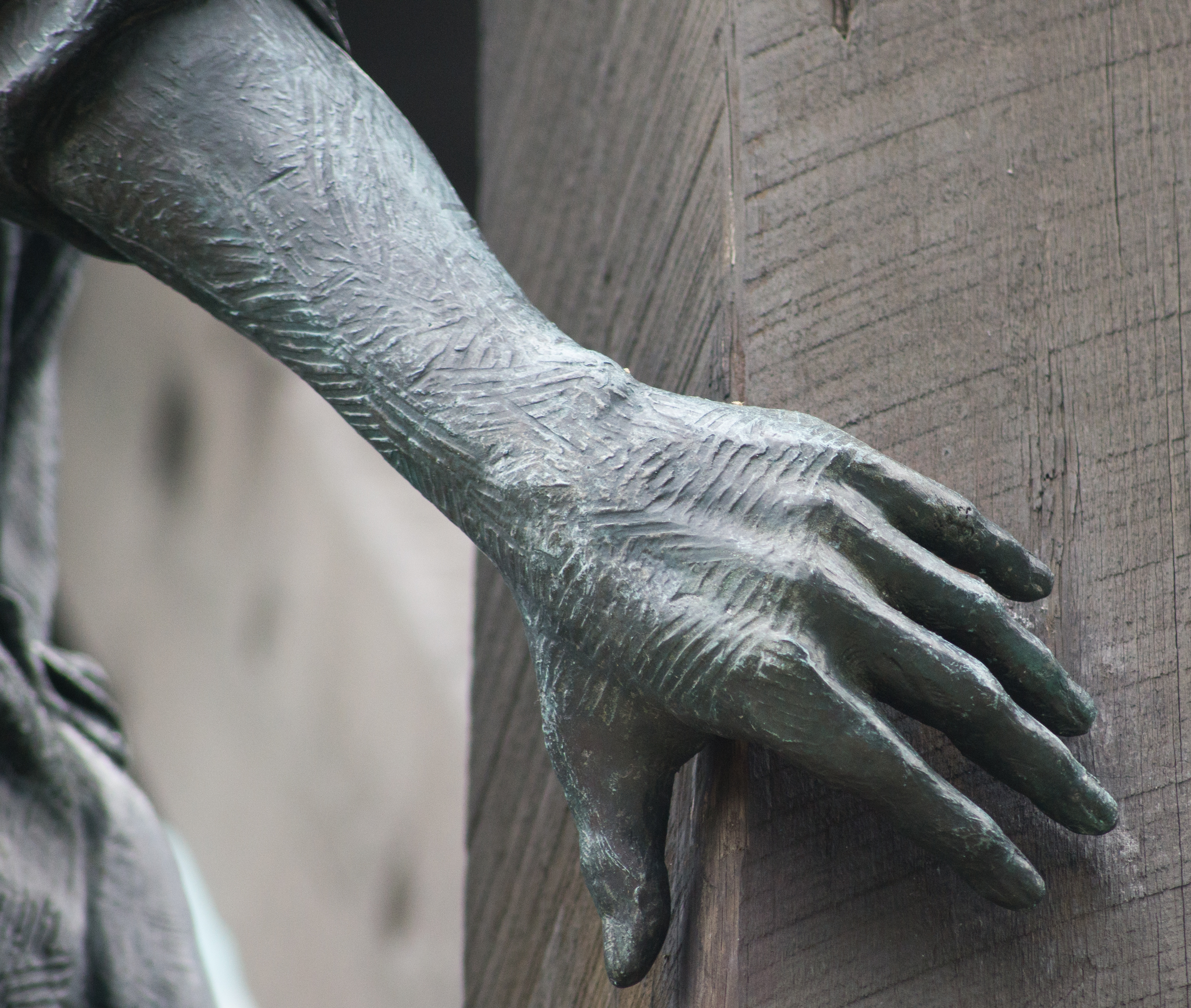
(Image is property of owner and is used here without permission because I refuse to let anyone sell out.)

Forgotten tribute

Railway 4

A nation born

On the backs

Of men not welcome.

Forgotten thanks

Never remiss,

Never too late.

Humble peace for your

Nation-building sacrifices

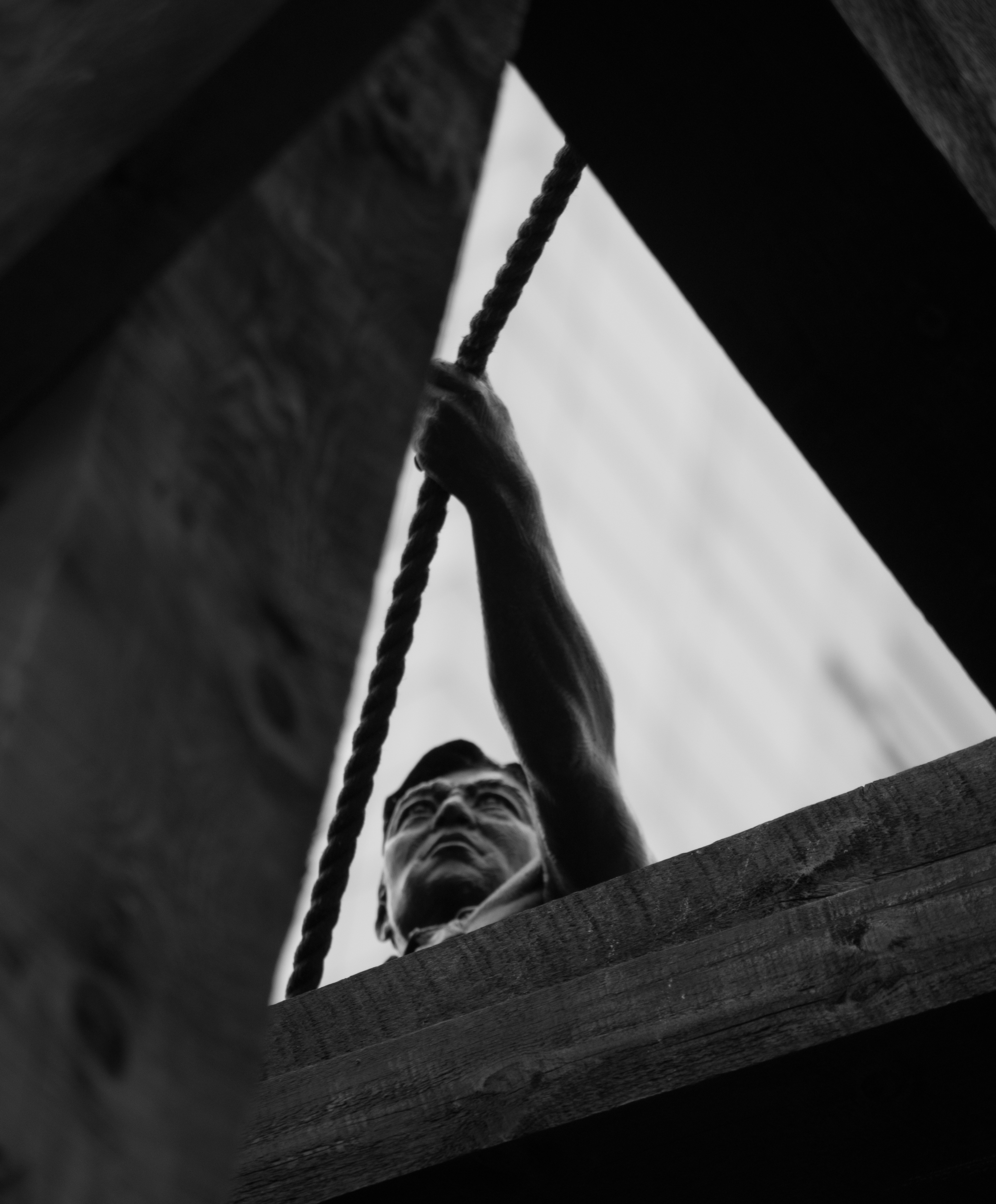
[Dedicated to the sacrifices of the Chinese population within Canada as they helped build the railway system that connected the country shore to shore, as commemorated in an art instillation in downtown Toronto]

Building a trestle, the basis of a bridge perhaps

Building a trestle, the basis of a bridge perhaps

A lone man stands in the line of fire should that rope fray

A lone man stands in the line of fire should that rope fray

His safety harness, a lone hand

His safety harness, a lone hand

Adapt or die

Image

Recently, I’ve read a couple of screenplays based on novels, and with this albeit low number of examples, let me start by saying thank goodness I have yet to find a book I wish to adapt for screen. The process, it would seem, is tedious and fraught with perils.

Odds are, especially if you are just starting out as a writer, you’ve chosen to adapt a specific book because you love it.

You love the way it is written. You love the story it tells. You love the characters. You may even love the paper on which it’s printed or its cover art.

Congratulations. You’re doomed.

I say this not to be mean but to point out that the book was written as a book for very specific reasons. The format and structure of a novel is incredibly different from that of a film.

At its simplest, you have the space in a novel to indulge yourself in narrative and character introspection. More simply put, you can describe a setting or reaction in such detail that if linearly translated to a screenplay, it would result in ten minutes of film focused exclusively on waves rolling across a beach or on the angle of an eyebrow raised over the left eye of your heroine.

Even simpler, novels are verbal, ironically, while films are visual.

And unless you’re planning on running a voice over throughout your movie—please say no—I have no idea what your characters are thinking. I can try to guess from their facial expressions, but it is a guess and will have as much to do with how easy it was to find a parking place in the megaplex as it does with the actor’s talent.

The novel could afford to be 500 or 1000 pages. Your screenplay can’t.

I love Kenneth Branagh. I love Shakespeare. Branagh did a very linear interpretation of Hamlet for film. I was bored. Mel Gibson’s Hamlet? Held my attention and was entertaining. [Compare the two “alas, poor Yorick” scenes linked here.]

The difference? A very sharp editorial knife.

So, I am going to ask you to take the thing you love and hack it. Cut it with broad strokes and wild abandon. This is no place for finesse.

This isn’t about trimming paragraphs. It is about slashing subplots or entire chapters. It is about burning away all of the decorative niceties until you reach the essence that turns your crank.

Be cruel. Be ruthless. Be honest.

Take that Sistine Chapel and reduce it to the handful of bricks that make you sweaty; that keep you coming back time after time.

It will feel like murder. In some ways, it is. But it’s murder for the greater good, because once you’ve hit that core, you can begin to rebuild. You can start to rescue some of the elements you set aside earlier or add new ones that are truly unique to your vision.

What is that core? I don’t know. That’s for you to decide.

Maybe it was the setting. Perhaps it was the relationship between two characters.

Whatever it is, find it and make that your story. That is what you love. That is why you keep coming back for more.

Honour that and you’ll have a screenplay worth turning into a movie.

(Image is property of owner and is used here without permission. I’m adaptable that way.)

Rainy night

Background lights reflect off watery pavement

Watery applause

filters through my window;

an atmospheric

stream of consciousness,

rafting my mind

to memories thought lost,

of friends, of love,

of pain, of loss.

Flushing rivulets

clear out the old

to make space for

sunnier days ahead.

Heavy rains make for sodden cycling

Heavy rains make for sodden cycling

Rain drops in such profusion that ripples annihilate ripples

Rain drops in such profusion that ripples annihilate ripples

Microcosms

Image

A thousand years ago (give or take), I listened to a radio theatre program called X Minus One, which told a story about a society that makes its first attempts to leave its planet only to slowly realize it lives within a bubble of water in our universe.

I have not been able to look at a dew droplet in quite the same way ever since.

Missing you

Image

I lie here, staring at the ceiling, and I miss you.

The stillness gently stirred by your breathing,

The sound of your hair sliding from the pillow,

The scents of the day rising from your skin,

The emanating heat of your body in repose.

A space lies empty beside me, undisturbed;

Duvet in quiet slumber, chaos contained;

Sheets unpressed by the weight of day.

Only one heart beats in the silence.

Only one mind wanders in the dark.

Only one body occupies the space of two.

I lie here, vision blurred, alone and I miss you.