Inferno(t) – a review

inferno-2016-film-movie

In a follow-up to The Da Vinci Code and Angels & Demons, Tom Hanks returns as famed symbologist Robert Langdon, the only man capable of solving the great riddles of today with clues left by our medieval artists and thinkers. In this case, it is the location of bioengineered microbes designed by mad billionaire Bertrand Zobrist (Ben Foster)—think Elon Musk with microscopes instead of rocket ships—to eradicate 95% of the world’s population.

And as the adventure starts, it appears that Langdon may be involved more directly in this mystery than even he thought possible. Along the way, he battles officials from the World Health Organization (WHO), zealous followers of the billionaire and the crafty dealings of a security firm.

As a fan of the previous two movies and puzzle-focused stories in general, I was looking forward to this latest installment. Hanks was back. Ron Howard was back as director. And Dan Brown, the novelist on whose books the movies are based, never tells a boring story.

Unfortunately, this latest venture simply does not live up to the mysteries developed in its predecessors. Simply put, the puzzle is missing and the action is merely serviceable.

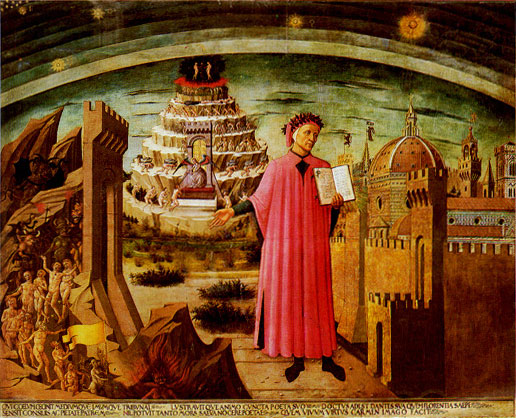
To watch the trailer for this movie is to assume that the riddle of this story is wrapped up in Dante’s Divine Comedy, source of our Western vision of Hell. And, for about two minutes, it is.
michelino_danteandhispoem

Dante couldn’t have predicted this new level of Hell

But unlike the earlier movies where clue was found buried in clue, each one linking together in an almost mystical way and tapping into the deep-seated paranoia of conspiracy freaks like me, here it was merely a token gesture. Dante’s masterpiece and the elements that followed it felt completely contrived, mere window decoration for the modern mystery that wasn’t much of a mystery.

And even the characters surrounding Langdon were largely throw-away, none showing the intricate twists and turns that kept you guessing throughout the earlier movies. In almost all cases, the functions of the characters were obvious from the outset (to explain more would be to serve spoilers).
hanks-jones

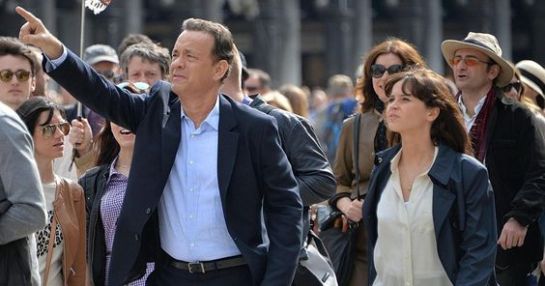
Tom Hanks and Felicity Jones spend a lot of time sight-seeing

And I think screenwriter David Koepp (Jurassic Park, Mission:Impossible, War of the Worlds, Angels & Demons) suspected as much as he littered the screen with small red herrings that suggested insights to the characters but never amounted to anything afterward.

One character, in fact, who appears vital from the story perspective effectively disappears from the story completely, factoring in no way into the ending of the story despite being involved in the precipitating events.

In the absence of medieval puzzles and ambiguously motivated characters, we are left with a barely passable action film that trots its merry way across the Mediterranean to the pretty unspectacular climax. Even the summary denouement is uninteresting and a bit saccharine.
1271033 - THE WALK

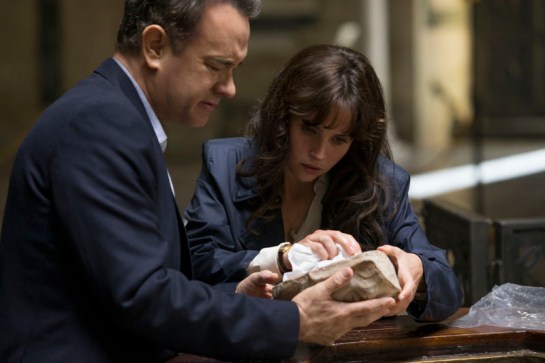
Entire screenplay written on back of Dante’s head

This is not a terrible movie, but I’m not sure I would even recommend it as an entry point to the Dan Brown pantheon, instead recommending you stick solely to the other two.

For me, Inferno never really got beyond a cold ember.

See also:

Tom Hanks returns as Robert Langdon in Inferno (Associated Press)

Say hello to the 10th circle of Hell (The Guardian)

A devil of a time making sense (Wall Street Journal)

The Man Who Knew Infinity – a review

the-man-who-knew-infinity-poster

In another life, I might have been a mathematician; in part, because I prefer to contemplate my universe in solitude, but perhaps more importantly, because there is a simplicity and elegance in math that simply cannot be matched by any other discipline.

It is the voice of God. It is the description of all existence and all possibility.

Thus, I greatly look forward to films like The Man Who Knew Infinity, which opened at the 2015 Toronto International Film Festival and this past week on Netflix.

Based on true events, it is much like A Beautiful Mind, in that it tells the story of a man who could see things intuitively that others could not even with the greatest of effort, but in this case, without the mental health issues.

Srinivasa Ramanujan (Dev Patel) is a poor mathematician living in Madras, India, burdened with an overwhelming fountain of knowledge and understanding of the maths. As one movie character so aptly put it, every positive integer is Ramanujan’s friend.

Frustrated by an oppressive society in India that sees him as an over-reaching Wog, Ramanujan reaches out with the aid of an understanding British diplomat to mathematicians in the United Kingdom. And he eventually catches the notice Cambridge University professor G. H. Hardy (Jeremy Irons), who brings Ramanujan to England.

As exciting as this is for the younger man, Ramanujan quickly becomes frustrated with his mentor. Rather than explore the mathematical cosmos, Hardy reins Ramanujan in, forcing him to develop mathematical proofs for his grand visions. Why, the younger man asks, do you need to prove the truth, the very word of the gods?

It is in answering this question that the movie becomes a love story between two driven men. These men change the face of mathematics, their work echoing to this day.

jeremy-irons-i-the-man-who-knew-infinity

Jeremy Irons is achingly poignant as mathematician G. H. Hardy

Despite the title of the film, this movie is more about Hardy than it is Ramanujan, who interestingly remains something of a mystery even into the story’s epilogue.

Intellectually brilliant in his own right, Hardy yet has to work to understand the universe, whereas Ramanujan is “given” the answers to great mathematical concepts. And despite any overt signs of jealousy, you have to wonder if this isn’t part of the reason Hardy fights so hard to rein in his mentee.

That said, as their relationship slowly blooms, Hardy risks his own expulsion from the college to push for Ramanujan’s acceptance at Cambridge as a fellow. So again, it is about Hardy’s relationships with his colleagues and the university establishment with Ramanujan as his raison d’etre.

The movie is visually beautiful and the story amazingly told.

Irons continues to be an actor of outstanding elegance no matter how curmudgeonly the character. His portrayal of a man who achingly wants to reach out to touch the face of God and yet cannot, is emotionally wrenching. This is a man who is afraid to believe in anything, but is presented with a glory that comes but once in a lifetime.

patel

Dev Patel portrays the anguish of Srinivasa Ramanujan, a man who speaks the voice of the gods only to find ignorance

Patel, likewise, offers a stirring performance. His confusion at the insanity of the world around him is palpable. He knows that he stands upon a great mountain, spouting the wisdoms of heaven, and yet finds himself spat upon and held back. He is very much a Christ figure to Irons’ Saul of Tarsus.

But as beautiful as this film is, I found it lacking in one very big way.

I never felt like I got to understand the titular character Ramanujan.

I have not read the similarly titled book on which the movie is based to know if there is more about Ramanujan there (its subtitle would suggest yes), but the film starts with fully formed Ramanujan scraping mathematical formulas on the stone floor of a temple. In looking for work to support his mother and new bride, he presents his efforts to bureaucrat after bureaucrat, only to be rejected.

infinity-book

What is never explored or explained, however, is how this supposedly lowly man learned how to write in the language of mathematics, and because of this, I feel like I watched only part two of a much larger story.

There is a beautiful moment late in the film between Ramanujan and Hardy that touches on the divine spark of mathematics, and we see the two men finally express their common love and fears. But for me, this wasn’t enough. It fulfilled an emotional requirement, but not the intellectual. I want to better understand Ramanujan and his gift.

Despite this rather large gap, however, this is a movie that I could watch again and again for its sheer beauty. And I can only hope that it just one of many such films—math-centric or otherwise—to be made in the coming years.

Pearls of Writing Wisdom – a review

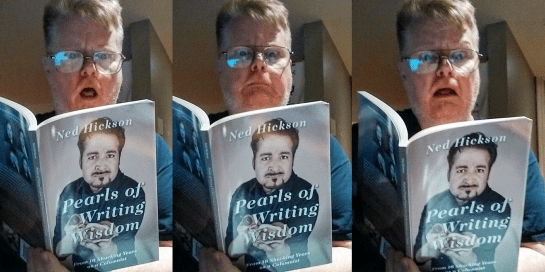
pearls-cover

There is something inside you constantly threatening to explode; an urgent feeling that simply refuses to be ignored. It keeps you from focusing on conversations. It keeps you from sleeping. It tears at the very fabric of your existence.

Now, unless you have recently ordered the taco salad at Chipotle or travelled interstellar space with Sigourney Weaver, these symptoms suggest you might be a writer.

Ned Hickson knows these feelings well, and recounts some of his own experiences in his latest book Pearls of Writing Wisdom: From 16 Shucking Years as a Columnist.

In many ways, the book is a writer’s version of that dreaded conversation between a child and loving parent/teacher about sex…and it’s just as awkward.

In his own nervously jovial way, Ned tries to encourage writers to explore their budding bodies of work and yet caution them about the challenges that lie ahead without scaring (or scarring) them into creative celibacy.

Without photos or illustrations, Ned routinely contextualizes the lessons he is giving with self-deprecating anecdotes—like that time he walked around a mall for four hours before someone mentioned his participle was dangling. The point being (I think) to highlight that even with these personal failings, he still managed to fool people into reading (and paying for) his stuff.

Given the subtitle, I originally expected this book to be a chronicle of things he’d learned in his day job with Oregon’s Siuslaw News, a newspaper for which he is Editor and writes a syndicated humor column.

Nedwork

Ned offers insights on sex…I mean, writing

Instead, I found a book that covered all aspects of writing from understanding the inherent urges to the mechanics of satisfying wordplay to dealing with the social and legal ramifications of your actions…hunh, this really is about sex.

And speaking of sex, Ned’s book isn’t very long (97 pages) but what he accomplishes in those short, floppy pages is quite effective in nurturing new talent, as well as reminding those of us sliding into senescence why we write.

Whether you are a writer or know someone wanting to act on those urges, I highly recommend Pearls of Writing Wisdom as a way to bolster courage and encourage good practices, and maybe laugh a little.


P.S. If Sigourney Weaver happens to read this review, I would happily risk alien infestation to meet you at the Chipotle of your choosing.

sig

See also:

Humor at the Speed of Life (Ned’s blog)

Humor at the Speed of Life (Ned’s other book)

Port Hole Books (Ned’s publisher)

Still Figuring It Out: Baram & Snieckus

baram_snieckus_1920x1080_website_image-726x400

If Elaine May and Mike Nichols were alive today that would be horrible, because Nichols was buried two years ago. (May is still alive.)

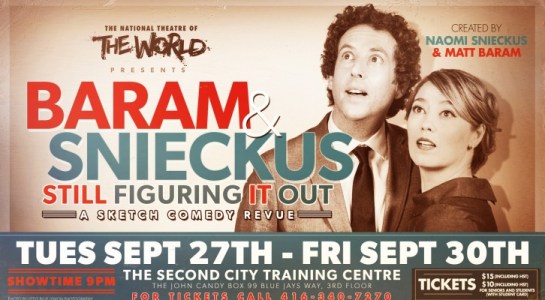
That said, I am sure they would be happy to know that the legacy they started in the 1950s is being continued quite ably by Naomi Snieckus and Matt Baram, who previewed their latest revue tonight at the John Candy Box Theatre in Toronto.

Long-standing staples on the Toronto comedy scene, Snieckus and Baram are veterans of the Second City and both have had their turn at television (Mr. D and Seed, respectively). But this real-life husband and wife are at their strongest when they stand across the stage from each other and reveal their neuroses in a mass therapy session that other people pay $15 to see.

The new show is aptly titled as they truly are still figuring it out. A combination of sketches, Nichols & May-style audio pieces, some improv, and playful audience banter, the show, which runs about 60 minutes, is still a work-in-progress, some bits decidedly more solid than others. But in many respects, that is the charm of a Baram & Snieckus production; it never feels complete.

red

This is a couple who consistently commit to their craft, who are willing to run with anything that comes up—including an audience suggestion of Dante’s cab ride, which turned into a motivational moment for an under-performing Satan with Daddy issues. But what makes this particularly charming is they are not afraid to let the audience know when they realize a bit isn’t working, and we all lean forward to see how they’ll extract themselves.

Their choice of venue facilitates this intimacy with the audience.

Although I have every confidence that Baram & Snieckus would have no trouble holding an audience in a large theatre, all of the revues that I have attended occurred in small venues, holding no more than 100 seats. The John Candy Box Theatre is no exception, and the audience sits so close to the stage that they become a tripping hazard for the performers.

Thus, when you see Baram & Snieckus perform, it is like you’re watching their lives from their living room.

[For the record, I have never been in their living room and this completely unnecessary ankle bracelet chafes.]

That intimacy, that vulnerability is the charm that bonds this team to the audience. These are your best friends and you are about to see them at their worst moment. Over and over and over again.

It’s schadenfreude for swingers. [The title of their next revue?]

One thing that was different from previous revues is the pair have started filming some of their classic sketches, and they projected two—from their previous revue You and Me Both—for tonight’s audience. This is part of a larger effort by the couple to make more of their material available online to audiences.

Still Figuring It Out, which runs until Friday, September 30, is practically sold out, so you’ll want to snatch the last few tickets soon, if you’re not already too late.

Alternatively, look for them on the web site of their company National Theatre of the World.

You will find laughs, and maybe a few insights as you too still figure it out.

close

See also:

Toronto Star review of Still Figuring It Out by Carly Maga

My review of You & Me Both

Central lodgings for intrepid explorers – review of Hotel Le Roberval

Graffiti

Hotel le Roberval centres an eclectic mix of neighbourhoods

Conveniently located within a short walk to Montreal’s Vieux Port, the Village and the restaurants of St. Denis, Hotel Le Roberval offers affordable, clean lodgings for people who like to explore the city on foot or with a quick jump on the Metro (Berri-UQAM).

The rooms are quite spacious and well-maintained, offering a kitchenette space that included a bar fridge, microwave, coffee maker and two sets of dishes. The Queen-sized bed was firm and comfortable, and the television was hi-def. And for those needing to work or wishing to keep in touch via social media, the free WiFi was very reliable and allowed rapid upload of photos to Facebook.

Parking is a bit of a chore, however, as you need to store your car in a shared lot less than a block from the hotel. Unfortunately, you need a room key to access the lot, so you have to check in before you can park. That said, you can leave your car on Rue Berri for up to 15 minutes while checking in.

The free continental breakfast leaves something to be desired. There is no hot food, the entire spread limited to croissants, cellophane-wrapped half-bagels, yoghurt, pastries and a couple of dry cereals, as well as milk, juices and coffee. Like the small dining room itself, however, the buffet is well-maintained and the staff who work the room are attentive to everyone’s needs.

Although the hotel is located on the corner of two busy streets (Boul. Rene-Levesque & Rue Berri), bound by government offices and the Universite du Quebec á Montréal (UQAM), there are several restaurants within a short walking distance (mostly in the Village) and a couple of depanneurs (convenience stores that also sell alcohol) if you just want to relax in your room.

As comfortable and accommodating as Hotel Le Roberval is, the lodgings are really just a place to store your stuff and rest your head as you explore what Montreal has to offer.

Sharing a laugh, enjoying great food at The Edmund Burke

The Edmund Burke

Family-owned gastropub that welcomes you as a friend

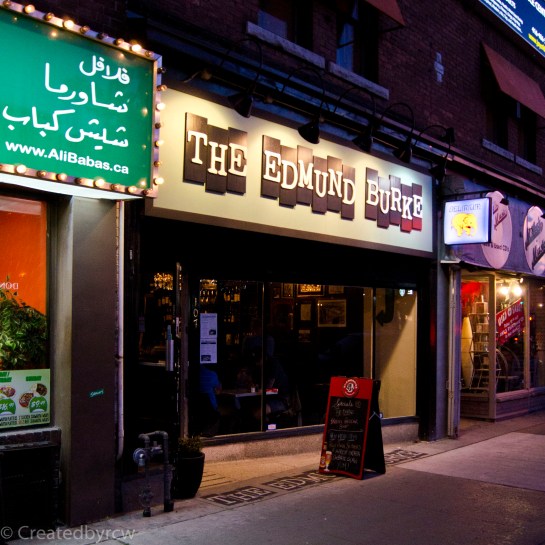
If you’re looking for an unassuming place to enjoy wonderful food, a decent pint and good company in the City of Toronto, The Edmund Burke is the place.

Conveniently located at the western end of Toronto’s Greektown, within a block of Broadview subway station and its many bus and streetcar routes, The Edmund Burke is a small, family-run gastropub that seems to have one mission: make its customers feel welcomed and satisfied.

In fact, I hesitate to call it a gastropub as that comes across as more pretentious than this place is. Visiting The Edmund Burke is like hanging out with your closest neighbours, because in many ways, you are.

The husband-and-wife team—Ginger & Russ—that owns the place live in the neighbourhood and can be found behind the bar or clearing tables at all hours. Their goal is to enliven and enhance the neighbourhood, and they do this in spades with a quick smile and attention to detail. And to add to the family feel, Ginger’s brother John serves as head chef and culinary mastermind.

The food is simple, both in range and presentation, but that simplicity works to its advantage. Chef John understands his ingredients and lets them do the heavy lifting in his cooking.

With none of his dishes are the taste buds overwhelmed; rather, they are cradled by a few flavours, each having a specific place and purpose.

A good example of this is his recently introduced pulled pork sliders. Where others might take the delicately cooked meat and smother it in a sauce that screams spice, Chef John allows the flavour to come from the meat itself, keeping sauces at arm’s length.

He then tops that with a subtle apricot slaw that offers just a hint of sweetness coupled with a crunch to balance the meat’s tenderness. Given that I generally dislike apricot, I was surprised at how much I enjoyed the slaw.

SONY DSC

Owner Ginger Robertson pulls the perfect pint

The chicken schnitzel is lightly crusted with the moisture sealed in, keeping the meat tender. And it sits atop perfectly prepared seasonal vegetables and a generous helping of spaetzle (a soft egg noodle). Although I quite enjoyed the chicken and vegetables, I have to admit to being so-so on the spaetzle, but that may just be me.

The Chicago-style beef burger with fries was completely solid, however, and a wonderful mix of flavours from the aged cheddar and garlic aioli. You may wonder how you make something as simple as a burger pop. Chef John does.

The pub itself is cozy without being claustrophobic, like so many Toronto restaurants, so you can draw together as a group or sit apart for quiet dining. By the same token, it can get a little loud should you be sitting near a particularly boisterous table.

The one aspect of the place that throws me off a bit is the choice of dining tables, which seem better suited to a rural truck stop diner than an urban gastropub, and particularly when set in contrast to the beautifully finished bar and beer taps. That being said, everything about this place is delicious, and you’ll be so focused on your meal that you’ll never see past your plate.

And finally, in keeping with the neighbours-looking-after-neighbours theme, Russ and Ginger have done everything they can to keep Chef John’s food reasonably priced without sacrificing on ingredients or his skills, and prices are more than competitive with the bars and restaurants in the area. Their menu would never be classed as cheap eats, but given the mastery that goes into the food preparation and the portion sizes, I’m ecstatic to pay $16 for the schnitzel or burger.

See also:

dine.to’s The Reveal – The Edmund Burke

Pints galore

Taps to tantalize all tastes

Startlingly meh: The Conjuring 2 (review)

conjuring 2 poster

I don’t really have the stomach for horror films. It’s not so much that I scare easily, but rather I am incredibly jumpy and therefore startle easily…and I don’t enjoy that sensation.

That being said, I have an idea for a horror film and decided I really needed to watch some before trying to write one. Thus, I finally acquiesced to my friends’ attempts to get me into a theatre, and last night, saw The Conjuring 2.

In many ways, including the opening scenes, this movie is a grandchild of the paranormal investigation classic The Amityville Horror. In the same timeline as that “based on” true event, a family in North London is being haunted by the spectre of an old man who is quite literally turning their lives upside down. The church sends American investigators Ed and Lorraine Warren to determine the merits of the case, only to discover it is linked to haunting visions in their own lives.

Lots of booming, thrashing and screaming ensue. Faces suddenly appear over shoulders. Bodies fly around rooms. More screaming. Demons, crucifixes and biting, oh my.

You can probably tell from that last part that I wasn’t very enthused about the movie. And to a large extent, I blame that on me more than the movie. I just don’t like horror and I don’t like being startled, which is really all this movie was: a two-hour effort to make me jump. Even at that, I think I jumped about six times and was never horrified or even mildly disturbed.

My friends were more effusive in their praise. One said it was the best horror film he had ever seen; he had never been more frightened. Others said it was a solid horror film that they quite enjoyed, although almost universally they said it wasn’t as disturbing as the original The Conjuring, which they insist I watch.

The story was pretty linear. Sceptics vs believers. Haunted, possessed child with glowing eyes and altered voices. Spectral specialists who speak wooden dialogue about God while dealing with their own demons. And underneath it all, an adorable love story between the real-life Warrens that went nowhere and added nothing to the story.

Twin warrens

Lorraine & Ed Warren: real and as portrayed by Vera Farmiga/Patrick Wilson

If you can get past the dialogue, the performances weren’t too bad. Patrick Wilson (Ed Warren) and Vera Farmiga (Lorraine Warren) do what they can with relatively two-dimensional Bible thumpers. Frances O’Connor, who played British mom Peggy Hodgson, did a very admirable job of portraying a woman who has taken about all she can from a world determined to crap on her at every turn. This could easily have been two hours of her screaming insanely, but she brought realism to the role.

But my biggest praise goes out to Madison Wolfe, who played Janet Hodgson, the young girl through whom the spectre works its evil. Half victim, half conduit, Janet’s struggles first to understand what is happening to her and then cope with feelings of abandonment as her friends and school become terrified of her (rather than the evil) are heart-breaking and play out across the young actress’s face. A true example of where a performance rises far above terrible material.

Janet

So many questions in those eyes

Unfortunately, even the stellar performances of O’Connor and Wolfe cannot save a bad movie that looks and feels like so many of its genre. That it is based on a true story—the Enfield poltergeist—doesn’t make it any more real for me; it may mean more to people wrapped up in poltergeist lore.

The slide show of the actual event participants during the closing credits, however, is an interesting touch. If nothing else, it tells me the set designers did a good job.

So, by the end of the evening, I wasn’t really any further ahead in my understanding of horror films and if this is an example of what is available, no more inclined to take in other films of this genre (or at least, sub-genre).


See also:

The Conjuring 2 fails to raise goosebumps. Bruce Demara, The Toronto Star

The demon-hunting Warrens are back in The Conjuring 2. Richard Crouse, Metro News

The Conjuring 2 is gorgeously shot and smartly conceived. Brad Wheeler, Globe & Mail


Much war, little craft

Warcraft-Movie-Banner-01

It is important to start this review of the movie Warcraft by stating: 1) I do not play video games; and 2) I like fully self-contained movies.

I went into seeing Warcraft with incredibly low expectations (perhaps unfair) and walked out having those expectations largely met and perhaps slightly exceeded.

Based on the video game series of the same name, Warcraft tells the story of Orcs determined to take over a new world because their own has died, possibly due to a malevolent force harnessed by their leader. The residents of the new world—populations of elves, mages, dwarves and humans—however, aren’t willing to lose their world…or at least the humans aren’t, and so fight back with the help of The Guardian, a wizard of immense power who lives in a tower and who is dealing with his own problems.

And while most of the movie is the playing out of this conflict, there is also an underlying mystery of what this malevolent force is, which leads to an Orc chieftain questioning the morality of the proposed genocides, and a couple of father-son/mentor-student relationships to suss out.

You may notice that in this description, I have offered no character names but rather simply archetypes. That’s because none of the characters is particularly memorable, nor is much of the movie. Perhaps if I had a greater familiarity with the game, much of this film would fall into place for me, but without that, the movie is mostly just a series of tropes with dialogue so wooden, the average porn filmmaker would be aghast.

Perhaps this is racist (specie-ist?), but I struggled to tell one Orc character from another, in part, because none of them had any personality much beyond “Hulk smash”. Thus, when an Orc would rampage into a scene, I had no emotional cues and so simply sat as a witness to events rather than being a participant. And even where I could recognize specific Orcs—the aforementioned chieftain and leader—the characters tended to be so two-dimensional (despite shelling out $20 for IMAX 3-D) that again, I was left cold.

Manly men

Three men and a movie reviewer (also a men)

The human characters weren’t a lot better. All the men look like my friend Danny, with whom I saw the movie, and women were almost non-existent. I do, however, have to give the filmmakers credit on two fronts here. First, although most of the humans were Caucasian, there were several of other ethnicities. And none of the female characters (I repeat NONE) were damsels by any measure. Each of the women, whether Orc, human or somewhere in between, were women of conviction and empowerment.

As to the plot, my biggest beef was that the writers seemed to simply drop in a device whenever they needed it to move the story forward, without any contextualization. I’d like to give you some concrete examples, but any of the major ones would, ironically, be spoilers. Suffice it to say, you are advised to check your credulity when you pick up your 3-D glasses.

Everything that occurs in this story was much better covered in Lord of the Rings, Game of Thrones, Harry Potter and Stargate…and The Ten Commandments.

But, in a strange way, that may end up being Warcraft’s saving grace as it frees the audience from having to participate in the story. Instead, you can just sit back and let the movie dance on your retinas, which is about as deep as it will go.

And this is possibly the one way in which Warcraft actually exceeded my expectations: it was visually captivating. The animation was incredibly good, with the Orc characters seemingly as real as the human actors. The fur of the giant wolves looked soft and the body movements of the griffins entirely plausible. Stylistically, I would put this movie in the realm of Avatar rather than Lord of the Rings.

WARCRAFT-Movie-2016

But back to the second point I raised at the start: self-contained movies.

Everything about Warcraft seemed to be designed to set up the myriad sequels that will be made, a trend in Hollywood blockbusters (and block-blowouts) that pisses me off. If nothing else, it shows complete disdain for the audience as it says “We really don’t care if you like the movie.”

Don’t get me wrong. I don’t have an issue with sequels and spin-offs in general. But when I go to a movie, I want to see an entire story play out, rather than have to wait for the next installment or rely on having seen the previous installment to understand the story (looking at you, Avengers).

This is one of the reasons why I am possibly the only person on the planet (this one, at least) who found The Empire Strikes Back to be lacking. It was a placeholder or bridge to The Return of the Jedi, nothing more.

Will I be back for Warcraftier: Where’s Your Messiah Now?

Not unless someone else is paying me to watch it…and for some reason, my online mahjongg isn’t working…and it’s raining or something.


See also:

Movie review: Warcraft by Danny F. Santos

Visiting Toronto? Try the bacon! (review)

Ossington

The familiar red awning says it all

(Trying my hand at food reviews)

If a restaurant earned a one-word review, that restaurant is Rashers and the one word is bacon.

Bacon is all you really need to know about Rashers, which specializes in all things bacon, offering multiple cuts—British style, peameal and strip—in a variety of formats…well, one format (sandwich) in a variety of constructions. (You can also order any of the sandwiches without bacon, but we can’t be friends if you do.)

My personal favourite and weekly go-to is the Beer BLT served on a ciabatta bun, which I sometimes get with double bacon just to blow up my electrolytes.

Beer BLT

Beer BLT (double-bacon), potato wedges (salt & pepper), homemade beer mayo

For the less adventurous, but just as hungry, there is the traditional bacon butty (British bacon, white bread, brown sauce) or the Hogtown grilled cheese (peameal bacon, aged cheddar, multigrain bun). For the more adventurous, the Full Monty (full British breakfast on a bun) and the Brie & Bacon (no explanation here).

And to help you hold all that delicious bacon grease are various potato sides, including wedges (my fav), curly fries and tater tots. Oh, and ask for the beer mayo, a homemade ambrosia that offers a subtle sweetness without the oily heaviness you might expect from a mayo.

But surprisingly, I think the best thing about Rashers is the staff, who—come to think of it—kinda smell like bacon. You will never meet a friendlier group of people who seem to love what they do and are truly grateful to see their patrons. If you’re a regular, you receive an eager welcome upon opening the door, and if you’re a newbie, you are immediately greeted with smiles and offers of assistance.

Rashers staff

Serious intent disguises the welcoming smiles that greet you

My weekly pilgrimage is to the Rashers location on Queen Street East near Carlaw Avenue in Toronto’s Leslieville neighbourhood. That it is squeezed between an over-priced tea shop and over-priced pet store makes Rashers’ more than reasonable prices a nice change of pace—its belly-filling sandwiches priced around $8-$10 and sides at $4.

The only real challenge with this particular location is lack of seating, which is essentially 4 bar stools against the window or a triplet of old-style school benches out front. Fortunately, at least from Spring to Autumn, there is a park a couple of blocks West that seems to make the food taste that much better.

More recently, Rashers opened a location in the Western end of Toronto’s downtown core on Ossington, near Dundas. A significantly larger place, this location has booths for dining in comfort and a central bench for stand-up dining (can’t remember if there were stools). And for your entertainment during your meal, they installed a huge mural along one wall that essentially bacon-ifies familiar motifs and Toronto-centric events or landmarks (e.g., Toronto Raptors, Ikea monkey, Yellow Submarine).

Bacon raptor

Both locations are easily accessible via local transit, whereas you may have issue at busier times finding a place to park in either neighbourhood. Regardless, you should make the effort to check these guys out.

I have come to bury Hail, Caesar!

The evil that men do lives after them;

The good is oft interred with their bones.

So let it be with Caesar.

—William Shakespeare

hail-caesar-poster

The Coen brothers love the Golden Age of Hollywood, the era when studios ruled, actors did what they were told, writers remained in the background and sound stages were spectacular. To demonstrate their adoration, the brothers wrote, directed and produced a love letter that showed up on theatre screens this week as Hail, Caesar!.

Unfortunately, the love letter they wrote was less a Shakespearean sonnet than the heart-dotted-i gushings of a pre-pubescent girl.

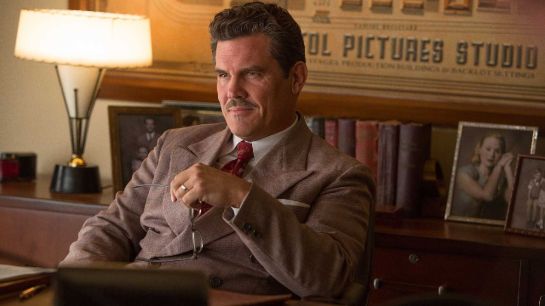
Briefly, Hail, Caesar! is a week-in-the-life story of Eddie Mannix (Josh Brolin), an executive for Capitol Pictures (think back to Barton Fink), a classic Hollywood studio. And like any good executive, Eddie spends his days and nights fixing the various issues that crop up around the studio, while trying to keep everything under wraps from the prying eyes of the gossip columnists (Tilda Swinton & Tilda Swinton).

Today, for example, Eddie is dealing with the unplanned pregnancy of twice-divorced swim star DeeAnna Moran (Scarlett Johansson), a celebrated cowboy (Alden Ehrenreich) unwisely thrown into a high-society role, and the kidnapping of Baird Whitlock (George Clooney) during the final days of shooting for the studio’s largest production ever, the titular Hail, Caesar: A Tale of the Christ.

brolin

And as Eddie scurries from location to location, equally supported and thwarted by the Hollywood clichés that surround him, he takes time to repeatedly visit confessional. Oh, and he is also being courted by Lockheed Martin, who want to make his life simpler while giving him buckets of money.

Now, one does not walk into a Coen brothers movie expecting something conventional, whether comedy or drama. You know that in many ways, you’ll experience theatre of the absurd. Unfortunately, this movie doesn’t really live up to that standard. It is more theatre of the silly and mildly amusing.

If the main story of Eddie Mannix is the Christmas tree, the various subplots that infect his day are more the individual ornaments that decorate the tree rather than the branches that flesh it out. For the most part, the subplots are self-contained elements that go nowhere. Each one carries certain amusement—the movie does have its laugh-out-loud moments—and provides a fire against which Eddie must test himself, but even here, the fires aren’t particularly threatening and Eddie handles all of them with aplomb (if exhaustion).

clooney

And because the individual subplots—Eddie’s raisons d’etre—are so thin, the main plot is thin. I get that his journey through the events of the week is meant to symbolize Christ’s walk through the desert, and that Lockheed Martin is the Devil offering to make Christ King of the world. But I don’t care.

I really never invested in Eddie, and so the rest of the film is largely eye candy.

Now, as eye candy goes, this is some lavish stuff that leaves you with a high-end sugar rush. The brothers did a wonderful job of capturing the look and feel of those classic Hollywood films, right down to some of the ham-fisted acting and over-emoting for which the era is famed. And full credit on the song-and-dance number starring Channing Tatum.

tatum

But like any sugar rush, the dazzle wears off quickly, and I left the theatre a little empty.

I really wanted to like this movie. Like the Coen brothers, I have a rabid affection for the studio era and its stars—don’t get me started on Errol Flynn and Olivia de Havilland. Unfortunately, Hail, Caesar! was the equivalent of fine-dining at Costco…it only really whets your appetite for something better.

O judgment! Thou art fled to brutish beasts,

And men have lost their reason. Bear with me.

My heart is in the coffin there with Caesar,

And I must pause till it come back to me.


Other reviews:

Movie Review: Hail, Caesar! (Danny F Santos)

Hail, Caesar! sees Joel and Ethan Coen trade acid for honey: review (Peter Howell, Toronto Star)

Review: ‘Hail, Caesar!’ a satire that doesn’t come together (Richard Crouse, CTV News)