Why story coaching?

Coaching

No matter where you are in your writing career, your work can almost always be helped by feedback from fresh eyes that do not have a vested interest in the work itself.

Story analysis can help you see challenges in your story that might be invisible to you, whether through inherent biases or because you see the story clearer in your head than it has been recorded on the page.

Story analysis can also help you see opportunities in your work that you overlooked, if only because you are too close to it. Your priority for that early draft, in all likelihood, was simply to get things out of your head and onto the page, and we all walk with the fear of wandering down so many blind alleys that we never come out of the other end, wherever that end may be.


So fine, story analysis is helpful. But what the hell is story coaching?

Almost by definition, story analysis happens AFTER you have completed a draft (or several). It comes AFTER you have wandered the desert of creative confusion. It comes AFTER you have bled your creative juices onto the page and have become smitten with your creation.

And in some very unfortunate cases, it never comes at all, because the storyteller never completed the project, whether due to fear of failure, a sense of being intractably lost, or simply because Life intervened to distract from the task at hand.

This is where story coaching can help.

Story coaching is about a work-in-progress, whether a screenplay, a novel, the writer him or herself…whatever the storyteller needs most.

Hurdles

As with life coaching, business coaching or athletics coaching, story coaching is about providing guidance to the storyteller on a regular basis, whether simply as a second set of eyes to critique the work or as a mentor who uses the work-in-progress as a framework within which to help the storyteller develop as an artist.

Story coaching is also about commitment and accountability for the storyteller.

By hiring a story coach, the writer has made his or her creative art a priority in life. Why else spend the money?

And working with the storyteller, the story coach establishes expectations and deliverables, whether that is new story ideas, number of newly written pages, rewrites. These are the foundations of creative habits that can be difficult to develop and entrench in solitude because the creative process is so personal and fraught with self-doubt and self-recrimination.


But I can get this from a writing course or a writers’ group.

Yes, this is true…to an extent.

Writing classes can be invaluable, depending on the composition of your classmates and the skill of your instructor.

With a roomful of students, however, it can be difficult for the instructor to provide truly focused guidance to an individual student. More typically, the student is presented with a spectrum of general direction, all of which can be valuable but only some of which may be germane to a given work-in-progress.

Writers’ groups can also be a wonderful resource, again depending on the composition of the group. That composition and the individual writer’s position within the skill hierarchy, however, are critical.

Most writers’ groups are comprised of peers with relatively equal experience, and so may not be able to provide the more advanced analysis and mentorship that an individual wants or needs. And if an individual is the most advanced or skilled within a given writers’ group, he or she may find little opportunity for improvement.

[NOTE: I firmly believe that you will always find something in the feedback of any group of readers. The question is more whether it is worth the effort you put into the group.]

Sports

Although it is not impossible, you are very unlikely to ever become a professional football or hockey player by spending any amount of time playing flag football or pond hockey with friends. Why would we expect storytelling to be any different?


How do I know a story coach is right for me?

You don’t. Well, you don’t until you start a conversation with him or her.


Oh, hey! Is the story coach going to try to tell me what stories to tell?

Absolutely not.

The story coach is here to understand what story you want to tell or help you understand it better yourself, and then help you tell it in the most effective manner.

You are the Creator. The story coach is not.


If you want to learn more about Story Coaching, feel free to reach out to me (no obligation) at:

So, What’s Your Story? (web site)

So, What’s Your Story? (Facebook)

SWYS-Facebook-Cover

Do not go gently – Having an impact

Indifference

Few are the creatives who do not want the world to love, or at least like, their work. We pour our heart, our soul, our tears into our art, and live in the dread that it will not find a receptive audience.

But are we dreading the wrong reaction?

Meaningful creative, to my mind, should evoke a reaction, and ideally one that is visceral and emotional before it is intellectual.

I want the viewer or reader to react instinctively, involuntarily to my creative, long before reason steps in and helps him or her modulate the response to more socially acceptable forms.

Thus, I fear less the angry or violent response to my work. Express those emotions and tell me why you revile my work. What is it in the creative that elicits such primitive, basal responses?

And if you find the work itself primitive, crude or malformed, the work of an unseasoned hand, then tell me how better to season it. What skills do I lack and how can I add them to my repertoire?

No, it is not rejection I fear. It is indifference.

It is the thought that my work is so devoid of meaning that it leaves you without any feeling whatsoever. It is simply not worth considering.

An emotional response, whether positive or negative, enhances my creative because the energy you expend to respond adds meaning to my work. Indifference, however, renders me and my creative effort void (collectively speaking, of course).

When we create, we should worry less about eliciting a positive reaction, and more about striking something at the very core of our audience. Something that they cannot ignore because it touches unnervingly close at their very essence.


For more on ways to improve your storytelling, visit:

So, What’s Your Story? (web site)

So, What’s Your Story? (Facebook)

A call to live your passion

My friend Jarrod Terrell, whom I met through Kevin Scott‘s Effortless Alphas group, recently challenged his fellow Alphas to share their goals and dreams for life in a Facebook video.

In part, the idea was that verbalizing your dreams made them real for you, but it also opened the door to others in your community who might be able to help make those dreams come to fruition.

Here is my video.

How can I help you discover, explore and share your passion?

See also:

So, What’s Your Story? (web site)

So, What’s Your Story? (FB page)

Contagious Adrenaline (FB page)


We are the stories we tell ourselves

boats

Human beings connect through story. We define our individual selves by story. We even define our universe in terms of the stories we tell ourselves.

And despite often sharing experiences with others, my understanding and interpretation of those experiences—my personal Truth—is the story that I build around those experiences.

If I see something I have never seen before, I immediately construct a story. I give it context from items around it or its location or its presence at this time of day.

And remarkably, if I came upon this same thing tomorrow rather than today, the story I construct then might be entirely different from the one I build today.

Thus, story is malleable. It lives and breathes as we take in new information from our surroundings and incorporate that information into the story, making tweaks and adjustments to ensure that everything continues to make sense.

When the story doesn’t make sense, when congruence is lost, we get upset, and in some cases, put up hostile blinders. This is when human beings lose connection.

Because story is such a personal thing, the Creative—whom I define as anyone who pursues a task with passion—is faced with an essentially insurmountable challenge: How do I share my story through myriad personal filters?

Ultimately, you cannot control how another receives and interprets your story.

abstract art

What is my story for this work? What story did the Creative intend?

Even if the Painter tells me her intent in painting a portrait or landscape, the Novelist types out in no uncertain terms precisely what he means to convey, the Musician strikes notes and chords to instill specific feelings, I can remain oblivious to those intents, consciously or un-.

This simply is; and we can only hope that it does not negatively influence the passion to create.

That passion, the drive to create, must be given voice, however; and so the Creative moves forward, doing his or her best to share (much as I am doing now in writing this).

A dedicated Creative struggles on, regardless of the insurmountable barriers, and strives to convey the most effective story he or she can, looking for ways to layer thoughts and emotions and spiritual energies onto the personal stories of others.

We practice what we know. We experiment with the unknown. We seek guidance and critical analysis.

And most importantly, we accept that we will never achieve 100% success instilling our stories in others, and yet push ourselves and our Art as if it were possible.

As Creatives, as people of passion, that is central to our stories.

*****

If you’re interested in learning how to build stories more effectively, seeking guidance for nascent projects or critical analysis of existing works, feel free to check out my website So, What’s Your Story or reach out to me here or via my Facebook page.

In the meantime, I wish you all the success in the world.

SWYS-Facebook-Cover

With my compliments

32510516-vector-illustration-of-orange-speech-bubble-for-well-done-stock-vector

Have you complimented someone today? This week? This month?

It’s amazing what a few words of support and kindness can do for someone who feels like he or she is uncertain or struggling to accomplish specific goals or develop certain skills.

And those kind words are particularly important when they come from someone who is in a position of authority in that subject.

I am an amateur photographer; a good one, in my own opinion. And I am eternally grateful for and happy to hear friends and loved ones tell me when they like a particular photo or group of images.

But recently, I have received some very kind comments from other photographers, whose work impresses the hell out of me, and who, in a few cases, don’t know me beyond what they have seen of my work on Facebook or Instagram or Twitter.

Earlier today, someone I did not know stopped by my Instagram account to comment on an image I posted recently.

Simply wonderful! You got what it takes for a good photographer!

I immediately jumped over to his account and realized that I was being complimented by someone who I believe has amazing talent. This is someone making a career as a professional photographer.

I have likewise built a nice friendship with one of the official photographers for my beloved Toronto Marlies; a man who will periodically compliment me on a particularly good shot. I have told him as much, but I’m not sure he believes how much his kind words and encouragement mean to me.

When someone does well, I like to let them know I think so. I think my compliments are most powerful, however, when they related to writing; my particular strength.

What is your area of expertise or authority?

When was the last time you took a moment to tell someone further down the development chain that he or she had done a really good job on something or that you found his or her work impressive?

Trust me; it will make their day to hear that.

And if you are already spreading encouragement and passion, thank you for that. We need to make sure this spreads.

sunset

You never know what people will like…so don’t try to anticipate; just create

Obnoxiously happy


happy

Dear World,

My apologies if my happiness has gotten a tad obnoxious of late, but my life is blessed in so many ways that I simply cannot keep the joy inside, nor truthfully do I wish to.

Alongside the wonderful gifts I am given every day, I am routinely presented with insane opportunities to express and explore the passions that light up my soul, whether it is writing or photography or sharing knowledge.

But beyond even that, I sit in complete awe at the wondrous passions of the people around me; people with amazing visions of who they are and how the world can be.

I know painters and actors and writers and musicians; parents and partners and children and pets; athletes and industrialists and service workers and technicians. And every single one of those people bring me insane joy simply by following their own passions, whether within their titles or not, and allowing me to be witness and in some cases, participant.

Even watching perfect strangers experience their worlds, or Nature express itself from day to day, brings a beauty and elegance that I simply did not choose to see in my former life but do now.

So how can my heart not burst forth, my spirit soar and the laughter ring forth?

I am both a newborn child seeing things for the first time and an ageless ancient finally understanding the patterns that have always splayed out before my once dulled eyes.

That is my joy. That is my happiness. That is my love.

And unasked, that is what I share with the world.

The Incoherent Blues

SONY DSC

As I rode the streetcar home last night, a streetcar busy with revelers heading downtown to party in the various bars and clubs, a louder-than-expected noise rose from the front. The sound was vaguely human and from its rising volume, I could only assume was approaching my area in the back.

Suddenly, an awkwardly rampaging bear of a man burst through the crowd, intent more on maintaining his feet than malevolence. It was just one of the many street denizens that populate Toronto, and this one was exceptionally inebriated, and loudly so.

Proving the theory that if you fall in all directions at the same time, you will stay on your feet, this tottering mass of humanity somehow lurched itself to a seat near the back of the streetcar, announcing to everyone—real or imaginary—that he had arrived.

His volume remained ear-splitting and mentally crushing, yet despite sounding like he was irritated with someone or something—Why are curse words so easy to enunciate under even the worst of conditions, while every other word remains a garbled mess?—he remained relatively harmless.

Had this been the extent of the interaction, he would have remained white noise in my background (I’m not sure, but perhaps I should be ashamed to admit that), and I would have blissfully gone back to contemplating the photos I had just taken at a hockey game or taken in the sights that passed outside my window.

But something changed.

SONY DSC

From somewhere within the mental and chemical maelstrom that struggled to maintain its physical if not social integrity behind me, beauty arose in the form of music.

Even though the man himself remained incoherent, magic happened when he placed a small harmonica against his lips. Riffs of Blues music poured forth in brief bursts.

Between these bursts, he continued his bilious bellowings; there was no attempt at lyrics to the best my ear could discern.

But the man mountain’s inner song rose slowly, incidental music to a life of struggle and dysfunction, signs perhaps that at one time, this free-range citizen was more free spirit.

The tide of revelers ebbed and flowed around the music man for several minutes as we continued our way across the city, most doing their best to ignore the intruder other than to throw incredulous glances or bemused smiles to one another.

Eventually, the music stopped as the human-encased chaos plunged out the back door into the night.

And if only in the smallest way, he left me changed as what otherwise would have been a self-indulgent ride across the city became a wondrous duel between incapacity and limitless capacity.

I hope he found repose.

SONY DSC

Whither the losers

coyote

History, we are told, is written by the victors. So, it also seems, are books about writing; although it is perhaps more accurate to say that books about writing only talk about winners.

Whether we’re talking about Star Wars, Unforgiven, Casablanca or The Wizard of Oz, almost any model of screenplay structure or character development or dialogue construction can be retrofitted to suit the film in question.

It’s like one of those mysterious illustrations that test whether you see two faces or a goblet. Once the secret is pointed out to you, it is virtually impossible to unsee.

illusions

Faces or a vase? Old woman or young?

Now, I’m not suggesting that these films or scenes or characters within aren’t good examples of the methods and approaches being promoted. Rather, because they are good examples, I question how much you can learn from them.

If you know the film well, it can be virtually impossible to imagine it any other way. And that is what the lesson should be telling you.

What happens when you don’t follow the model?

What does bad writing look like and how can you fix it?

Without that last part, learning to write well becomes the typing equivalent of being given paint, brushes, canvas and the Mona Lisa. Now, go out there and launch the new Renaissance! (The Rerenaissance?)

A couple of years ago, I had the good fortune to take a comedy writing workshop given by Steve Kaplan. Aside from providing our small group with a series of tools to not only analyze but also develop comedy—nicely captured in his wonderful book The Hidden Tools of Comedy—Steve walked us through examples of where these tools were used to great effect AND examples where they weren’t.

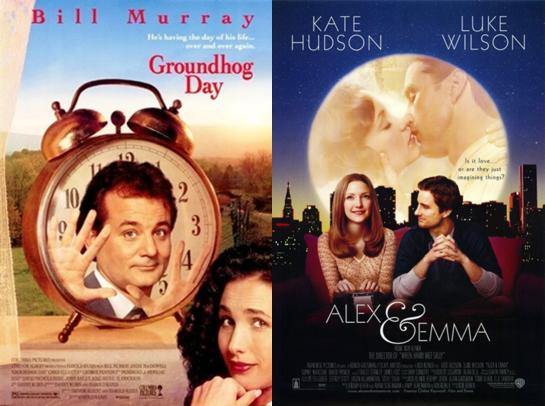
Alongside excerpts of Groundhog Day, we watched scenes from Alex & Emma. After considering the classic sitcom about nothing Seinfeld, we were inflicted with the show’s original and quite terrible pilot.

groundhog-and-emma

Like with the positive examples, you see the failures when they are pointed out to you. But the nice thing about the failures is you can ask what could have been done differently to make the idea or scene work better.

(Note: Sometimes, the answer is nothing, because it was a weak idea or poorly written.)

You may not have committed the specific sin you’re studying, but it at least gives you the opportunity to use the tools you’ve just acquired and see if you can’t make that “Elvis on crushed velvet” look more like the Mona Lisa.

elvis-lisa

And particularly for the relatively novice or untested writers, examining failures helps to keep from establishing an impossible bar of success. Rather, it suggests that whereas we always strive for greatness, mediocrity can make it to the screen, and more importantly, we do not need to (and never will) achieve gold with every piece we write.

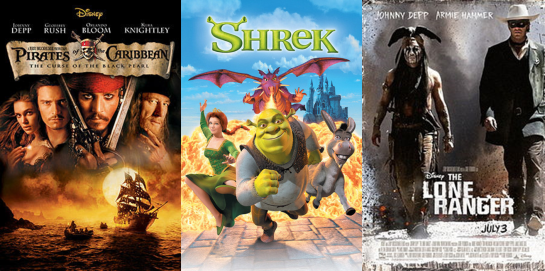
Which is good, because for every Pirates of the Caribbean and Shrek, there is a The Lone Ranger (all written in part by the wonderful and giving Terry Rossio).

rossio

See also:

The Hidden Tools of Comedy (Steve Kaplan)

Story is everywhere

[First part of a weekly series related to my new story analysis service So, What’s Your Story.]

bookshelf

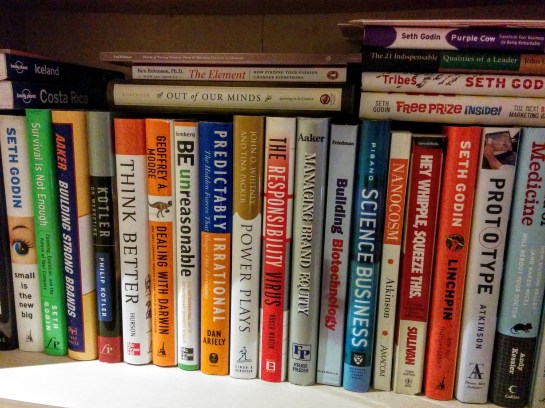
Even the most esoteric subjects have story, with all the elements of a fictional novel or screenplay…even text books about business or biochemistry or writing.

There’s no story in text books!

Yes, there is.

Only here, plot is less about action sequences and more about the interplay of the different aspects of your subject and the causes and effects that drive your theses or perspectives forward. This can be reflected in the cadence of your descriptions, as you walk the reader through your arguments, leading them to your conclusion.

Likewise, your characters are less about personalities and more a sense of the…you guessed it…characteristics of your subjects. In the broadest sense, the conflicts and synergies between the component parts or ideas of any topic are what effectively humanize the topic, providing a familiarity to the reader or viewer.

Without story, your manuscript or presentation has no narrative drive, nothing to draw the reader or viewer forward. Instead, it reads like a specification sheet or spreadsheet; a series of minimally connected facts and figures that provide information but only to the most intrepid reader.

Story is one of the reasons why you can have hundreds (thousands?) of different versions of the same facts, and how publishers and book retailers stay in business.

So, if you’re working on a nonfiction manuscript or presentation, let’s talk and see how well you are bringing your ideas to your audience.

Reach out and tell me: What’s your story?

Twitter: @createdbyrcw

Facebook: https://www.facebook.com/storyanalysis/

Website: [to come]

Pearls of Writing Wisdom – a review

pearls-cover

There is something inside you constantly threatening to explode; an urgent feeling that simply refuses to be ignored. It keeps you from focusing on conversations. It keeps you from sleeping. It tears at the very fabric of your existence.

Now, unless you have recently ordered the taco salad at Chipotle or travelled interstellar space with Sigourney Weaver, these symptoms suggest you might be a writer.

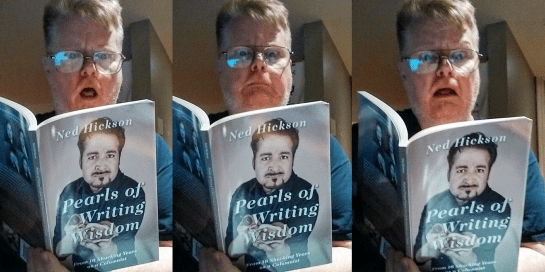
Ned Hickson knows these feelings well, and recounts some of his own experiences in his latest book Pearls of Writing Wisdom: From 16 Shucking Years as a Columnist.

In many ways, the book is a writer’s version of that dreaded conversation between a child and loving parent/teacher about sex…and it’s just as awkward.

In his own nervously jovial way, Ned tries to encourage writers to explore their budding bodies of work and yet caution them about the challenges that lie ahead without scaring (or scarring) them into creative celibacy.

Without photos or illustrations, Ned routinely contextualizes the lessons he is giving with self-deprecating anecdotes—like that time he walked around a mall for four hours before someone mentioned his participle was dangling. The point being (I think) to highlight that even with these personal failings, he still managed to fool people into reading (and paying for) his stuff.

Given the subtitle, I originally expected this book to be a chronicle of things he’d learned in his day job with Oregon’s Siuslaw News, a newspaper for which he is Editor and writes a syndicated humor column.

Nedwork

Ned offers insights on sex…I mean, writing

Instead, I found a book that covered all aspects of writing from understanding the inherent urges to the mechanics of satisfying wordplay to dealing with the social and legal ramifications of your actions…hunh, this really is about sex.

And speaking of sex, Ned’s book isn’t very long (97 pages) but what he accomplishes in those short, floppy pages is quite effective in nurturing new talent, as well as reminding those of us sliding into senescence why we write.

Whether you are a writer or know someone wanting to act on those urges, I highly recommend Pearls of Writing Wisdom as a way to bolster courage and encourage good practices, and maybe laugh a little.


P.S. If Sigourney Weaver happens to read this review, I would happily risk alien infestation to meet you at the Chipotle of your choosing.

sig

See also:

Humor at the Speed of Life (Ned’s blog)

Humor at the Speed of Life (Ned’s other book)

Port Hole Books (Ned’s publisher)