Startlingly meh: The Conjuring 2 (review)

conjuring 2 poster

I don’t really have the stomach for horror films. It’s not so much that I scare easily, but rather I am incredibly jumpy and therefore startle easily…and I don’t enjoy that sensation.

That being said, I have an idea for a horror film and decided I really needed to watch some before trying to write one. Thus, I finally acquiesced to my friends’ attempts to get me into a theatre, and last night, saw The Conjuring 2.

In many ways, including the opening scenes, this movie is a grandchild of the paranormal investigation classic The Amityville Horror. In the same timeline as that “based on” true event, a family in North London is being haunted by the spectre of an old man who is quite literally turning their lives upside down. The church sends American investigators Ed and Lorraine Warren to determine the merits of the case, only to discover it is linked to haunting visions in their own lives.

Lots of booming, thrashing and screaming ensue. Faces suddenly appear over shoulders. Bodies fly around rooms. More screaming. Demons, crucifixes and biting, oh my.

You can probably tell from that last part that I wasn’t very enthused about the movie. And to a large extent, I blame that on me more than the movie. I just don’t like horror and I don’t like being startled, which is really all this movie was: a two-hour effort to make me jump. Even at that, I think I jumped about six times and was never horrified or even mildly disturbed.

My friends were more effusive in their praise. One said it was the best horror film he had ever seen; he had never been more frightened. Others said it was a solid horror film that they quite enjoyed, although almost universally they said it wasn’t as disturbing as the original The Conjuring, which they insist I watch.

The story was pretty linear. Sceptics vs believers. Haunted, possessed child with glowing eyes and altered voices. Spectral specialists who speak wooden dialogue about God while dealing with their own demons. And underneath it all, an adorable love story between the real-life Warrens that went nowhere and added nothing to the story.

Twin warrens

Lorraine & Ed Warren: real and as portrayed by Vera Farmiga/Patrick Wilson

If you can get past the dialogue, the performances weren’t too bad. Patrick Wilson (Ed Warren) and Vera Farmiga (Lorraine Warren) do what they can with relatively two-dimensional Bible thumpers. Frances O’Connor, who played British mom Peggy Hodgson, did a very admirable job of portraying a woman who has taken about all she can from a world determined to crap on her at every turn. This could easily have been two hours of her screaming insanely, but she brought realism to the role.

But my biggest praise goes out to Madison Wolfe, who played Janet Hodgson, the young girl through whom the spectre works its evil. Half victim, half conduit, Janet’s struggles first to understand what is happening to her and then cope with feelings of abandonment as her friends and school become terrified of her (rather than the evil) are heart-breaking and play out across the young actress’s face. A true example of where a performance rises far above terrible material.

Janet

So many questions in those eyes

Unfortunately, even the stellar performances of O’Connor and Wolfe cannot save a bad movie that looks and feels like so many of its genre. That it is based on a true story—the Enfield poltergeist—doesn’t make it any more real for me; it may mean more to people wrapped up in poltergeist lore.

The slide show of the actual event participants during the closing credits, however, is an interesting touch. If nothing else, it tells me the set designers did a good job.

So, by the end of the evening, I wasn’t really any further ahead in my understanding of horror films and if this is an example of what is available, no more inclined to take in other films of this genre (or at least, sub-genre).


See also:

The Conjuring 2 fails to raise goosebumps. Bruce Demara, The Toronto Star

The demon-hunting Warrens are back in The Conjuring 2. Richard Crouse, Metro News

The Conjuring 2 is gorgeously shot and smartly conceived. Brad Wheeler, Globe & Mail


Much war, little craft

Warcraft-Movie-Banner-01

It is important to start this review of the movie Warcraft by stating: 1) I do not play video games; and 2) I like fully self-contained movies.

I went into seeing Warcraft with incredibly low expectations (perhaps unfair) and walked out having those expectations largely met and perhaps slightly exceeded.

Based on the video game series of the same name, Warcraft tells the story of Orcs determined to take over a new world because their own has died, possibly due to a malevolent force harnessed by their leader. The residents of the new world—populations of elves, mages, dwarves and humans—however, aren’t willing to lose their world…or at least the humans aren’t, and so fight back with the help of The Guardian, a wizard of immense power who lives in a tower and who is dealing with his own problems.

And while most of the movie is the playing out of this conflict, there is also an underlying mystery of what this malevolent force is, which leads to an Orc chieftain questioning the morality of the proposed genocides, and a couple of father-son/mentor-student relationships to suss out.

You may notice that in this description, I have offered no character names but rather simply archetypes. That’s because none of the characters is particularly memorable, nor is much of the movie. Perhaps if I had a greater familiarity with the game, much of this film would fall into place for me, but without that, the movie is mostly just a series of tropes with dialogue so wooden, the average porn filmmaker would be aghast.

Perhaps this is racist (specie-ist?), but I struggled to tell one Orc character from another, in part, because none of them had any personality much beyond “Hulk smash”. Thus, when an Orc would rampage into a scene, I had no emotional cues and so simply sat as a witness to events rather than being a participant. And even where I could recognize specific Orcs—the aforementioned chieftain and leader—the characters tended to be so two-dimensional (despite shelling out $20 for IMAX 3-D) that again, I was left cold.

Manly men

Three men and a movie reviewer (also a men)

The human characters weren’t a lot better. All the men look like my friend Danny, with whom I saw the movie, and women were almost non-existent. I do, however, have to give the filmmakers credit on two fronts here. First, although most of the humans were Caucasian, there were several of other ethnicities. And none of the female characters (I repeat NONE) were damsels by any measure. Each of the women, whether Orc, human or somewhere in between, were women of conviction and empowerment.

As to the plot, my biggest beef was that the writers seemed to simply drop in a device whenever they needed it to move the story forward, without any contextualization. I’d like to give you some concrete examples, but any of the major ones would, ironically, be spoilers. Suffice it to say, you are advised to check your credulity when you pick up your 3-D glasses.

Everything that occurs in this story was much better covered in Lord of the Rings, Game of Thrones, Harry Potter and Stargate…and The Ten Commandments.

But, in a strange way, that may end up being Warcraft’s saving grace as it frees the audience from having to participate in the story. Instead, you can just sit back and let the movie dance on your retinas, which is about as deep as it will go.

And this is possibly the one way in which Warcraft actually exceeded my expectations: it was visually captivating. The animation was incredibly good, with the Orc characters seemingly as real as the human actors. The fur of the giant wolves looked soft and the body movements of the griffins entirely plausible. Stylistically, I would put this movie in the realm of Avatar rather than Lord of the Rings.

WARCRAFT-Movie-2016

But back to the second point I raised at the start: self-contained movies.

Everything about Warcraft seemed to be designed to set up the myriad sequels that will be made, a trend in Hollywood blockbusters (and block-blowouts) that pisses me off. If nothing else, it shows complete disdain for the audience as it says “We really don’t care if you like the movie.”

Don’t get me wrong. I don’t have an issue with sequels and spin-offs in general. But when I go to a movie, I want to see an entire story play out, rather than have to wait for the next installment or rely on having seen the previous installment to understand the story (looking at you, Avengers).

This is one of the reasons why I am possibly the only person on the planet (this one, at least) who found The Empire Strikes Back to be lacking. It was a placeholder or bridge to The Return of the Jedi, nothing more.

Will I be back for Warcraftier: Where’s Your Messiah Now?

Not unless someone else is paying me to watch it…and for some reason, my online mahjongg isn’t working…and it’s raining or something.


See also:

Movie review: Warcraft by Danny F. Santos

I have come to bury Hail, Caesar!

The evil that men do lives after them;

The good is oft interred with their bones.

So let it be with Caesar.

—William Shakespeare

hail-caesar-poster

The Coen brothers love the Golden Age of Hollywood, the era when studios ruled, actors did what they were told, writers remained in the background and sound stages were spectacular. To demonstrate their adoration, the brothers wrote, directed and produced a love letter that showed up on theatre screens this week as Hail, Caesar!.

Unfortunately, the love letter they wrote was less a Shakespearean sonnet than the heart-dotted-i gushings of a pre-pubescent girl.

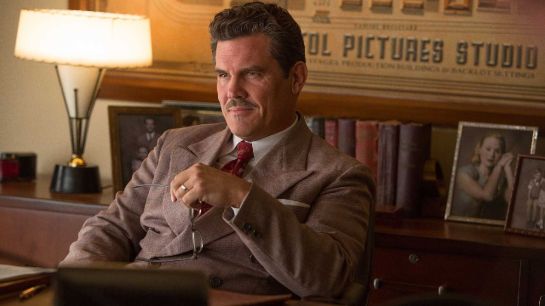
Briefly, Hail, Caesar! is a week-in-the-life story of Eddie Mannix (Josh Brolin), an executive for Capitol Pictures (think back to Barton Fink), a classic Hollywood studio. And like any good executive, Eddie spends his days and nights fixing the various issues that crop up around the studio, while trying to keep everything under wraps from the prying eyes of the gossip columnists (Tilda Swinton & Tilda Swinton).

Today, for example, Eddie is dealing with the unplanned pregnancy of twice-divorced swim star DeeAnna Moran (Scarlett Johansson), a celebrated cowboy (Alden Ehrenreich) unwisely thrown into a high-society role, and the kidnapping of Baird Whitlock (George Clooney) during the final days of shooting for the studio’s largest production ever, the titular Hail, Caesar: A Tale of the Christ.

brolin

And as Eddie scurries from location to location, equally supported and thwarted by the Hollywood clichés that surround him, he takes time to repeatedly visit confessional. Oh, and he is also being courted by Lockheed Martin, who want to make his life simpler while giving him buckets of money.

Now, one does not walk into a Coen brothers movie expecting something conventional, whether comedy or drama. You know that in many ways, you’ll experience theatre of the absurd. Unfortunately, this movie doesn’t really live up to that standard. It is more theatre of the silly and mildly amusing.

If the main story of Eddie Mannix is the Christmas tree, the various subplots that infect his day are more the individual ornaments that decorate the tree rather than the branches that flesh it out. For the most part, the subplots are self-contained elements that go nowhere. Each one carries certain amusement—the movie does have its laugh-out-loud moments—and provides a fire against which Eddie must test himself, but even here, the fires aren’t particularly threatening and Eddie handles all of them with aplomb (if exhaustion).

clooney

And because the individual subplots—Eddie’s raisons d’etre—are so thin, the main plot is thin. I get that his journey through the events of the week is meant to symbolize Christ’s walk through the desert, and that Lockheed Martin is the Devil offering to make Christ King of the world. But I don’t care.

I really never invested in Eddie, and so the rest of the film is largely eye candy.

Now, as eye candy goes, this is some lavish stuff that leaves you with a high-end sugar rush. The brothers did a wonderful job of capturing the look and feel of those classic Hollywood films, right down to some of the ham-fisted acting and over-emoting for which the era is famed. And full credit on the song-and-dance number starring Channing Tatum.

tatum

But like any sugar rush, the dazzle wears off quickly, and I left the theatre a little empty.

I really wanted to like this movie. Like the Coen brothers, I have a rabid affection for the studio era and its stars—don’t get me started on Errol Flynn and Olivia de Havilland. Unfortunately, Hail, Caesar! was the equivalent of fine-dining at Costco…it only really whets your appetite for something better.

O judgment! Thou art fled to brutish beasts,

And men have lost their reason. Bear with me.

My heart is in the coffin there with Caesar,

And I must pause till it come back to me.


Other reviews:

Movie Review: Hail, Caesar! (Danny F Santos)

Hail, Caesar! sees Joel and Ethan Coen trade acid for honey: review (Peter Howell, Toronto Star)

Review: ‘Hail, Caesar!’ a satire that doesn’t come together (Richard Crouse, CTV News)

Surprise, but never lie

Roff

I recently saw the following advice from filmmaker and screenwriter Don Roff posted on the Facebook page of the PAGE International Screenwriting Awards:

Always mystify, torture, mislead and surprise the audience as much as possible. — Don Roff

Although I agree with the sentiment, I don’t think it is complete (Note: I was unable to locate the source of the quote to learn if Roff said more on the subject). Thus, I offer the following codicil:

Mislead and surprise, but NEVER lie to your audience. Everything must be possible within the context of the universe you have built in your story. If you lose the trust of the audience, you’ve lost them forever.

Call me disappointed – Review of In the Heart of the Sea

in-the-heart-of-the-sea_banner1

Bluntly, In the Heart of the Sea was such a disappointing movie that I can’t even come up with a metaphor about a man driven mad by a desire for revenge against a ghostly leviathan. And that statement is made all the sadder by director Ron Howard’s attempt to do just that with almost every character in the movie.

For the under-informed, In the Heart of the Sea is the story of the writing of the novel Moby Dick by Herman Melville. It is also the story of the story that led to the writing of the novel Moby Dick. In short, the film occurs in two timelines that unto themselves cannot disguise the fact that neither plot line is satisfying.

Adding to this sense of disappointment is the fact that my friends and I saw the movie in 3-D IMAX, neither of which was needed to tell this narrative, which is surprising given the majestic concept of a whale attacking ships in the open ocean.

Even the actors couldn’t manage enough dimensions to be considered flat, let alone 3-D. Somehow, stalwarts like Brendan Gleeson, Ben Winshaw and Thor…I mean Chris Hemsworth…failed to bring life to this bilge water. Hell, even the great white sperm whale was unable to add excitement to this movie.

Moby Thor

If you want the experience I think Ron Howard was targeting, watch Apollo 13 and every time Tom Hanks appears on screen, imagine him in a cape with a Viking helmet. You’ll have a much more enjoyable experience.

As one of my friends suggested, it was as though Howard was going through a checklist of clichés.

Man vs. inner demons  √

Man vs. the elements  √

Man vs. society/class system  √

Man vs. nature/whale  √

Man vs. himself/his past  √

Unfortunately, Howard missed the most important one:

Man vs. coherent story with a point to make  X

Having read the novel Moby Dick and watched two film versions—Gregory Peck is a God—this version actually did damage to the franchise. It somehow took an exciting tale and examination of the destructive demons that possess us all, and turned it into a melodramatic soulless mess.

The only real positive that I can offer this film was that for all the time spent watching nothing happen, I never reached the bum-squirming phase where I positively itched to flee the theatre.

This was a Hollywood gimme, and yet somewhow they managed to blow it.


Other reviews:

Danny F. Santos (coming)

Less than a whale of a tale (Toronto Star)

It’s Man vs Leviathan (New York Times)

Chris Hemsworth Anchors a Whale of a Tale (Forbes)

Documentaries can change the world

Save

Just when you thought it was safe to go back near the water, SeaWorld announced that it will phase out its world-famous—and more recently, infamous—killer whale shows. The decision comes after months of pressure from community and animal-rights groups outraged by scenes depicted in the documentary Blackfish.

To further show the power of documentaries, however, the U.S. National Institutes of Health (NIH) recently announced that it would phase out the use of chimpanzees in biomedical research, transferring its remaining test subjects to an ape sanctuary.

NIH officials have given numerous reasons for the decision, citing the weakness of animal models for human disease and technological advances that make such animals less necessary. Many, however, suspect the government agency is bowing to pressure from community groups fearing the post-apocalyptic world highlighted in the documentary series Planet of the Apes.

In particular, the actions of former laboratory test subject Koba scared the shit out of everyone.

There is no doubt that this trend of documentaries changing animal policies will intensify. For example, it is anticipated that the 2016 release of Ice Age: Collision Course will prompt the U.S. government to change its policies regarding the Scrat…whatever the feck that is.

Bringing joy to others

I’m not a celeb-stalker generally, but I was killing time with my camera downtown when I stumbled across a crowd awaiting the arrival of movie stars (no one knew who) for the Toronto International Film Festival or TIFF.

I managed to grab a couple of shots of Dev Patel and Jeremy Irons (check out my Twitter feed), but I specifically loved this photo. If you can bring this type of joy to people in your life or to those completely peripheral to it, you have done well.

After premiering his movie, Dev Patel came back out to embrace his fans.

After premiering his movie, Dev Patel came back out to embrace his fans.

Illiterate in 3 languages…all English

canadianEnglish

“That which we call a rose, would by any other name, smell…”

William Shakespeare, Bad Line Break theatre

As many of you know (or have quickly surmised), I am Canadian, and more specifically, Anglo Canadian. Unto itself, that’s a pretty cushy thing to be in this country.

In choosing to live as a writer, however, I added an otherwise unnecessary twist to my life—I forced myself to learn English as a second language.

Wait. Didn’t you just self-identify as an English-speaking Canadian?

Yes, I did. But I’m a Canadian English-speaking Canadian.

And one of the first things you realize when you become a Canadian writer is that you will probably starve for lack of work.

Now, I’m not knocking Canadian writing, whether fiction, for film and television, journalism, what have you. It is easily some of the most beautiful writing available in the English world. But it is often written to (if not for) an incredibly small market, and opportunities to succeed are therefore often few and far between.

If feels like 8 writers encompass the entire Canadian television landscape. And name a Canadian movie. (I’ll wait.)

Nope and nope.

Nope and nope.

Okay, now name one not directed by David Cronenberg or Denys Arcand.

I was once offered a job as the Editor of a Canadian biotech magazine—yes, I used to be even more nerdy—for $30kpa. And yet, already on my resume was a job working for an American biotech mag that started around $65kpa.

Bottom line is thank goodness for my passion to write, because my passion for money has taken a beating.

(Side note: This was a choice I made and for which I take full responsibility. I don’t mean this to be a “life is so unfair” rant.)

What this has meant, therefore, is that to make it as a writer, I have had to learn English as a second language. In this case, American English.

Recently, the BBC published a short article that tried to explain Canadian English within the context of its British and American counterparts. Rightly, the author noted that the differences were more than a matter of spelling (e.g., centre v center; honor v honour). Rather, the differences also manifested in idioms, speech patterns and word choice.

As long as everyone's having fun

As long as everyone’s having fun

As with most Canadians, I had a bit of a leg up on learning American as our proximity to the border (mere kilometres and even fewer miles) means we are inundated daily by American film and television programming. But I also had the additional benefit of having been married to an American, and a Southerner to boot (more on “boots” later).

Where I would recommend taking the 401 across north Toronto, Leela would suggest taking 66 from Fairfax into Washington. Luckily, we were both practical enough to set aside arguments about whether we needed to go to hospital or the hospital.

All this to say that although the differences between Canadian English and American English can be subtle, they can easily explode before the eyes of the unsuspecting.

Writing for an American biotech magazine and working with American editors was something of an ESL boot camp. And over the intervening 15 years, I like to think I honed my American skills to the point where you suspect I am from Minnesota or Western New York (hello, North Tonawanda).

In fact, I’m going to rely heavily on my multi-Angloism as most of my writing, whether for money or in my screen- and novel writing, is aimed at American audiences. And although my primary goal remains writing the best story, my secondary goal is writing it in the most innocuous way. I don’t want my writing to “read” Canadian.

Versus

Truth be told, I don’t want my writing per se to be noticeable at all. If it is, I’ve taken the reader out of the story.

This is not to say that I want my stories to be bland, but rather that I want all of the art to be in the story itself, rather than the more mechanical aspects.

In my Canadian stories (so far a sitcom pilot and screenplay), which are set in Canada, involve Canadians and target Canadian audiences, I write Canadian. For pretty much everything else, I write American.

Should I start targeting British audiences, then I’ll spend more time learning British English, and make fewer spelling changes.

In the meantime, I’ll continue to bounce back and forth between the multiple Englishes like a character out of Monty Python.

What’s it aboot?

Anyone can make fun of how Canadians communicate (or don’t). Goodness knows Canadians do. But I have to admit that I struggle with the whole “oot and aboot” phrasing that American audiences in particular seem to see as a Canadian phrase.

It’s not that I think we pronounce these words correctly so much as we don’t say “oot”. Rather, we say “oat”.

As I mentioned, I was married to a Southerner, and one day, we had a lengthy conversation about the word “South”. Try as she might, Leela could not get me to pronounce the “ou” without it taking on a surreal emphasis akin to “owwwwwww”.

Instead, I would say “Soath”. And instead of “about”, I would say “aboat”. And as I made a point of listening closely to Anglo-Canadians speak, I never heard a single one say “aboot”. It was always “aboat”.

That being stated, I will totally cop to “eh”. It’s us. End of story.

The Man from UNCLE – see it while you can (a review)

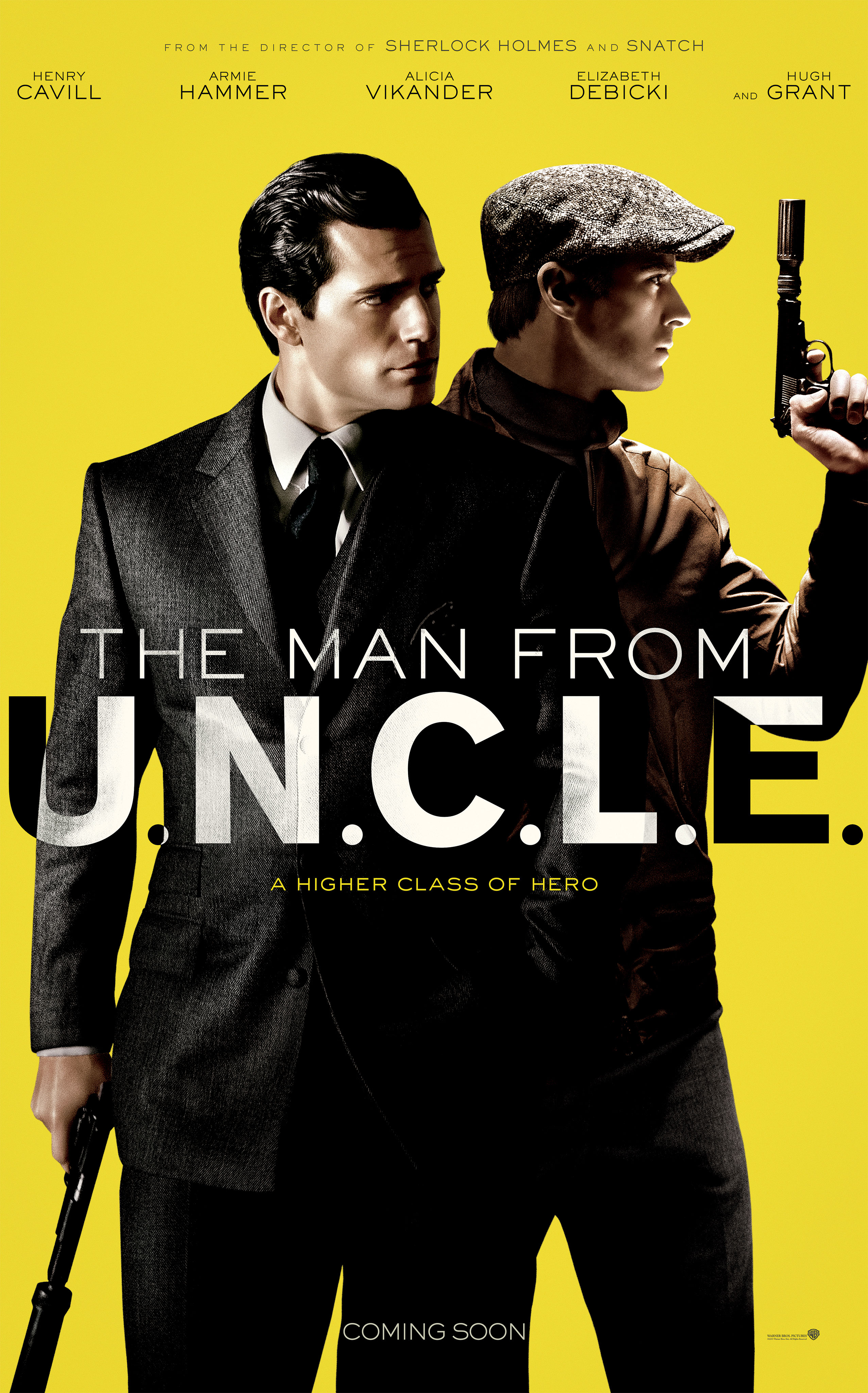
MfU poster

As a literal child of the 60s, I am barely old enough to remember the television series The Man from UNCLE, yet another show centred on Cold-War America’s fascination with the spy world. While Bond, Flint and Helm were doing their thing in theatres, The Men were joined by the likes of The Saint, I Spy, The Persuaders and Get Smart.

Unfortunately, whereas I can quote lines from Get Smart (don’t judge me) and have fond memories of The Saint, things are a little foggier when it comes to The Man from UNCLE. Thus, when I took in the newly released movie, my mind was open.

Essentially, an origin story for the UNCLE organization—United Network Command for Law and Enforcement—the movie introduces us to the two men on which the series hinged, American spy Napoleon Solo and Soviet spy Illya Kuryakin, and how they are forced to work as a team despite their complete distrust both of each other and of their own governments.

I won’t go into great detail about the plot as it really doesn’t matter—much as the plot of a typical Bond flick doesn’t matter. The only reason for the central plot conflict is to force these two guys together and watch them play “whose dick is bigger.” Really. I mean it.

Over a two hour span, I think there was maybe 30 minutes of actual story. The rest of the time was spent in a great variety of chase scenes, some of which were quite funny, or watching Solo (Henry Cavill) and Kuryakin (Armie Hammer) argue over fashion, spy gadgets and how badly the Soviet needs to get laid.

Now & Then: Chemistry is key for bickering twosome Napoleon Solo (dark hair) and Illya Kuryakin

Now & Then: Chemistry is key for bickering twosome Napoleon Solo (dark hair) and Illya Kuryakin

All of the friends who saw this movie with me had issues with this. The story wasn’t particularly engrossing and they felt like director Guy Ritchie had simply provided a light dessert; enjoyable in the moment, but offering little satisfaction.

To some extent, I agree with them. I am a fan of Ritchie’s earlier efforts with the Sherlock Holmes movies (Robert Downey, Jr., Jude Law). Here, the stories were quite rich and complicated, as one would hope with a Sherlock Holmes tale. Using this barometer, The Man from UNCLE definitely failed.

But to some extent, I think my friends missed the point (but then, I would). I don’t think Ritchie was going so much for a story that you might find in the most recent Bond films, filled with character complexities and inner conflicts, longer story arcs, generous back story.

Rather, I think Ritchie was going for the vibe and energy of that earlier generation of spy films, which were more a vehicle for the star than anything and featured much shallower stories. To me, this film was more about Dean Martin’s Matt Helm, James Coburn’s Derek Flint, and if only for the humoured banter, Roger Moore’s James Bond.

Ritchie is trying to capture a time and place, or perhaps more specifically, a style. And if we have learned anything about Guy Ritchie, in a battle between style and substance, he will always go with style. In some ways, I see him more as a painter than a director, as his primary goal seems to be a luxurious visual. Dialogue is simply a necessary evil for him.

Although, this is not to say that the dialogue was a burden here. The chemistry between Cavill and Hammer is palpable, much as it was between Downey Jr. and Law. And the addition of Alicia Vikander’s character Gaby simply enriches that dance.

Alicia Vikander's Gaby complicates life for the boys

Alicia Vikander’s Gaby complicates life for the boys

She is a very capable actor and this role is perhaps the complete opposite of her performance in Ex Machina (my review). Although, you may end up questioning which role was more manipulative.

Unfortunately, Ritchie may have overestimated the power of his painter’s brush in this film if my friends and the 2/3-filled Friday night opener was any indication of how this movie is being received. This film was obviously set up to be a franchise, but as we have seen in the past, that decision doesn’t rest with the studios as much as with the audience (aka box office).

I’m hoping the movie does financially better than it looked. I’d like to see more of these movies. May have to live with reruns of the original series, instead.

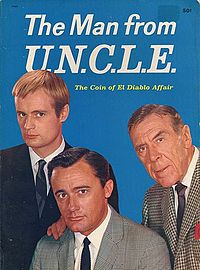
200px-ManFromUNCLEbook

Other reviews of The Man from UNCLE:

The Man From U.N.C.L.E. about more than just the cool clothes: review – Peter Howell, The Toronto Star

Movie Review: The Man from U.N.C.L.E. – Danny F Santos

Close but no Clouseau

600full-the-pink-panther-poster

So, I just finished watching the 2006 reboot of The Pink Panther with Steve Martin, Kevin Kline and Jean Reno, and all I can think is nice try.

Hollywood has always loved its remakes and reboots—this is not a new phenomenon—and sometimes they pay off. For example, I particularly enjoyed the Star Trek reboot of 2009, although its follow-up remake of Wrath of Khan was a bust for me.

But I seriously believe there are a handful of quintessential films that simply cannot be remade or rebooted, and in each case, I suspect it is because the lead character was so completely defined by the actor who played him or her.

Such is the case with Inspector Clouseau.

One of these men is an imposter

One of these men is an imposter

In the 2006 reboot and its unfathomably inexplicable sequel in 2009, Clouseau was performed by Steve Martin, a man for whom I have the utmost respect as a comedian and actor. But the key term there is “performed”. Steve Martin portrayed Inspector Clouseau.

But Peter Sellers was Inspector Clouseau. He didn’t portray or perform the honoured member of the Surete, he gave birth to the man, he lived the man, he was the man.

And when the beloved actor, comedian, writer, raconteur passed away in 1980, so too should have any thought of reviving Clouseau. For all intents and purposes, Sellers’ tombstone might also have read “Here reposes Chief Inspector Jacques Clouseau”.

Sellers was that kind of an actor. He was a shape-shifter, a modern-day Proteus. Upon donning the hat, moustache and trench coat, Sellers ceased to be and Clouseau emerged.

And in giving birth to Clouseau, he launched onto the world a character that would become immortal, and thus a character who cannot simply be portrayed.

Perhaps one day, an actor will come along who can inhabit the character, be the character enough to do it justice, but I can’t think of anyone. And even if such an actor exists, someone with that kind of talent is better served giving genesis to new characters of the immortal prowess of Clouseau.

So, bless director Shawn Levy and Martin for trying, although over-trying might be more appropriate. You and the rest of the cast and crew had pretty much no chance to leave a footprint given that your predecessor left craters.

* * * * *

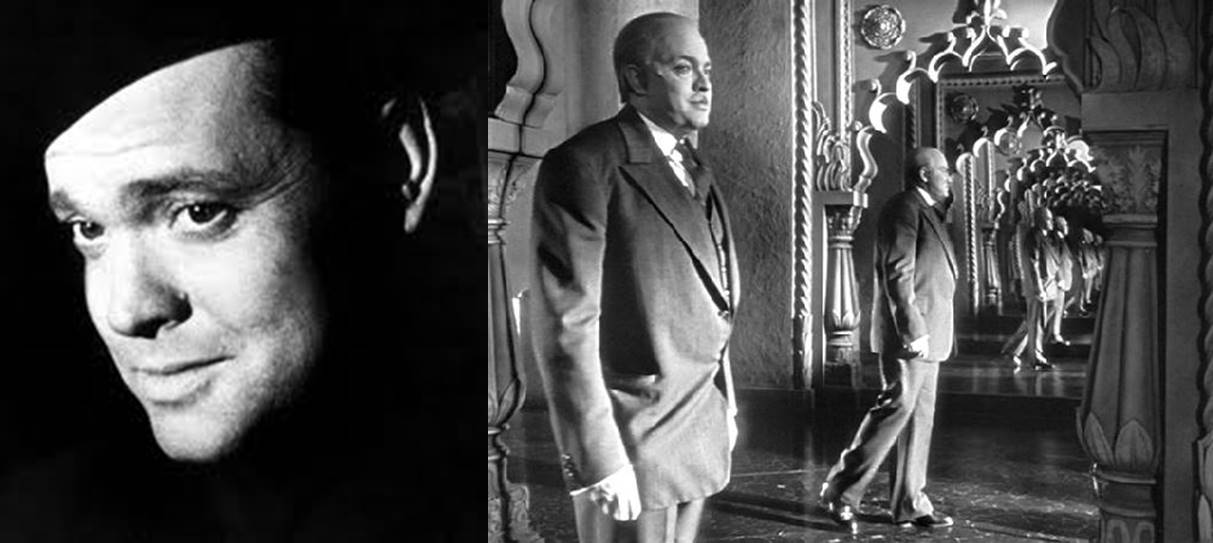
For reference, another actor I put in the unrebootable/unremakeable category is Orson Welles.

Can you imagine anyone else trying to step into the roles of Charles Foster Kane (Citizen Kane) or Harry Lime (The Third Man)? I can’t.

Harry Lime and Charles Foster Kane

Harry Lime and Charles Foster Kane